
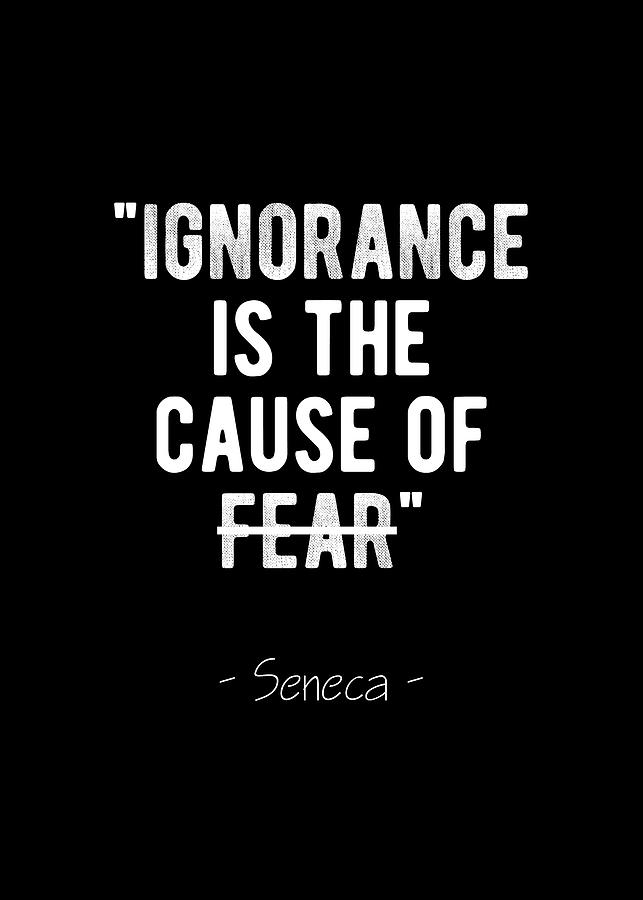
Fear, in its purest form, is a primal instinct essential for survival, alerting us to genuine threats. However, not all fear serves a protective purpose. A particularly insidious form of apprehension, often more detrimental than beneficial, is “ignorant fear.” This isn’t the instinctive recoil from a tangible danger, but rather a profound anxiety, hesitation, or outright paralysis born from a lack of understanding, knowledge, or accurate information. In the complex world of personal finance, investing, and business, ignorant fear is a silent destroyer of wealth, opportunity, and peace of mind. It manifests as a deep-seated resistance to making informed decisions, often leading to inaction, poor choices, or reliance on outdated heuristics, all because the underlying mechanisms or potential outcomes are simply not understood.

The Psychology of Fear in Financial Decisions
Financial decisions are inherently fraught with uncertainty. Markets fluctuate, economies shift, and personal circumstances evolve. This inherent unpredictability can naturally trigger apprehension. However, when this apprehension is rooted not in a rational assessment of risk but in a void of knowledge, it transforms into ignorant fear. This psychological barrier prevents individuals from engaging constructively with their financial future, often leading to detrimental outcomes.
The Unknown as a Catalyst for Paralysis
Humans are hardwired to prefer certainty over ambiguity. When faced with financial concepts that seem overly complex, jargon-filled, or abstract—such as stock market volatility, inflation, interest rate mechanisms, or diversified portfolio strategies—many individuals experience a mental block. This lack of comprehension creates a sense of the “unknown,” which the brain often interprets as a threat. Instead of seeking to understand, the default response can be to avoid the perceived threat altogether. This avoidance leads to financial paralysis: individuals postpone crucial investment decisions, delay retirement planning, or shy away from exploring income-generating opportunities because the unfamiliar territory is too daunting. They fear what they don’t understand, and this fear prevents them from gaining the understanding that would dispel it.
Cognitive Biases Fueling Financial Apprehension
Ignorant fear is often exacerbated by various cognitive biases that distort rational financial thinking. Confirmation bias, for example, leads individuals to seek out and interpret information that confirms their existing fears or misconceptions, reinforcing their reluctance to engage. If someone believes investing is inherently risky, they might selectively recall stories of market crashes while ignoring periods of sustained growth. The availability heuristic, another common bias, causes people to overestimate the likelihood of events that are easily recalled or vivid in their memory, such as a recent news report about a company bankruptcy or a financial scandal, making them overly cautious about the entire market. Furthermore, loss aversion—the psychological tendency to prefer avoiding losses over acquiring equivalent gains—can be intensified by ignorance. If one doesn’t understand the long-term historical resilience of markets, the mere possibility of a short-term loss becomes magnified into an overwhelming threat, leading to overly conservative decisions that ultimately undermine wealth accumulation.
Manifestations of Ignorant Fear in Personal Finance
The impact of ignorant fear is pervasive across all facets of personal finance, manifesting in various forms of inaction and poor decision-making that silently erode financial well-being.
Investment Paralysis and Missed Opportunities
Perhaps the most visible manifestation of ignorant fear is investment paralysis. Many individuals, intimidated by the perceived complexity and risk of the stock market, mutual funds, or real estate, keep their savings in low-yield accounts, effectively allowing inflation to diminish their purchasing power over time. They understand that “investing is important,” but the specific “how” and “why” remain shrouded in mystery. This lack of understanding breeds fear: fear of losing money, fear of making the wrong choice, or fear of being scammed. Consequently, they miss out on the power of compound interest and long-term capital appreciation, sacrificing potential financial growth for the illusion of safety. The opportunity cost of this paralysis is often staggering, amounting to hundreds of thousands or even millions of dollars over a lifetime.
Debt Avoidance vs. Debt Management
Another area where ignorant fear takes root is in the perception and management of debt. While excessive debt is undoubtedly harmful, not all debt is created equal. Mortgages, student loans, or business loans can be strategic tools for wealth creation or acquiring valuable assets when understood and managed properly. However, an ignorant fear of all debt can lead to suboptimal financial choices. Some individuals might avoid taking out a low-interest mortgage to purchase a appreciating asset, opting instead to rent indefinitely, driven by an overarching fear of being “in debt.” Conversely, others might fall into high-interest consumer debt traps, not out of malice, but because they don’t fully comprehend the mechanics of interest rates, minimum payments, or the true cost of revolving credit. Their fear might be focused on immediate inability to pay, rather than a strategic understanding of debt utilization and elimination.
Procrastination in Financial Planning
The labyrinthine nature of financial planning—encompassing retirement savings, estate planning, insurance, and tax strategies—often serves as a breeding ground for ignorant fear-driven procrastination. The sheer volume of information, coupled with unfamiliar terminology, can be overwhelming. Instead of engaging with these critical aspects, many people delay, telling themselves they’ll “get to it later.” This procrastination is often underpinned by a fear of making irrevocable mistakes, a fear of confronting an uncertain future, or simply a fear of admitting they don’t understand. The consequences are severe: inadequate retirement funds, lack of protection against unforeseen events, and missed opportunities for tax optimization, all of which compromise long-term financial security.

The Economic Costs of Financial Ignorance
The individual ramifications of ignorant fear compound into broader economic costs, affecting not just personal balance sheets but also societal stability and growth. When a significant portion of the population is hampered by financial apprehension rooted in ignorance, the collective economic landscape suffers.
Eroding Wealth Through Inaction
At an individual level, the primary economic cost of ignorant fear is the erosion of wealth through inaction or suboptimal decisions. Money that sits idle in savings accounts, earning negligible interest, loses purchasing power over time due to inflation. Individuals who delay investing miss out on market gains. Those who don’t plan adequately for retirement face a shortfall in their later years, potentially becoming a burden on public services or younger generations. This widespread financial stagnation at the personal level contributes to lower overall capital formation and investment within an economy, slowing down innovation and job creation. The cumulative effect of millions of people making financially conservative or indecisive choices due to fear of the unknown results in a less dynamic and less prosperous society.
Vulnerability to Scams and Misinformation
Another significant economic cost is the heightened vulnerability to scams and misinformation. When individuals are operating from a place of financial ignorance and fear, they become prime targets for predatory schemes. Con artists prey on fear (e.g., fear of missing out, fear of not having enough for retirement) and promise quick, effortless solutions that bypass the perceived complexity of legitimate financial planning. Without a fundamental understanding of financial principles, risk assessment, or due diligence, victims of ignorant fear are less equipped to spot red flags and differentiate sound advice from deceptive pitches. This not only results in direct financial losses for individuals but also erodes trust in legitimate financial institutions and processes, creating a more cautious and less engaged investor base.
Strategies to Conquer Ignorant Financial Fear
Overcoming ignorant financial fear is not merely about accumulating more information; it’s about transforming that information into actionable knowledge and building confidence. It requires a proactive and systematic approach.
Embrace Financial Literacy
The most potent weapon against ignorant fear is education. Commit to continuous financial literacy. Start with fundamental concepts: budgeting, saving, debt management, the basics of investing (stocks, bonds, mutual funds), and the power of compound interest. Utilize reputable sources such as financial education websites, books from certified financial planners, university courses, and government consumer protection agencies. Understand that learning is a journey, not a destination. As your comprehension grows, the unknown shrinks, and with it, the fear. Practical application, even on a small scale, reinforces learning and builds confidence.
Seek Expert Guidance
You don’t have to navigate the complexities of finance alone. A qualified and ethical financial advisor can be an invaluable ally. Look for fee-only fiduciaries who are legally bound to act in your best interest. They can help you demystify complex concepts, create a personalized financial plan, and provide objective advice. Their expertise can help you assess risks rationally, understand the implications of different choices, and build a strategy that aligns with your goals, thereby mitigating the fear born from a lack of understanding. Be prepared to ask questions until you fully grasp the advice being given.
Cultivate a Long-Term Perspective
Many financial fears are amplified by a short-term focus. The daily fluctuations of the stock market, for instance, can be terrifying if one only looks at immediate gains or losses. By adopting a long-term perspective, you gain resilience against market noise and temporary downturns. Understand that economic cycles are normal, and historically, well-diversified investments tend to recover and grow over extended periods. This perspective allows you to weather volatility with greater equanimity, reducing the panic that ignorant fear often instigates.
Start Small and Build Momentum
The journey to financial empowerment doesn’t require giant leaps. Overcoming ignorant fear often begins with small, manageable steps. Start by automating a small savings contribution, opening a low-cost index fund with a minimal initial investment, or setting up a basic budget. Each successful small step builds confidence and provides tangible evidence that financial management is achievable. As your confidence grows, you can gradually tackle more complex aspects of your financial life, steadily dismantling the walls of ignorant fear that once seemed insurmountable.
aViewFromTheCave is a participant in the Amazon Services LLC Associates Program, an affiliate advertising program designed to provide a means for sites to earn advertising fees by advertising and linking to Amazon.com. Amazon, the Amazon logo, AmazonSupply, and the AmazonSupply logo are trademarks of Amazon.com, Inc. or its affiliates. As an Amazon Associate we earn affiliate commissions from qualifying purchases.