
The Chemistry Behind the Buzz: Understanding Freebasing
Freebase nicotine represents a pivotal advancement in nicotine delivery technology, particularly within the realm of electronic nicotine delivery systems (ENDS). To truly grasp its significance, one must delve into its fundamental chemistry, which contrasts sharply with nicotine in its natural state or its more recent counterpart, nicotine salts. At its core, freebasing is a chemical process that alters nicotine’s molecular structure, enhancing its volatility and increasing its bioavailability upon inhalation. This modification has profound implications for how nicotine interacts with various technological delivery mechanisms.
Nicotine in its Natural State
Nicotine, an alkaloid naturally occurring in the tobacco plant, exists in two primary forms: protonated (salt form) and deprotonated (freebase form). In its natural state within the tobacco leaf, a significant portion of nicotine is in a salt form. This protonated form is stable but less volatile and is absorbed relatively slowly by the body. Historically, traditional cigarettes relied on combustion to deliver nicotine, but even then, the burning process naturally converted some nicotine to its freebase form due to the high temperatures and alkaline environment created by tobacco fillers and additives.
The Alkalinization Process
The transformation of nicotine from its protonated salt form to freebase involves a chemical reaction known as deprotonation. This is typically achieved by adding a strong base, such as ammonia, to the nicotine solution. The base increases the pH level, stripping a proton from the nicotine molecule. This chemical alteration results in freebase nicotine—a purer, uncharged form of the molecule. The lack of an electrical charge makes freebase nicotine more lipid-soluble, meaning it can more readily cross biological membranes, including those in the lungs and brain. This increased permeability is critical for rapid absorption and a quicker onset of effects. The technology of deprotonation, while simple in chemical terms, was a game-changer for subsequent nicotine delivery systems.
Enhancing Bioavailability and Delivery
The primary technological advantage of freebase nicotine lies in its enhanced bioavailability. Once deprotonated, freebase nicotine becomes more volatile, allowing it to vaporize at lower temperatures and be absorbed much more efficiently into the bloodstream. When inhaled, freebase nicotine passes through the lung membranes and into the capillaries with remarkable speed, leading to a near-instantaneous effect often described as a “throat hit” or “rush.” This characteristic makes it highly effective for users seeking rapid nicotine delivery, mimicking the quick satisfaction traditionally associated with smoking combustible tobacco. The technological design of vaping devices, from atomizers to coil resistance, is often optimized to leverage these properties of freebase nicotine, ensuring efficient vaporization and delivery.
A Technological Revolution in Nicotine Delivery
The advent of freebase nicotine fundamentally reshaped the landscape of nicotine delivery, moving beyond traditional combustion and paving the way for advanced electronic devices. Its properties directly influenced the design and evolution of early vaping technology, setting benchmarks for subsequent innovations.
Early E-cigarettes and Freebase Nicotine
When e-cigarettes first emerged on the market, freebase nicotine was the undisputed standard for e-liquids. The technology behind these early devices aimed to replicate the smoking experience by heating an e-liquid containing freebase nicotine to produce an inhalable aerosol. The “throat hit” provided by freebase nicotine, even at lower concentrations, was crucial for satisfying former smokers and mimicking the sensory experience of traditional cigarettes. Device manufacturers had to engineer atomizers and batteries capable of efficiently vaporizing these e-liquids while managing power consumption and heat output. The specific chemical properties of freebase nicotine dictated the initial parameters for coil resistance, wattage settings, and airflow designs in these pioneering vaporizers.
The Rise of Sub-Ohm Vaping and Cloud Chasing
As vaping technology advanced, particularly with the introduction of more powerful batteries and customizable atomizers, a new trend emerged: sub-ohm vaping. This involves using coils with resistance below 1.0 ohm, allowing for significantly higher power output and, consequently, much larger vapor production. Freebase nicotine e-liquids were perfectly suited for this development. The enhanced volatility of freebase nicotine meant that even at lower concentrations (typically 3mg/mL to 6mg/mL), users could achieve substantial nicotine delivery through increased vapor volume. This led to the “cloud chasing” phenomenon, where users focused on producing massive vapor clouds, often showcasing the intersection of vapor production technology and the sensory experience provided by freebase nicotine.
Freebase Nicotine vs. Nicotine Salts: A Technological Divide
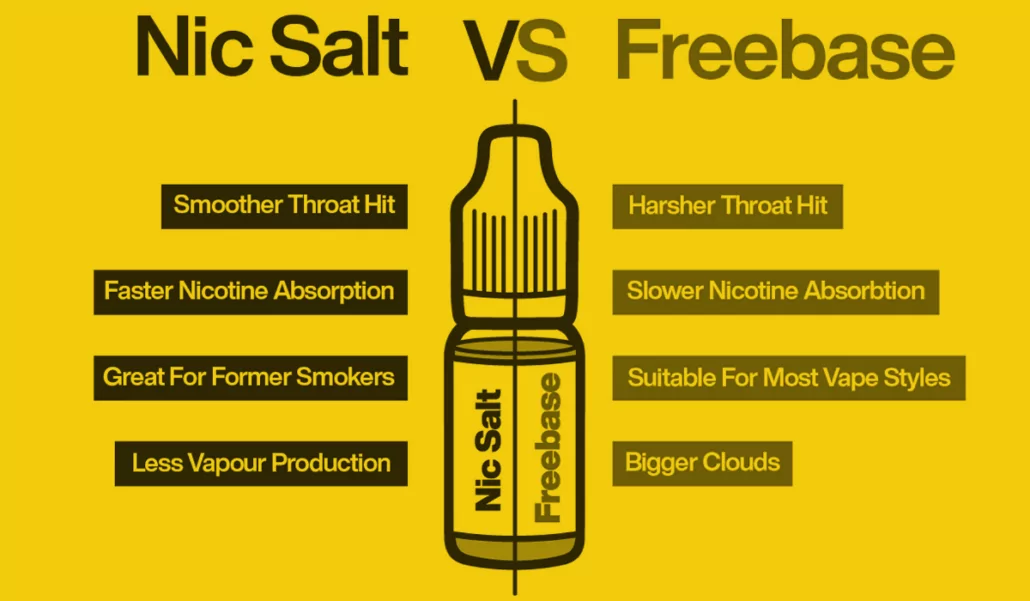
While freebase nicotine dominated the early years, the mid-2010s saw the emergence of nicotine salts, presenting a significant technological alternative. Nicotine salts are protonated nicotine molecules that are typically formulated with a benzoic acid to create a stable, less alkaline compound. This innovation allowed for higher nicotine concentrations to be inhaled more smoothly, without the harsh throat hit associated with high-concentration freebase nicotine.
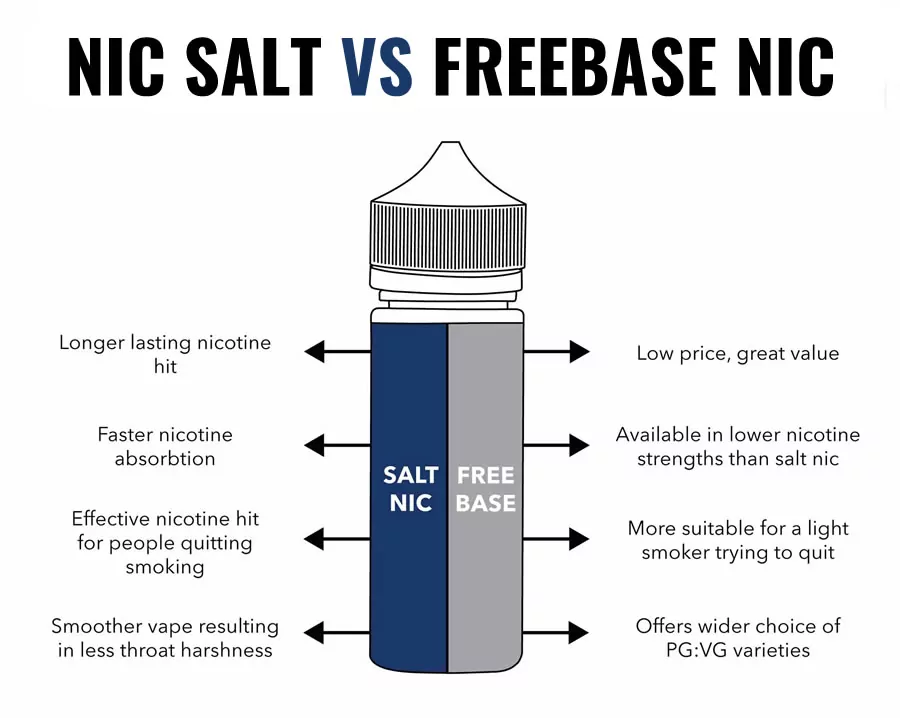
This created a technological divide:
- Freebase Nicotine: Optimized for devices with higher wattage, lower resistance coils (sub-ohm), and larger vapor production. Ideal for users who prefer a noticeable throat hit and operate more advanced, customizable devices.
- Nicotine Salts: Optimized for lower wattage, higher resistance devices (pod systems, MTL – Mouth-To-Lung devices) that produce less vapor but deliver nicotine more subtly at higher concentrations. Ideal for users seeking a smoother experience and transitioning from traditional cigarettes with a focus on nicotine satisfaction over vapor volume.
The choice between freebase and nicotine salts now dictates entirely different device ecosystems, influencing everything from battery capacity and coil materials to airflow design and e-liquid formulations.
Impact on Device Design and User Experience
The unique characteristics of freebase nicotine have fundamentally shaped the design principles and user experience paradigms within the vaping industry. Its interaction with device components dictates performance, vapor quality, and user satisfaction, highlighting a direct link between chemical properties and technological implementation.
Optimizing Vaporizers for Freebase E-liquids
Vaporizer technology is intricately tuned to the properties of the e-liquid it processes. For freebase nicotine, device manufacturers prioritize certain design elements:
- Higher Wattage Output: To efficiently vaporize freebase nicotine, especially in lower concentrations, devices often feature more powerful chipsets and batteries capable of delivering higher wattage (e.g., 20W-200W). This ensures rapid heating of the coil and abundant vapor production.
- Low Resistance Coils (Sub-Ohm): Coils with resistance typically below 1.0 ohm are common, as they allow for greater power flow, leading to more heat and vapor. These coils are often made from materials like Kanthal, stainless steel, or nichrome, chosen for their heat resistance and conductivity.
- Direct-to-Lung (DTL) Airflow Systems: To accommodate the large vapor volumes produced with freebase e-liquids, atomizers and tanks are designed with wide airflow channels. This facilitates a direct-to-lung inhalation technique, akin to taking a deep breath, which is preferred by many freebase users for maximizing vapor and flavor.
- Larger Tank Capacities: Due to the higher power consumption and greater vapor production, devices optimized for freebase nicotine often feature larger e-liquid tanks to reduce the frequency of refilling.
The Role of PG/VG Ratios
The base ingredients of e-liquids—propylene glycol (PG) and vegetable glycerin (VG)—also play a crucial role and are often tailored to freebase nicotine.
- Propylene Glycol (PG): A thinner liquid that carries flavor more effectively and contributes to the “throat hit.” Higher PG ratios can intensify the freebase nicotine’s inherent throat sensation.
- Vegetable Glycerin (VG): A thicker liquid that produces dense vapor clouds. Freebase e-liquids designed for sub-ohm vaping often have higher VG ratios (e.g., 70% VG / 30% PG) to maximize vapor production, aligning with the “cloud chasing” trend.
The chosen PG/VG ratio directly influences the viscosity of the e-liquid, which in turn affects wicking speed, coil longevity, and overall vapor quality in a specific device. Device engineers must consider these ratios when designing wicking ports and coil structures.
User Preferences and Device Compatibility
The “throat hit” characteristic of freebase nicotine is a key determinant of user preference. Some users find this sensation satisfying, especially those transitioning from traditional cigarettes, as it mimics the feel of smoking. Others, however, may find higher concentrations of freebase nicotine too harsh. This distinction drives the market for diverse device types:
- Advanced Mod Systems: Often paired with freebase e-liquids for experienced users seeking customization, high power, and large vapor clouds.
- Pod Systems: Typically used with nicotine salts, but some lower-power pod systems can accommodate freebase e-liquids at very low concentrations for a milder experience.
The compatibility between freebase nicotine e-liquids and various devices is paramount. Using a high-concentration freebase e-liquid in a sub-ohm, high-wattage device can lead to an overwhelming and unpleasant experience, while low-concentration freebase in a low-power device might not deliver sufficient nicotine or vapor. This highlights the intricate interplay between chemical formulation and device technology in meeting diverse user needs.
Regulatory Landscape and Future Tech Trends
The evolution of freebase nicotine technology and its integration into vaping devices is inextricably linked to the ever-changing regulatory landscape and ongoing innovation within the industry. Future tech trends will continue to be shaped by both scientific understanding and consumer demand, always under the watchful eye of public health bodies.
Device Evolution Amidst Changing Regulations
Regulations concerning nicotine products, including e-cigarettes containing freebase nicotine, vary significantly across regions. These regulations often influence device design and marketing strategies. For example, restrictions on nicotine strength or tank capacity can drive manufacturers to innovate within these constraints, leading to more efficient atomizers or improved battery life to compensate for reduced e-liquid volume. Age restrictions and flavor bans also impact the market, pushing R&D towards compliance while still aiming to deliver satisfying user experiences. The technology must adapt not only to scientific advancements but also to the legal frameworks governing its use and sale. This often involves developing advanced firmware, child-resistant features, and sophisticated safety protocols integrated into the device hardware and software.
Innovation in Nicotine Delivery Systems
Despite the maturity of freebase nicotine technology, innovation continues. Manufacturers are constantly seeking ways to optimize vapor production, flavor accuracy, and battery efficiency for freebase e-liquids. This includes:
- Smarter Chipsets: Integrating AI and machine learning into device chipsets to automatically adjust wattage based on coil resistance and e-liquid viscosity, providing an optimal vaping experience.
- Advanced Coil Materials: Experimenting with new alloys and mesh designs that offer faster ramp-up times, more even heating, and extended coil lifespan, enhancing the efficiency of freebase nicotine vaporization.
- Temperature Control (TC) Technology: Refinements in TC modes allow for more precise control over coil temperature, preventing dry hits and ensuring consistent vapor quality for freebase users.
- Ergonomic Designs: Improvements in device ergonomics, portability, and user interfaces make freebase-compatible devices more accessible and appealing to a broader user base.

The Future of Vaping Technology and Freebase Nicotine
Looking ahead, freebase nicotine will likely remain a foundational component of the vaping industry, especially for advanced users and those who prefer a strong throat hit and large vapor production. Future technological advancements will likely focus on improving the safety profile of vapor delivery, enhancing user customization, and increasing device sustainability. This could involve further integration of smart technology for health monitoring, development of fully recyclable or biodegradable device components, and more sophisticated filtering systems for aerosols. The interplay between the chemical properties of freebase nicotine and the cutting-edge hardware and software of vaping devices will continue to drive innovation, ensuring its enduring presence in the evolving landscape of nicotine delivery technology.
aViewFromTheCave is a participant in the Amazon Services LLC Associates Program, an affiliate advertising program designed to provide a means for sites to earn advertising fees by advertising and linking to Amazon.com. Amazon, the Amazon logo, AmazonSupply, and the AmazonSupply logo are trademarks of Amazon.com, Inc. or its affiliates. As an Amazon Associate we earn affiliate commissions from qualifying purchases.