
In the intricate world of real estate and homeownership, various acronyms and terms often emerge, shaping the financial landscape for borrowers. Among these, M.I.P. stands as a crucial element, particularly for those utilizing government-backed mortgages. M.I.P., or Mortgage Insurance Premium, is a type of insurance required on certain home loans, designed to protect the lender in the event that a borrower defaults on their mortgage. While similar in principle to Private Mortgage Insurance (PMI) found on conventional loans, MIP has distinct characteristics, particularly in its application to Federal Housing Administration (FHA) loans. Understanding MIP is fundamental for anyone considering an FHA mortgage, as it directly impacts monthly housing costs and the overall financial commitment of homeownership.
The Core Purpose and Types of MIP
At its heart, MIP serves as a risk mitigation tool for lenders. When a borrower makes a small down payment—typically less than 20% of the home’s purchase price—the lender faces a higher risk of financial loss if the borrower defaults. MIP steps in to cover a portion of that potential loss, thereby making it safer for lenders to offer loans to individuals who might not qualify for conventional mortgages with larger down payments.
Protecting the Lender
The primary beneficiary of MIP is the lender, not the borrower. This insurance safeguards the financial institution against the increased risk associated with high loan-to-value (LTV) mortgages. Without MIP, many lenders would be unwilling to approve loans for borrowers who cannot afford a substantial down payment, effectively limiting access to homeownership for a significant segment of the population. By providing this layer of security, MIP facilitates broader access to mortgage credit, especially for first-time homebuyers or those with modest savings.
FHA Loans and MIP
MIP is a mandatory component of virtually all FHA-insured loans. The FHA, a division of the U.S. Department of Housing and Urban Development (HUD), does not directly lend money but rather insures loans made by FHA-approved lenders. This insurance provides a government guarantee, encouraging lenders to offer more favorable terms, such as lower down payment requirements and more lenient credit qualifications, to a wider range of borrowers. However, in exchange for this government backing, borrowers are required to pay MIP.
There are two distinct components to FHA’s Mortgage Insurance Premium:
- Upfront Mortgage Insurance Premium (UFMIP): This is a one-time fee paid at the time of closing. It is a percentage of the base loan amount and is usually financed into the loan, meaning it is added to the principal balance and repaid over the life of the mortgage.
- Annual Mortgage Insurance Premium (AMIP): Despite its name, the annual MIP is divided into 12 equal installments and added to the borrower’s monthly mortgage payment. It is a percentage of the outstanding loan balance, and this percentage varies based on the loan term, loan-to-value (LTV) ratio, and the original loan amount.
Conventional Loans and PMI
It is important to distinguish MIP from Private Mortgage Insurance (PMI), which serves a similar purpose but applies to conventional loans. While both protect the lender when a borrower has less than 20% equity, their rules for calculation, payment, and especially cancellation differ significantly. PMI on conventional loans is typically paid monthly and can often be canceled once a borrower reaches 20% equity (80% LTV) in their home. FHA’s MIP, particularly the annual component, has more stringent and often longer-lasting requirements for cancellation.
How MIP is Calculated and Paid
The calculation and payment structure of MIP are critical factors in determining the total cost of an FHA loan. These premiums directly influence the affordability and long-term financial commitment for borrowers.
Upfront MIP (UFMIP)
The Upfront MIP (UFMIP) is a fixed percentage of the base loan amount, regardless of the borrower’s down payment. For instance, as of recent guidelines, UFMIP is typically 1.75% of the loan amount. So, on a $300,000 FHA loan, the UFMIP would be $5,250.
While it is theoretically possible to pay UFMIP in cash at closing, the vast majority of borrowers choose to finance it into their mortgage. This means the $5,250 in our example would be added to the principal balance, making the total loan amount $305,250. Financing the UFMIP spreads the cost over the entire loan term, reducing the immediate cash outlay required at closing. However, it also means the borrower will pay interest on the UFMIP over the life of the loan.
Annual MIP (AMIP)
The Annual MIP (AMIP) is a recurring premium that is paid monthly. Its rate is determined by several factors: the original loan-to-value (LTV) ratio, the loan term (e.g., 15 years vs. 30 years), and the initial loan amount. For example, for a 30-year FHA loan with an LTV greater than 90% (meaning a down payment of less than 10%), the annual MIP rate might be 0.55% of the outstanding loan balance. If the LTV is 90% or less (meaning a down payment of 10% or more), the rate might be 0.50%.
To calculate the monthly AMIP payment, the annual rate is applied to the current outstanding loan balance, and that result is then divided by 12. For instance, if the annual MIP rate is 0.55% and the outstanding loan balance is $300,000, the annual premium would be $1,650 (0.55% of $300,000). Divided by 12, the monthly AMIP payment would be $137.50. It’s important to note that because AMIP is calculated on the outstanding balance, the actual dollar amount of the monthly AMIP payment will gradually decrease as the loan principal is paid down over time.
Impact on Monthly Payments
Both UFMIP (when financed) and AMIP contribute to the overall cost of an FHA loan. The financed UFMIP increases the principal on which interest is charged, slightly raising the monthly principal and interest payment. The AMIP, however, is a direct addition to the monthly payment.
A typical mortgage payment (PITI) includes Principal, Interest, Property Taxes, and Homeowners Insurance. For FHA loan borrowers, this becomes PITI + MIP. This additional component can significantly impact the overall affordability of the loan, making it crucial for borrowers to understand and budget for. While FHA loans offer the advantage of lower down payment requirements, the presence of MIP often results in a higher overall monthly housing expense compared to a conventional loan with the same interest rate and a 20% down payment.
The Lifespan and Cancellation of MIP
One of the most significant differences between FHA MIP and conventional PMI lies in the rules governing their cancellation. For many FHA borrowers, MIP can be a long-term, if not permanent, component of their mortgage payments.
FHA Loan Cancellation Rules
The cancellation policy for FHA MIP depends primarily on when the loan was originated and the initial loan-to-value (LTV) ratio.
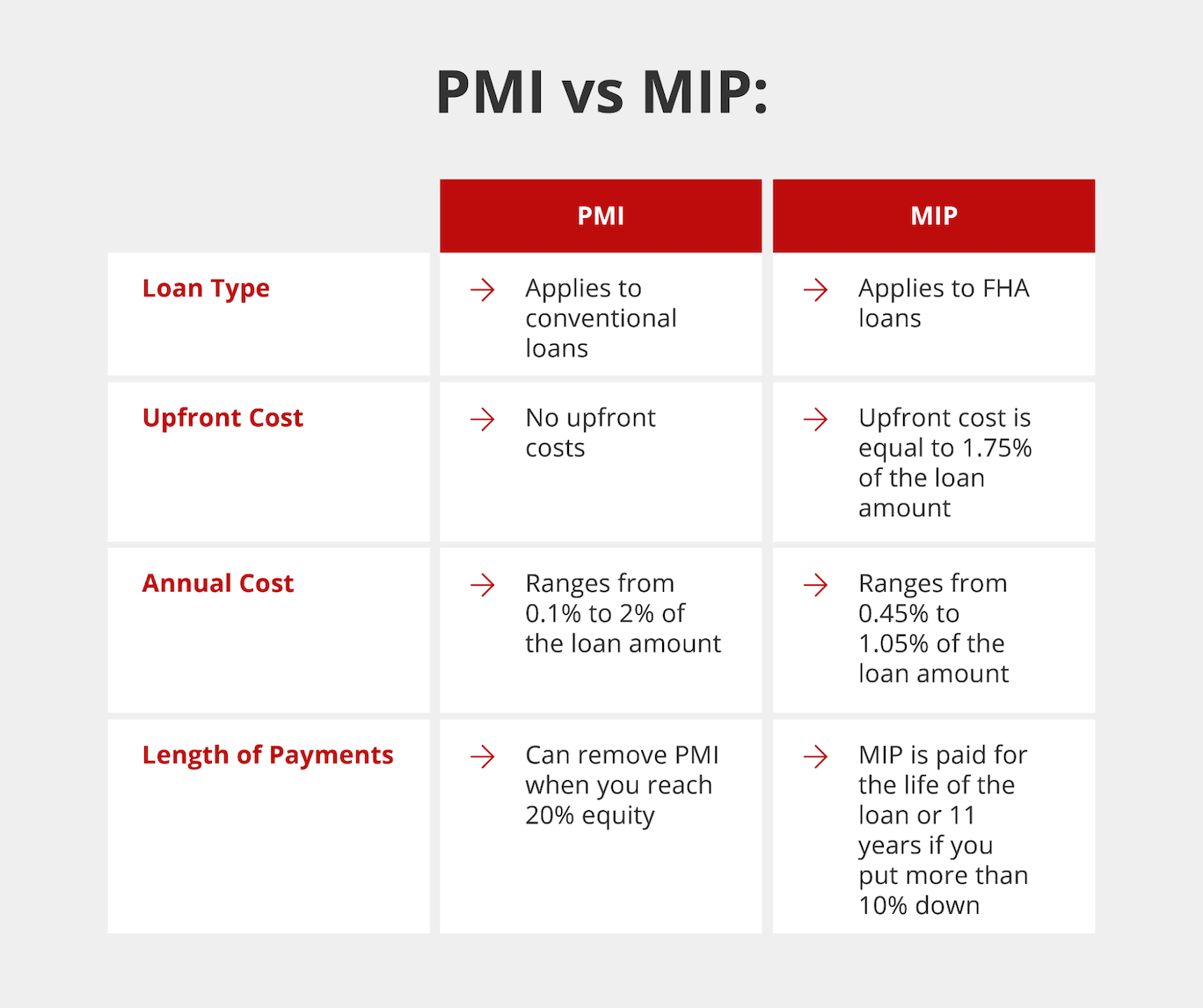
- Loans originated on or after June 3, 2013, with an original LTV greater than 90% (less than 10% down payment): For these loans, the Annual MIP is required for the entire life of the loan. This means it will never automatically cancel, regardless of how much equity the borrower builds. The only way to remove it is to refinance into a conventional loan.
- Loans originated on or after June 3, 2013, with an original LTV less than or equal to 90% (10% or more down payment): For these loans, the Annual MIP is required for a minimum of 11 years. After 11 years, if the borrower has maintained their payments, the AMIP will automatically cancel.
This “life of the loan” rule for higher LTV FHA loans is a critical point that many borrowers overlook. It can significantly increase the total cost of homeownership over the mortgage term if not addressed.
Refinancing to Remove MIP
Given the strict cancellation rules for FHA MIP, especially for loans with smaller down payments, refinancing is often the most common strategy to eliminate it. If an FHA loan borrower builds sufficient equity (typically 20% or more) in their home, they may be able to refinance into a conventional loan. When refinancing, if the new conventional loan has an LTV of 80% or less, it will not require PMI, effectively removing the mortgage insurance obligation entirely.
However, refinancing comes with its own costs, including closing fees and potentially a new interest rate. Borrowers must weigh these costs against the savings from eliminating MIP to determine if refinancing is a financially sound decision. Market interest rates also play a significant role; if rates are higher than the original FHA loan, refinancing might not be advantageous.
Distinguishing from PMI Cancellation
In contrast, Private Mortgage Insurance (PMI) on conventional loans offers much more flexibility for cancellation. Lenders are generally required to cancel PMI once the loan-to-value (LTV) ratio reaches 78% of the home’s original appraised value. Borrowers can also request cancellation once their LTV reaches 80%, provided they have a good payment history. This automatic or borrower-requested cancellation is a key advantage of conventional loans over FHA loans with their more rigid MIP rules.
Strategies for Managing and Minimizing MIP
While MIP is an inherent part of FHA loans, borrowers can adopt several strategies to manage its impact or even avoid it altogether.
The 20% Down Payment Goal
The most direct way to avoid paying any form of mortgage insurance, whether MIP or PMI, is to make a down payment of 20% or more of the home’s purchase price. While FHA loans are popular precisely because they allow for much lower down payments (as little as 3.5%), saving up for a 20% down payment eliminates the need for mortgage insurance, thus reducing monthly housing costs and potentially saving tens of thousands of dollars over the life of the loan.
Accelerating Equity Growth
For FHA borrowers who already have a loan with MIP, increasing equity faster can be a goal. While this won’t eliminate MIP for “life of the loan” scenarios, it is crucial for building a strong financial position for a future refinance. Making extra principal payments whenever possible can accelerate the rate at which equity builds. This means directing additional funds specifically towards the loan’s principal balance, reducing the outstanding amount faster than the regular amortization schedule. The quicker equity grows, the sooner a borrower might be in a position to refinance into a conventional loan without PMI.
The Role of Home Appreciation
Market appreciation can also play a significant role in accumulating equity. If the value of the home increases significantly after purchase, the loan-to-value (LTV) ratio naturally decreases, even without extra principal payments. This increased equity makes it easier to qualify for a conventional refinance without PMI. However, relying solely on appreciation is not a guaranteed strategy, as home values can fluctuate due to market conditions.
Comparing Loan Options
Before committing to an FHA loan, prospective homebuyers should carefully compare it with conventional loan options. While FHA loans are attractive due to lower down payment requirements and more lenient credit standards, the cost and duration of MIP can make them more expensive in the long run, especially if the borrower plans to stay in the home for an extended period.
A conventional loan, even with PMI, might be more cost-effective if the borrower can afford a slightly higher down payment or expects to build equity rapidly. Financial advisors and mortgage lenders can provide personalized comparisons based on a borrower’s specific financial situation, credit score, and down payment capabilities.
When is an FHA Loan with MIP a Good Option?
Despite the long-term cost implications of MIP, FHA loans remain an invaluable tool for many individuals seeking to achieve homeownership. For certain borrower profiles, the benefits of an FHA loan often outweigh the costs associated with MIP.
First-Time Homebuyers
FHA loans are particularly beneficial for first-time homebuyers who may not have accumulated substantial savings for a large down payment. The minimum down payment of 3.5% makes homeownership accessible to a wider demographic. This lower barrier to entry allows individuals to stop renting and start building equity sooner, even if it means paying MIP initially. The ability to enter the housing market is often more valuable than immediately avoiding mortgage insurance for these individuals.
Credit Score Flexibility
Another significant advantage of FHA loans is their more flexible credit score requirements compared to conventional loans. While specific requirements can vary by lender, FHA guidelines generally allow for lower credit scores. This flexibility opens the door to homeownership for individuals who may have experienced past financial challenges but are now on a path to recovery. Conventional loans typically demand higher credit scores to qualify for favorable terms and avoid PMI.
Lower Down Payment Requirements
The 3.5% minimum down payment is arguably the most compelling feature of an FHA loan. For many, saving 20% of a home’s value (which can be tens of thousands of dollars) is an insurmountable hurdle. An FHA loan dramatically reduces the upfront cash needed, allowing borrowers to reserve funds for other closing costs, emergencies, or home improvements. While MIP adds to the monthly cost, the ability to get into a home with minimal cash upfront makes FHA loans a powerful tool for those with limited savings but stable income.
In summary, while MIP is an added cost that merits careful consideration, an FHA loan remains a viable and often necessary pathway to homeownership for many. Understanding its purpose, calculation, and cancellation rules is essential for making an informed financial decision.
aViewFromTheCave is a participant in the Amazon Services LLC Associates Program, an affiliate advertising program designed to provide a means for sites to earn advertising fees by advertising and linking to Amazon.com. Amazon, the Amazon logo, AmazonSupply, and the AmazonSupply logo are trademarks of Amazon.com, Inc. or its affiliates. As an Amazon Associate we earn affiliate commissions from qualifying purchases.