
A Health Savings Account (HSA) stands out as a uniquely powerful financial tool, not just for its immediate tax advantages related to healthcare expenses, but also for its significant role in retirement planning and, crucially, in estate planning. Unlike many other financial instruments, the treatment of an HSA upon the death of the account holder varies dramatically depending on who is designated as the beneficiary. Understanding these distinctions is paramount for any HSA owner looking to ensure their legacy and minimize potential tax burdens for their loved ones. Far from simply being a healthcare savings vehicle, an HSA transforms into a valuable inheritable asset, and how it is managed post-mortem can have profound financial implications for those left behind.

The HSA as an Inheritable Asset: An Overview
At its core, an HSA offers a triple tax advantage: contributions are tax-deductible, earnings grow tax-free, and withdrawals for qualified medical expenses are tax-free. This robust combination makes it an attractive savings vehicle for current and future healthcare costs. However, its utility doesn’t end with the account holder’s life. Upon death, the HSA’s assets become part of the account holder’s estate, subject to specific rules governing inheritance.
Unlike some other accounts that might simply close or pass through probate without much nuance, an HSA’s fate is highly dependent on the designated beneficiary. This distinction is critical because the tax treatment for heirs can range from virtually seamless continuation of benefits to immediate taxable income, significantly impacting the inherited amount. The IRS views the transfer of an HSA differently based on the relationship of the beneficiary to the deceased, particularly distinguishing between spouses and non-spousal heirs. This complexity underscores the necessity of proactive estate planning for HSA owners, ensuring that their accumulated health savings are distributed according to their wishes and with the most favorable tax outcomes for their intended recipients. Failing to plan effectively can inadvertently strip the HSA of its tax-advantaged status for beneficiaries, diminishing its value.
Spousal Beneficiary: The Most Favorable Inheritance
Designating a spouse as the beneficiary of an HSA is, without question, the most advantageous option from a tax and administrative perspective. The IRS provides specific, favorable rules that allow for a seamless transition, preserving the HSA’s unique benefits. When a spouse inherits an HSA, they essentially step into the shoes of the deceased account holder, inheriting the account as their own.
Seamless Transition and Continued Tax Benefits
Upon the original account holder’s death, if the surviving spouse is the designated beneficiary, they can elect to treat the HSA as their own. This means the account continues to function as an HSA in every sense, retaining its tax-advantaged status. The surviving spouse can continue to make contributions (if eligible), invest the funds, and take tax-free withdrawals for qualified medical expenses. There are no immediate tax implications or probate processes involved in this transfer, making it an incredibly efficient way to pass on wealth intended for healthcare. This direct transfer allows the spouse to leverage the HSA’s triple tax benefits, potentially for many years to come, effectively extending the financial planning benefits established by the deceased. It can be a crucial component of financial security for the surviving spouse, especially in retirement when healthcare costs often rise significantly. This continuation ensures that the funds remain dedicated to their intended purpose without incurring premature taxation, aligning perfectly with the long-term health and financial planning goals often associated with HSAs.
Re-designating Beneficiaries Post-Inheritance
Once the surviving spouse assumes ownership of the inherited HSA, it becomes their personal account, just as if they had opened it themselves. This means they gain full control over the account, including the critical ability to designate their own beneficiaries. This step is often overlooked but is essential for comprehensive estate planning. The surviving spouse should promptly review and update the beneficiary designation for the now-inherited HSA to reflect their current wishes and family situation. For instance, if the spouse initially had children named as secondary beneficiaries on their own separate accounts, they might now want to name those same children as beneficiaries on the newly inherited HSA. This ensures that the funds will continue to be distributed according to their updated estate plan, preventing the account from going through probate in the future and allowing them to choose how the funds will be treated upon their eventual death, whether for their own spouse, children, or other designated individuals.
Non-Spousal Beneficiaries: Understanding the Differences
While designating a spouse as an HSA beneficiary offers clear advantages, the rules change significantly when a non-spousal individual, such as a child, parent, sibling, or another person, is named as the beneficiary. In these scenarios, the inherited funds generally lose their HSA status and are subject to different tax treatments, which can diminish the overall value transferred.
Loss of HSA Status and Immediate Taxability
When an HSA is inherited by a non-spouse, the account immediately ceases to be treated as an HSA for tax purposes. Instead, the fair market value of the account as of the date of the account holder’s death is considered taxable income to the beneficiary. This income must generally be reported in the year of the account holder’s death, or the year the beneficiary actually receives the distribution, which can lead to a substantial tax liability. For example, if a child inherits an HSA with a balance of $50,000, that entire amount could be added to their gross income for the year, potentially pushing them into a higher tax bracket.
This immediate taxation contrasts sharply with the tax-free growth and withdrawal benefits enjoyed by the original account holder and a surviving spouse. The primary benefit of the HSA – its tax-advantaged status – is effectively lost upon transfer to a non-spousal beneficiary. This outcome highlights why careful consideration of beneficiary designations is so crucial for HSA owners, particularly when the intent is to leave funds to individuals other than a spouse. It’s not merely about who receives the money, but how much of that money they actually get to keep after taxes.
Deducting Decedent’s Unreimbursed Medical Expenses
While the general rule for non-spousal beneficiaries is that the inherited HSA funds become taxable income, there is an important exception that can somewhat mitigate the tax burden. A non-spousal beneficiary may be able to deduct any qualified medical expenses incurred by the decedent that were not reimbursed or paid by the HSA prior to their death. This deduction can reduce the amount of taxable income attributed to the inherited HSA.
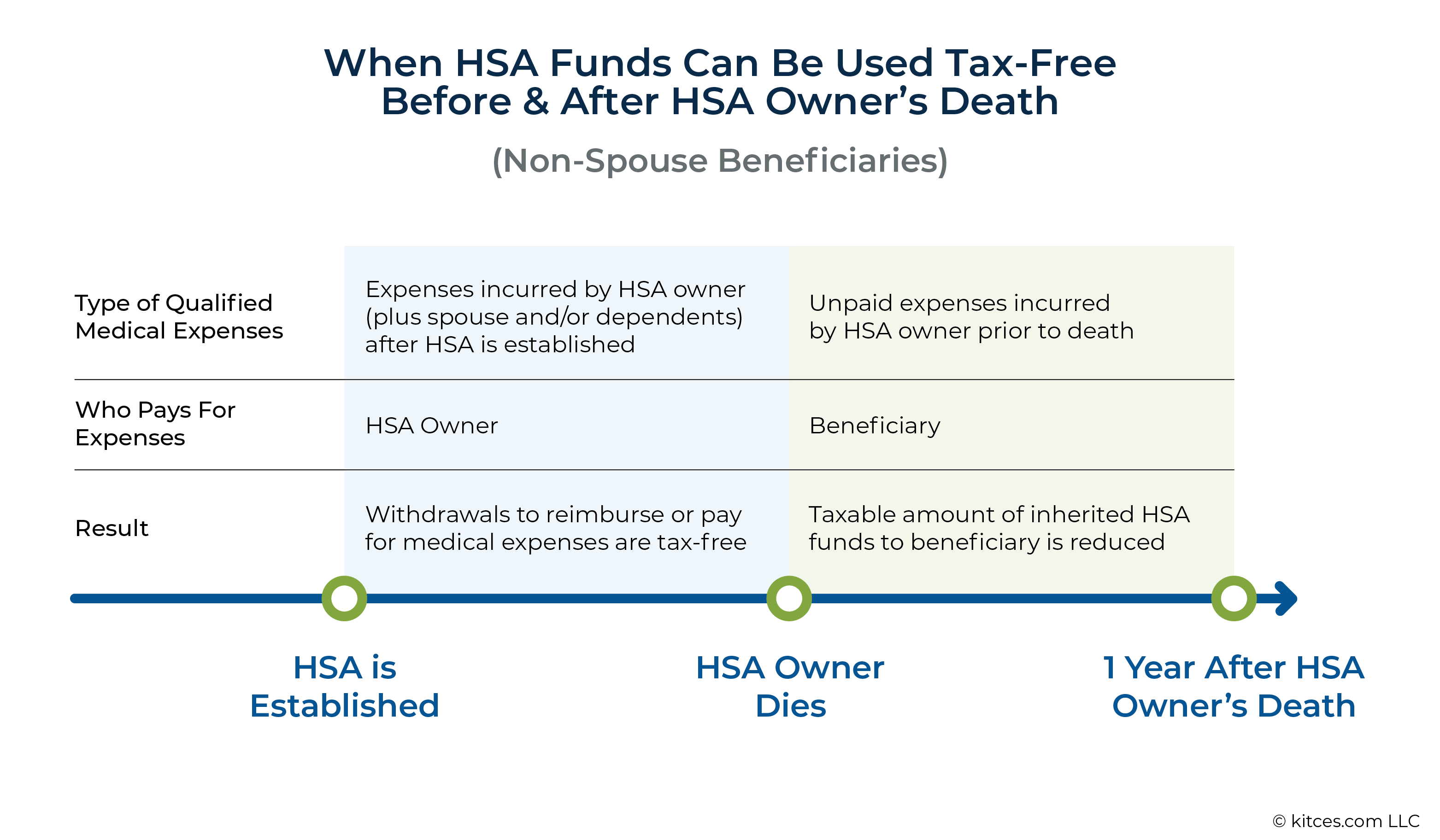
To qualify for this deduction, these medical expenses must have been incurred within one year after the date of death and must not have been reimbursed by insurance or other means. The beneficiary must itemize deductions on their tax return to claim this, which can be a limiting factor for some. This provision allows for a limited use of the inherited funds for their original purpose (medical expenses), even after the HSA status has been revoked. While helpful, it often covers only a fraction of the total inherited amount, meaning a significant portion will still typically be subject to income tax for the non-spousal beneficiary. Understanding this nuance is key for beneficiaries to accurately report their income and potentially reduce their tax liability.
When No Beneficiary is Designated (or the Estate is Named)
The absence of a designated beneficiary, or the naming of the estate itself as the beneficiary, leads to the most complex and often the least tax-efficient outcome for an inherited HSA. This situation generally necessitates the involvement of the probate court and subjects the HSA assets to significant tax liabilities.
The Probate Process and Estate Settlement
If an HSA owner dies without having designated a beneficiary, or if the designated beneficiary has predeceased them, the HSA funds become part of the decedent’s probate estate. Probate is the legal process through which a deceased person’s will is proved valid in court, and their assets are distributed to heirs. This process can be lengthy, costly, and public, involving court fees, attorney fees, and executor fees, all of which can deplete the value of the estate.
During probate, the HSA assets are managed by the estate’s executor or administrator, who is responsible for paying the decedent’s debts and distributing the remaining assets according to the will or state intestacy laws if there is no will. This means that access to the funds can be significantly delayed, and the ultimate recipients might not be those the deceased would have preferred, especially if there are complexities in the will or disputes among potential heirs. The primary goal of designating beneficiaries on all financial accounts, including HSAs, is to bypass this often cumbersome and expensive probate process, allowing for a more direct and efficient transfer of assets.
Significant Tax Consequences for the Estate
When an HSA passes into the estate due to a lack of a beneficiary designation or the estate being named directly, the tax consequences are severe. The fair market value of the HSA on the date of death is immediately included in the decedent’s gross income for their final income tax return. This effectively means the entire value of the HSA becomes taxable income, similar to how it would be treated for a non-spousal beneficiary, but with the added layer of being taxed at the estate level.
This immediate inclusion can push the decedent’s final income tax return into a higher tax bracket, leading to a substantial tax bill that must be paid by the estate before assets can be distributed. Unlike a non-spousal beneficiary who might be able to deduct the decedent’s qualified medical expenses, the estate generally does not have the same flexibility. This outcome significantly erodes the value of the HSA, defeating its purpose as a tax-advantaged savings vehicle. It emphasizes that failing to proactively designate an individual beneficiary, especially a spouse, can result in the most detrimental financial outcome for the funds accumulated in an HSA. The funds, intended for health and financial security, end up primarily funding tax obligations rather than supporting the deceased’s beneficiaries.
Essential Estate Planning for HSA Owners
The significant differences in how an HSA is treated upon death, contingent on beneficiary designations, underscore the critical importance of proactive estate planning for every HSA owner. Strategic planning can preserve the HSA’s value and ensure a smooth, tax-efficient transfer of assets to intended heirs.
Prioritizing Beneficiary Designations
The single most impactful step an HSA owner can take is to clearly and carefully designate beneficiaries. For those with a spouse, naming them as the primary beneficiary is almost always the most favorable option, preserving the account’s tax-advantaged status and allowing for a seamless transition. If there is no spouse, or if a spouse is designated as primary, secondary (contingent) beneficiaries should also be named. This ensures that if the primary beneficiary predeceases the account holder, the assets still bypass probate and are transferred directly to the next chosen individual, albeit under the non-spousal beneficiary rules if applicable. The clarity of these designations prevents assets from defaulting to the estate, which incurs the highest tax burden and administrative complexity. Designating beneficiaries acts as a simple yet powerful directive, ensuring your wishes are honored without unnecessary delays or costs.
Regular Review and Updates
Life circumstances are dynamic, and so too should be your estate plan. It is crucial to regularly review and update your HSA beneficiary designations, ideally at least once a year or after significant life events. These events include marriage, divorce, birth or adoption of a child, the death of a beneficiary, or substantial changes in financial status. Forgetting to update beneficiaries after a divorce, for instance, could result in an ex-spouse inheriting funds that were intended for current family members. Similarly, if a named beneficiary passes away, and no contingent beneficiary was named, the HSA could default to the estate. Making these updates is typically a straightforward process, often done online or by submitting a simple form to the HSA administrator. This small effort can prevent major complications and ensure that the legacy of your HSA aligns with your current family structure and financial goals.

Integrating HSAs into Your Broader Estate Plan
While beneficiary designations are powerful, they should not operate in a vacuum. Your HSA should be considered an integral part of your broader estate plan, which includes wills, trusts, and other financial accounts. Discussing your HSA with an estate planning attorney or financial advisor can help ensure that its disposition aligns with your overall wishes and minimizes potential conflicts or inefficiencies.
For example, you might have specific intentions for how your non-spousal heirs should use the inherited HSA funds, despite the tax implications. While you cannot dictate their use after it becomes taxable income, clarity in your will or a letter of instruction can convey your wishes. Furthermore, an estate planner can advise on strategies to mitigate the tax impact for non-spousal beneficiaries, perhaps through coordinating with other inheritances or through specific trust structures in complex situations. Integrating your HSA into a comprehensive plan provides peace of mind, knowing that your health savings will serve your beneficiaries efficiently and according to your ultimate intent, without leaving them with unexpected administrative or tax burdens.
aViewFromTheCave is a participant in the Amazon Services LLC Associates Program, an affiliate advertising program designed to provide a means for sites to earn advertising fees by advertising and linking to Amazon.com. Amazon, the Amazon logo, AmazonSupply, and the AmazonSupply logo are trademarks of Amazon.com, Inc. or its affiliates. As an Amazon Associate we earn affiliate commissions from qualifying purchases.