
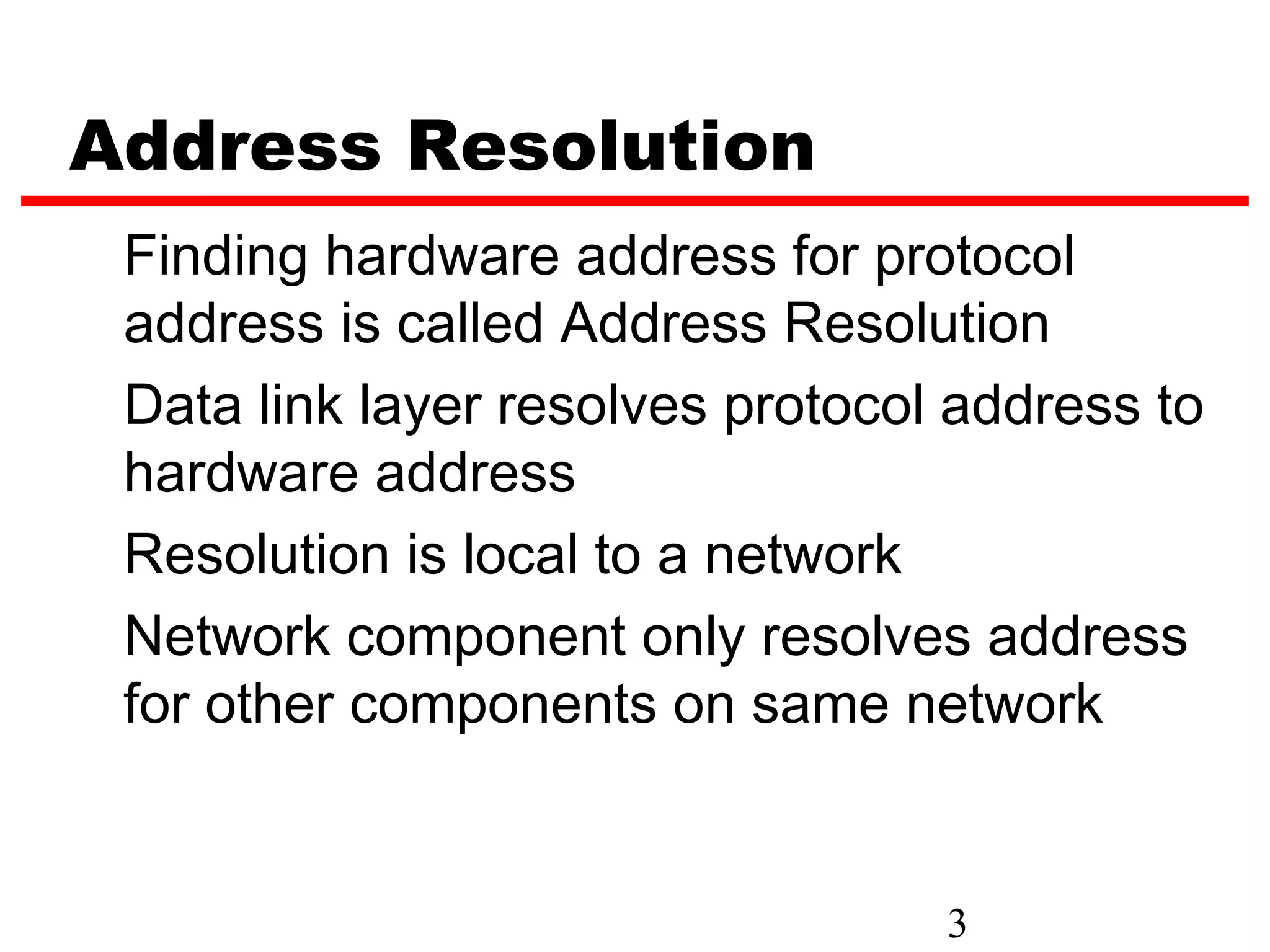
The digital world, from a simple home network to the vast expanse of the internet, operates on a complex interplay of protocols, each performing a specific, vital role. Among these, the Address Resolution Protocol (ARP) stands out as a fundamental, though often overlooked, workhorse that ensures seamless communication within local network segments. At its core, the Address Resolution Protocol (ARP) functions as a crucial bridge between the logical addressing used at the Network Layer (IP addresses) and the physical addressing used at the Data Link Layer (MAC addresses) within a local area network (LAN) segment. Without ARP, IP packets, the foundational units of internet communication, could not be successfully framed and delivered to their intended recipients on a local broadcast domain.

Understanding the Core Challenge: IP vs. MAC
To fully grasp ARP’s significance, it’s essential to understand the duality of network addressing that exists in the TCP/IP model. Data transmission across networks relies on two primary types of addresses, each operating at a different layer of the networking stack and serving distinct purposes.
The Duality of Network Addressing
At Layer 3, the Network Layer, we encounter IP addresses (Internet Protocol addresses). These are logical, software-assigned addresses that are hierarchical and routable across vast networks, including the internet. An IP address uniquely identifies a device on a network from a global perspective, allowing packets to be routed from a source to a destination potentially thousands of miles away. IPv4 addresses, the most common type, are 32-bit numbers typically represented in dotted-decimal format (e.g., 192.168.1.1).
Conversely, at Layer 2, the Data Link Layer, we deal with MAC addresses (Media Access Control addresses). These are physical, hardware-assigned addresses, often “burned in” to the network interface card (NIC) by the manufacturer. MAC addresses are unique worldwide and are used for local communication within a specific network segment or broadcast domain (e.g., an Ethernet LAN). They are 48-bit numbers, typically represented as six pairs of hexadecimal characters separated by colons or hyphens (e.g., 00:0A:95:9D:68:16).
The challenge arises because while an IP address tells a device where to send data logically across the internet, the actual physical transmission of data on a local network segment (like an Ethernet cable or Wi-Fi network) requires the destination’s MAC address. An IP packet, destined for another device on the same local network, must be encapsulated within an Ethernet frame. This Ethernet frame requires the destination’s MAC address to physically reach the correct device on the shared medium. If a device only knows the IP address of its local peer, but not its MAC address, it cannot construct the necessary Layer 2 frame. This is the precise problem ARP was designed to solve.
The Address Resolution Protocol: Bridging the Divide
ARP steps into this void, providing the crucial mechanism for dynamically discovering the MAC address corresponding to a known IP address on a local network segment.
The Fundamental Role of ARP
ARP’s primary purpose is to enable successful data frame delivery within a local broadcast domain. When a device (let’s call it Host A) wants to communicate with another device (Host B) on the same local network and knows Host B’s IP address but not its MAC address, Host A uses ARP to query the network for Host B’s physical address. This dynamic resolution process prevents network administrators from having to manually configure every IP-to-MAC mapping, a task that would be impractical and error-prone in any sizeable network. Without ARP, direct IP-based communication between devices on the same local segment would be impossible, as the underlying hardware cannot route purely based on IP.
Beyond Local Devices: The Gateway’s Role
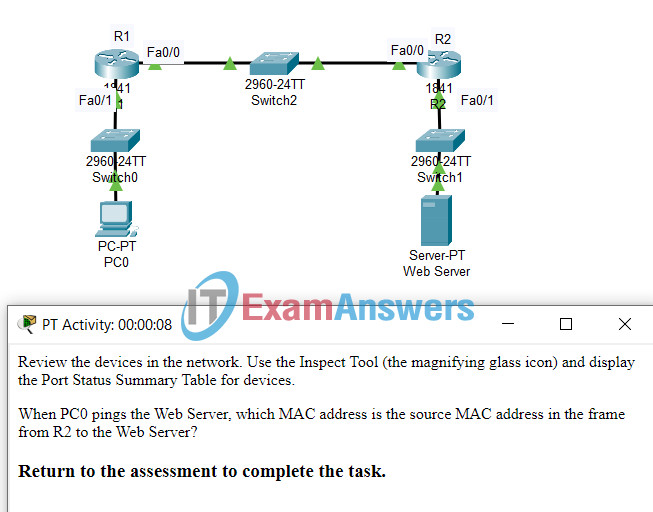
It’s important to note that ARP’s function is strictly localized to a single network segment or broadcast domain. When a host needs to send data to a destination outside its local network (e.g., to a website on the internet), it doesn’t attempt to resolve the MAC address of that remote destination’s IP address. Instead, it resolves the MAC address of its default gateway (typically a router on the local network).
The host uses ARP to find the MAC address of its gateway, constructs an Ethernet frame with the gateway’s MAC address as the destination, and sends the IP packet to the gateway. The router then takes responsibility for forwarding the packet to its next hop, potentially on another segment or to the internet, using its own routing tables and ARP processes as needed along the path. This highlights ARP’s localized scope but universal necessity for even external communications to initiate from a local device.
How ARP Works: A Step-by-Step Breakdown
The operation of ARP is a simple yet elegant two-part process: a broadcast request followed by a unicast reply.
The ARP Request: A Broadcast Call
Imagine Host A (with IP 192.168.1.10 and MAC AAAA) wants to send data to Host B (with IP 192.168.1.20) on the same local network. Host A knows Host B’s IP address but needs its MAC address.
- Initiation: Host A first checks its internal ARP cache (a temporary table of IP-to-MAC mappings) to see if it already knows Host B’s MAC address. If not, it proceeds with an ARP request.
- Packet Creation: Host A constructs an ARP request packet. This packet typically contains:
- Sender’s IP address (192.168.1.10)
- Sender’s MAC address (AAAA)
- Target’s IP address (192.168.1.20)
- Target’s MAC address (set to all zeros, as it’s unknown)
- Broadcasting: Host A encapsulates this ARP request into an Ethernet frame. Crucially, the destination MAC address of this Ethernet frame is set to the broadcast address (FF:FF:FF:FF:FF:FF). This means the frame is sent to every device on the local network segment.
- Analogy: It’s like Host A shouting across the room, “Hey everyone, who has IP address 192.168.1.20? If you do, please tell 192.168.1.10 (my MAC is AAAA).”
The ARP Reply: A Unicast Response
Upon receiving the broadcast ARP request:
- Reception: Every device on the local network segment receives and processes the ARP request.
- Target Identification: Each device compares the “Target IP address” in the ARP request with its own IP address.
- Response Generation: Only the device that matches the Target IP address (Host B in our example) recognizes itself. Host B then creates an ARP reply packet. This reply contains:
- Sender’s IP address (192.168.1.20 – now Host B’s IP)
- Sender’s MAC address (BBBB – Host B’s MAC)
- Target’s IP address (192.168.1.10 – now Host A’s IP)
- Target’s MAC address (AAAA – Host A’s MAC, learned from the original request)
- Unicast Delivery: Host B encapsulates this ARP reply into an Ethernet frame. The destination MAC address of this Ethernet frame is set to Host A’s actual MAC address (AAAA), which Host B learned from the original ARP request. The ARP reply is thus sent directly back to Host A as a unicast message.
- Analogy: Host B replies directly to Host A, “I am 192.168.1.20, and my MAC address is BBBB.”
Learning and Caching
When Host A receives the ARP reply from Host B, it now has the necessary MAC address (BBBB) for Host B. Host A stores this IP-to-MAC mapping (192.168.1.20 -> BBBB) in its local ARP cache. This caching mechanism is vital for efficiency, as it prevents the need for an ARP request every time Host A wants to communicate with Host B. Similarly, when Host B receives Host A’s original ARP request, it can also update its own ARP cache with Host A’s IP-to-MAC mapping, anticipating future communication.
ARP Cache and Its Importance
The ARP cache is more than just a temporary storage; it’s a critical component for network efficiency and performance.
The Role of the ARP Cache
The ARP cache is a temporary storage table maintained by every network device (hosts, routers, switches). It stores recently resolved IP-to-MAC address mappings. Its primary purpose is to reduce network overhead. Without a cache, every time a device needed to send a packet to another device on the local segment, it would have to perform an ARP broadcast, creating unnecessary network traffic and delaying communication. By checking the cache first, a device can quickly retrieve the needed MAC address and proceed with data transmission, avoiding the broadcast cycle.
ARP cache entries are dynamic and have a Time-To-Live (TTL), meaning they expire after a certain period (e.g., 20 minutes for Windows by default). This expiration mechanism ensures that the cache doesn’t hold stale information if a device’s MAC address changes (though this is rare) or if a device is removed from the network and replaced by another, potentially with the same IP but a different MAC.
Commands and Management
Users and administrators can view and manage the ARP cache on most operating systems.
- On Windows, the
arp -acommand displays the current ARP cache.arp -dcan delete specific entries, andarp -sallows adding static, non-expiring entries. - On Linux/macOS, similar commands like
arp -aorip neigh showdisplay the cache, andarp -dorip neigh delmanage entries.
Adding static ARP entries, which are permanent and do not expire, can be useful for critical servers or specific security requirements. However, this approach is not scalable for large networks and can introduce rigidity if network topology or device addresses change.
ARP in Modern Networks and Security Implications
Despite its age and relative simplicity, ARP remains absolutely fundamental to the operation of nearly all modern IPv4-based Ethernet networks.
Essential for Connectivity
Every time you access a local server, print to a network printer, or even send data to your default gateway to reach the internet, ARP is silently working in the background to resolve addresses. Without it, IP packets would effectively be unroutable on the local Layer 2, rendering higher-layer protocols useless. It underpins the very fabric of local network communication. It’s worth noting that IPv6, the successor to IPv4, utilizes the Neighbor Discovery Protocol (NDP), which provides similar IP-to-MAC resolution functionality but with enhancements and differences suited for the IPv6 architecture. However, the function of resolving logical to physical addresses remains a core requirement.
ARP Spoofing and Man-in-the-Middle Attacks
ARP’s design, which implicitly trusts ARP replies without prior verification, makes it vulnerable to various attacks, most notably ARP spoofing (also known as ARP poisoning). An attacker can exploit this trust by sending fake or malicious ARP replies to devices on the network. For instance, an attacker could send an ARP reply to Host A, falsely claiming that their own MAC address is associated with the IP address of the default gateway. Similarly, they could send an ARP reply to the gateway, falsely associating their own MAC address with Host A’s IP address.
The consequences of successful ARP spoofing can be severe:
- Man-in-the-Middle (MITM) Attacks: By positioning themselves between two communicating devices, attackers can intercept all traffic flowing between them. They can then inspect, modify, or drop the data, compromising confidentiality, integrity, and availability.
- Denial of Service (DoS): An attacker can send incorrect ARP replies for critical devices (like a file server or the default gateway), causing legitimate traffic to be misdirected or dropped, effectively preventing users from accessing essential services.
- Session Hijacking: By intercepting traffic, attackers can capture session cookies or authentication tokens, allowing them to impersonate legitimate users and hijack their sessions.
Mitigating ARP Vulnerabilities
Given these significant security implications, various mitigation strategies have been developed:
- Static ARP Entries: For critical network devices like default gateways, manually configuring static ARP entries on hosts can prevent dynamic resolution and subsequent spoofing for those specific mappings. However, this is not scalable for large networks.
- Dynamic ARP Inspection (DAI): This is a security feature implemented on managed network switches. DAI validates ARP packets against the switch’s DHCP snooping binding database. It inspects ARP requests and replies and drops any invalid packets, preventing an attacker from poisoning the ARP caches of other devices on the network.
- Network Access Control (NAC): NAC solutions can monitor and control devices connecting to the network, potentially detecting anomalous ARP behavior or unauthorized devices attempting ARP spoofing.
- VPNs and Encryption: While not directly preventing ARP spoofing, encrypting traffic (e.g., using HTTPS for web traffic or a Virtual Private Network (VPN) for all network traffic) makes intercepted data unreadable. This significantly mitigates the impact of a successful MITM attack, even if traffic is routed through an attacker’s machine.
- Intrusion Detection/Prevention Systems (ID/PS): These systems can be configured to detect and alert on suspicious ARP activity, such as a high volume of ARP replies from a single, unexpected source, which might indicate an ARP spoofing attempt.
In conclusion, the Address Resolution Protocol is an indispensable component of modern network communication, silently performing the vital task of translating logical IP addresses into physical MAC addresses for local data delivery. While its simplicity makes it efficient, it also introduces vulnerabilities that necessitate careful consideration and the implementation of appropriate security measures in any robust network environment.
aViewFromTheCave is a participant in the Amazon Services LLC Associates Program, an affiliate advertising program designed to provide a means for sites to earn advertising fees by advertising and linking to Amazon.com. Amazon, the Amazon logo, AmazonSupply, and the AmazonSupply logo are trademarks of Amazon.com, Inc. or its affiliates. As an Amazon Associate we earn affiliate commissions from qualifying purchases.