
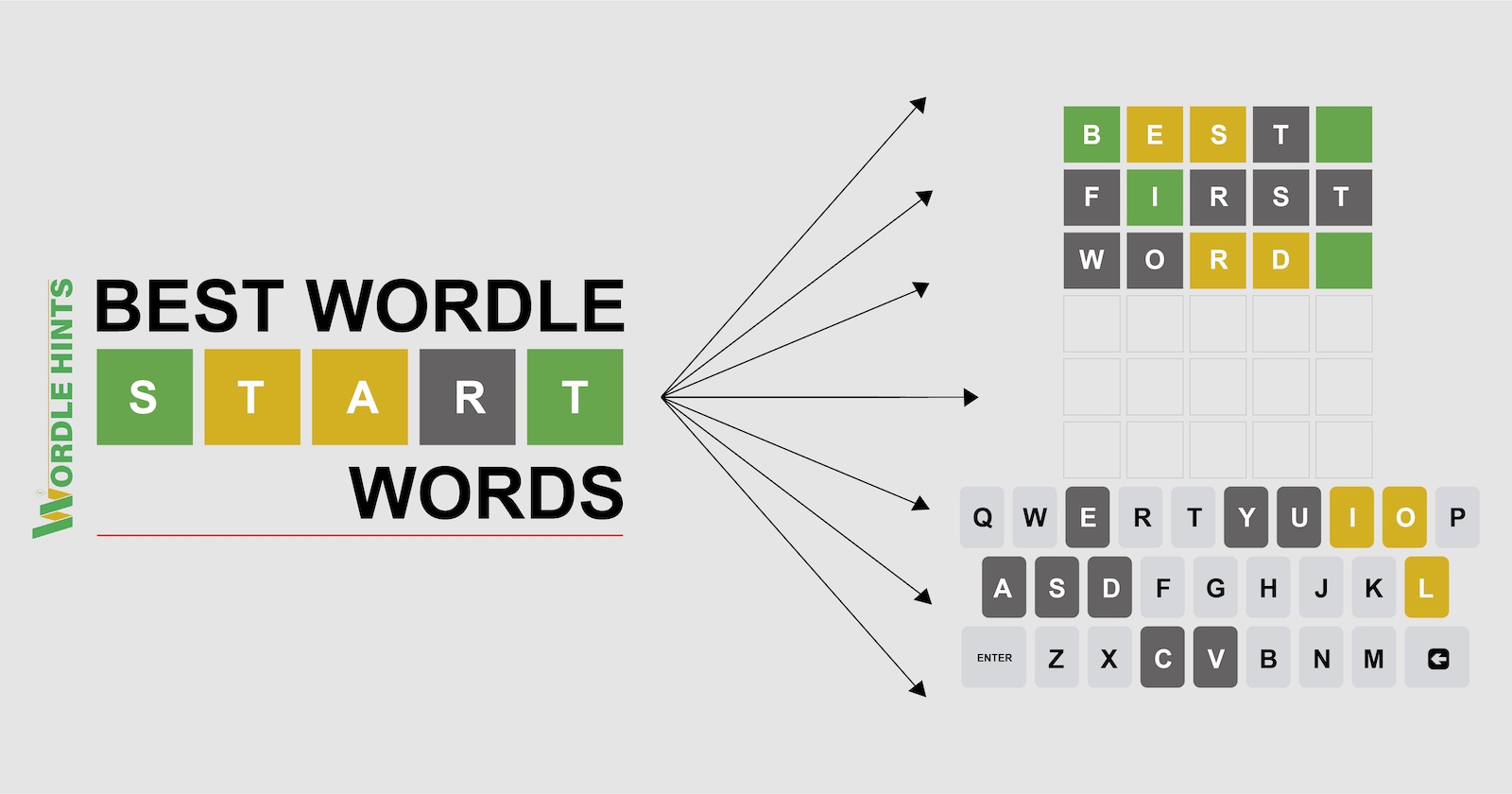
The deceptively simple five-letter word puzzle, Wordle, has captivated millions, sparking daily debates over strategy. While many players rely on intuition, the quest for the “best” first word is a deeply technical challenge, rooted in data science, computational linguistics, and information theory. It’s not just about guessing a word; it’s about executing an optimal algorithm to maximize information gain and minimize the average number of guesses, transforming a casual game into a subject of rigorous scientific inquiry.
The Algorithmic Quest for Optimal Wordle Starts
At its core, Wordle presents a finite problem space, making it ripe for algorithmic analysis. The game involves deducing a five-letter word within six attempts, receiving feedback (green for correct letter and position, yellow for correct letter but wrong position, gray for absent letter) after each guess. This feedback loop is the data signal, and the objective is to process this signal most efficiently.

Understanding Wordle’s Design Constraints
The primary constraints are the lexicon and the feedback mechanism. Wordle’s dictionary is split into two: a larger list of valid guess words (around 12,972 words) and a smaller, curated list of possible solution words (around 2,315 words). The true “solution space” is this smaller list, which is critical for analysis. Any algorithm aiming to find the best first word must operate within these constraints, understanding that even if a word is a valid guess, it might not be a possible solution. The number of guesses (six) dictates the need for aggressive information extraction upfront.
Data Science to the Rescue: Letter Frequency Analysis
The initial foray into finding optimal starting words often begins with basic statistical analysis: letter frequency. By analyzing the entire set of possible Wordle solutions, data scientists can determine which letters appear most often. Unsurprisingly, common English letters like E, A, R, O, T, I, N, S, L, C, U, D tend to dominate.
However, simple overall frequency isn’t enough. Positional frequency is equally important. For example, ‘S’ is a very common letter overall, but it’s less common in the middle of a word and more common at the beginning or end. Similarly, ‘E’ and ‘A’ are frequently found in almost all positions. An effective first word should ideally contain letters that are both high in overall frequency and represent a good spread across different positional probabilities, maximizing the chance of hitting a correct letter, regardless of its eventual position. Furthermore, balancing vowels and consonants is a common heuristic, as words typically contain 2-3 vowels, and knowing the vowel structure early significantly reduces the search space.
Beyond Simple Frequencies: Maximizing Information Gain
While letter frequency analysis provides a foundation, truly optimal strategies delve into the principles of information theory. The goal isn’t just to guess letters; it’s to make a guess that, on average, provides the most differentiating information, drastically reducing the set of remaining possible solutions.
The Concept of Entropy and Information Theory
Every Wordle guess is an experiment that yields information. In information theory, this information is quantified using concepts like entropy. A “good” first word is one that, on average, provides the maximum “information gain.” This means it partitions the remaining solution space into the smallest possible subsets, regardless of the feedback received. For instance, if you guess a word and receive all gray letters, you’ve eliminated all words containing those letters. If you receive green or yellow, you’ve gained positive information about specific letters and their positions. The best first word is the one expected to prune the solution list most effectively, leading to the fastest solution.
Computational Approaches to Word Selection
To precisely calculate information gain, computational methods are indispensable. Developers and data scientists have employed various algorithms:
- Brute-Force Simulation: One method involves simulating every possible first word against every possible solution. For each first word, the algorithm calculates the feedback pattern for all 2,315 solutions. It then counts how many solutions remain consistent with that feedback. The word that, on average, leaves the fewest remaining possible solutions after one guess is considered optimal. This is computationally intensive but provides the most accurate measure of a word’s effectiveness.
- Scoring Systems: Other approaches involve developing sophisticated scoring systems for words. These systems might assign points based on letter frequency, uniqueness of letters (to avoid redundant information if a letter appears twice in a first guess), and the diversity of common letter combinations. Words with many common letters that are also distinct (e.g., “CRANE” or “ARISE”) are often favored because they test a wide array of high-probability letters without repetition. Repetition, while sometimes unavoidable, reduces the information density of a single guess, as a double ‘L’ in “SWELL” only provides information about the letter ‘L’ once.
- Minimax Strategy: A more advanced strategy involves a “minimax” approach, aiming to minimize the maximum number of remaining possible words for any given feedback. This guarantees the best “worst-case” performance, ensuring that even if the feedback is unfavorable, the remaining solution set is still as small as possible.

Popular Candidates and Their Data-Driven Justifications
Through rigorous computational analysis, several words consistently emerge as strong contenders for the “best” Wordle opener. These aren’t random choices but are backed by solid statistical and algorithmic reasoning.
SAREI, CRANE, TRACE, SLATE: The Traditional Favorites
These words are frequently cited by both casual players and data enthusiasts. Their popularity isn’t coincidental; they often feature a high concentration of the most common English letters (E, A, R, S, T, L) and often avoid repeating letters, thus maximizing the diversity of letters tested in a single guess.
- CRANE: Contains C, R, A, N, E – five of the most frequent letters.
- SLATE: Contains S, L, A, T, E – another excellent spread.
- TRACE: Similar to CRANE, using T, R, A, C, E.
These words are efficient because they provide a high probability of hitting at least one correct letter (green or yellow), while also giving insight into the presence or absence of a wide variety of other common letters.
ADIEU, OUIJA: Vowel-Focused Strategies
Another school of thought, often supported by certain algorithmic analyses, prioritizes quickly identifying the vowel structure of the target word. Since every Wordle solution is guaranteed to have at least one vowel, and typically 2-3, narrowing down the vowels can significantly reduce the search space.
- ADIEU: Contains A, D, I, E, U – four distinct vowels plus a common consonant.
- OUIJA: Contains O, U, I, J, A – all five vowels.
While these words might not hit as many high-frequency consonants immediately, their strength lies in quickly clarifying the vowel landscape, which can be a powerful filter for subsequent guesses. This strategy often performs well in scenarios where the solution has an unusual vowel pattern.
ARISE, ROATE, SALET: The Mathematically Optimized
Some of the deepest dives into Wordle optimization, often conducted by engineers and data scientists, have identified words that perform exceptionally well under complex information theory metrics.
- ARISE: Features A, R, I, S, E – all common letters, no repeats, and a good mix of vowels and consonants. Various studies have shown
ARISEto be an extremely effective opener, often ranking in the top tier for maximizing information gain across all possible solutions. - ROATE: Contains R, O, A, T, E – again, a strong combination of high-frequency letters.
- SALET: Another statistically strong choice, using S, A, L, E, T.
These words often achieve the lowest average number of guesses across extensive simulations, demonstrating their superior performance in a purely data-driven context. The “best” word often depends on the specific metric used (e.g., lowest average guesses, lowest worst-case guesses, highest information entropy). However, words like ARISE consistently appear at or near the top across different robust analytical models, emphasizing their inherent algorithmic efficiency.
Tools and Software for Wordle Optimization
The popularity of Wordle has spawned a vibrant ecosystem of technological solutions, from web-based solvers to sophisticated Python scripts, all aiming to assist players or further analyze the game’s mechanics.
Wordle Solvers and Analyzers
Numerous online tools and applications have emerged to help players optimize their Wordle strategy. These tools often integrate the computational methods discussed earlier. Users can input their first guess and the resulting feedback, and the solver will then suggest the mathematically optimal next guess by filtering the remaining possible solutions and calculating which word will provide the most information.
Features typically include:
- Real-time filtering: As feedback is entered, the list of possible words shrinks dynamically.
- Letter frequency heatmaps: Visualizing which letters are still highly probable across different positions.
- Optimal guess suggestions: Using algorithms (often based on information theory) to recommend the best next move.
These tools effectively democratize advanced game theory, allowing even casual players to leverage sophisticated algorithms without needing to write code.
Open-Source Projects and Community Contributions
The Wordle phenomenon has also fueled a rich landscape of open-source projects. Developers on platforms like GitHub have shared their algorithms, Wordle dictionaries, and simulation environments. These projects often implement various strategies, from basic frequency analysis to advanced information theory models, allowing others to scrutinize, improve, and learn from their methodologies. These contributions have helped refine our understanding of optimal Wordle play and provided the raw data and computational frameworks necessary for deeper analysis. These repositories often feature Python scripts that can simulate thousands of Wordle games to determine the average number of guesses for different starting words, providing empirical evidence for which words truly perform best.
The Future of Game AI in Puzzle Solving
The algorithmic approach to Wordle is a microcosm of broader trends in game AI and computational problem-solving. The techniques used—data analysis, information theory, search algorithms, and simulation—are fundamental to how AI tackles complex challenges, from optimizing logistics to developing sophisticated game-playing agents (like those for chess or Go). Wordle serves as an accessible case study for how computational power and data science can unravel the “optimal” strategy in a seemingly simple human game, demonstrating the power of technological insight to enhance understanding and performance in diverse problem domains. As AI continues to evolve, similar frameworks will undoubtedly be applied to an ever-wider array of logic puzzles and strategic games, pushing the boundaries of what machines can ‘solve.’
aViewFromTheCave is a participant in the Amazon Services LLC Associates Program, an affiliate advertising program designed to provide a means for sites to earn advertising fees by advertising and linking to Amazon.com. Amazon, the Amazon logo, AmazonSupply, and the AmazonSupply logo are trademarks of Amazon.com, Inc. or its affiliates. As an Amazon Associate we earn affiliate commissions from qualifying purchases.