
The 27th Amendment to the United States Constitution, a testament to enduring fiscal scrutiny, addresses the seemingly straightforward yet politically charged issue of congressional compensation. Far from a mere historical footnote, this amendment serves as a critical, albeit often overlooked, constitutional mechanism designed to inject fiscal prudence and accountability into the legislative process, profoundly influencing how public funds are allocated for elected officials’ salaries. Its journey to ratification, spanning over two centuries, underscores a persistent societal demand for transparency and a check on potential financial self-interest within government, placing it squarely within discussions of public finance, governmental budgeting, and the ethical management of taxpayer dollars.

The Financial Context of Congressional Compensation
The genesis of the 27th Amendment is rooted deeply in a historical context rife with public concern over the financial practices of elected officials. Unlike personal finance, where individuals manage their own income, congressional salaries are drawn directly from the national treasury—the collective financial contribution of American taxpayers. This fundamental difference mandates a higher degree of oversight and ethical consideration, making the financial aspects of congressional pay a matter of intense public interest and, often, contention.
Historical Fiscal Grievances
The drive for the 27th Amendment can be traced back to the post-Revolutionary War era, a period marked by significant national debt and economic instability. Early American citizens were acutely aware of the financial sacrifices made during the war and viewed any attempt by lawmakers to enrich themselves prematurely or without public consent as a betrayal of trust. The initial proposal for what would become the 27th Amendment, penned by James Madison in 1789, directly followed a contentious debate over congressional salary increases. At the time, legislators had the power to vote themselves immediate pay raises, a practice that understandably sparked outrage among a populace burdened by taxes and struggling financially.
This historical backdrop illustrates a fundamental fiscal grievance: the perceived lack of accountability when elected officials directly control their own remuneration without immediate electoral consequences. From a financial perspective, this scenario presented a moral hazard, where agents (legislators) could potentially act in their own financial interest at the expense of the principals (the public/taxpayers). The proposed amendment aimed to rectify this imbalance, ensuring that any financial adjustment to congressional salaries would first face public review through the electoral process.
The Amendment’s Core Financial Mechanism
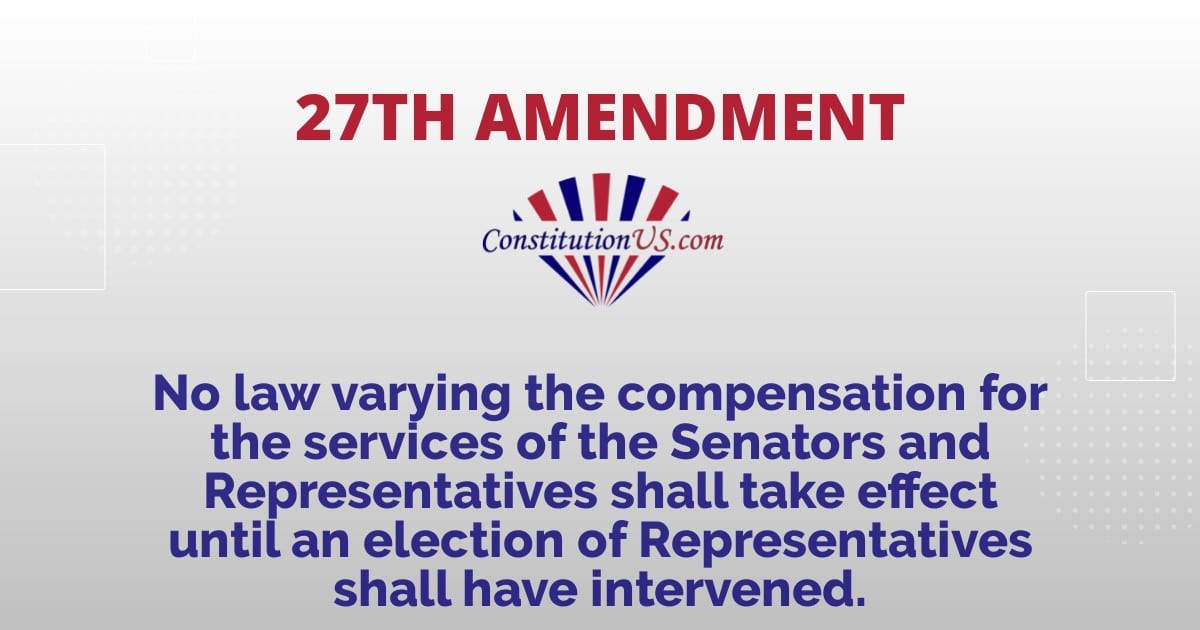
At its core, the 27th Amendment is a constitutional financial instrument. It stipulates: “No law, varying the compensation for the services of the Senators and Representatives, shall take effect, until an election of Representatives shall have intervened.” This seemingly simple sentence imposes a profound fiscal safeguard. It doesn’t prohibit Congress from increasing its own pay; rather, it delays the effective date of such an increase until after the next federal election.
This delay is crucial for financial accountability. It transforms a potentially self-serving legislative act into a matter of public debate and electoral consequence. If Congress votes itself a pay raise, voters have the opportunity to evaluate that decision—alongside other legislative actions—at the ballot box before the financial change takes effect. From a financial management perspective, this mechanism acts as a delayed vesting clause, akin to how some corporate executive compensation is structured to align long-term interests and prevent short-term, self-serving decisions. It ensures that the financial implications of a pay raise are considered by the electorate, rather than being an internal financial decision made by legislators for immediate benefit.
Fiscal Prudence and Legislative Accountability
The 27th Amendment profoundly influences the fiscal discipline of the legislative branch, framing congressional salaries not just as personal income but as an integral part of governmental expenditure that demands public oversight. It acts as a bulwark against impulsive financial decisions, fostering a climate of greater accountability.
Impact on Government Expenditure and Budgeting
While congressional salaries represent a relatively small fraction of the overall federal budget, their management is symbolic of broader fiscal responsibility. The 27th Amendment ensures that any increase in this expenditure stream cannot be immediate. This forces congressional leaders and budget planners to consider the longer-term implications of salary adjustments, knowing that such changes will undergo public scrutiny. In the realm of government budgeting, predictability and public acceptance are vital. The amendment contributes to both by creating a structured delay, allowing time for economic impact assessments and public discourse, rather than immediate financial implementation.
In essence, the amendment aligns legislative financial decision-making with the principles of sound public finance. Just as a corporation’s board might carefully deliberate executive compensation, considering shareholder reactions and market conditions, Congress must now implicitly weigh the financial impact of pay raises against potential electoral repercussions. This provides an external check, moving beyond internal budgetary considerations to encompass the broader economic and political landscape.
A Tool for Public Financial Oversight
The amendment empowers the electorate with a unique form of financial oversight. By delaying the effective date of a pay raise, it transforms congressional compensation into a direct electoral issue. Voters can effectively ‘veto’ a raise by electing new representatives who might reverse the decision or penalize those who voted for it. This aligns perfectly with the democratic principle of public control over public funds.
Consider it as a constitutional “shareholder meeting” for financial review. Just as shareholders assess the performance and compensation of a company’s leadership, citizens, as stakeholders in the national enterprise, get to weigh in on the financial compensation of their legislative leaders. This direct linkage between financial decisions (pay raises) and electoral outcomes bolsters the public’s role in ensuring fiscal prudence at the highest levels of government. It’s a critical financial “check and balance” mechanism that reinforces the idea that public office is a public trust, and its financial rewards must be justifiable to those who ultimately bear the cost.
Economic Implications and Public Trust
Beyond the mechanics of budgeting and oversight, the 27th Amendment carries significant economic and psychological weight, particularly concerning public perception of governmental integrity and the careful stewardship of public resources.
Managing Public Funds and Perceptions
The effective management of public funds is not solely about mathematical accounting; it’s also about maintaining public confidence. Congressional pay raises have historically been sensitive issues, often perceived as self-serving, especially during times of economic hardship for average citizens. The amendment serves as a buffer against these perceptions by introducing a necessary delay. This delay provides a cooling-off period, allowing the public to digest the news, understand the rationale (if any), and voice their opinions through the electoral process.
From an economic perspective, this helps to mitigate what is known as the “agency problem” in governance, where the interests of the agents (elected officials) might diverge from the interests of the principals (the citizens). By imposing a delay, the amendment encourages legislators to consider the broader economic context and public sentiment before enacting financial changes that directly benefit themselves. This can contribute to greater economic stability by fostering trust in government and reducing cynicism about how public funds are managed.
The Long-Term Fiscal Wisdom
The 27th Amendment embodies long-term fiscal wisdom by promoting a more considered approach to governmental financial decisions. It discourages short-sighted, politically expedient decisions regarding pay that could erode public trust and destabilize fiscal policy. By forcing a temporal gap, it allows for a more comprehensive assessment of economic conditions, inflation, and the actual cost of living for legislators, thereby justifying any proposed increase in a more robust and publicly acceptable manner.
This long-term perspective is crucial for the financial health of any large organization, including the government. It prevents the rapid escalation of fixed costs (salaries) without adequate external review, contributing to more sustainable financial practices within the legislative branch. It encourages lawmakers to think about their salaries as part of a national economic picture, rather than an isolated budgetary item.
The 27th Amendment in the Broader Financial Landscape
The principles embedded in the 27th Amendment resonate with broader financial controls and governance structures found across both public and private sectors, positioning it as a fundamental element within the nation’s financial framework.
Parallels to Executive Compensation Controls
In the corporate world, executive compensation is often a complex affair, typically involving base salaries, bonuses, stock options, and other performance-based incentives. Crucially, these compensation packages are almost always subject to approval by a board of directors and often by shareholders, sometimes through “say on pay” votes. These mechanisms are designed to align the interests of executives with those of the company and its shareholders, and to prevent excessive or unjustified self-enrichment.
The 27th Amendment functions similarly, albeit in a governmental context. It acts as a constitutional “shareholder vote” on legislative executive compensation. By requiring an intervening election, it subjects congressional pay decisions to the ultimate “shareholders”—the voters. This parallel highlights the fundamental need for external review and accountability when individuals in positions of power determine their own financial rewards, whether in a corporation or in the halls of Congress.

A Constitutional Financial Instrument
Ultimately, the 27th Amendment stands as a unique constitutional financial instrument. It is not a tax law, nor does it dictate specific budgetary allocations; instead, it establishes a foundational rule for how a specific category of government expenditure—legislative salaries—must be handled. It represents a constitutional commitment to financial transparency and accountability for the cost of governing.
In a nation where personal finance, investing, and business finance are meticulously regulated and analyzed, the 27th Amendment ensures that even the internal financial mechanics of the government itself are subject to constitutional oversight. It underscores the profound principle that all aspects of public financial management, from massive infrastructure projects to the salaries of elected officials, are ultimately accountable to the citizens who fund them. Its quiet operation over decades continues to embody a vital aspect of fiscal integrity within American democracy.
aViewFromTheCave is a participant in the Amazon Services LLC Associates Program, an affiliate advertising program designed to provide a means for sites to earn advertising fees by advertising and linking to Amazon.com. Amazon, the Amazon logo, AmazonSupply, and the AmazonSupply logo are trademarks of Amazon.com, Inc. or its affiliates. As an Amazon Associate we earn affiliate commissions from qualifying purchases.