
In the rapidly evolving world of technology, precision and clarity are paramount. Concepts that provide structure, order, and a definitive standard often underpin the most robust and efficient digital systems. One such concept, frequently encountered yet sometimes misunderstood, is “canonical.” While the term originates from ecclesiastical law, signifying adherence to a rule or standard, its application in technology has broadened significantly, becoming a cornerstone in areas from web development and search engine optimization (SEO) to data architecture and software design. Understanding what “canonical” means in a technological context is essential for anyone building, managing, or optimizing digital assets and processes.
Understanding ‘Canonical’ in the Digital Landscape
At its core, “canonical” in technology refers to the preferred, authoritative, or standard form of an entity or piece of information. It signifies the singular, definitive version among multiple potential variations or representations. The digital realm is inherently prone to duplication, redundancy, and diverse ways of expressing the same thing. Without a mechanism to identify the canonical version, systems can become inefficient, data can become inconsistent, and users (including search engine robots) can become confused.
The need for canonicalization arises from the practical challenges of managing digital information:
- Redundancy: The same content or data might exist at multiple locations or in different formats.
- Ambiguity: Multiple paths or representations might lead to the same logical resource or meaning.
- Interoperability: Different systems or components need a common, agreed-upon format for data exchange.
By establishing a canonical form, we aim to eliminate ambiguity, consolidate authority, and streamline processing. This principle permeates various layers of technology, from how a website is indexed to how complex data sets are integrated.
The Cornerstone of Web Presence: Canonical URLs and SEO
Perhaps the most widely recognized application of “canonical” in technology is in the context of web addresses, specifically Canonical URLs, and their critical role in Search Engine Optimization (SEO). A Canonical URL is the official, preferred URL for a given piece of content on the web.
The Problem of Duplicate Content
On the internet, it’s remarkably easy for the same content to be accessible via multiple URLs. This “duplicate content” issue can arise from various scenarios:
- URL Variations:
http://example.comvs.https://example.comexample.comvs.www.example.comexample.com/pagevs.example.com/page/(trailing slash)- URLs with query parameters that don’t change content (e.g.,
example.com/products?color=redvs.example.com/products). - Session IDs appended to URLs (
example.com/page?sessionid=XYZ).
- Content Management Systems (CMS): Many CMS platforms automatically generate multiple paths to the same content, for example, through category archives, tag pages, and individual post URLs.
- Syndication and Pagination: Content republished on other sites, or articles broken into multiple pages (e.g.,
example.com/article/page/1,example.com/article/page/2). - E-commerce Sites: Product pages often have numerous variations for colors, sizes, or specific configurations, each potentially generating a unique URL for essentially the same product description.
- Printer-Friendly Versions: Dedicated URLs for print-optimized pages.
Why Search Engines Care
Search engines like Google strive to provide the best and most relevant search results. Duplicate content poses several challenges for them:
- Crawl Budget Waste: Search engine bots have a limited “crawl budget” for each website. If they spend time crawling and indexing multiple URLs containing identical content, they might miss discovering new or updated content.
- Link Equity Dilution: When multiple URLs host the same content, any backlinks pointing to those pages might have their “link equity” (or “ranking power”) split between them. This dilutes the authority that could otherwise be consolidated on a single, canonical page, potentially hindering its ranking performance.
- User Experience: Presenting multiple identical results for a single query can be confusing for users.
To combat these issues, search engines need a clear signal indicating which version of a page is the definitive one. This is where canonicalization comes in.
Implementing the Canonical Tag (rel="canonical")
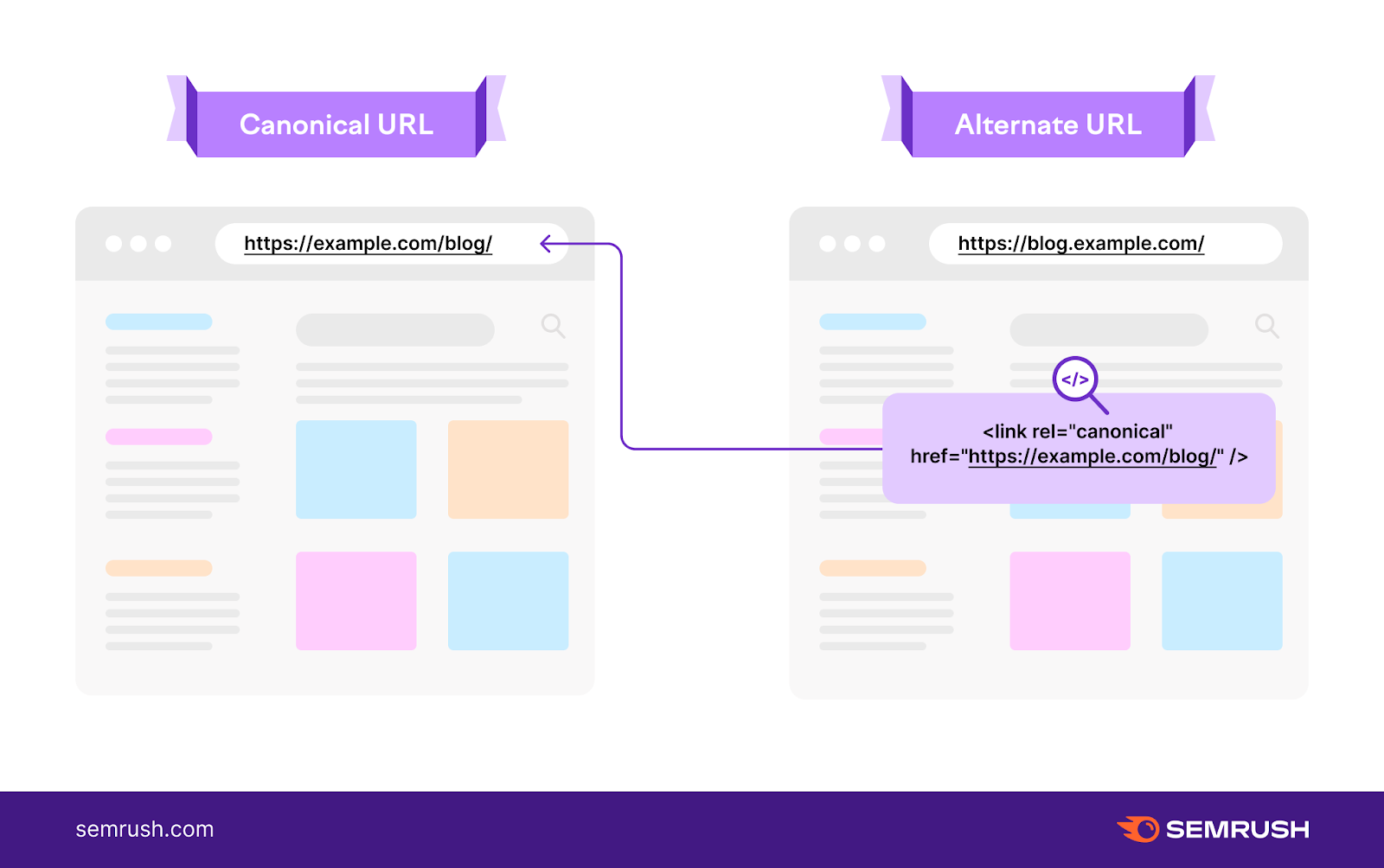
The primary method for signaling the canonical version of a page is the rel="canonical" HTML tag. This tag, placed within the <head> section of an HTML document, tells search engines: “While this page might be similar to others, this is the official version I want you to index and assign authority to.”
Example:
If https://example.com/product?color=red is a duplicate of https://example.com/product/red-widget, the product?color=red page would include:
<link rel="canonical" href="https://example.com/product/red-widget" />
Best Practices for Canonical Tags:
- Absolute URLs: Always use absolute URLs (e.g.,
https://example.com/page) rather than relative ones. - Self-Referencing Canonical: The canonical tag should point to itself if the page is the preferred version. This helps reinforce its status.
- Consistency: Ensure the canonical URL matches the preferred domain version (e.g.,
httpsoverhttp,wwwovernon-www). - One Canonical Tag Per Page: Using multiple
rel="canonical"tags on a single page can confuse search engines. - Use with Caution on Paginated Content: For paginated series, the canonical tag typically points to the specific page itself, not to the first page of the series, unless you intend to consolidate all content onto a single “view all” page.

Canonicalization Beyond the Tag
While the rel="canonical" tag is powerful, other methods contribute to canonicalization:
- 301 Redirects: For pages that are permanently moved or deprecated, a 301 (permanent) redirect is the strongest signal to transfer all link equity to the new canonical URL.
- Internal Linking: Consistently linking to the canonical version of your pages from within your site helps search engines understand your preferred URLs and passes internal link equity correctly.
- XML Sitemaps: Including only the canonical versions of your URLs in your XML sitemap signals your preferred pages to search engines.
Correct canonicalization is not merely a technical detail; it’s a fundamental aspect of effective SEO, ensuring that search engines accurately understand, crawl, and rank your content, ultimately contributing to better visibility and organic traffic.
Canonical Data Models: Harmonizing Information Systems
Beyond the public web, the concept of “canonical” is equally vital in the realm of enterprise data management and software architecture. Here, a Canonical Data Model (CDM) refers to a standardized, common format for data representation that facilitates interoperability between disparate systems.
The Challenge of Disparate Data
Modern enterprises often use a multitude of applications, databases, and services that generate and consume data in various formats, structures, and semantic meanings. For example, a customer’s name might be “FirstName, LastName” in one system, “FirstName LastName” in another, and “GivenName, Surname” in a third, with varying fields for address, phone numbers, and IDs. Integrating these systems directly often requires complex, point-to-point data transformations, leading to a “spaghetti” architecture where every new integration adds significant complexity.
How a CDM Solves Integration Problems
A Canonical Data Model acts as a universal translator or an agreed-upon “lingua franca” for data. Instead of each system translating data directly to every other system it needs to communicate with, each system translates its internal data representation to and from the single canonical model.
Benefits of a CDM:
- Reduced Complexity: Instead of N*(N-1) integrations (where N is the number of systems), you have 2N transformations (to and from the CDM).
- Improved Data Quality and Consistency: By mapping all incoming data to a single, well-defined canonical structure, inconsistencies can be identified and resolved, leading to a higher quality master data.
- Easier Integration of New Systems: Adding a new system only requires developing two transformations (to and from the CDM) rather than many-to-many integrations.
- Enhanced Scalability: The integration layer becomes more resilient and adaptable to changes in individual systems.
- Standardization: Enforces a consistent understanding and definition of core business entities across the enterprise.
CDMs are particularly prevalent in Enterprise Application Integration (EAI), Service-Oriented Architectures (SOA), and microservices environments, where data needs to flow seamlessly between numerous independent services. They ensure that all parts of an organization “speak the same language” when it comes to critical business data.
Canonicalization in Software Development and AI
The principle of canonicalization extends further into various aspects of software development and even artificial intelligence:
- Code Canonicalization: This refers to ensuring a consistent and standard representation of source code. Tools like formatters, linters, and style guides enforce canonical code styles (e.g., indentation, brace placement, naming conventions). This improves readability, maintainability, and collaboration among developers.
- Data Normalization: In databases, normalization seeks to reduce data redundancy and improve data integrity by organizing fields and tables according to specific rules, often leading to a canonical form of the data structure. In machine learning, data normalization (e.g., scaling features to a common range) ensures that input data for models is in a consistent, canonical format, preventing certain features from disproportionately influencing results due to their scale.
- Representational Canonicalization: In algorithms and data structures, it’s often crucial to have a unique or canonical representation for an object. For instance, a graph might have multiple adjacency matrix representations, but a canonical form (e.g., sorted nodes, specific traversal order) allows for unambiguous comparison and processing.
- AI and Data Processing: For AI models, especially those dealing with natural language or images, canonicalizing input data is crucial. This might involve standardizing text (lowercase, removing punctuation, stemming), normalizing image sizes, or aligning audio samples to ensure the model receives consistent and predictable input.
The Broader Implications of Canonical Thinking in Tech
The concept of “canonical” provides a powerful framework for addressing complexity and ambiguity in technology. By proactively defining preferred, authoritative versions, organizations can:
- Improve User Experience: Clear, consistent paths to information reduce confusion and frustration.
- Enhance System Reliability: Standardized data and processes lead to more predictable and robust systems with fewer errors.
- Boost Maintainability and Scalability: Well-defined canonical forms make systems easier to understand, modify, and expand.
- Drive Strategic Value: Ensuring the correct version of content or data is identified and prioritized directly impacts business objectives, whether through improved search rankings, more efficient data analytics, or seamless application integration.
In an increasingly interconnected and data-rich world, recognizing and actively establishing canonical forms is not just a best practice; it’s a strategic imperative for building effective, resilient, and future-proof technological solutions.
aViewFromTheCave is a participant in the Amazon Services LLC Associates Program, an affiliate advertising program designed to provide a means for sites to earn advertising fees by advertising and linking to Amazon.com. Amazon, the Amazon logo, AmazonSupply, and the AmazonSupply logo are trademarks of Amazon.com, Inc. or its affiliates. As an Amazon Associate we earn affiliate commissions from qualifying purchases.