
For decades, LEGO has been more than a children’s toy; it has evolved into a legitimate asset class. Much like rare coins, vintage comics, or fine art, specific LEGO sets have demonstrated a consistent ability to appreciate in value, often outperforming traditional investment vehicles like gold or the S&P 500 index. Investors—or “AFOLs” (Adult Fans of LEGO)—track market trends with the same intensity as stock traders, analyzing production runs, licensing agreements, and cultural relevance to identify the next high-yield collector’s item. When discussing the most valuable LEGO sets, the conversation invariably turns toward the intersection of scarcity, nostalgia, and brand equity.
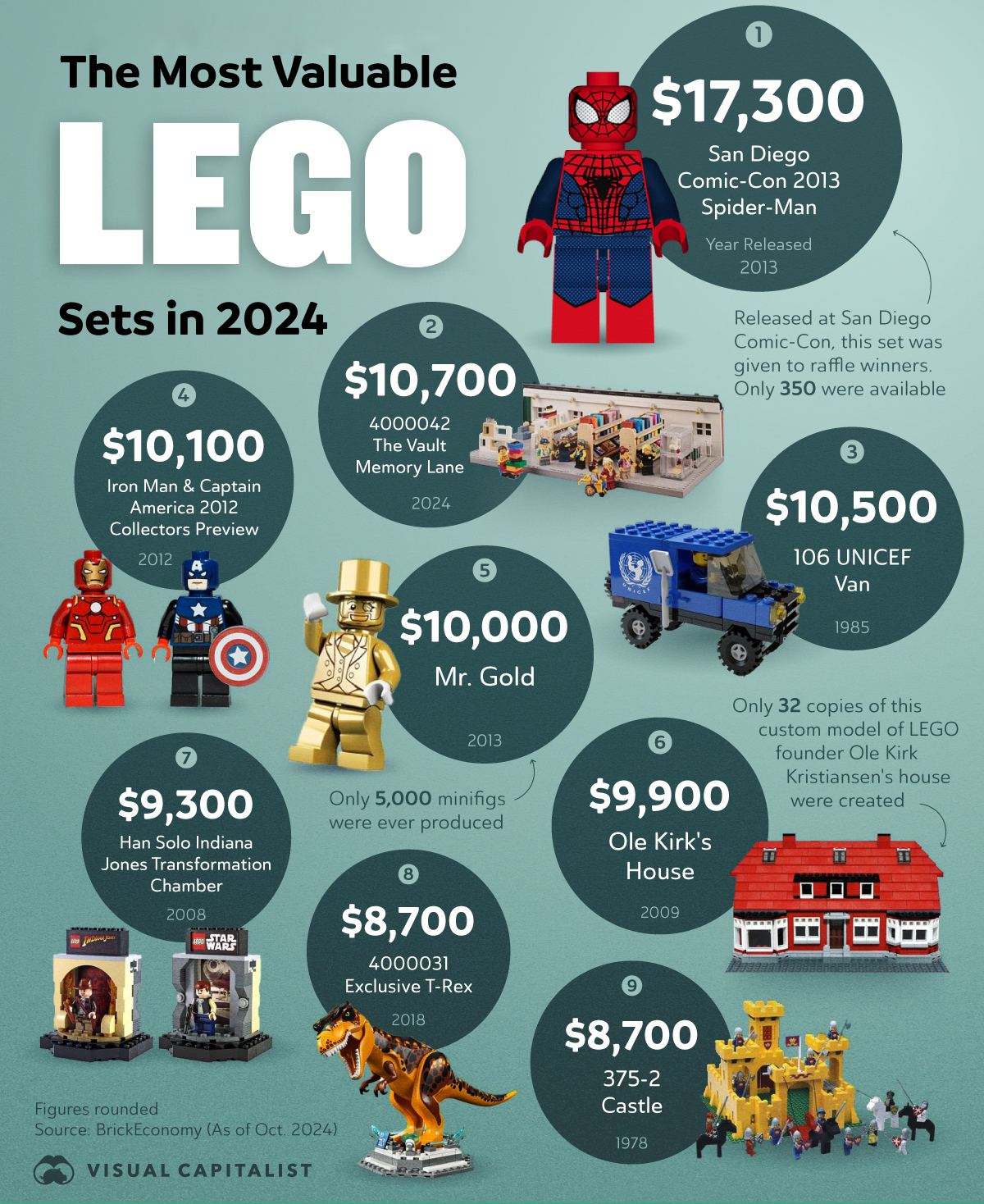
The Ultimate Grail: The Star Wars Millennium Falcon (10179)
If there is a “Blue Chip” stock in the world of LEGO investing, it is undoubtedly the 2007 Ultimate Collector Series (UCS) Millennium Falcon, set 10179. For years, this set has held the crown as the most sought-after piece in any portfolio, representing the pinnacle of large-scale, high-complexity LEGO engineering.
Why Scarcity Drives Valuation
The value of the 10179 Millennium Falcon is rooted in its unique place in the market. Released when the LEGO Group was in the midst of a business turnaround, this set was produced in limited numbers compared to modern standards. Because it was incredibly expensive at the time of its release—retailing for $499—fewer units were sold to the general public. As demand for high-end Star Wars collectibles surged, the secondary market price for a sealed-in-box (MISB) 10179 skyrocketed, often fetching anywhere from $5,000 to $10,000 depending on the condition and the “First Edition” certificate status.
The Impact of Re-releases
Market analysts often point to the 2017 re-release of the Millennium Falcon (set 75192) as a fascinating case study in market dynamics. Conventional wisdom in finance suggests that a re-release should crash the price of the original. However, the original 10179 maintained much of its value because it became a historical artifact. Collectors prioritize the “First Edition” stamp and the original box art, proving that in the world of collectibles, provenance and historical timeline are just as important as the physical build.
Factors That Determine Long-Term Financial Appreciation
Investing in LEGO is not as simple as buying every box that hits the shelves. To understand why a set becomes “the most valuable,” one must look at the financial levers that influence the secondary market. A set is essentially a commodity, and its value is dictated by the fundamental laws of supply and demand.
The “Retired” Status and Production Cycles
The most critical factor for any investor is the “End of Life” (EOL) date. LEGO sets have a finite production run, usually lasting between 12 to 24 months. Once a set is retired, the supply becomes fixed. If a set is popular, licensed, and features exclusive “minifigures,” demand continues to climb while the supply remains static. This imbalance creates the premium prices seen on platforms like eBay and BrickLink.
Licensing and Intellectual Property
LEGO sets tied to major intellectual properties—specifically Star Wars, Marvel, and DC Comics—tend to appreciate faster than original LEGO themes like City or Friends. The crossover appeal of these sets reaches beyond the core LEGO community into the broader world of pop-culture enthusiasts. When a set carries a high-profile brand, it inherits the brand equity of that franchise. For instance, a rare Star Wars set appeals to both brick-builders and cinema memorabilia collectors, effectively doubling the potential buyer pool and creating price support.
The “Minifigure” Multiplier
In many cases, the value of a set is derived almost entirely from the included minifigures. This is particularly true for rare promotional sets or limited-run figures. Investors look for sets that contain exclusive, high-detail figures that will never be produced again. Even if the build itself is modest, the presence of a “grail” figure can turn a $100 set into a $1,000 asset. This mirrors the collector’s market for trading cards, where the rarity of a specific character creates a price floor for the entire product line.

Portfolio Diversification: Beyond the Grail
While the Millennium Falcon holds the top spot for historical prestige, savvy investors look for sets that offer the best return on investment (ROI) relative to their initial cost. Value is not just about the absolute highest price; it is about the percentage growth over time.
Modular Buildings and Architectural Appeal
The “Modular Building” series is a favorite for long-term investors. These sets, which include buildings like the Grand Emporium, the Palace Cinema, and the modular townhouses, are bought by collectors who want to create a cohesive cityscape. Because collectors often need the entire series to complete their display, the demand for older, retired buildings remains consistently high. These sets provide a reliable, predictable appreciation profile that is less volatile than the speculative high-end Star Wars market.
Sealed vs. Used Assets
From a financial perspective, the condition of the asset is the single largest variable in its valuation. An “Open/Used” set is typically worth significantly less than a “New in Sealed Box” (NISB) set. Serious investors store their assets in climate-controlled environments, shielded from sunlight, moisture, and temperature fluctuations, which can degrade the integrity of the box and the color of the bricks. The “Mint” status of a LEGO box is equivalent to a high grade on a comic book or a perfect score on an action figure’s blister pack.
Risks and Financial Considerations
No investment is without risk, and LEGO is no exception. While the historical data is impressive, there are structural headwinds that investors must consider before allocating capital.
Storage Costs and Liquidity
Unlike a digital stock portfolio, LEGO sets are physical assets that take up space. Storage costs—such as rent for a climate-controlled unit or the loss of space in one’s home—must be factored into the total return. Furthermore, liquidity is lower than that of the stock market. You cannot sell a LEGO collection instantly at market price; you must find a buyer, negotiate shipping, and pay platform fees on sites like StockX or eBay, which can eat into your profit margins.
The “Bubble” Phenomenon
As more people recognize LEGO as a viable investment vehicle, the market becomes more crowded. Increased competition for new releases can lead to overvaluation, where sets are priced for “perfect” returns that may never materialize. Investors must be wary of “flipping” trends. If too many people buy a set thinking it will be the next Millennium Falcon, the market becomes saturated with sealed boxes, preventing the scarcity required for significant price appreciation once the set retires.
Market Volatility and Changing Tastes
The LEGO Group is a business that monitors its own secondary market. They have occasionally re-released popular retired sets or updated versions of classic models. This “re-issue risk” is the biggest threat to a collector’s portfolio. Additionally, the popularity of specific themes can wane. A trend that is massive today may not hold the same cultural cachet in ten or twenty years, which can flatten the value of a collection over the long run.
Final Assessment: The Path to Smart Investing
Ultimately, the most valuable LEGO set is a combination of design excellence, cultural importance, and artificial scarcity. While the 10179 Millennium Falcon remains the undisputed king, the true value for an investor lies in identifying the “hidden gems”—sets that are currently overlooked but possess the characteristics of a future classic.
To be successful, one must adopt a professional mindset, treating each LEGO set as a discrete financial asset. This involves diligent record-keeping, an understanding of macro-economic demand for pop culture, and a long-term horizon. When treated with the same discipline as any other alternative asset class, LEGO investing offers a unique combination of joy and capital appreciation, proving that even a box of plastic bricks can be a powerful tool for building financial security.
aViewFromTheCave is a participant in the Amazon Services LLC Associates Program, an affiliate advertising program designed to provide a means for sites to earn advertising fees by advertising and linking to Amazon.com. Amazon, the Amazon logo, AmazonSupply, and the AmazonSupply logo are trademarks of Amazon.com, Inc. or its affiliates. As an Amazon Associate we earn affiliate commissions from qualifying purchases.