
The mechanics of plate tectonics represent the fundamental engine driving the geological evolution of our planet. While many are familiar with the concept of continental drift, the specific forces that facilitate the movement of these massive lithospheric plates are often misunderstood. Among these primary drivers, “ridge push” stands out as a critical gravitational force. To understand ridge push, one must look toward the mid-ocean ridges—the underwater mountain ranges where new crust is birthed—and examine how the inherent elevation of these ridges exerts a horizontal force on the surrounding tectonic plates.
The Geological Foundation of Ridge Push
At its core, ridge push is a gravitational process rather than a mechanical “push” in the traditional sense of a piston or a physical ram. It is intrinsically linked to the thermal structure of the Earth’s mantle and the formation of the oceanic lithosphere.
The Thermal Gradient of Mid-Ocean Ridges
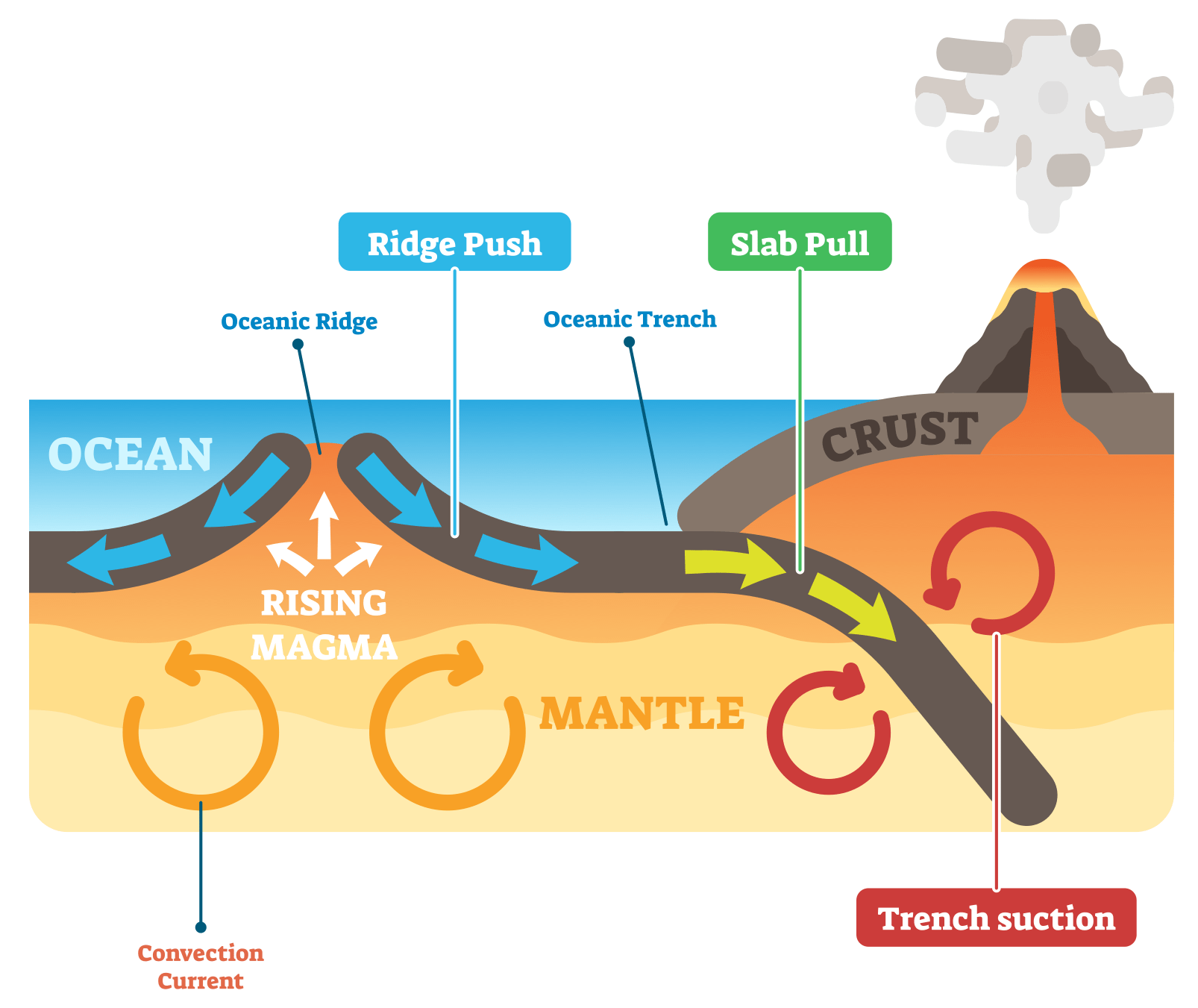
Mid-ocean ridges are formed at divergent plate boundaries. As mantle material rises to fill the gap created by separating plates, it undergoes decompression melting, creating new basaltic oceanic crust. Because this newly formed crust is extremely hot, it is less dense and therefore more buoyant than the older, cooler, and denser oceanic crust located further away from the ridge. This difference in temperature causes the crust to sit at a higher elevation, creating an elevated ridge topography that rises several kilometers above the surrounding abyssal plains.
Gravity and the Slope Effect
As the oceanic lithosphere moves away from the ridge axis, it gradually cools. As it cools, the material becomes denser and sinks deeper into the mantle, creating a gentle slope that extends away from the ridge. Gravity acts on this slope, pulling the lithosphere downward and outward. While the slope is very gradual, the sheer mass of the oceanic plate is enormous. The cumulative effect of this gravitational slide is what geologists define as ridge push. It is the downward force resulting from the elevated position of the mid-ocean ridge that effectively pushes the tectonic plate toward subduction zones.
Ridge Push within the Broader Tectonic Engine
To fully comprehend the significance of ridge push, it must be placed within the context of the total forces acting upon a tectonic plate. Ridge push does not operate in a vacuum; it acts in concert with other mechanisms, most notably slab pull.
The Debate Over Driving Forces
For decades, geophysicists have debated the relative contributions of ridge push versus slab pull. Slab pull occurs at convergent boundaries where a cold, dense tectonic plate sinks into the mantle. As the heavy slab descends, it creates a powerful downward tug that pulls the rest of the plate along with it. Modern geophysical models suggest that while slab pull is generally the dominant force in plates attached to subducting slabs, ridge push acts as a consistent, secondary driver that maintains the outward momentum of the plates.
Dynamic Interaction with Convection Currents
Beyond slab pull and ridge push, mantle convection serves as the underlying current of the system. While early theories suggested that plates were simply “dragged” along by convection cells in the mantle—much like a conveyor belt—modern science views the relationship as more complex. The plate is an active participant in the thermal system. The weight of the ridge and the pull of the slab regulate the speed at which these plates travel. If ridge push were to cease, the equilibrium of the plate system would be fundamentally altered, likely slowing the rate of seafloor spreading and changing the global distribution of seismic activity.

The Mathematical and Physical Implications
The magnitude of ridge push is not arbitrary; it can be quantified through physical principles related to the density structure of the lithosphere.
Calculating Gravitational Potential Energy
The force exerted by ridge push can be calculated by assessing the gravitational potential energy of the cooling oceanic lithosphere. By integrating the density profile of the plate from the ridge axis to the distant ocean floor, scientists can determine the net force pushing the plate horizontally. This calculation reveals that ridge push is directly proportional to the age of the oceanic lithosphere. As a plate ages and becomes cooler and denser, the “height” of the ridge relative to the surrounding sea floor increases, thereby increasing the gravitational potential energy and the resulting ridge push force.
Limitations and Constraints
While ridge push is a powerful contributor to plate motion, its effectiveness is limited by the resistance it encounters. The motion of a plate is not frictionless; it must overcome “basal drag,” the resistance offered by the asthenosphere (the semi-plastic layer beneath the lithosphere). Furthermore, the interaction between ridges and transform faults can dissipate some of the horizontal stress. Understanding these constraints is essential for computer modeling of plate movement. If researchers only account for ridge push without factoring in the frictional resistance of the underlying mantle, the resulting simulations would predict plate speeds far higher than those observed in nature.
Geopolitical and Scientific Significance
The study of ridge push extends beyond purely academic interest. By understanding how these forces shift the Earth’s surface, scientists can better predict long-term geological changes that impact global infrastructure and safety.
Implications for Seismic Forecasting
Because ridge push exerts significant horizontal stress on tectonic plates, it influences the stress accumulation at plate boundaries. Areas where ridge push is actively driving plates toward continental masses are often characterized by high seismic activity. By mapping the gravitational forces at play, seismologists can develop more accurate models of how stress propagates through the lithosphere. This is vital for regions prone to earthquakes, as it helps define the “stress budget” of a specific fault line.
Understanding Long-Term Climate and Seafloor Evolution
The rate of ridge push directly dictates the rate of seafloor spreading. During periods of rapid seafloor spreading, increased volcanic activity at the ridges releases higher volumes of carbon dioxide and other gases into the atmosphere, potentially driving long-term greenhouse cycles. Conversely, slower ridge push leads to lower volcanic output and distinct cooling patterns. Studying ridge push, therefore, provides a window into the Earth’s deep-time climate history. By analyzing the paleomagnetic records preserved in the seafloor, scientists can reconstruct how the “push” of the ridges has fluctuated over millions of years, offering clues about the ancient atmosphere.

The Future of Tectonic Research
As we move forward into an era of more precise satellite geodesy and deep-sea sensing, our grasp of ridge push continues to evolve. High-resolution bathymetric mapping has allowed us to see the seafloor in unprecedented detail, revealing that the “push” is not always uniform. Variations in mantle temperature, chemical composition of the crust, and the presence of hotspots can all modify the local effectiveness of ridge push.
The synthesis of these factors suggests that ridge push is not a static constant but a dynamic component of a living, breathing planet. It is a reminder that the solid ground beneath our feet is a byproduct of immense, invisible gravitational and thermal forces. By identifying ridge push as a central pillar of plate movement, we gain a deeper appreciation for the interconnectedness of Earth’s interior systems. From the cooling of basaltic rocks miles beneath the surface to the seismic shifts that redefine our continents, ridge push remains a testament to the persistent, transformative power of gravity. Understanding this force is, ultimately, understanding the mechanics of the Earth itself.
aViewFromTheCave is a participant in the Amazon Services LLC Associates Program, an affiliate advertising program designed to provide a means for sites to earn advertising fees by advertising and linking to Amazon.com. Amazon, the Amazon logo, AmazonSupply, and the AmazonSupply logo are trademarks of Amazon.com, Inc. or its affiliates. As an Amazon Associate we earn affiliate commissions from qualifying purchases.