
In the world of precision optics and tactical gear, few innovations have fundamentally transformed the way shooters interface with their environment as much as the red dot sight. Whether utilized for high-stakes defensive applications, competitive shooting sports, or precision hunting, the red dot sight serves as a bridge between human biology and mechanical accuracy. By replacing traditional iron sights—which require the shooter to align a front post, rear notch, and target on three different focal planes—the red dot sight simplifies the aiming process into a single point of reference.
As technology has advanced, these devices have evolved from bulky, tube-style curiosities into miniaturized, ultra-reliable pieces of hardware that sit comfortably atop everything from full-sized battle rifles to compact concealed-carry pistols. Understanding the mechanics, utility, and selection process of these optics is essential for anyone looking to optimize their equipment for performance.

The Engineering and Mechanics of Red Dot Technology
At its core, a red dot sight is a non-magnifying optical device. Unlike a traditional rifle scope that uses complex lens arrangements to bring an image closer, a red dot sight is designed for rapid target acquisition at close to mid-range distances.
How the Optical System Works
The secret behind the red dot sight lies in its internal LED emitter and the spherical semi-reflective glass lens. The LED produces a small point of light that is projected onto the internal surface of the front lens. Because the lens is specially coated, it reflects that specific wavelength of light back toward the shooter’s eye, while allowing other light from the environment to pass through clearly.
Because the light is projected as a collimated beam, the red dot appears to be floating at the same distance as the target. This eliminates the need for “eye relief”—the specific distance your eye must be from the optic—that is common in magnified scopes. As long as the shooter can see the red dot superimposed on the target, the point of impact remains consistent, regardless of where the shooter’s eye is positioned relative to the center of the lens.
Parallax and Focal Plane Advantage
One of the most significant engineering benefits of a high-quality red dot sight is the reduction of parallax error. Parallax occurs when the target image and the aiming reticle are not on the same focal plane; if your eye shifts slightly behind a traditional scope, the reticle may appear to move, leading to inaccuracy. Because the red dot is projected at infinity, the dot remains aligned with the bore of the firearm even if the shooter’s head position is not perfectly centered. This feature is a game-changer during high-stress scenarios where a perfect “cheek weld” or textbook sight alignment is not always possible.
Types of Red Dot Sights: Reflex vs. Holographic
While the term “red dot” is often used as a catch-all, there are two distinct categories of technology that dominate the market: reflex sights and holographic sights. While they serve the same function, their underlying tech differs significantly.
Reflex Sights
Reflex sights are the most common form of red dot optic. They rely on the LED emitter system described above. They are generally categorized into two subtypes:
- Tube Sights: These look like small telescopes. They are robust, offer excellent protection for the internal electronics, and are often compatible with various mounts and magnifiers.
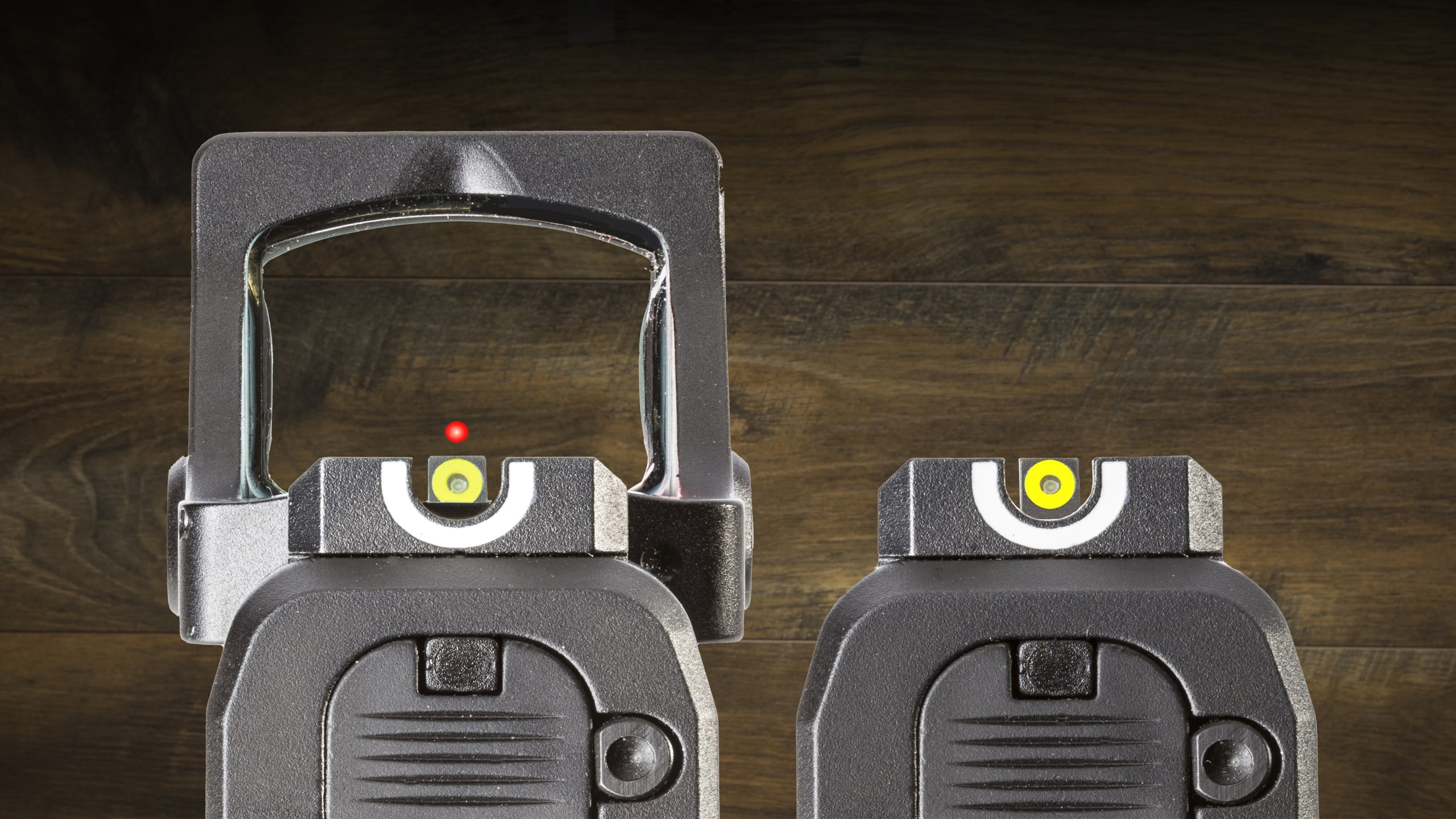
- Open Reflex Sights: These consist of a single glass lens with an emitter mounted at the base. They are lighter and have a smaller footprint, making them the preferred choice for modern micro-pistols.
Reflex sights are prized for their extreme battery efficiency. Because they use a low-power LED, many modern units can remain powered on for three to five years on a single battery, making them “always-ready” for home defense.
Holographic Sights
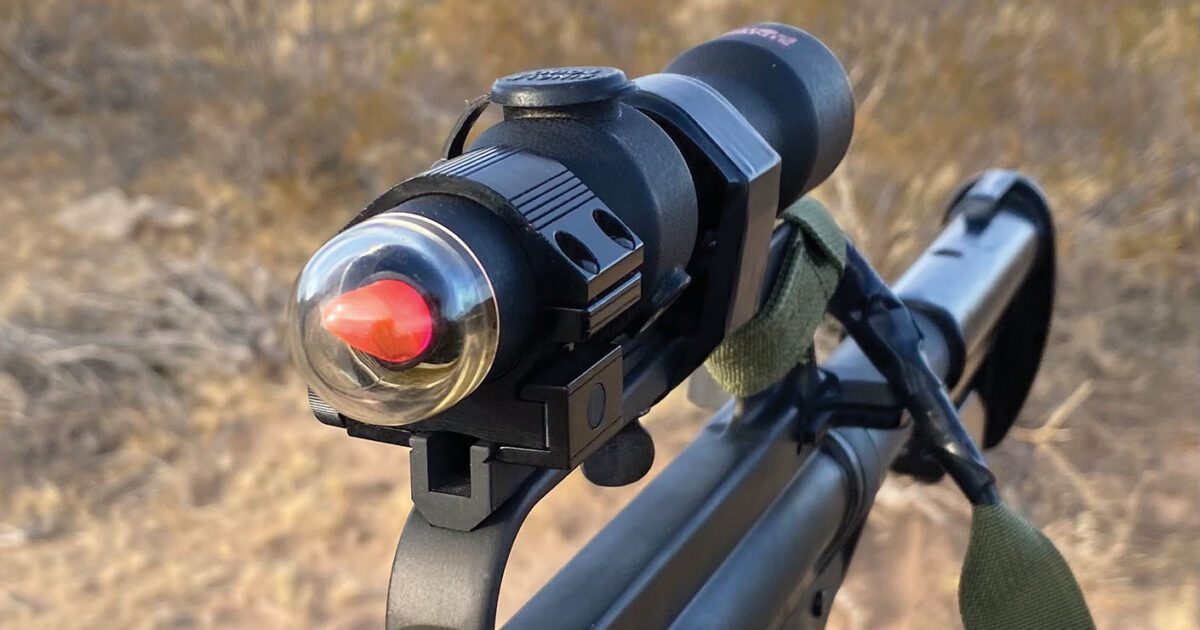
Holographic weapon sights (HWS) operate on a different principle. Instead of an LED emitter, they use a laser to illuminate a holographic reticle recorded onto a piece of film within the sight’s housing. When the shooter looks through the sight, the laser reconstructs the image of the reticle.
The primary advantage of holographic technology is clarity. Because the reticle is holographic, it remains crisp even under night vision or if the front lens becomes partially obstructed by dirt or mud. Additionally, the reticle is perceived to be at a further distance than a reflex dot, which some shooters find helps with depth perception. However, this increased technical complexity usually results in higher power consumption and a physically larger, heavier optic.
The Tactical and Practical Utility of Electronic Optics
The transition from iron sights to red dots represents a move toward biological optimization. When humans are under stress, our natural tendency is to lose fine motor control and prioritize “target fixation”—the instinct to stare at the threat.
Speed and Target Acquisition
Iron sights require the brain to process three distinct distances: the rear sight, the front sight, and the target. This is cognitively taxing and physically slow. A red dot sight requires the shooter to focus only on the target, simply “placing” the dot where they want the impact to occur. This drastically reduces the time between identifying a target and delivering an accurate shot.
Shooting with Both Eyes Open
Because the red dot allows for a non-magnified view that maintains the shooter’s natural depth perception, it is designed for both-eyes-open operation. This is crucial for situational awareness. When shooting with one eye closed, a significant portion of the user’s peripheral vision is lost. By keeping both eyes open, the shooter maintains full awareness of their surroundings, identifying potential threats or obstacles that might have otherwise remained hidden.
Versatility in Lighting Conditions
The human eye is poorly adapted to seeing black iron sights against dark backgrounds in low light. Red dot sights feature adjustable brightness settings, allowing the shooter to tailor the intensity of the dot to the ambient light. Whether in the bright noon sun or a dimly lit hallway, the red dot remains visible and distinct, providing a level of contrast that traditional sights simply cannot match.
Considerations for Implementation and Maintenance
Integrating a red dot sight into a firearm setup requires more than just bolting a device onto a rail. Reliability and training are the final pillars of effective use.
Mounting and Co-Witnessing
For tactical applications, the concept of “co-witnessing” is vital. This is the practice of mounting the red dot at a height where the iron sights are still visible through the lower portion of the optic lens. In the unlikely event of an electronic failure, the shooter can simply transition to their backup iron sights without needing to remove the optic.
Battery Life and Durability
Modern optics manufacturers have pushed the boundaries of durability, with many sights now rated for thousands of rounds of recoil and extreme environmental conditions, including being submerged in water. However, the user must still maintain the device. Routine inspection of battery compartments, lens cleaning with proper optical solutions, and verifying the optic’s “zero”—the point where the dot aligns with the projectile’s impact—are standard maintenance procedures.
The red dot sight is no longer a luxury for elite military units or competitive shooters; it is a fundamental technological evolution in the realm of shooting sports and defense. By simplifying the aiming process and allowing the shooter to maintain focus on the target, these devices offer a level of precision and speed that is unattainable with traditional methods. Whether choosing a lightweight reflex sight for a concealed carry handgun or a rugged holographic sight for a patrol rifle, the red dot sight stands as an essential tool for the modern marksman.
aViewFromTheCave is a participant in the Amazon Services LLC Associates Program, an affiliate advertising program designed to provide a means for sites to earn advertising fees by advertising and linking to Amazon.com. Amazon, the Amazon logo, AmazonSupply, and the AmazonSupply logo are trademarks of Amazon.com, Inc. or its affiliates. As an Amazon Associate we earn affiliate commissions from qualifying purchases.