
When you delve into the mechanical architecture of an automobile, few components are as critical—or as misunderstood—as the rear differential. Often referred to simply as the “rear diff,” this gearbox is a cornerstone of automotive engineering, serving as the bridge between the engine’s power and the physical movement of the wheels. Whether you are driving a daily commuter, a heavy-duty truck, or a high-performance sports car, the rear differential is the silent workhorse that makes turning, accelerating, and maintaining traction possible.
The Fundamental Purpose of the Rear Differential
At its simplest level, the rear differential is a mechanical assembly located between the rear wheels of a vehicle, connected to the transmission via the driveshaft. To understand why it is necessary, one must consider the physics of a moving car, particularly when navigating a turn.

Solving the Geometry of a Turn
When a vehicle drives around a corner, the outer wheels must travel a greater distance than the inner wheels. If both wheels were locked to a single, solid axle, the inner wheel would be forced to skid or hop to keep up with the outer wheel, leading to immense tire wear, mechanical strain on the driveshaft, and unstable handling. The differential solves this by allowing the rear wheels to rotate at different speeds while still receiving power from the engine.
Torque Multiplication and Directional Change
Beyond facilitating turns, the rear differential serves two other primary functions. First, it changes the direction of the rotational energy provided by the driveshaft by 90 degrees to spin the axles. Second, it acts as a final gear reduction. By increasing the torque sent to the wheels, the differential allows the engine to operate efficiently while providing the necessary force to get a heavy vehicle moving from a complete stop.
How a Differential Works: Inside the Gearbox
The internal mechanism of a standard, or “open,” differential is a masterpiece of compact, heavy-duty engineering. It consists of a series of interlocking gears that manage the distribution of rotational force.
The Pinion and Ring Gear
Power enters the differential through the pinion gear, which is connected to the driveshaft. This pinion meshes with a much larger ring gear. The size difference between these two gears provides the gear reduction ratio; a larger ring gear relative to the pinion creates a lower gear ratio, which increases torque at the expense of top speed.
The Spider Gears
Attached to the ring gear is a carrier assembly that houses the “spider gears”—small bevel gears that sit at the heart of the differential. These gears are the key to the differential’s ability to differentiate wheel speeds. When the vehicle is traveling in a straight line, the spider gears remain stationary relative to the carrier, forcing both wheels to rotate at the same speed. As soon as the vehicle turns, the spider gears begin to rotate on their own axes, effectively “stealing” speed from one wheel and adding it to the other to compensate for the difference in travel distance.
Types of Rear Differentials and Their Applications
Not all differentials are built for the same purpose. Depending on the vehicle’s intended use—ranging from off-roading to track racing—manufacturers employ different configurations to optimize performance.
The Open Differential
The open differential is the most common setup in passenger vehicles. It is cost-effective, durable, and smooth for highway driving. However, its primary weakness is its behavior on low-traction surfaces. Because an open differential always sends power to the path of least resistance, if one wheel hits a patch of ice or mud, the engine’s power will be directed entirely to that spinning wheel, leaving the vehicle stuck.
Limited-Slip Differentials (LSD)
To combat the shortcomings of the open differential, engineers developed the Limited-Slip Differential. An LSD uses a clutch pack or gear-based mechanism to detect when one wheel is losing traction. When a significant speed difference is detected, the LSD partially locks the two axles together, ensuring that power is still delivered to the wheel with grip. This is essential for performance cars that need to accelerate out of corners without wasting power on a spinning inside wheel.
Locking Differentials
The “locker” is the gold standard for off-road enthusiasts. A locking differential allows the driver to manually (or automatically) force the differential to lock the two wheels together permanently. This forces both wheels to turn at the exact same speed, regardless of traction. While this makes turning on dry pavement incredibly difficult and destructive, it is invaluable for crawling over rocks or navigating deep sand where both wheels must exert maximum force to keep the vehicle moving forward.
Torque-Vectoring Differentials
In the realm of high-end automotive technology, torque-vectoring differentials represent the cutting edge. These electronic systems use sensors to monitor steering angle, throttle position, and yaw rates to actively distribute torque to specific wheels. By “overdriving” the outside wheel during a corner, the differential can actually help pull the nose of the car into the turn, dramatically improving agility and cornering precision.
Maintenance and Common Issues
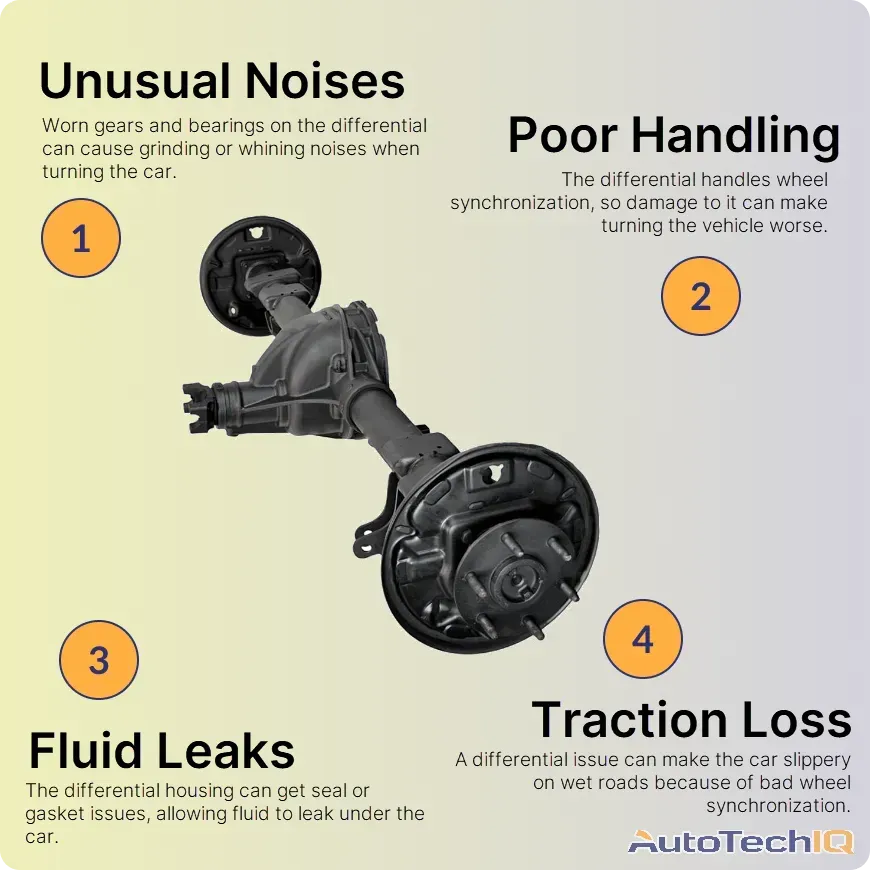
Because the rear differential operates under extreme mechanical pressure and relies on a constant bath of specialized lubricant, it requires consistent maintenance to ensure longevity. Ignoring the rear diff can lead to catastrophic failure, often signified by grinding, whining, or clunking noises.
The Importance of Differential Fluid
Differential fluid is a high-viscosity oil designed to withstand the immense heat and pressure generated by the hypoid gears. Over time, this fluid breaks down, loses its lubricating properties, and collects metal shavings from normal gear wear. Most manufacturers recommend changing this fluid at specific intervals—typically every 30,000 to 60,000 miles. Failing to do so can lead to burnt-out bearings and pitted gear teeth, resulting in a repair bill that far exceeds the cost of a routine fluid swap.
Identifying Problems Early
Drivers should be attentive to the sounds their vehicle makes. A persistent high-pitched whine that changes in volume depending on whether you are accelerating or coasting is a classic sign of gear wear. A clunking noise when you shift into gear or start moving from a stop may indicate worn spider gears or excessive backlash in the carrier assembly. Catching these symptoms early can often save the housing, allowing for a rebuild rather than a complete replacement of the differential unit.

The Future of Differentials in an Electric Age
As the automotive industry pivots toward electric vehicles (EVs), the role of the traditional mechanical rear differential is evolving. Many electric vehicles utilize “electric torque vectoring,” where independent motors drive each rear wheel separately. By eliminating the mechanical differential and driveshaft entirely, engineers can achieve near-instantaneous control over wheel speed, allowing for traction management that is orders of magnitude faster than traditional clutch-based or gear-based systems.
However, even in the EV era, the principles of the differential remain relevant. Some high-performance EVs still utilize a rear-mounted motor integrated with a traditional differential gear set to optimize weight distribution and torque multiplication. The “rear diff” may change its form, but the fundamental requirement—managing rotational force to provide controlled movement—remains a timeless constant in the world of automotive technology. Understanding this component is not just about appreciating a piece of hardware; it is about understanding the very bridge that connects the driver to the road.
aViewFromTheCave is a participant in the Amazon Services LLC Associates Program, an affiliate advertising program designed to provide a means for sites to earn advertising fees by advertising and linking to Amazon.com. Amazon, the Amazon logo, AmazonSupply, and the AmazonSupply logo are trademarks of Amazon.com, Inc. or its affiliates. As an Amazon Associate we earn affiliate commissions from qualifying purchases.