
In the rapidly evolving landscape of digital infrastructure and global networking, acronyms often act as the shorthand for complex technical architectures. Among these, RIC—the Near-Real-Time Radio Access Network Intelligent Controller—has emerged as a foundational element in the deployment of Open Radio Access Networks (Open RAN). As telecommunications providers and tech conglomerates shift toward disaggregated, software-defined ecosystems, understanding the role of the RIC is no longer optional for network engineers, architects, and stakeholders in the telecommunications software space.
The Evolution of the Radio Access Network
To grasp the significance of the RIC, one must first understand the traditional Radio Access Network (RAN). For decades, the RAN was a proprietary, “black box” environment. Telecom operators relied on single-vendor solutions where the hardware and the software were tightly coupled. If an operator purchased radio hardware from one vendor, they were essentially locked into that vendor’s proprietary software stack, management interfaces, and optimization algorithms.

The Shift Toward Open RAN
Open RAN represents a paradigm shift designed to dismantle these vendor silos. By defining open interfaces between components—such as the Radio Unit (RU), the Distributed Unit (DU), and the Centralized Unit (CU)—Open RAN allows operators to mix and match components from different manufacturers. However, this flexibility introduces a new challenge: how to manage, optimize, and orchestrate these disparate pieces of hardware and software in real time. This is where the RIC enters the architecture.
The Strategic Role of the Controller
The RIC acts as the “brain” of the Open RAN. It is a cloud-native software component that sits within the RAN architecture, responsible for controlling and optimizing radio resources. By introducing programmability and intelligence into the network, the RIC transforms the RAN from a rigid, static infrastructure into a dynamic, software-driven asset that can be upgraded through applications rather than hardware swaps.
Architecture and Functional Components of the RIC
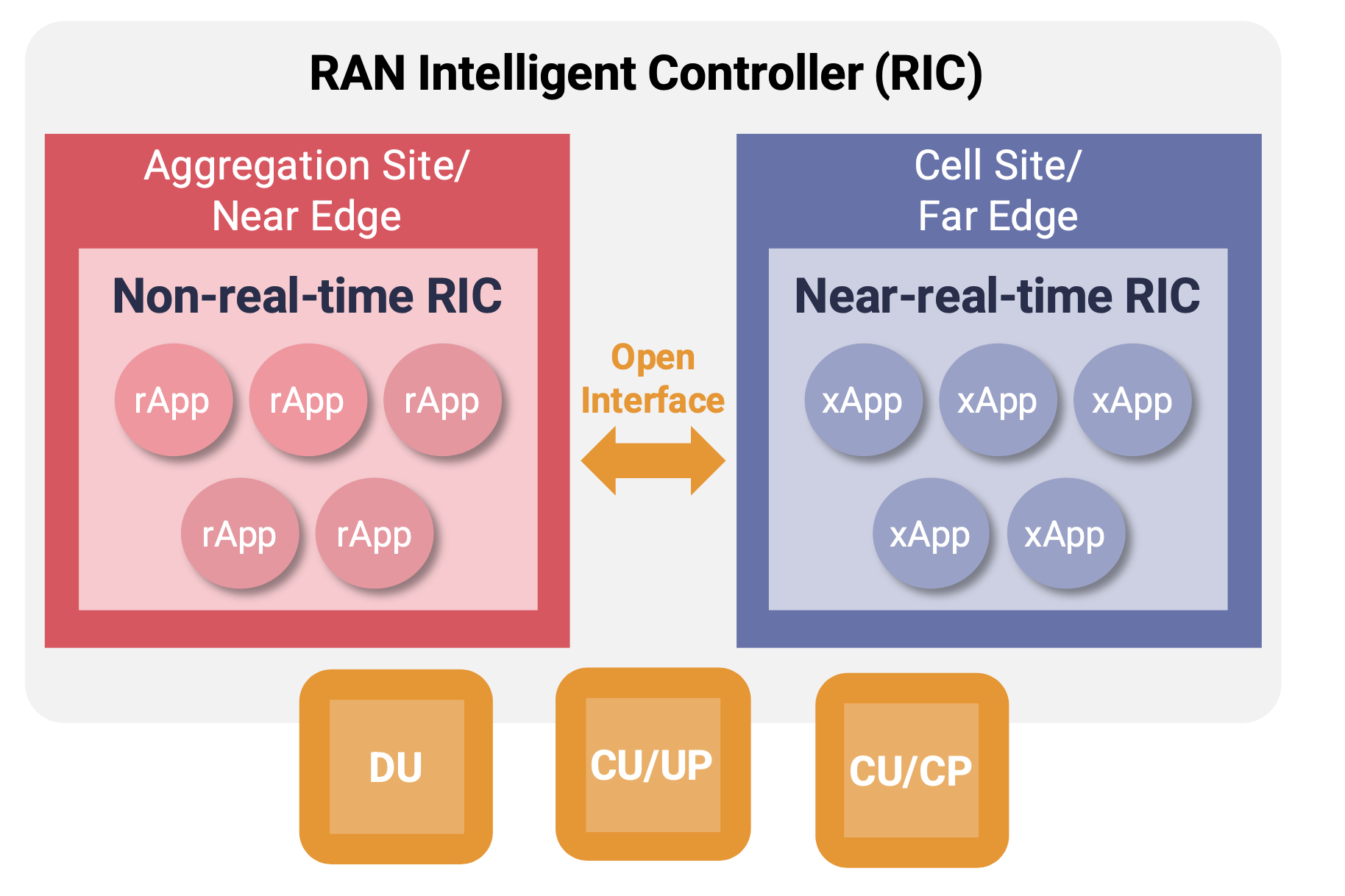
The O-RAN Alliance, the body responsible for defining the technical specifications of Open RAN, categorizes the RIC into two primary functional components: the Near-Real-Time RIC (Near-RT RIC) and the Non-Real-Time RIC (Non-RT RIC). Distinguishing between the two is vital for understanding how modern networks handle everything from millisecond-latency tasks to long-term network modeling.
The Non-Real-Time RIC (Non-RT RIC)
The Non-RT RIC resides within the Service Management and Orchestration (SMO) framework. It operates on a timescale of one second or greater. Its primary function is to provide guidance, policy, and machine learning model training for the rest of the network.
Because it operates outside the strict latency requirements of active radio scheduling, the Non-RT RIC is the ideal environment for AI/ML training. Data is gathered from the network, processed by advanced algorithms, and then pushed back down to the Near-RT RIC as updated policies. It serves as the strategic planning layer, ensuring that the network aligns with long-term business goals, such as energy efficiency or service-level agreement (SLA) adherence.
The Near-Real-Time RIC (Near-RT RIC)
The Near-RT RIC is where the heavy lifting occurs. Operating within a control loop of 10 milliseconds to one second, it is responsible for fine-grained radio resource management. It manages connections, handover decisions, and interference mitigation. By maintaining this lower latency window, the Near-RT RIC can react to changing environmental conditions—such as a user moving rapidly between cells or sudden spikes in traffic demand—almost instantaneously.
The Power of xApps and rApps
The true innovation behind the RIC is its application-centric design. In a traditional network, if an operator wanted to implement a new optimization algorithm, they had to wait for their primary vendor to release a software update—a process that could take months or years. With the RIC, this timeline is slashed.
Understanding xApps
An xApp is a modular software application that runs on the Near-RT RIC. These applications can be developed by third-party software providers, the operator themselves, or traditional network equipment vendors. Because the RIC provides standardized APIs, an xApp can be deployed to optimize a specific slice of the network or solve a localized coverage issue without requiring an overhaul of the entire RAN software stack. For example, an xApp might be designed to prioritize high-definition video streaming traffic or to manage power consumption in a residential zone during off-peak hours.
Understanding rApps
rApps, by contrast, run on the Non-RT RIC. They are generally concerned with broader network optimization and automation that do not require millisecond responses. An rApp might analyze historical congestion data to suggest optimal configuration changes across an entire metropolitan area. The symbiotic relationship between rApps and xApps creates a closed-loop automation system: the rApp performs the long-term analytics, and the xApp executes the resulting policies in real time.
Why the RIC Matters for the Future of Connectivity
The introduction of the RIC is not merely a technical upgrade; it is an economic and operational evolution. As we move toward 6G and the maturation of 5G, the complexity of networks will only increase.
Accelerating Innovation and Vendor Diversity
By decoupling software from hardware, the RIC lowers the barrier to entry for smaller, specialized software firms. This competition drives down costs and fosters innovation. Operators are no longer at the mercy of a “one-size-fits-all” software suite; they can select the best-of-breed applications for their specific network needs. If a startup develops a revolutionary AI-based algorithm for spectrum efficiency, an operator can integrate that xApp into their RIC within weeks.
AI and Machine Learning Integration
The RIC is arguably the most significant enabler of Artificial Intelligence in mobile networking. Traditionally, AI in telecommunications was limited by the hardware’s inability to support high-compute models at the edge. The cloud-native architecture of the RIC allows for the integration of sophisticated ML models directly into the radio management path. This enables “self-healing” networks that can predict faults before they occur and “self-optimizing” networks that adjust to traffic patterns in real time without human intervention.
Energy Efficiency and Sustainability
Global network energy consumption is a major concern for mobile network operators. The RIC provides the granular control necessary to implement aggressive power-saving measures. Through xApps, a network can intelligently “sleep” radio resources during periods of low usage, powering them back on in milliseconds when demand resurfaces. This level of precision was historically impossible, as the power-management cycles were too coarse and the risk of dropped connections was too high. With the RIC, operators can align their network performance with green initiatives, significantly reducing their carbon footprint while maintaining high-quality user experiences.

The Path Forward for Telecom Infrastructure
As the telecommunications industry continues to lean into virtualization, the RIC stands as the gateway to a more agile, programmable future. While the transition to an Open RAN architecture presents challenges—including the integration of complex multi-vendor software and the need for new security protocols—the benefits provided by the RIC are undeniable.
By shifting from fixed, proprietary systems to open, software-defined controllers, the industry is creating a foundation where connectivity is treated as a programmable resource. Whether it is through the deployment of custom xApps for unique enterprise use cases or the use of rApps for global network management, the RIC is the definitive component that allows the RAN to keep pace with the demands of a digital-first world. As we look toward the horizon of 6G, the RIC will likely evolve further, absorbing more advanced cognitive functions and cementing its status as the heartbeat of the future wireless ecosystem. For professionals in the software and telecom sectors, the mastery of RIC-based architectures is becoming a foundational skill, essential for those navigating the next decade of digital infrastructure development.
aViewFromTheCave is a participant in the Amazon Services LLC Associates Program, an affiliate advertising program designed to provide a means for sites to earn advertising fees by advertising and linking to Amazon.com. Amazon, the Amazon logo, AmazonSupply, and the AmazonSupply logo are trademarks of Amazon.com, Inc. or its affiliates. As an Amazon Associate we earn affiliate commissions from qualifying purchases.