
Investing in individual stocks, especially those of globally recognized companies like Apple (AAPL), can be an exciting prospect for many aspiring investors. The allure of owning a piece of a technology giant that has consistently shaped consumer culture and delivered robust financial performance is powerful. However, navigating the world of stock market investing requires a clear understanding of the process, the underlying principles, and the potential risks involved. This comprehensive guide will demystify the steps to investing in Apple stock, offering insights into strategic considerations and practical execution within the realm of personal finance and investment management.
Understanding Apple Stock as an Investment
Before diving into the mechanics of buying shares, it’s crucial to understand what investing in Apple stock entails and why it might be an attractive option for your portfolio. This foundational knowledge helps in making informed decisions and aligning your investment with your financial goals.
Why Consider Apple (AAPL)?
Apple Inc. (AAPL) stands as one of the most valuable companies globally, renowned for its innovative products, strong brand loyalty, and significant market capitalization. From an investment perspective, its consistent revenue growth, substantial free cash flow, and ability to generate significant profits are often cited as key strengths. The company’s ecosystem – encompassing hardware (iPhones, Macs, iPads), software (iOS, macOS), and services (App Store, Apple Music, iCloud) – creates a powerful network effect that enhances customer retention and drives recurring revenue. Investors often look to Apple for its potential for long-term capital appreciation and, increasingly, its consistent dividend payments, which can contribute to overall returns. However, like any investment, it’s not without its risks, including market competition, regulatory scrutiny, and dependence on consumer spending trends.
The Basics of Stock Ownership
When you invest in Apple stock, you are purchasing shares, which represent a tiny fraction of ownership in the company. As a shareholder, you become a part-owner and may be entitled to certain rights, such as voting on corporate matters (though this is often minimal for individual retail investors) and receiving dividends if the company declares them. The value of your investment fluctuates with the stock price, which is influenced by a myriad of factors including company performance, industry trends, economic conditions, and overall market sentiment. Understanding that stock ownership is a claim on future earnings and assets, rather than just a number on a screen, is fundamental to a sound investment philosophy.
Risks and Rewards of Investing in Individual Stocks
Investing in individual stocks like Apple offers the potential for higher returns compared to more diversified options like index funds, but it also comes with increased risk. The primary reward is capital appreciation – the increase in the stock’s price over time – and potential dividend income. If Apple continues to innovate and grow, your investment could see significant gains.
However, the risks are equally significant. An individual stock carries company-specific risk; poor management decisions, product failures, or competitive pressures could negatively impact Apple’s stock price, irrespective of broader market performance. Furthermore, market volatility can cause even fundamentally strong stocks to experience sharp downturns. Diversification, which means spreading your investments across various assets, industries, and geographies, is a critical strategy to mitigate these inherent risks, preventing a single stock’s poor performance from devastating your entire portfolio.
Essential Steps to Investing in Apple Stock
Once you understand the basic premise of investing in Apple, the next logical step is to navigate the practical aspects of making the investment. This involves setting up the right accounts and executing your first trade.
Open a Brokerage Account
The first and most critical step to buying Apple stock is to open a brokerage account. A brokerage account is a specialized investment account offered by a financial institution that allows you to buy and sell stocks, bonds, mutual funds, ETFs, and other investment products. When choosing a brokerage, consider factors such as:
- Fees: Look for commission-free stock and ETF trading, which is standard with many online brokers today.
- Platform Features: Evaluate the ease of use, availability of research tools, mobile app functionality, and educational resources.
- Customer Service: Assess the responsiveness and quality of support offered.
- Account Minimums: Many brokers have no minimum to open an account, making them accessible to investors with various starting capital.
Popular online brokers include Charles Schwab, Fidelity, Vanguard, E*TRADE, and Robinhood, among others. You’ll typically need to provide personal information, including your Social Security number, address, and employment details, to comply with regulatory requirements. You can choose between a taxable brokerage account or a tax-advantaged retirement account like an Individual Retirement Account (IRA) if you’re investing for retirement.
Fund Your Account
After opening your brokerage account, you’ll need to transfer money into it before you can purchase any shares. Common methods for funding include:
- Electronic Funds Transfer (ACH): This is the most common method, allowing you to link your bank account for free transfers, though it may take a few business days for funds to become available for trading.
- Wire Transfer: Faster than ACH but often incurs fees.
- Check Deposit: A slower method, requiring mail delivery and processing time.
- Account Transfer: If you’re transferring investments from another brokerage, this process can take several weeks.
Ensure you have sufficient funds to cover the purchase price of the shares you intend to buy, plus any potential transaction fees (though these are rare for individual stock purchases today).
Placing Your Order
With your account funded, you’re ready to buy Apple stock. You’ll log into your brokerage account, search for Apple using its ticker symbol, AAPL, and initiate a trade. Key decisions you’ll make at this stage include:
- Number of Shares: Decide how many shares you want to buy. If you have limited capital, many brokers now offer fractional share investing, allowing you to buy a portion of an Apple share for as little as $1. This makes investing in high-priced stocks more accessible.
- Order Type:
- Market Order: Instructs your broker to buy Apple stock immediately at the best available current price. While simple, the exact price you pay may differ slightly from what you saw moments before, especially in fast-moving markets.
- Limit Order: Allows you to specify the maximum price you’re willing to pay per share. Your order will only execute if the stock price drops to or below your specified limit. This offers more control over your purchase price but there’s no guarantee the order will fill if the stock doesn’t reach your limit.
For most beginners, a market order is sufficient for an initial purchase, assuming the stock isn’t experiencing extreme volatility. Always double-check your order details before confirming.
Understanding Trading Hours and Settlement
The U.S. stock markets (NYSE and NASDAQ, where Apple is listed) typically operate from 9:30 AM to 4:00 PM Eastern Time, Monday through Friday, excluding holidays. You can place orders outside these hours, but they will generally be queued for execution when the market reopens. After your order is executed, there’s a “settlement” period, typically two business days (T+2), during which the ownership of the shares officially transfers to your account and the cash is debited. While you can often sell immediately, understanding the settlement process is important for certain advanced strategies or for withdrawing funds.
Investment Strategies for Apple Stock
Simply buying Apple stock is just the beginning. A thoughtful investment strategy is crucial for optimizing returns and managing risk over the long term.
Long-Term vs. Short-Term Investing
The approach you take to investing in Apple stock will largely depend on your financial goals and risk tolerance.
- Long-Term Investing (Buy and Hold): This strategy involves buying shares with the intention of holding them for several years, often decades. Long-term investors in Apple typically believe in the company’s sustained growth potential, its ability to innovate, and its resilience through various economic cycles. They tend to ride out short-term market fluctuations, focusing on the company’s fundamental performance. This approach aligns well with growth investing, where the focus is on companies expected to grow earnings and revenues faster than the overall market.
- Short-Term Investing/Trading: This involves buying and selling stocks within days, weeks, or months to profit from price swings. While some traders may target Apple due to its liquidity and volatility, short-term trading is significantly riskier, requires extensive market knowledge, and can incur higher transaction costs (though less so with commission-free trading). It is generally not recommended for novice investors.
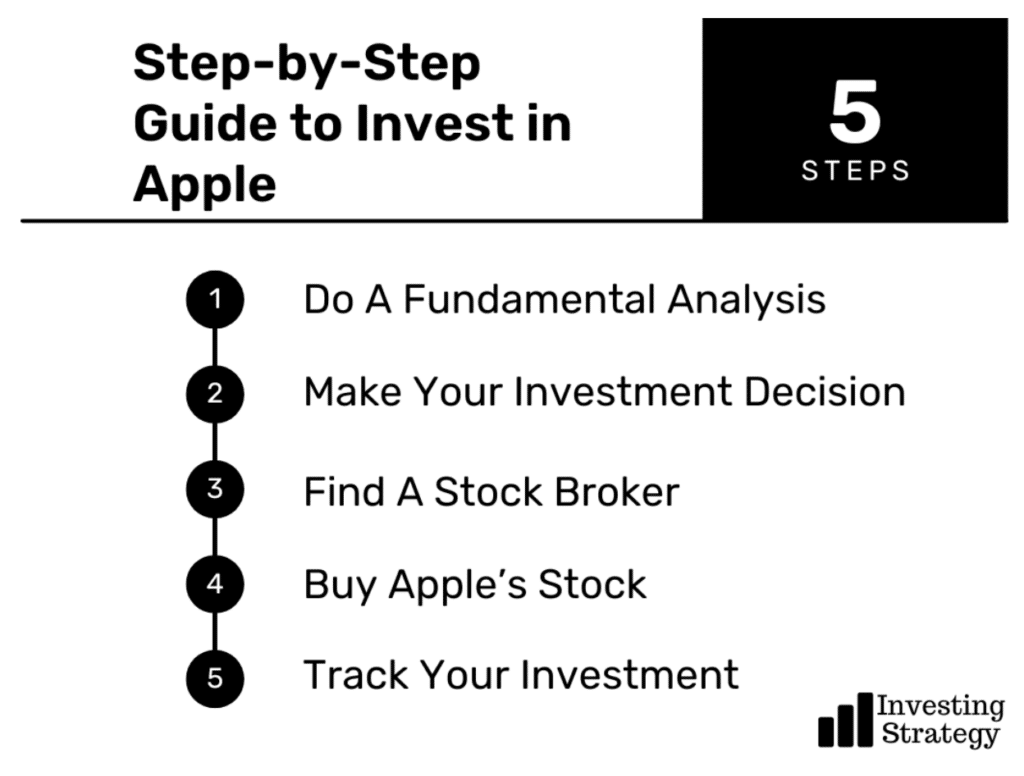
For most individuals seeking to build wealth, a long-term “buy and hold” strategy for a company like Apple is often more prudent and less stressful.
Diversification and Portfolio Management
Even with a strong company like Apple, putting all your investment capital into a single stock is highly risky. Diversification is key to robust portfolio management. By investing in Apple, you are exposed primarily to the technology sector and to the consumer discretionary sector. To diversify, consider:
- Sector Diversification: Invest in companies from different industries (e.g., healthcare, finance, energy, industrials).
- Asset Class Diversification: Combine stocks with other asset classes like bonds or real estate to reduce overall portfolio volatility.
- Geographic Diversification: Invest in companies from various countries to reduce exposure to any single economy.
Apple can be a valuable component of a diversified portfolio, but it should typically represent only a portion of your overall holdings, proportionate to your conviction and risk tolerance.
Dollar-Cost Averaging
Dollar-cost averaging (DCA) is a powerful strategy, especially when investing in individual stocks like Apple. It involves investing a fixed amount of money at regular intervals (e.g., $100 every month) regardless of the stock price. When the price is high, your fixed amount buys fewer shares; when the price is low, it buys more shares. Over time, this strategy helps to average out your purchase price, reducing the risk of making a large investment at an unfavorable peak price. DCA removes emotion from investing, promotes discipline, and can be particularly effective for long-term investors steadily building their position in Apple.
Research and Due Diligence
Successful investing in individual stocks isn’t about guesswork; it’s about informed decision-making. Before and after investing in Apple, engage in continuous research and due diligence:
- Financial Reports: Review Apple’s quarterly and annual reports (10-K and 10-Q filings with the SEC). Pay attention to revenue, earnings, profit margins, debt levels, and cash flow.
- Analyst Ratings and Reports: While not gospel, professional analysts often provide valuable insights into a company’s prospects.
- Company News and Industry Trends: Stay abreast of product launches, competitive landscape changes, regulatory challenges, and broader technology trends that could impact Apple.
- Valuation Metrics: Understand basic valuation metrics like Price-to-Earnings (P/E) ratio, Price-to-Sales (P/S), and dividend yield to gauge whether the stock appears overvalued or undervalued relative to its historical performance and peers.
Thorough research helps you understand the intrinsic value of your investment and gives you conviction to hold through market volatility.
Alternative Ways to Gain Exposure to Apple
Beyond directly buying individual shares, there are other financial instruments that allow investors to gain exposure to Apple’s performance, often with different risk profiles and benefits.
ETFs and Mutual Funds
For investors who prefer a more diversified approach or have limited capital, Exchange Traded Funds (ETFs) and mutual funds can be excellent alternatives. Many technology-focused ETFs and broad market index funds (like those tracking the S&P 500, in which Apple is a significant component) hold Apple stock as one of their top holdings.
- ETFs: Traded like individual stocks, offering diversification and often lower expense ratios than actively managed mutual funds.
- Mutual Funds: Professionally managed portfolios of stocks, bonds, or other investments. They offer diversification and convenience, though often with higher fees.
Investing in an ETF or mutual fund that includes Apple allows you to participate in its growth while simultaneously diversifying your investment across many other companies, thereby reducing company-specific risk. This can be a particularly appealing option for beginners.
Options Trading
Options trading provides another, albeit more complex and riskier, way to gain exposure to Apple’s stock movements. Options contracts give the holder the right, but not the obligation, to buy (call option) or sell (put option) a stock at a specified price before a certain date. While options can offer leverage and potentially higher returns, they also come with a significant risk of losing your entire investment quickly, especially for novice traders. Due to their complexity and speculative nature, options are generally not recommended for investors new to the stock market or those with a low-risk tolerance.
Dividend Reinvestment Plans (DRIPs)
Apple pays a quarterly dividend to its shareholders. Many brokerage accounts offer a Dividend Reinvestment Plan (DRIP) option. With a DRIP, instead of receiving cash dividends, the money is automatically used to purchase more shares or fractional shares of Apple stock. This strategy allows you to compound your returns over time, accelerating your ownership without needing to manually invest additional capital. It’s a hands-off approach to growing your investment.
Managing Your Apple Investment and Beyond
Investing is an ongoing process, not a one-time event. Effective management of your Apple stock and overall portfolio requires continuous attention and a forward-looking perspective.
Monitoring Your Investment
Regularly monitor the performance of your Apple stock, but avoid obsessing over daily fluctuations. Focus on the company’s fundamental health, earnings reports, strategic announcements, and relevant industry news. Use the research tools provided by your brokerage or reputable financial news sources. Understanding why the stock is moving is more important than simply knowing how much it moved.
Tax Implications
Understanding the tax implications of your investments is crucial. When you sell Apple stock for a profit, you’ll incur capital gains taxes. The rate depends on how long you held the stock:
- Short-Term Capital Gains: For stocks held one year or less, these are taxed at your ordinary income tax rate.
- Long-Term Capital Gains: For stocks held longer than one year, these are taxed at preferential lower rates (typically 0%, 15%, or 20% depending on your income).
Dividends received from Apple are also subject to income tax, either as qualified dividends (taxed at long-term capital gains rates) or non-qualified dividends (taxed at ordinary income rates). Keep accurate records of your purchases and sales. Always consult with a qualified tax professional to understand your specific tax obligations and opportunities.
Rebalancing Your Portfolio
Over time, the performance of different assets in your portfolio can shift its original allocation. If Apple performs exceptionally well, it might grow to represent an outsized portion of your portfolio, increasing your overall risk. Periodically (e.g., annually or semi-annually), you should review your portfolio and rebalance it to bring it back to your target asset allocation. This might involve selling some of your Apple shares to invest in other underperforming assets or simply stopping new investments into Apple for a period. Rebalancing helps maintain your desired risk level and ensures diversification remains intact.
Continuous Learning in Investing
The financial markets are dynamic, constantly evolving with new products, regulations, and economic forces. Continuous learning is a cornerstone of successful investing. Read financial news, explore educational resources offered by your brokerage, follow reputable financial advisors (with caution), and continually refine your understanding of market dynamics, company analysis, and personal finance strategies. The more you learn, the better equipped you’ll be to make sound investment decisions for your Apple stock and your entire financial future.
Investing in Apple stock can be a rewarding journey for those who approach it with diligence, strategic planning, and a long-term perspective. By understanding the fundamentals, executing the practical steps, and maintaining a disciplined approach, you can effectively integrate Apple into your investment portfolio and work towards your financial aspirations.
aViewFromTheCave is a participant in the Amazon Services LLC Associates Program, an affiliate advertising program designed to provide a means for sites to earn advertising fees by advertising and linking to Amazon.com. Amazon, the Amazon logo, AmazonSupply, and the AmazonSupply logo are trademarks of Amazon.com, Inc. or its affiliates. As an Amazon Associate we earn affiliate commissions from qualifying purchases.