
The Dow Jones Industrial Average (DJIA), often simply referred to as “the Dow,” stands as one of the most widely recognized and frequently cited stock market indices in the world. For over a century, it has served as a critical barometer of the health and direction of the U.S. economy and corporate sector. When investors, journalists, and the general public ask, “What is the highest the Dow Jones has ever been?”, they are not merely seeking a numerical peak; they are delving into the economic narrative of an era, the forces that propelled market surges, and the implications for both seasoned investors and the broader financial landscape. This article will explore the nature of the Dow, trace its historical high points, analyze the underlying drivers of these peaks, and discuss their significance within the context of prudent financial management and investing.

The Dow Jones Industrial Average: A Century of Market Insight
To truly appreciate the significance of the Dow’s highest points, one must first understand what the index represents and how it functions as a snapshot of American industrial strength.
What is the Dow Jones Industrial Average (DJIA)?
The Dow Jones Industrial Average is a stock market index that tracks the performance of 30 large, publicly-traded companies based in the United States. Established in 1896 by Charles Dow, editor of The Wall Street Journal and co-founder of Dow Jones & Company, it was initially designed to measure the performance of the industrial sector of the U.S. stock market. Over time, its composition has evolved significantly, moving beyond heavy industry to include companies from various sectors such as technology, healthcare, and finance, reflecting the changing nature of the American economy. Despite its name, it is no longer purely “industrial” but rather a diverse cross-section of leading companies.
The Dow’s Role as an Economic Barometer
The DJIA’s status as a leading economic indicator stems from the fact that its constituent companies are often bellwethers for their respective industries and the economy at large. When these large, established firms are performing well – increasing profits, expanding operations, and generating shareholder value – it often signals a healthy economic environment. Conversely, sustained declines in the Dow can point to economic headwinds, corporate challenges, or investor uncertainty. While it represents only 30 companies, their sheer size and influence mean their collective performance can offer valuable insights into market sentiment and economic trends.
How the Dow is Calculated (Price-Weighted Average)
Unlike many modern indices that are market-capitalization weighted (where companies with larger market caps have a greater influence), the Dow is a price-weighted average. This means that stocks with higher share prices have a greater impact on the index’s value than those with lower share prices. This methodology has been a point of occasional criticism, as a company with a very high stock price but smaller market capitalization could potentially sway the index more than a massive company with a lower share price. However, adjustments (known as the Dow divisor) are made for stock splits, dividends, and changes in the constituent companies to maintain historical continuity and prevent distortion. Understanding this calculation helps in interpreting the scale of its movements and its historical highs.
Tracing the Dow’s Historic Highs: A Journey Through Economic Eras
The journey of the Dow Jones Industrial Average from its inception to its current levels is a testament to the long-term growth trajectory of the U.S. economy, punctuated by periods of rapid expansion, speculative bubbles, and significant downturns. Each record high often coincides with a unique set of economic conditions and investor sentiment.
Milestones and Market Bubbles
The Dow’s history is replete with remarkable peaks. Early highs in the “Roaring Twenties” preceded the Great Depression. Subsequent recoveries saw new peaks in the post-WWII boom and into the 1960s. More recently, the late 1990s witnessed the “Dot-Com Bubble,” where unprecedented optimism around technology stocks propelled the Dow to then-unseen levels, only to see a significant correction in the early 2000s. These periods of rapid ascent are often characterized by strong economic growth, corporate innovation, and, at times, speculative exuberance that can push valuations beyond fundamental justification.
Navigating Crises and Recoveries
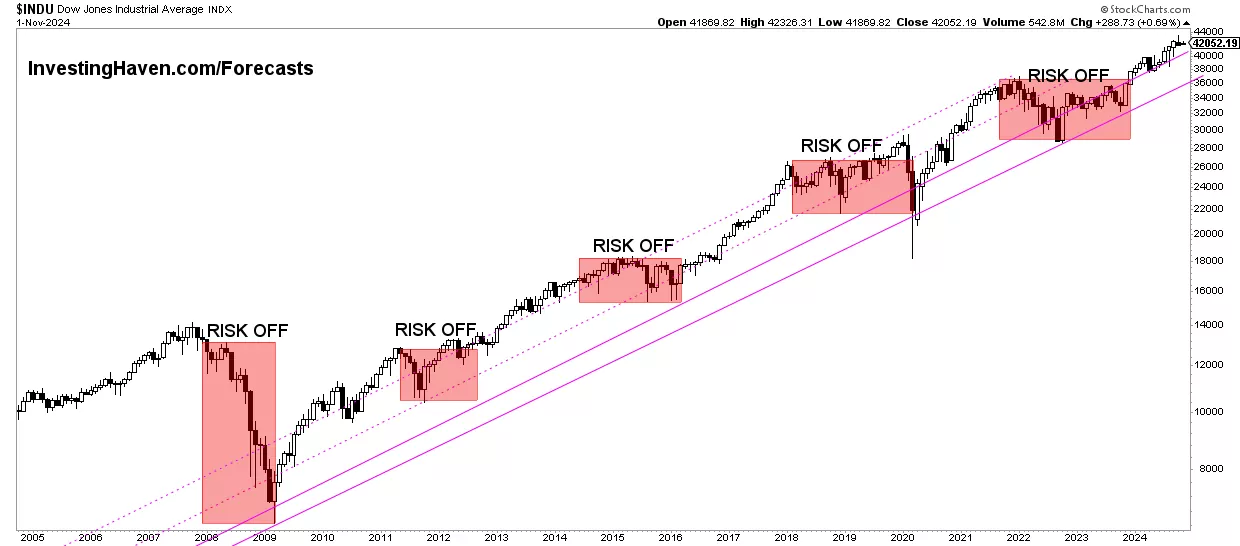
The Dow’s path to new highs is not linear. It has weathered numerous storms, including the 1987 Black Monday crash, the 2000 Dot-Com bust, the 2008 Global Financial Crisis, and the 2020 COVID-19 pandemic-induced downturn. Each of these events saw steep declines, sometimes wiping out years of gains. However, a defining characteristic of the Dow, and the broader U.S. market, has been its resilience and capacity for recovery. Following each major crisis, economic stimulus, corporate adaptation, and investor confidence have eventually led to new bull markets, pushing the index beyond its previous highs. This cyclical pattern underscores the adage that “time in the market beats timing the market.”
The Relentless March Upwards: Factors Driving Long-Term Growth
Despite the volatility, the overall trend of the Dow Jones Industrial Average has been undeniably upwards. This long-term growth is driven by several fundamental factors: continuous innovation, productivity gains, demographic expansion (which drives demand), globalization (though this has shifted over time), effective monetary and fiscal policies, and the inherent capacity of American corporations to adapt, grow, and generate profits. Each new historical high reflects a new chapter in this ongoing narrative of economic expansion and wealth creation.
Dissecting the Drivers Behind Dow Peaks
Understanding why the Dow reaches new highs involves analyzing a confluence of economic, corporate, and psychological factors that coalesce to create upward momentum.
Corporate Earnings and Economic Growth
At the heart of any sustainable market rally, and certainly any Dow peak, are strong corporate earnings. When the 30 companies in the index are reporting robust profits, revenue growth, and positive outlooks, it signals underlying economic health. Strong earnings growth often reflects a growing economy, increased consumer spending, business investment, and favorable operating conditions. Investors are more willing to pay a premium for shares of companies that are consistently profitable and demonstrating growth potential.
Interest Rates and Monetary Policy
The actions of central banks, particularly the U.S. Federal Reserve, play a pivotal role. Low interest rates, for instance, make borrowing cheaper for businesses, encouraging investment and expansion. They also make bonds less attractive as an investment, prompting investors to seek higher returns in the stock market. Quantitative easing and other accommodative monetary policies inject liquidity into the financial system, often finding their way into asset markets. Conversely, rising interest rates can make borrowing more expensive and shift investor capital away from stocks, potentially capping or reversing rallies. Periods of sustained low interest rates have frequently coincided with market uptrends and new Dow peaks.
Investor Sentiment and Market Psychology
Beyond fundamentals, investor sentiment—the collective attitude of investors toward the market—is a powerful driver. Optimism, confidence, and a “fear of missing out” (FOMO) can lead to increased buying activity, pushing prices higher. Conversely, fear and uncertainty can trigger selling. When the Dow is hitting new highs, it often reflects widespread positive sentiment, sometimes bordering on irrational exuberance. This psychological component can create self-fulfilling prophecies, at least in the short to medium term, where rising prices attract more buyers, further fueling the rally.
Technological Advancements and Innovation
The evolution of the Dow’s composition itself highlights the impact of innovation. From the industrial giants of the early 20th century to the technology behemoths of today, groundbreaking advancements drive productivity, create new markets, and reshape industries. Companies at the forefront of technological waves often experience significant growth, and their inclusion and strong performance within the Dow can contribute substantially to its upward trajectory. The rise of computing, the internet, and artificial intelligence, for example, have all played a part in powering market rallies and subsequent Dow peaks by creating new economic opportunities and efficiencies.
The Significance of Dow Peaks for Investors and the Economy
A record high in the Dow Jones Industrial Average is more than just a headline number; it carries significant implications for various stakeholders.
A Reflection of Business Health and Consumer Confidence
When the Dow reaches a new peak, it generally indicates that the largest, most influential American companies are thriving. This often correlates with strong corporate profits, robust employment figures, and healthy consumer spending, all indicative of a sound economy. For consumers, a rising stock market can create a “wealth effect,” where individuals feel wealthier due to increased values in their retirement accounts and investments, potentially leading to more spending and further economic stimulation.
Psychological Impact and Market Euphoria
New highs can generate a sense of euphoria and optimism in the market. This can encourage more people to invest, leading to increased capital flows into stocks. While this positive feedback loop can extend rallies, it also carries the risk of overvaluation, where asset prices become disconnected from their underlying fundamentals. Astute investors understand the importance of distinguishing between genuine growth and speculative bubbles during such times.
The “New Normal” and Inflationary Pressures
Each new peak often establishes a new baseline for the market. What was once considered a “high” can become a regular trading level in subsequent years. However, rising asset prices, if unchecked by productivity gains, can also contribute to inflationary pressures, as more money chases a relatively stable supply of goods and services. Central banks closely monitor these trends to ensure economic stability.
Long-Term vs. Short-Term Perspectives
For long-term investors, Dow peaks are often validations of their investment strategies, reaffirming the historical tendency for equity markets to grow over time. They understand that short-term volatility and corrections are part of the journey. For short-term traders, peaks might signal potential turning points or opportunities for profit-taking, but they also carry increased risk if not managed carefully. The historical “highest” level provides a benchmark, but the future trajectory is never guaranteed.
Beyond the Peak: Prudent Investing in a Dynamic Market
While the Dow’s historical highs are compelling and often celebrated, a truly insightful approach to investing goes beyond fixating on these milestones. Prudent financial management requires a strategic, long-term perspective, irrespective of current market peaks or troughs.
Diversification and Risk Management
No matter how robust the market appears, diversification remains a cornerstone of sound investing. Spreading investments across different asset classes (stocks, bonds, real estate), industries, and geographies helps mitigate risk. Relying solely on the performance of the 30 companies in the Dow, or any single index, can expose an investor to undue concentration risk. A well-diversified portfolio is better equipped to weather inevitable market fluctuations and corrections.
The Importance of a Long-Term Strategy
Market timing, or attempting to buy at the bottom and sell at the top, is notoriously difficult, even for professionals. A long-term investment horizon, often measured in decades, allows investors to ride out market cycles, benefit from compounding returns, and capitalize on the historical upward bias of equity markets. Instead of reacting emotionally to daily market movements or chasing fleeting highs, focusing on long-term goals and consistent contributions is a more effective strategy.
Understanding Market Corrections and Bear Markets
Every bull market, no matter how strong, is eventually followed by a correction (a decline of 10-20%) or a bear market (a decline of 20% or more). These downturns are a natural, albeit often painful, part of the market cycle. Instead of panicking, disciplined investors often view these periods as opportunities to buy quality assets at lower prices. Understanding that peaks are temporary and drawdowns are inevitable helps prepare investors emotionally and financially.
Consulting Financial Professionals
Navigating the complexities of the stock market, especially during periods of extreme highs or lows, can be challenging. For many, consulting a qualified financial advisor can provide invaluable guidance. A professional can help assess individual risk tolerance, define financial goals, construct a diversified portfolio, and provide objective advice that helps investors stay disciplined and focused on their long-term objectives, rather than getting swept up by market euphoria or despair.
In conclusion, the question “what is the highest the Dow Jones has ever been?” leads us down a fascinating path through economic history, revealing the forces that drive market growth and the resilience of the American corporate sector. While new peaks are celebrated as symbols of prosperity and progress, they also serve as a reminder for investors to maintain a balanced perspective, adhere to sound financial principles, and focus on long-term wealth creation in a perpetually dynamic market environment.
aViewFromTheCave is a participant in the Amazon Services LLC Associates Program, an affiliate advertising program designed to provide a means for sites to earn advertising fees by advertising and linking to Amazon.com. Amazon, the Amazon logo, AmazonSupply, and the AmazonSupply logo are trademarks of Amazon.com, Inc. or its affiliates. As an Amazon Associate we earn affiliate commissions from qualifying purchases.