
The Dow Jones Industrial Average (DJIA), often simply referred to as “the Dow,” stands as one of the most recognized and frequently cited stock market indices in the world. Far more than just a number on a screen, the Dow represents a curated collection of 30 prominent American companies whose performance is widely considered a barometer for the health of the U.S. economy and its broader industrial landscape. For investors, financial journalists, and economists alike, understanding what constitutes “Dow stocks” offers critical insights into market sentiment, economic trends, and the enduring power of America’s corporate giants.

This article delves into the heart of the Dow, exploring its historical significance, the unique methodology behind its composition, the types of companies it comprises, and the implications for both seasoned investors and those just beginning their financial journey. By unpacking the intricacies of this venerable index, we aim to provide a comprehensive understanding of why the Dow stocks continue to command such attention in the intricate world of finance.
Unpacking the Dow Jones Industrial Average
To truly grasp the essence of Dow stocks, it’s essential to first understand the index itself – its origins, its purpose, and how it has evolved to remain relevant in a constantly changing economic landscape.
A Historical Perspective and Its Significance
The Dow Jones Industrial Average traces its roots back to May 26, 1896, when it was created by Charles Dow, editor of The Wall Street Journal and co-founder of Dow Jones & Company. Initially, the index consisted of just 12 predominantly industrial companies, such as American Cotton Oil, General Electric, and U.S. Leather. Charles Dow’s vision was to create a simple, easy-to-understand measure to gauge the health of the U.S. stock market and, by extension, the broader industrial sector that powered the nation’s economy.
Over the decades, the DJIA grew in prominence, expanding to 30 components in 1928, a number it maintains today. Its straightforward calculation and long history have cemented its status as a vital market barometer. Even in an age of sophisticated algorithms and complex financial models, the Dow retains a unique psychological significance, often being the first metric cited in news reports about market performance. A strong Dow is often interpreted as a sign of economic confidence, while a significant drop can trigger broader concerns. Its enduring appeal lies in its simplicity and its ability to offer a snapshot of America’s most established and influential corporations.
The “Industrial” Misnomer
Despite its name, the “Industrial” in Dow Jones Industrial Average is largely a historical artifact. While the index initially comprised heavy manufacturing and industrial firms, the U.S. economy has undergone profound transformations over the past century. Today, the 30 companies that make up the Dow represent a far broader spectrum of economic activity, extending well beyond traditional manufacturing.
Modern Dow components include leading technology firms, healthcare giants, financial services powerhouses, consumer discretionary and staples companies, and even communication services providers. For instance, Apple, Microsoft, UnitedHealth Group, Visa, and McDonald’s are all key components. The committee responsible for selecting Dow stocks focuses on companies that are leaders in their respective industries and are representative of the U.S. economy as a whole, rather than strictly adhering to a narrow definition of “industrial.” The name has simply stuck due to tradition and its deep historical roots, serving as a reminder of the index’s origins rather than an accurate descriptor of its current composition.
The Selection Criteria and Methodology
Unlike some other prominent indices, the selection process for Dow stocks is not purely quantitative. It involves a blend of subjective judgment and specific calculation methodologies that give the DJIA its unique characteristics.
More Than Just the “Biggest” Companies
The 30 companies included in the Dow are not simply the 30 largest companies by market capitalization in the United States. If that were the case, the list would likely be dominated by technology giants, creating a less diversified and representative index. Instead, the selection process is managed by a committee at S&P Dow Jones Indices, which employs a set of qualitative criteria to ensure the index remains relevant and influential.
Key factors considered by the committee include:
- Reputation: Companies must have an excellent reputation, demonstrate sustained growth, and be of interest to a large number of investors.
- Industry Leadership: Components are typically large, well-established “blue-chip” companies that are leaders in their respective industries.
- Broad Representation: The committee aims for a diverse representation of the U.S. economy, seeking to include companies from various sectors to reflect the overall economic landscape.
- Financial Health: While not explicitly a size requirement, the selected companies are invariably financially robust, profitable, and have a proven track record of stability.
Changes to the Dow’s composition are infrequent, typically occurring only when a component company undergoes a significant structural change (like a merger or bankruptcy), experiences a sustained decline in relevance, or when a new industry leader emerges that better represents the evolving U.S. economy. When a company is added or removed, it’s often a significant event that garners considerable media attention, highlighting the prestige associated with being a Dow stock.
The Price-Weighted Average and Its Implications
One of the most distinctive features of the DJIA is its calculation methodology: it is a price-weighted index. This means that stocks with higher share prices have a greater influence on the index’s value than stocks with lower share prices, regardless of the companies’ actual market capitalization (total value of all outstanding shares).
The index is calculated by summing the prices of the 30 component stocks and then dividing that sum by a factor known as the “Dow Divisor.” This divisor is adjusted periodically to account for stock splits, spin-offs, and other structural changes to the component companies, ensuring the historical continuity of the index’s value. Without the divisor, a stock split would artificially lower the index’s value, even if the underlying company’s total market value remained unchanged.

The price-weighted nature contrasts sharply with market-capitalization-weighted indices, such as the S&P 500, where a company’s influence on the index is directly proportional to its total market value. The implications of price-weighting are significant:
- Disproportionate Influence: A $1 increase in a $400 stock will move the Dow more than a $1 increase in a $100 stock, even if the lower-priced stock represents a much larger company overall.
- Less Reflective of Market Value: The index might not perfectly reflect the total market value shifts of its components, as smaller companies with high stock prices can exert more influence than larger companies with lower stock prices.
- Simplicity: Despite its quirks, the price-weighted calculation is historically simple and easy to understand at a glance, contributing to its broad appeal.
Who Are Today’s Dow Stocks? A Glimpse into the Elite
The list of Dow stocks is a who’s who of American corporate power, featuring household names that touch nearly every aspect of daily life, both domestically and globally.
A Diverse Representation of the American Economy
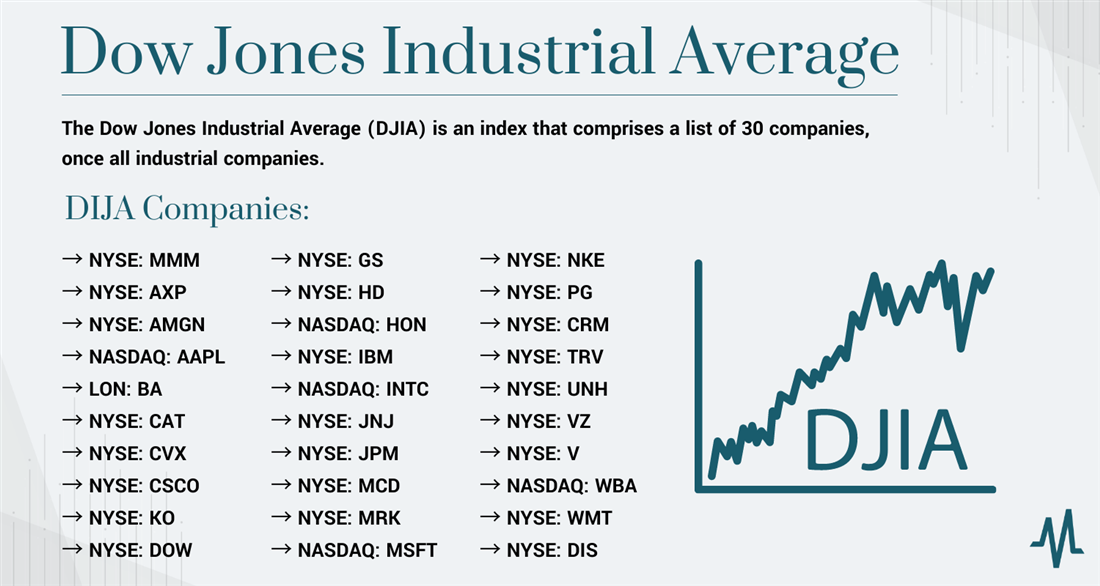
As of recent compositions, the Dow features companies from a wide array of sectors, showcasing the breadth of the U.S. economy:
- Technology: Apple Inc. (AAPL), Microsoft Corp. (MSFT), Salesforce Inc. (CRM)
- Healthcare: UnitedHealth Group Inc. (UNH), Johnson & Johnson (JNJ), Merck & Co. Inc. (MRK)
- Financial Services: JPMorgan Chase & Co. (JPM), Visa Inc. (V), American Express Co. (AXP)
- Consumer Discretionary/Staples: McDonald’s Corp. (MCD), The Coca-Cola Co. (KO), Home Depot Inc. (HD), Walmart Inc. (WMT), Nike Inc. (NKE)
- Industrials: Caterpillar Inc. (CAT), Honeywell International Inc. (HON), Boeing Co. (BA)
- Energy: Chevron Corp. (CVX)
- Communication Services: Verizon Communications Inc. (VZ), Walt Disney Co. (DIS)
This diverse composition underscores the committee’s objective: to select companies that are not only market leaders but also offer a representative cross-section of the economic activities driving the nation. These are typically “blue-chip” companies, known for their established brand names, consistent profitability, strong balance sheets, and often, a history of paying dividends to shareholders.
Rotations and Relevancy: The Dynamic Nature of the Index
While the Dow’s composition is relatively stable compared to broader market indices, it is not static. The committee continuously monitors the relevance and performance of its components, making changes when necessary to ensure the index accurately reflects the evolving U.S. economic landscape.
Recent changes have highlighted this dynamic nature. For example, in 2020, Salesforce, Amgen, and Honeywell were added, replacing ExxonMobil, Pfizer, and Raytheon Technologies. These changes reflected a broader shift in the U.S. economy away from traditional industrial and energy sectors towards technology, biotechnology, and diversified industrials. The removal of ExxonMobil, a long-time Dow component, was particularly symbolic, marking a generational shift in the index’s representation of economic power.
Such rotations are not taken lightly; they reflect significant economic trends and can have an impact on the perception and trading volumes of the companies involved. Inclusion in the Dow bestows a certain prestige and often attracts passive investment from index-tracking funds, while removal can lead to some selling pressure. These changes ensure the Dow remains a forward-looking indicator, rather than merely a historical relic.
Investing in Dow Stocks: Opportunities and Considerations
For investors, understanding Dow stocks isn’t just an academic exercise; it offers practical insights into potential investment strategies and market dynamics.
The Allure of Blue-Chip Investments
Investing in Dow stocks, either individually or through an index fund, often appeals to investors seeking stability, established performance, and a degree of prestige:
- Stability and Reliability: Dow components are typically mature, well-capitalized companies with long histories of navigating various economic cycles. They often exhibit less volatility than smaller, growth-oriented companies.
- Dividend Income: Many Dow stocks are renowned for their consistent dividend payments, making them attractive to income-focused investors or those seeking to compound returns over the long term through dividend reinvestment.
- Market Leadership: Investing in Dow companies means investing in industry leaders that have demonstrated competitive advantages, strong management, and global reach.
- Gateway to Diversification: While only 30 companies, their diverse sectoral representation provides a degree of diversification across major segments of the U.S. economy, reducing single-industry risk.
For long-term investors, blue-chip stocks often form the foundation of a robust portfolio, offering a balance of growth potential and capital preservation.
Limitations and Alternative Perspectives
Despite their appeal, relying solely on the Dow as an investment guide or a complete portfolio strategy comes with certain limitations:
- Limited Diversification: Thirty companies, no matter how influential, do not fully represent the thousands of publicly traded companies in the U.S. market. A portfolio composed exclusively of Dow stocks would miss out on significant growth opportunities from mid-cap and small-cap companies, as well as emerging sectors not yet represented in the index.
- Price-Weighted Bias: As discussed, the price-weighted methodology can distort the true representation of market value. A stock split, for instance, reduces a company’s influence on the Dow, even if its market cap remains unchanged.
- Not a Total Market Indicator: While widely watched, the Dow is not as comprehensive a measure of the overall U.S. stock market as broader, market-cap-weighted indices like the S&P 500 (which tracks 500 large-cap companies) or the Russell 3000 (which covers virtually the entire U.S. equity market).
- Passive vs. Active Investing: Investors can gain exposure to Dow stocks by purchasing shares of individual companies, but a more common and efficient approach is through Exchange Traded Funds (ETFs) like the SPDR Dow Jones Industrial Average ETF Trust (DIA), which passively tracks the performance of the index. This offers instant diversification across all 30 components.
Ultimately, while Dow stocks represent some of the finest corporations in America, a well-rounded investment strategy often involves looking beyond a single index. Investors should consider their individual financial goals, risk tolerance, and time horizon, and typically aim for broader market exposure through diversified portfolios that might include a mix of large-cap, mid-cap, and small-cap stocks, international equities, and other asset classes.
Conclusion
The Dow Jones Industrial Average, with its exclusive collection of 30 “Dow stocks,” remains an indelible fixture in the financial world. From its humble beginnings as a simple gauge of industrial health, it has evolved into a closely watched barometer for the broader U.S. economy, featuring a dynamic roster of leading companies from diverse sectors. Understanding the Dow’s history, its unique price-weighted methodology, and the rigorous selection process for its components provides invaluable context for any investor.
While the prestige and stability of Dow stocks make them attractive components for many investment portfolios, it’s crucial to appreciate both their strengths and their limitations. The Dow offers a compelling snapshot of America’s corporate elite, but it is one tool among many for navigating the complex landscape of investing. For optimal financial health, investors are encouraged to consider a holistic approach that extends beyond any single index, aligning investment choices with their personal financial objectives and a well-diversified strategy.
aViewFromTheCave is a participant in the Amazon Services LLC Associates Program, an affiliate advertising program designed to provide a means for sites to earn advertising fees by advertising and linking to Amazon.com. Amazon, the Amazon logo, AmazonSupply, and the AmazonSupply logo are trademarks of Amazon.com, Inc. or its affiliates. As an Amazon Associate we earn affiliate commissions from qualifying purchases.