
The stock market, often perceived as a mysterious realm of complex transactions and rapid wealth creation (or destruction), is in reality a foundational pillar of modern economies. Far from being a mere casino for the wealthy, it serves as a critical mechanism for companies to raise capital for growth and innovation, and for individuals and institutions to invest their savings, aiming to grow their wealth over time. Understanding how this intricate system operates is essential not just for investors, but for anyone seeking to comprehend the economic forces that shape our world.
At its core, a stock market is simply a marketplace where shares of publicly traded companies are bought and sold. These shares represent fractional ownership in a company, and their value fluctuates based on a myriad of factors, from company performance to broader economic trends and investor sentiment. This article will demystify the stock market, breaking down its fundamental components, key players, and dynamic processes, offering a comprehensive and insightful look into one of the most powerful financial engines on the planet.

The Core Mechanics: What is a Stock?
To truly grasp how stock markets function, one must first understand the fundamental unit of trade: the stock itself. A stock, also known as equity, is more than just a piece of paper or a digital entry; it represents a slice of ownership in a company. When you own a stock, you own a tiny part of that business, and this ownership comes with certain rights and potential benefits.
Equity Ownership and Shareholder Rights
Each share of stock represents a claim on a portion of the company’s assets and earnings. For example, if a company has one million shares outstanding and you own 1,000 of them, you own 0.1% of that company. As a shareholder, you typically gain certain rights, although these can vary between different classes of stock (e.g., common vs. preferred shares). The most significant right for common shareholders is often the right to vote on important company matters, such as electing the board of directors, approving mergers, or making major strategic decisions. This gives shareholders a say in how the company is managed, albeit a small one for individual investors in large corporations. Furthermore, shareholders have a residual claim on the company’s assets in the event of liquidation, meaning they get paid only after creditors have been satisfied.
Why Companies Issue Stock: Capital Formation
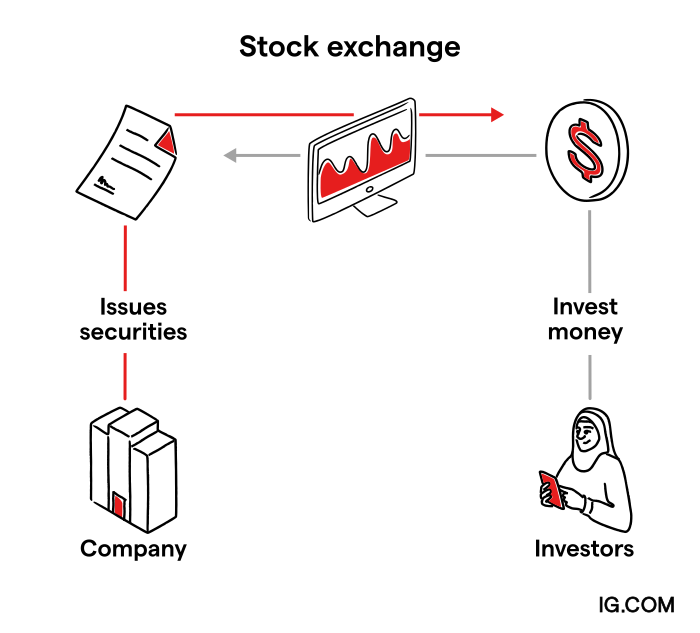
Companies primarily issue stock for one overarching reason: to raise capital. When a private company decides to “go public” through an Initial Public Offering (IPO), it sells shares to the public for the first time. This infusion of cash from new investors allows the company to finance expansion projects, invest in research and development, pay down debt, acquire other businesses, or simply provide working capital to support its operations. It’s a powerful way for businesses to fund their growth without taking on additional debt, which incurs interest payments, or diluting the control of existing owners too heavily. By selling equity, companies are essentially inviting public investors to share in their future success, offering them a piece of the upside in exchange for immediate capital.
Primary vs. Secondary Markets: Where Trading Happens
The stock market is broadly divided into two main components: the primary market and the secondary market. The primary market is where new securities are issued for the first time. This is where IPOs occur, as well as subsequent offerings (like follow-on public offerings or rights issues) where companies sell newly created shares directly to investors. The funds raised in the primary market go directly to the issuing company.
Once shares have been sold in the primary market, they then trade on the secondary market. This is the market most people refer to when they talk about the “stock market.” Stock exchanges like the New York Stock Exchange (NYSE) or NASDAQ are examples of secondary markets. In the secondary market, investors buy and sell existing shares from each other, not directly from the company. The company that originally issued the stock does not receive any money from these secondary market transactions; rather, the money changes hands between individual investors. The secondary market is crucial because it provides liquidity – the ability to easily buy or sell shares – which makes investing in stocks attractive in the first place. Without a liquid secondary market, investors would be hesitant to buy shares in a primary offering, fearing they might not be able to sell them later.
Key Players and Their Roles
The stock market is a complex ecosystem populated by a diverse array of participants, each playing a distinct and crucial role in its operation. Understanding these players helps to illuminate the interconnectedness of the financial world.
Companies (Issuers): The Engine of Value
At the heart of the stock market are the companies themselves. These are the publicly traded corporations that issue shares to raise capital and fund their operations and growth initiatives. From tech giants to small-cap startups, every company listed on an exchange is essentially offering investors a chance to partake in its future success. Their financial health, innovation, management decisions, and market strategies are the primary drivers of the value that flows through the stock market. Without viable businesses seeking capital, there would be no stocks to trade.
Investors (Buyers/Sellers): The Capital Providers
On the other side of the trade are the investors. These individuals and entities provide the capital that companies need and seek returns on their investments. Investors come in many forms:
- Individual Investors (Retail Investors): Everyday people who invest their savings, often through brokerage accounts, for goals like retirement, education, or wealth accumulation.
- Institutional Investors: Large organizations with substantial capital to invest, such as mutual funds, hedge funds, pension funds, insurance companies, and endowment funds. These institutions often have significant influence due to the sheer volume of their trades.
- Traders: Individuals or firms who buy and sell stocks frequently, often seeking to profit from short-term price fluctuations rather than long-term ownership.
Each type of investor brings different objectives, risk tolerances, and time horizons to the market, contributing to its dynamic nature.
Exchanges (Marketplaces): The Trading Arenas
Stock exchanges are the organized marketplaces where buying and selling of securities takes place. Historically, these were physical locations with trading floors, but today most trading occurs electronically. Examples include the New York Stock Exchange (NYSE), the NASDAQ Stock Market, the London Stock Exchange (LSE), and the Tokyo Stock Exchange (TSE). Exchanges provide the infrastructure, rules, and technology to facilitate efficient, fair, and transparent trading. They list companies, match buyers and sellers, disseminate real-time price data, and often play a role in regulating the behavior of their listed companies and members. Their primary function is to ensure an orderly market where prices are discovered through supply and demand.
Brokers and Dealers: The Intermediaries
Brokers act as intermediaries between investors and the stock exchange. They execute buy and sell orders on behalf of their clients, charging a commission or fee for their services. Today, online discount brokers have made stock trading accessible to millions, allowing individuals to place trades directly through a digital platform. Dealers, on the other hand, trade securities for their own account, taking positions and profiting from the spread between their buying and selling prices. Many firms act as both brokers and dealers, serving clients while also engaging in proprietary trading. They provide liquidity by being willing to buy or sell securities when no direct counterparty is immediately available.
Regulators: Ensuring Fairness and Transparency
To protect investors and maintain confidence in the financial system, regulators play a vital oversight role. In the United States, the primary regulator is the Securities and Exchange Commission (SEC), which enforces securities laws, promotes disclosure, and oversees stock exchanges, broker-dealers, and other market participants. Similar bodies exist globally, such as the Financial Conduct Authority (FCA) in the UK or the China Securities Regulatory Commission (CSRC). Regulators establish rules regarding trading practices, corporate reporting, insider trading, and market manipulation, aiming to ensure fairness, transparency, and efficiency, thereby fostering a level playing field for all participants.
Understanding Market Dynamics and Pricing
The price of a stock is rarely static; it fluctuates constantly throughout trading hours. These movements are not random but are driven by a complex interplay of forces, primarily rooted in the principles of supply and demand.
Supply and Demand: The Fundamental Force

At its most basic level, stock prices are determined by the classic economic principle of supply and demand. If there are more buyers interested in a particular stock than sellers, the demand for that stock is high, pushing its price up. Conversely, if there are more sellers than buyers, the supply exceeds demand, leading to a fall in price. This dynamic interaction between buyers and sellers, constantly placing orders at different price points, is what generates the real-time price quotations seen on trading screens. News, company announcements, economic data, and even rumors can rapidly shift this balance, causing prices to move.
Factors Influencing Stock Prices
While supply and demand are the immediate mechanisms, numerous underlying factors influence these forces and, consequently, stock prices:
- Company Performance: The most direct influence. Strong earnings reports, revenue growth, successful product launches, and effective management typically lead to higher stock prices, as these indicate a healthy and growing business. Poor performance, missed earnings, or scandal can have the opposite effect.
- Economic Indicators: Broader economic health significantly impacts investor confidence and corporate profits. Factors like interest rates (set by central banks), inflation, Gross Domestic Product (GDP) growth, unemployment rates, and consumer spending all play a role. Lower interest rates, for example, can make stocks more attractive compared to bonds, and stimulate economic activity.
- Industry Trends and Sector Performance: A company’s stock price can be affected by trends within its specific industry or broader sector. For instance, a surge in demand for renewable energy might boost stocks across the entire green energy sector, regardless of an individual company’s specific news.
- Geopolitical Events: International conflicts, trade wars, political instability, or major global events (like pandemics) can create uncertainty and impact global supply chains, commodity prices, and investor sentiment, leading to widespread market fluctuations.
- Investor Sentiment and Psychology: Emotional factors often play a significant, if less rational, role. Fear, greed, herd mentality, and exuberance can lead to market bubbles or crashes, sometimes disconnected from underlying fundamentals. News cycles, social media, and market gurus can amplify these psychological effects.
Market Indexes: Gauging the Health of the Market
To understand the broader movements of the stock market, investors rely on market indexes. These are statistical measures that track the performance of a basket of stocks, representing a particular market, sector, or segment of the economy. Well-known examples include:
- S&P 500: Represents 500 of the largest U.S. publicly traded companies, widely considered a benchmark for the overall health of the U.S. stock market.
- Dow Jones Industrial Average (DJIA): Tracks 30 large, publicly owned companies based in the United States, serving as a gauge of the health of the U.S. industrial sector.
- NASDAQ Composite: Heavily weighted towards technology and growth companies, often seen as an indicator of the tech sector’s performance.
These indexes provide a snapshot of market performance, helping investors gauge whether the overall market, or a specific segment, is moving up or down, and aiding in portfolio benchmarking.
Types of Orders and Trading Strategies
Engaging with the stock market requires more than just knowing what stocks are; it involves understanding how to execute trades and the different approaches one can take to investing.
Basic Order Types: Directing Your Trades
When you decide to buy or sell a stock, you place an order with your broker. There are several fundamental types of orders:
- Market Order: This is the simplest order. You instruct your broker to buy or sell a stock immediately at the best available current price. While it guarantees execution, it doesn’t guarantee a specific price, which can be an issue in volatile markets where prices can change rapidly.
- Limit Order: With a limit order, you specify the maximum price you’re willing to pay to buy a stock (buy limit order) or the minimum price you’re willing to accept to sell a stock (sell limit order). Your order will only be executed if the stock reaches your specified price or better. This gives you price control but doesn’t guarantee execution.
- Stop Order (or Stop-Loss Order): This order becomes a market order once a specified “stop price” is reached. It’s often used to limit potential losses on an existing position. For example, if you own a stock trading at $100, you might place a stop-loss order at $95. If the stock falls to $95, your stop order triggers a market order to sell, helping to prevent further losses. There are also “stop-limit” orders which combine features of both.
Understanding these order types is crucial for managing risk and achieving desired entry or exit prices.
Common Trading Approaches: Tailoring Your Investment Journey
Investors adopt various strategies based on their financial goals, risk tolerance, and time horizon:
- Long-Term Investing (Buy and Hold): This strategy involves purchasing stocks of fundamentally sound companies and holding them for many years, often decades, regardless of short-term market fluctuations. The goal is to benefit from capital appreciation and dividends over the long run, allowing compounding to work its magic.
- Value Investing: Focuses on finding stocks that are trading below their intrinsic value, often overlooked or undervalued by the market. Pioneered by Benjamin Graham and popularized by Warren Buffett.
- Growth Investing: Seeks out companies with above-average growth potential, often innovative businesses in emerging industries, even if their current valuations seem high.
- Short-Term Trading (Active Trading): This involves frequent buying and selling of stocks to profit from daily or weekly price movements. It requires significant time commitment, research, and a high tolerance for risk.
- Day Trading: Buying and selling stocks within the same trading day, closing all positions before the market closes. Day traders aim to profit from small price movements.
- Swing Trading: Holding stocks for a few days or weeks to profit from “swings” in price.
- Diversification and Portfolio Management: Regardless of the primary strategy, a fundamental principle of sound investing is diversification. This involves spreading investments across different companies, industries, asset classes (stocks, bonds, real estate), and geographical regions to reduce risk. A well-managed portfolio minimizes the impact of any single investment performing poorly, creating a smoother and more consistent return trajectory over time. Regular rebalancing of the portfolio ensures it remains aligned with the investor’s risk profile and goals.
Risks and Rewards of Stock Market Participation
Participating in the stock market offers the potential for significant wealth creation, but it is not without its perils. A balanced understanding of both the potential upsides and the inherent downsides is crucial for any investor.
Potential Rewards: Building Wealth Over Time
The stock market has historically been one of the most effective vehicles for long-term wealth accumulation. The primary rewards include:
- Capital Appreciation: This is the most straightforward reward. If you buy a stock at $50 and its value increases to $70, you’ve made a capital gain of $20 per share. Over time, the growth of successful companies can lead to substantial increases in share price.
- Dividends: Many companies distribute a portion of their profits to shareholders in the form of regular payments called dividends. These can be a significant source of income, especially for long-term investors or those in retirement. Reinvesting dividends can also supercharge capital appreciation through compounding.
- Compounding Returns: The magic of compounding is perhaps the most powerful aspect of stock market investing. When initial investments and subsequent earnings generate further earnings, the growth accelerates exponentially over time. Even modest returns, consistently achieved and reinvested over many years, can lead to substantial wealth.
- Inflation Hedge: Over the long term, stocks have historically outperformed inflation, helping investors maintain and grow their purchasing power. Unlike cash which erodes in value due to inflation, well-chosen stocks tend to increase in value as the cost of goods and services rises.
Inherent Risks: Understanding the Downsides
While the rewards are compelling, the stock market is also characterized by significant risks:
- Market Volatility: Stock prices can be highly unpredictable and subject to rapid and sometimes dramatic fluctuations. Factors like economic news, geopolitical events, and shifts in investor sentiment can cause market-wide downturns, known as bear markets, where even fundamentally sound stocks may decline in value.
- Company-Specific Risk (Idiosyncratic Risk): The performance of an individual stock can be affected by factors unique to that company, such as poor management decisions, product failures, legal issues, or competitive pressures. Even in a strong market, a particular stock can perform poorly.
- Economic Downturns and Systemic Risk: Broader economic recessions or financial crises can impact the entire market, leading to widespread losses across many companies and sectors. These systemic risks are difficult for individual investors to mitigate entirely.
- Liquidity Risk: While most major stocks are highly liquid, some smaller or less frequently traded stocks may be difficult to sell quickly without significantly impacting their price, especially if you hold a large block of shares.
- Inflation Risk: Although stocks can be an inflation hedge, if a company’s earnings don’t keep pace with inflation, the real return on investment can be diminished.
- Interest Rate Risk: Changes in interest rates can impact the attractiveness of stocks versus fixed-income investments like bonds. Higher interest rates can make borrowing more expensive for companies and reduce the present value of future earnings, potentially pushing stock prices down.
Mitigating Risks: Strategic Approaches
While risks cannot be entirely eliminated, they can be managed effectively through strategic approaches:
- Diversification: As mentioned earlier, spreading investments across various assets, industries, and geographies is the single most effective way to reduce company-specific and sector-specific risks.
- Thorough Research (Due Diligence): Investing in companies you understand, analyzing their financial health, competitive landscape, and management quality can help in making informed decisions and avoiding speculative bets.
- Long-Term Perspective: Adopting a long-term mindset allows investors to ride out short-term market volatility and benefit from the power of compounding and economic growth over extended periods.
- Risk Management: Setting clear investment goals, understanding your personal risk tolerance, and using tools like stop-loss orders or dollar-cost averaging (investing a fixed amount regularly, regardless of price) can help manage potential losses and emotional decision-making.
In conclusion, the stock market is a dynamic and essential component of the global financial system. It provides a vital conduit for capital formation, enabling businesses to grow and innovate, while simultaneously offering investors a powerful mechanism to build wealth over time. While its complexities can seem daunting, a clear understanding of its core mechanics, key players, driving forces, and inherent risks allows individuals to approach it with confidence and strategic intent, harnessing its potential to achieve their financial aspirations.
aViewFromTheCave is a participant in the Amazon Services LLC Associates Program, an affiliate advertising program designed to provide a means for sites to earn advertising fees by advertising and linking to Amazon.com. Amazon, the Amazon logo, AmazonSupply, and the AmazonSupply logo are trademarks of Amazon.com, Inc. or its affiliates. As an Amazon Associate we earn affiliate commissions from qualifying purchases.