
Purchasing a car is one of the most significant financial decisions many individuals make, often second only to buying a home. For most, this involves securing a car loan, which necessitates a clear understanding of the financial commitment involved. The monthly payment for a car loan isn’t just an arbitrary number; it’s a crucial component of your personal budget, impacting everything from your savings potential to your ability to manage other financial obligations. Understanding how this payment is calculated empowers you to make informed decisions, negotiate effectively, and ultimately secure a vehicle that fits comfortably within your financial means.

This comprehensive guide will break down the mechanics of calculating your monthly car payment, demystifying the variables involved and providing practical insights. We’ll delve into the core components that shape your payments, explore the underlying financial formulas, and discuss strategies to manage or reduce these costs, ensuring you approach your next car purchase with confidence and financial acumen.
Understanding the Core Components of a Car Loan
A car loan is fundamentally a form of installment credit, where a lender provides you with funds to purchase a vehicle, and you agree to repay that amount, plus interest, over a set period. Three primary components dictate the size of your monthly payment: the principal amount, the interest rate, and the loan term.
Principal Amount
The principal amount is the actual sum of money you borrow to purchase the car. It’s the sticker price of the vehicle, minus any down payment, trade-in value, or rebates. This is the foundation upon which all other calculations are built, and minimizing it upfront is one of the most effective ways to reduce your monthly payment and the total interest you’ll pay over the life of the loan.
- Down Payment: This is the initial lump sum of cash you pay directly to the dealer at the time of purchase. A larger down payment directly reduces the principal amount you need to borrow, thereby lowering your monthly payments and often leading to less interest paid over the loan term. Financial advisors often recommend a down payment of at least 10-20% for a new car and 10% for a used car, if feasible.
- Trade-in Value: If you’re trading in an existing vehicle, its agreed-upon value will be subtracted from the new car’s purchase price, further reducing the principal amount you need to finance. Researching your car’s trade-in value beforehand through resources like Kelley Blue Book or Edmunds can strengthen your negotiation position.
- Rebates and Incentives: Manufacturers and dealerships frequently offer cash rebates or special financing incentives. These can either be applied as a direct discount off the purchase price (reducing principal) or as cash back to you. Always consider how these impact the actual amount you need to finance.
Interest Rate (APR)
The interest rate, often expressed as an Annual Percentage Rate (APR), is the cost of borrowing money. It’s a percentage of the principal amount that you pay to the lender for the privilege of using their funds. A higher interest rate means a more expensive loan and a higher monthly payment, all else being equal.
- Factors Influencing APR: Your credit score is the most significant determinant of the interest rate you’ll qualify for. Borrowers with excellent credit scores (typically 720+) are offered the lowest rates, as they are deemed lower risk. Other factors include the current market interest rates (set by the Federal Reserve), the specific lender (banks, credit unions, dealership financing), and even the loan term (shorter terms sometimes have slightly lower rates).
- Impact on Total Cost: While a slight difference in APR might seem negligible on a monthly basis, it can lead to thousands of dollars in extra interest paid over the full term of a multi-year loan. For example, on a $25,000 loan over five years, a 6% APR results in significantly more total interest than a 4% APR.
Loan Term
The loan term is the duration over which you agree to repay the loan, typically expressed in months (e.g., 36, 48, 60, 72, or even 84 months). The loan term has a direct and inverse relationship with your monthly payment and a direct relationship with the total interest paid.
- Shorter Terms: A shorter loan term (e.g., 36 or 48 months) means higher monthly payments because you’re repaying the principal over fewer installments. However, you pay less total interest over the life of the loan, as the principal is paid off faster, and the interest doesn’t have as long to accrue. This is generally the more financially prudent option if you can afford the higher monthly payments.
- Longer Terms: A longer loan term (e.g., 72 or 84 months) results in lower monthly payments, making the car seem more affordable in the short term. The downside is that you’ll pay significantly more interest over the loan’s duration, potentially thousands more. Additionally, you run a greater risk of going “upside down” on your loan (owing more than the car is worth), especially during the early years of ownership, due to rapid depreciation.
The Formula for Car Loan Calculation
While online calculators are convenient, understanding the underlying formula provides a deeper appreciation of how your payments are structured. Car loan payments are calculated using an amortization formula, which evenly distributes the principal and interest payments over the loan term.
The Standard Loan Amortization Formula Explained
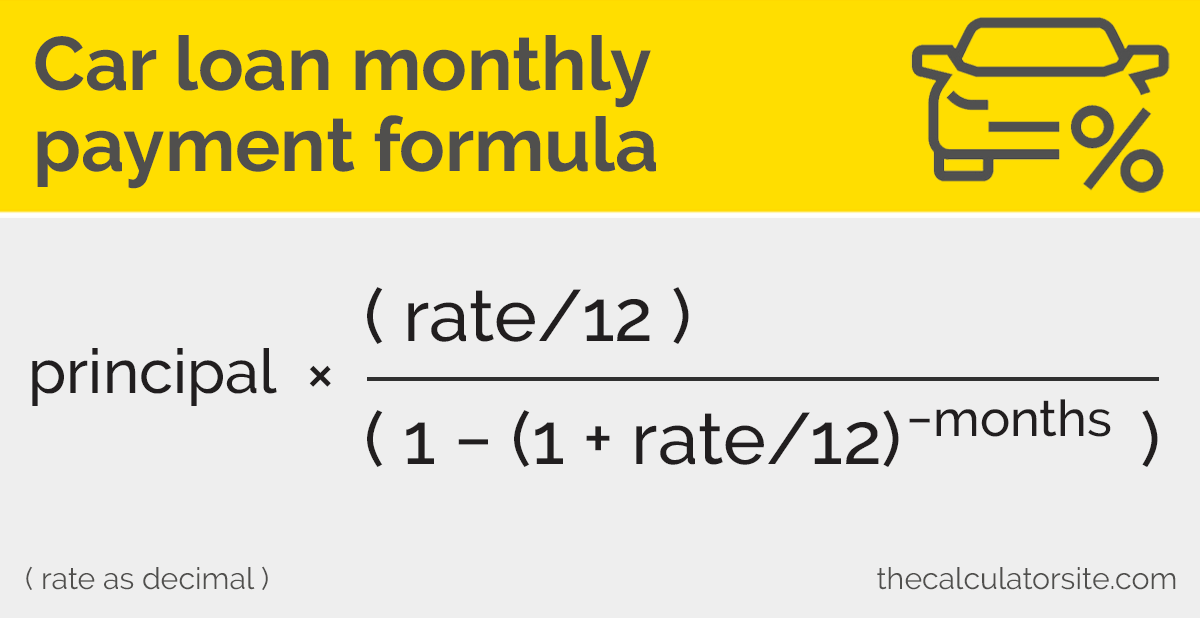
The formula to calculate a fixed monthly loan payment is:
M = P [ i(1 + i)^n ] / [ (1 + i)^n – 1]
Where:
- M = Monthly Payment
- P = Principal Loan Amount (the amount you are borrowing)
- i = Monthly Interest Rate (your annual APR divided by 12)
- n = Total Number of Payments (loan term in years multiplied by 12)
Let’s break down each part to understand its function:
- P: As discussed, this is the core amount you need to repay.
- i: Your annual interest rate needs to be converted to a monthly rate. If your APR is 6%, then
i = 0.06 / 12 = 0.005. It’s crucial to use the decimal form for percentages in the calculation. - (1 + i)^n: This component accounts for the compounding effect of interest over the loan term. Interest isn’t just applied to the initial principal; it’s applied to the remaining balance each month, which includes previously accrued interest.
- n: This is the total number of payments. A 5-year loan would be
5 * 12 = 60payments.
Step-by-Step Calculation Guide
Let’s walk through an example to illustrate the formula.
Scenario: You want to borrow $30,000 for a car at an APR of 5% over 60 months (5 years).
- Identify the Principal (P): P = $30,000
- Calculate the Monthly Interest Rate (i):
- APR = 5% = 0.05
- Monthly Rate (i) = 0.05 / 12 = 0.00416667
- Determine the Total Number of Payments (n):
- Loan Term = 5 years
- Total Payments (n) = 5 * 12 = 60
- Plug the Values into the Formula:
- M = 30000 [ 0.00416667 * (1 + 0.00416667)^60 ] / [ (1 + 0.00416667)^60 – 1]
- First, calculate (1 + 0.00416667)^60 = (1.00416667)^60 ≈ 1.283359
- Then, M = 30000 [ 0.00416667 * 1.283359 ] / [ 1.283359 – 1 ]
- M = 30000 [ 0.00534735 ] / [ 0.283359 ]
- M = 160.4205 / 0.283359
- M ≈ $566.15
So, your estimated monthly payment would be approximately $566.15. This step-by-step approach demonstrates the mathematical foundation of your car loan.
The Role of Online Calculators
While manually calculating provides valuable insight, online car loan calculators are incredibly useful and accurate for practical application. Websites of lenders, financial institutions, and automotive review sites often feature these tools.
- Convenience: Simply input your principal, interest rate, and loan term, and the calculator instantly provides the monthly payment.
- Comparison: They allow you to quickly compare different scenarios—e.g., how a higher down payment affects your monthly cost, or the difference between a 60-month and 72-month loan.
- Accuracy: They perform the complex calculations flawlessly, minimizing human error.
- Additional Features: Many calculators also provide an amortization schedule, showing how much principal and interest you pay each month over the life of the loan. This can highlight how interest makes up a larger portion of early payments and principal dominates later payments.
Beyond the Basic Calculation: Hidden Costs and Considerations
Calculating the monthly car payment is essential, but it only tells part of the financial story of car ownership. Several other costs, often overlooked, contribute to the true financial burden and should be factored into your overall budget.
Sales Tax and Fees
When you purchase a car, it’s not just the sticker price. Sales tax (which varies by state and locality) is typically applied to the vehicle’s purchase price and can add hundreds or even thousands of dollars. This tax is either paid upfront or rolled into your loan, increasing the principal amount you finance. Beyond sales tax, you’ll also encounter:
- Registration Fees: Required to legally operate your car, these vary by state and vehicle type.
- Title Fees: For transferring ownership.
- Documentation Fees (Doc Fees): Charged by dealerships for processing paperwork. While often negotiable to an extent, these are a common part of the purchase.
- License Plate Fees: For your new plates.
Ensure you inquire about all associated taxes and fees before finalizing your purchase, as they can significantly impact the total out-of-pocket cost or the total amount borrowed.
Car Insurance
This is a non-negotiable, ongoing cost for car ownership. Before you even drive off the lot, you’ll need proof of insurance. The cost of car insurance can vary dramatically based on factors like:
- Your age and driving record.
- The make, model, and year of the car (its value, safety features, theft risk).
- Where you live (urban vs. rural, crime rates).
- Your chosen coverage limits and deductibles.
It’s highly advisable to get insurance quotes for the specific vehicle you’re considering before committing to a purchase. A seemingly affordable car could come with unexpectedly high insurance premiums, pushing it out of your comfortable budget.
Maintenance and Fuel Costs
Cars require ongoing maintenance to run reliably, from routine oil changes and tire rotations to eventual brake pad replacements and larger repairs. These costs, though sporadic, should be budgeted for. Similarly, fuel costs are a significant recurring expense, directly impacted by gas prices, your car’s fuel efficiency (MPG), and how much you drive.
- Research Reliability: Look into the expected reliability and common maintenance costs for different car models. Websites like Consumer Reports or JD Power provide valuable insights.
- Budget for the Unexpected: Set aside a small amount each month into a “car maintenance” fund to cover unforeseen repairs.
- Consider Fuel Efficiency: Especially with fluctuating gas prices, a car with better MPG can save you hundreds or even thousands of dollars annually.
Gap Insurance and Extended Warranties
These are optional additions that can impact your overall cost and provide peace of mind in specific scenarios.
- Gap Insurance: If your car is totaled or stolen, your standard auto insurance policy will pay out its market value at that time. Due to depreciation, this might be less than what you still owe on your loan, leaving you “upside down” and responsible for the difference. Gap insurance covers this “gap” between what you owe and what the car is worth. It’s often recommended for new cars, cars with small down payments, or long loan terms.
- Extended Warranties: Also known as service contracts, these cover certain repairs after the manufacturer’s original warranty expires. While they can save you from costly repairs, they also come at an upfront cost and have specific limitations. Carefully evaluate if the cost justifies the potential benefits, considering the car’s reliability and your emergency fund.
Strategies for Reducing Your Monthly Car Payment
Once you understand the calculation and associated costs, you can employ several strategies to lower your monthly outlay and make your car purchase more financially sustainable.
Make a Larger Down Payment
As discussed, a larger down payment directly reduces the principal amount you need to borrow. This is arguably the most impactful strategy. Not only does it lower your monthly payment, but it also reduces the total amount of interest you’ll pay over the life of the loan and helps mitigate the risk of being upside down on your loan.
Improve Your Credit Score
Your credit score is paramount in securing a favorable interest rate. Lenders offer the best rates to borrowers with excellent credit because they represent a lower risk of default. Before applying for a car loan:
- Check your credit report: Look for errors and dispute them.
- Pay bills on time: Payment history is the biggest factor in your score.
- Reduce outstanding debt: A lower credit utilization ratio (how much credit you’re using vs. available) can boost your score.
- Avoid opening new credit accounts: This can temporarily ding your score.
Even a small improvement in your credit score can translate into a significantly lower APR, saving you money every month and over the loan term.
Shop Around for Lenders
Don’t just accept the first financing offer, especially not from the dealership without prior research. Dealerships often add a markup to the interest rates they secure for you. It’s wise to:
- Get pre-approved: Apply for pre-approval from several different banks, credit unions, and online lenders before you even step foot in a dealership. This gives you a benchmark interest rate and empowers you to negotiate.
- Compare offers: Pit lenders against each other to get the best rate and terms.
- Consider credit unions: They often offer more competitive interest rates than traditional banks.
Having a pre-approved loan in hand gives you leverage and the ability to focus on negotiating the car price, knowing you already have your financing sorted.
Consider a More Affordable Car
This might seem obvious, but it’s the most straightforward way to lower your monthly payment. If your desired car stretches your budget, exploring slightly less expensive models, trims, or even a well-maintained used car can significantly reduce the principal amount and, consequently, your monthly payment. Remember, buying a car you can comfortably afford leaves more room in your budget for other financial goals and unexpected expenses.
Refinancing Your Loan
If you’ve already purchased a car and your financial situation has improved, or interest rates have dropped, refinancing your car loan could be an option. Refinancing involves taking out a new loan to pay off your existing one, ideally with a lower interest rate or a more favorable term.
- When to consider it: If your credit score has improved significantly since you took out the original loan, if interest rates have fallen, or if you initially took a high-interest loan due to limited credit history.
- Benefits: Lower monthly payments (due to a lower rate or longer term), less total interest paid, or a shorter loan term to pay off the car faster.
- Process: Shop around for new lenders, compare rates, and ensure the new loan’s fees don’t outweigh the savings.

Conclusion
Calculating your monthly car payment is more than just running numbers through a calculator; it’s a fundamental exercise in personal financial planning. By understanding the interplay of the principal amount, interest rate, and loan term, and by factoring in other crucial costs like insurance and maintenance, you gain a holistic view of the true financial commitment of car ownership.
Equipped with this knowledge, you are empowered to approach your car purchase strategically. You can make larger down payments, actively work to improve your credit, shop aggressively for the best loan terms, and realistically assess the total cost of ownership. The goal isn’t just to find a car you love, but to secure one that fits comfortably and sustainably within your financial life, allowing you to enjoy the freedom of the open road without financial stress.
aViewFromTheCave is a participant in the Amazon Services LLC Associates Program, an affiliate advertising program designed to provide a means for sites to earn advertising fees by advertising and linking to Amazon.com. Amazon, the Amazon logo, AmazonSupply, and the AmazonSupply logo are trademarks of Amazon.com, Inc. or its affiliates. As an Amazon Associate we earn affiliate commissions from qualifying purchases.