
In the digital age, where transactions are increasingly seamless and often intangible, understanding the true cost of borrowing with a credit card is paramount. While the convenience of plastic (or virtual plastic) is undeniable, the financial implications can quickly escalate if not managed wisely. At the heart of this cost lies the concept of finance charges on a credit card. These charges are not a one-time fee; they are the ongoing price you pay for carrying a balance on your credit card from one billing cycle to the next.
This article will delve deep into the world of credit card finance charges, breaking down what they are, how they are calculated, and the factors that influence their impact on your personal finances. We’ll explore the various components that contribute to these charges, the strategies you can employ to minimize them, and how they intertwine with broader financial literacy and smart money management. Given our website’s focus on technology, branding, and money, we will examine how digital tools, savvy financial planning, and understanding the psychology of spending all play a role in navigating these often-hidden costs.
The Anatomy of a Finance Charge: Beyond the APR
When you hear “finance charge,” the immediate association is often with the Annual Percentage Rate (APR). While the APR is the cornerstone of calculating these charges, it’s crucial to understand that a finance charge is the actual monetary amount you’re billed for borrowing. It’s the tangible outcome of interest accumulating on your outstanding balance.
Understanding the Annual Percentage Rate (APR)
The APR is essentially the yearly cost of borrowing money expressed as a percentage. It’s a standardized way for consumers to compare the cost of credit across different lenders. However, it’s important to note that the APR is an annualized rate, and your finance charge is typically calculated on a daily or monthly basis.
There are several types of APRs that can apply to your credit card, and understanding these nuances is vital:
- Purchase APR: This is the most common APR and applies to purchases you make with your credit card. If you don’t pay your statement balance in full by the due date, you’ll start incurring interest on your purchases at this rate.
- Balance Transfer APR: If you transfer a balance from one credit card to another, this APR will apply. Often, balance transfer APRs are introductory, meaning they are low for an initial period before increasing to a standard rate.
- Cash Advance APR: Taking out cash using your credit card almost always comes with a higher APR than the purchase APR. Furthermore, cash advances typically do not have a grace period, meaning interest starts accruing immediately from the day of the transaction.
- Penalty APR: This is the highest APR and is applied when you violate the terms of your credit card agreement, such as making a late payment or exceeding your credit limit. It can significantly increase your finance charges.
The APR itself can also vary based on several factors:
- Your Creditworthiness: Individuals with higher credit scores typically qualify for lower APRs, as they are seen as less risky by lenders.
- The Type of Card: Premium or rewards cards might have higher APRs to offset the cost of the benefits they offer.
- Market Conditions: Interest rates are influenced by broader economic factors, including the prime rate set by central banks.
The Grace Period: Your Ally Against Finance Charges
A crucial element in understanding finance charges is the concept of the grace period. This is a period of time between the end of your billing cycle and the payment due date. If you pay your entire statement balance in full by the due date, you generally won’t be charged any interest on new purchases made during that billing cycle.
- How it Works: Imagine your billing cycle ends on the 15th of the month. You have a grace period until, say, the 10th of the next month to pay your statement balance. If you pay the full amount by the 10th, no finance charges will be applied to the purchases made between the 16th of the previous month and the 15th of the current month.
- When the Grace Period is Lost: The grace period is a valuable tool, but it can be easily lost. If you carry a balance from one month to the next, you typically lose the grace period on new purchases. This means interest will start accruing on new transactions from the date they are made, even if you pay your statement balance in full later.
- No Grace Period for Cash Advances and Balance Transfers: It’s a common misconception that cash advances and balance transfers also benefit from a grace period. In most cases, they do not. Interest begins to accrue on these transactions immediately.
Calculating the Finance Charge: The Daily Interest Formula
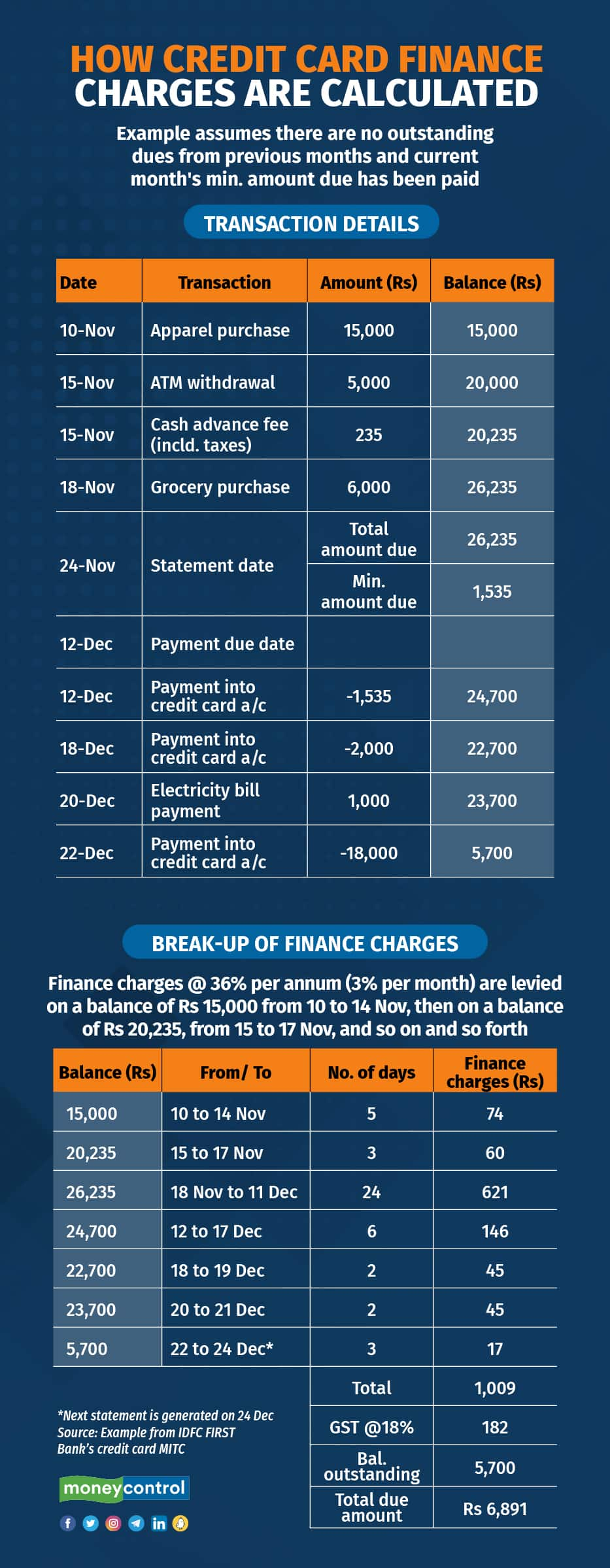
The actual finance charge you see on your statement is calculated using a formula that involves your APR, your average daily balance, and the number of days in your billing cycle.
The basic formula is:
Finance Charge = (Average Daily Balance) × (Daily Periodic Rate)
Let’s break this down:
- Average Daily Balance: This is the average amount you owed on your credit card each day during the billing cycle. It’s calculated by adding up your balance at the end of each day and dividing by the number of days in the billing cycle. If you make payments or new purchases throughout the cycle, this balance will fluctuate.
- Example: If your balance was $1000 for 15 days and then $1200 for the remaining 16 days of a 31-day billing cycle, your average daily balance would be:
- ($1000 * 15 + $1200 * 16) / 31 = $34,200 / 31 ≈ $1103.23
- Example: If your balance was $1000 for 15 days and then $1200 for the remaining 16 days of a 31-day billing cycle, your average daily balance would be:
- Daily Periodic Rate: This is derived from your APR. To find the daily rate, you divide your APR by 365 (or 360 in some cases, depending on the card issuer’s calculation method).
- Example: If your Purchase APR is 18%, your daily periodic rate would be 18% / 365 = 0.18 / 365 ≈ 0.000493
Using the example above, if your Purchase APR is 18%:
- Daily Periodic Rate = 18% / 365 = 0.000493
- Finance Charge = $1103.23 × 0.000493 × 31 days (to annualize for the month) ≈ $16.78
This $16.78 would be the finance charge added to your next statement if you carried that average daily balance for the entire month.
It’s important to remember that this is a simplified example. Credit card issuers may have slightly different calculation methods, and there can be multiple APRs applied to different parts of your balance simultaneously, especially if you have cash advances or balance transfers.
Beyond the APR: Other Fees and Their Impact
While finance charges are the primary cost of borrowing, credit cards can also incur other fees that add to the overall expense. Understanding these fees is crucial for a holistic view of credit card costs.
Annual Fees
Some credit cards, particularly those with premium rewards programs or exclusive benefits, come with an annual fee. This is a flat fee charged once a year, regardless of how much you use the card.

- When it’s Worth It: If the benefits you receive from the card (e.g., travel rewards, cash back, airport lounge access) significantly outweigh the annual fee, then it can be a worthwhile expense.
- When to Reconsider: If you’re not fully utilizing the card’s perks, the annual fee becomes a pure cost that erodes the value of any rewards you might earn.
Late Payment Fees
As mentioned earlier, missing a payment due date can trigger a late payment fee. These fees can be substantial and often have a compounding effect as they can also lead to a Penalty APR.
- The Importance of Timely Payments: The most straightforward way to avoid this fee is to make at least the minimum payment by the due date. Setting up automatic payments or calendar reminders can be invaluable.
Over-Limit Fees
If you spend more than your credit limit, your credit card issuer may charge an over-limit fee. Many issuers have moved away from automatically applying these fees, instead requiring cardholders to opt-in. However, if you do exceed your limit and have opted in, this fee can add to your debt.
Foreign Transaction Fees
If you use your credit card for purchases made in a foreign currency or with a merchant outside your home country, you may be subject to a foreign transaction fee. This is typically a percentage of the transaction amount.
- Travel-Friendly Cards: If you travel frequently, consider a credit card that waives foreign transaction fees.
Balance Transfer Fees
When you transfer a balance from one card to another, you’ll often encounter a balance transfer fee. This is usually a percentage of the amount being transferred, with a minimum fee.
- Weighing the Costs: While a balance transfer can be a good strategy to consolidate debt and take advantage of a lower introductory APR, always factor in the balance transfer fee to ensure it’s truly cost-effective.
Strategic Approaches to Minimize Finance Charges
The good news is that you have considerable control over the finance charges you incur on your credit cards. By adopting smart financial habits and leveraging available tools, you can significantly reduce these costs.
The Power of Paying in Full
This is the golden rule of credit card usage. If you can pay your entire statement balance in full by the due date every month, you will effectively avoid paying any finance charges on your purchases. This allows you to enjoy the convenience and rewards of credit cards without the added cost of interest.
- Budgeting and Tracking: Effective budgeting and diligent tracking of your spending are fundamental to ensuring you have the funds available to pay off your balance each month.
Strategic Debt Management
If you find yourself carrying a balance, there are strategies to manage and reduce the associated finance charges:
- Prioritize High-Interest Debt: Focus on paying down balances with the highest APRs first. This is known as the “debt avalanche” method and is mathematically the most efficient way to save on interest.
- Balance Transfers: As mentioned, a balance transfer to a card with a 0% introductory APR can be a powerful tool. However, be sure to have a plan to pay off the balance before the introductory period ends, and factor in any balance transfer fees.
- Debt Consolidation Loans: For larger debts, a personal loan with a lower fixed interest rate might be an option to consolidate your credit card debt and pay it off more quickly and affordably.
Leveraging Technology for Financial Literacy
In today’s digital landscape, technology offers a wealth of tools to help you manage your finances and understand your spending.
- Budgeting Apps: Apps like Mint, YNAB (You Need A Budget), or Personal Capital can link to your credit card accounts, track your spending, categorize your expenses, and alert you to upcoming payment due dates. This visibility is crucial for avoiding late fees and staying on top of your balances.
- Credit Score Trackers: Many credit card issuers and financial institutions offer free credit score monitoring. Understanding your credit score helps you negotiate better APRs and identify potential issues.
- AI-Powered Financial Advisors: Emerging AI tools can provide personalized insights into your spending habits, suggest areas for savings, and even help you create debt repayment plans. These tools can democratize access to financial advice.
Understanding Brand Loyalty and Credit Card Choices
When choosing a credit card, it’s not just about the immediate rewards; it’s also about understanding the long-term financial implications.
- Brand Reputation and Transparency: Reputable financial institutions are generally more transparent about their fees and interest rates. As a consumer, researching the brand behind the credit card is as important as comparing the APRs.
- Personal Branding and Financial Habits: Your personal brand as a consumer is built on your financial habits. Consistently managing credit responsibly enhances your financial reputation, opening doors to better financial products and opportunities.
Conclusion: Empowering Your Financial Future
Finance charges on a credit card are a significant component of the true cost of borrowing. By understanding the nuances of APRs, grace periods, and various fees, you can make informed decisions about how you use your credit. The key to minimizing these charges lies in responsible financial behavior: paying your balance in full whenever possible, strategically managing debt when carrying a balance, and leveraging the wealth of technological tools available to enhance your financial literacy.
In an era where digital finance is becoming increasingly complex, a solid understanding of fundamental concepts like finance charges is not just about saving money; it’s about empowering yourself to build a secure and prosperous financial future. By embracing smart money management, informed choices about credit products, and the strategic use of technology, you can turn your credit card from a potential debt trap into a powerful tool for achieving your financial goals.
aViewFromTheCave is a participant in the Amazon Services LLC Associates Program, an affiliate advertising program designed to provide a means for sites to earn advertising fees by advertising and linking to Amazon.com. Amazon, the Amazon logo, AmazonSupply, and the AmazonSupply logo are trademarks of Amazon.com, Inc. or its affiliates. As an Amazon Associate we earn affiliate commissions from qualifying purchases.