
For most individuals, purchasing a home represents the largest financial commitment they will ever make. It’s a journey fraught with decisions, complex terminology, and significant long-term implications. Among the most critical elements to grasp is the mortgage interest rate. Far from being a mere percentage, it’s a dynamic figure that dictates a substantial portion of your monthly housing payment, profoundly influencing your overall financial health and purchasing power. Understanding what an interest rate is, how it’s determined, and its various forms is not just beneficial—it’s essential for anyone navigating the intricate world of homeownership. This article aims to demystify mortgage interest rates, offering a comprehensive guide to empower you with the knowledge needed to make informed financial decisions regarding your home loan.
The Core Concept: Understanding Mortgage Interest Rates
At its heart, a mortgage interest rate is the cost you pay to borrow money from a lender to purchase a home. When a bank or financial institution lends you a substantial sum for many years, they do so with the expectation of earning a return on that loan. This return is the interest. It’s the price of using the lender’s capital and is expressed as a percentage of the principal amount borrowed.
Defining Interest Rates
An interest rate is fundamentally a percentage charged by a lender for the use of assets, typically money. In the context of a mortgage, it’s the annual cost of the loan, calculated as a percentage of the outstanding principal balance. This rate is usually quoted annually but translates directly into how much interest you pay each month on your outstanding loan amount. It’s crucial to distinguish between the nominal interest rate and the Annual Percentage Rate (APR), which includes other loan costs like origination fees, discount points, and some closing costs, offering a more complete picture of the total cost of borrowing.
Why Interest Rates Matter for Mortgages
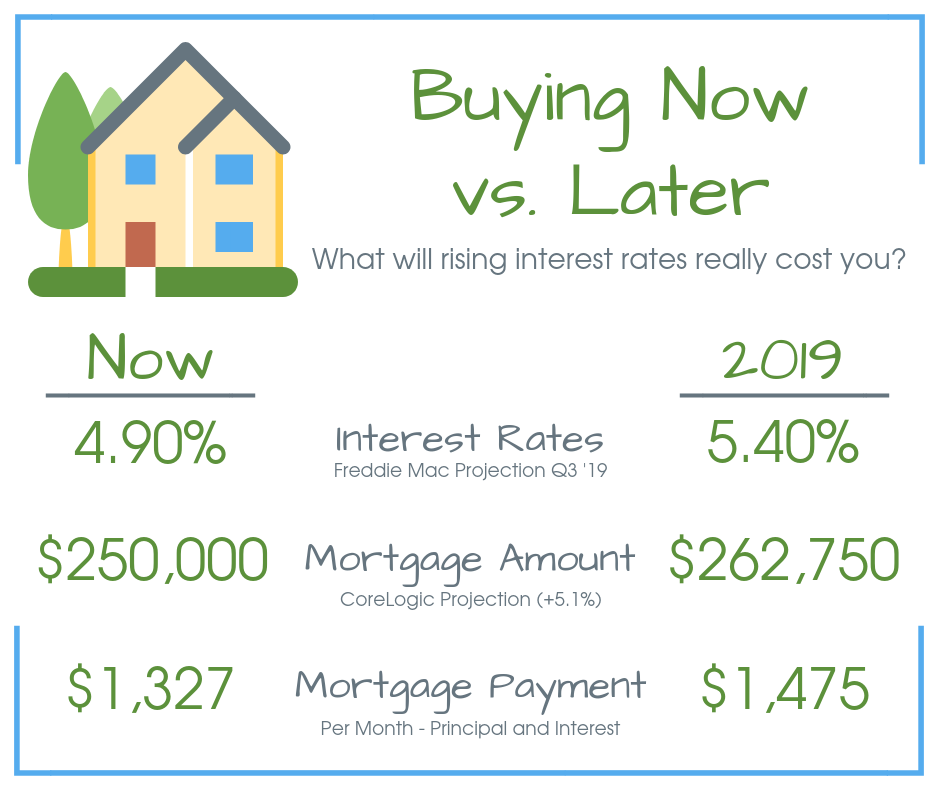
The interest rate is perhaps the single most impactful factor determining the affordability and total cost of your mortgage over its lifetime. A difference of even a quarter or half percentage point can translate into tens of thousands of dollars in interest payments over a 15-year or 30-year term. A lower interest rate means a lower monthly payment, making homeownership more accessible and freeing up more of your budget for other financial goals. Conversely, a higher interest rate can significantly increase your monthly burden and the overall amount you repay, potentially limiting your purchasing power or stretching your budget thin. Understanding this direct correlation is the first step toward strategically approaching your home loan.
Simple vs. Compound Interest in Mortgages
While mortgages primarily involve simple interest calculations on the outstanding principal for each payment period, the cumulative effect over time can resemble compounding. Each month, interest is calculated on the remaining principal balance. As you make payments, a portion goes to interest and a portion to principal. With each subsequent payment, as the principal balance decreases, the amount of interest due also decreases, assuming a fixed rate. This process, known as amortization, ensures that over the life of the loan, you gradually pay down the principal until the entire loan is satisfied. However, early in the loan term, a larger portion of your payment goes towards interest, effectively “compounding” the impact of the rate on your initial payments.
How Mortgage Interest Rates Are Determined
Mortgage interest rates are not arbitrarily set; they are a complex interplay of various economic indicators, market forces, lender policies, and individual borrower characteristics. Understanding these influences can help prospective homeowners anticipate market movements and better position themselves for favorable rates.
Economic Factors
Several broad economic factors exert significant influence on mortgage rates. The Federal Reserve’s monetary policy, particularly its actions regarding the federal funds rate, plays a pivotal role. While the federal funds rate doesn’t directly dictate mortgage rates, it influences the overall cost of borrowing for banks, which in turn affects what they charge consumers. Inflation is another critical driver; lenders demand higher rates during periods of high inflation to ensure their returns aren’t eroded by a decrease in purchasing power. The bond market, specifically the yield on 10-year Treasury bonds, often acts as a benchmark for long-term interest rates like those on 30-year fixed mortgages. Global economic stability, employment rates, and consumer confidence also contribute to the rate environment.
Lender-Specific Factors
Beyond macroeconomic trends, individual lenders have their own set of factors that shape the rates they offer. These include their cost of funds, which is what they pay to borrow money themselves; their overhead costs for operations; and their desired profit margins. Lenders also consider their risk assessment of the overall market and their specific loan portfolio. A lender might offer slightly different rates based on their current lending goals, their appetite for risk, or even their geographic market. Comparison shopping across multiple lenders is crucial because these internal factors can lead to varying rate offers for the same borrower.
Borrower-Specific Factors
Your personal financial profile significantly impacts the interest rate you qualify for. Lenders assess several key metrics to gauge your creditworthiness:
- Credit Score: A higher credit score (typically FICO score) indicates a lower risk to lenders, often qualifying you for the best available rates. Scores typically range from 300-850.
- Debt-to-Income (DTI) Ratio: This ratio compares your total monthly debt payments to your gross monthly income. A lower DTI ratio (ideally below 43%) demonstrates your ability to manage additional debt.
- Down Payment: A larger down payment reduces the amount you need to borrow, thus decreasing the lender’s risk and potentially leading to a lower interest rate. It also affects your loan-to-value (LTV) ratio.
- Loan-to-Value (LTV) Ratio: This is the ratio of the loan amount to the home’s appraised value. A lower LTV (meaning a larger down payment) often results in a better rate.
- Loan Term and Type: The duration of your loan (e.g., 15-year vs. 30-year) and its structure (fixed vs. adjustable) also influence the rate, as discussed below.
Loan Product Type
The specific mortgage product you choose has a direct bearing on the interest rate. Fixed-rate mortgages typically carry a higher initial rate than adjustable-rate mortgages (ARMs) because they offer the borrower stability and protection from future rate increases. ARMs, while starting lower, introduce interest rate risk as their rates can fluctuate over time. The loan term also matters; shorter-term loans (e.g., 15-year fixed) generally have lower interest rates than longer-term loans (e.g., 30-year fixed) due to the reduced risk for the lender over a shorter period.
Types of Mortgage Interest Rates
When seeking a mortgage, you’ll encounter two primary categories of interest rates: fixed and adjustable. Each comes with its own set of characteristics, benefits, and risks, making the choice a crucial one based on your financial situation and market outlook.
Fixed-Rate Mortgages: Stability and Predictability
A fixed-rate mortgage is characterized by an interest rate that remains constant for the entire duration of the loan. This means your principal and interest payment will never change, providing unparalleled stability and predictability for your monthly budget. Common fixed-rate terms include 15, 20, and 30 years, with the 30-year fixed mortgage being the most popular choice due to its lower monthly payments.
The primary advantage of a fixed-rate mortgage is the security it offers. You are insulated from future interest rate hikes, which can be a significant relief if rates climb after you’ve locked in. This predictability simplifies long-term financial planning. The main drawback is that if market interest rates fall significantly, you won’t benefit from the lower rates unless you refinance, which involves new closing costs. Fixed-rate mortgages are generally preferred by borrowers who plan to stay in their homes for many years or those who value budgetary certainty above all else.
Adjustable-Rate Mortgages (ARMs): Flexibility and Risk
An Adjustable-Rate Mortgage (ARM) features an interest rate that can change periodically over the life of the loan. ARMs typically start with a lower interest rate than comparable fixed-rate mortgages for an initial period (e.g., 3, 5, 7, or 10 years). After this introductory fixed period, the rate adjusts at regular intervals (e.g., annually) based on a specific financial index plus a fixed margin set by the lender.

The allure of an ARM lies in its lower initial payments, which can make homeownership more accessible, especially in periods of high fixed rates. However, ARMs carry inherent risk. If interest rates rise after the fixed period, your monthly payments could increase significantly. Most ARMs include caps on how much the rate can adjust per period and over the life of the loan, offering some protection but not eliminating the risk entirely. ARMs are often suitable for borrowers who anticipate selling or refinancing before the fixed-rate period ends, or those who expect their income to increase substantially in the future to absorb potential payment hikes.
Hybrid ARMs (e.g., 5/1 ARM)
Hybrid ARMs are the most common type of adjustable-rate mortgage. They combine features of both fixed-rate and adjustable-rate loans. For example, a “5/1 ARM” means the interest rate is fixed for the first five years, and then it adjusts annually for the remainder of the loan term. Other popular hybrids include 3/1, 7/1, and 10/1 ARMs. These offer an initial period of payment stability, which is often attractive to borrowers who want the lower starting rate of an ARM but desire some predictability for an extended period before rate adjustments begin.
Comparison: Fixed vs. Adjustable – Which is Right for You?
The choice between a fixed-rate and an adjustable-rate mortgage depends heavily on your individual circumstances, financial goals, and market outlook.
- Choose Fixed if: You plan to stay in your home for many years, prioritize predictable monthly payments, or believe interest rates will rise in the future.
- Choose ARM if: You plan to sell or refinance before the fixed-rate period expires, you expect interest rates to fall, or you can comfortably afford potential payment increases.
Careful consideration of your risk tolerance, income stability, and long-term housing plans is paramount in making this critical decision.
The Impact of Interest Rates on Your Mortgage and Financial Future
The interest rate you secure on your mortgage is not merely a number on a piece of paper; it has profound, lasting implications for your immediate budget and your long-term financial trajectory. Understanding this impact is key to prudent financial planning.
Monthly Payments and Total Cost of the Loan
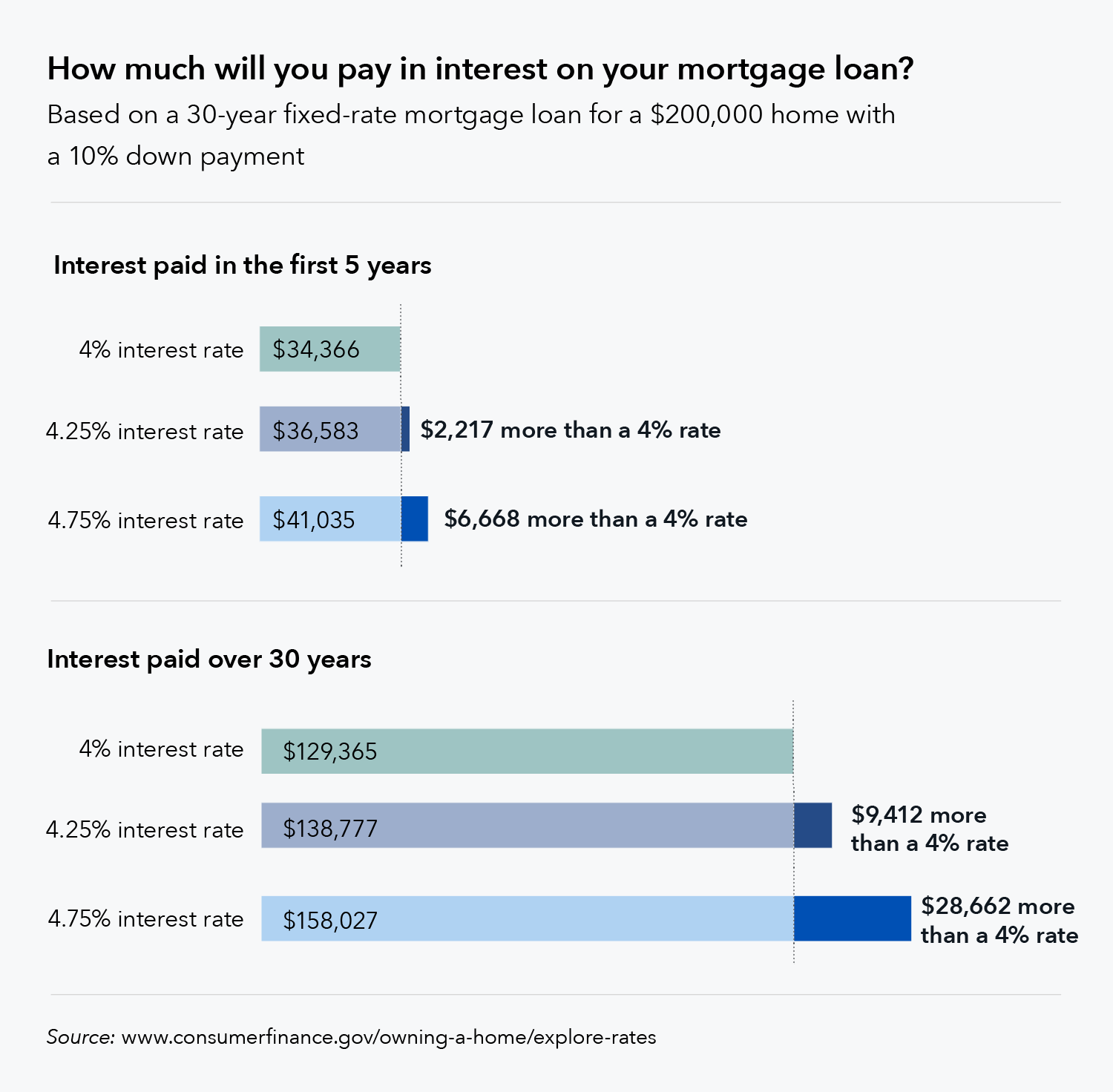
The most immediate and obvious impact of the interest rate is on your monthly mortgage payment. A higher rate means a larger portion of your payment goes towards interest, resulting in a higher overall monthly expense for the same loan amount. Over the life of a 15-year or 30-year mortgage, even small differences in the interest rate can add up to tens or even hundreds of thousands of dollars in total interest paid. This directly affects your cash flow and how much disposable income you have each month for other necessities, savings, or investments. The difference between a 4% and 5% rate on a $300,000, 30-year fixed mortgage could mean an additional $180 per month and over $65,000 more paid in interest over the life of the loan.
Affordability and Buying Power
Interest rates directly influence how much home you can afford. Lenders calculate your maximum loan amount based on your income, debts, and the current interest rates, ensuring your monthly payments don’t exceed a certain percentage of your income (your debt-to-income ratio). When interest rates are low, your monthly payment for a given loan amount is lower, meaning you can afford to borrow more and potentially purchase a more expensive home. Conversely, when rates are high, your buying power diminishes because a larger portion of your budget is consumed by interest, forcing you to consider less expensive properties or settle for a smaller loan amount.
Refinancing Opportunities
The volatility of interest rates creates opportunities for homeowners through refinancing. If market interest rates drop significantly after you’ve secured your initial mortgage, you might be able to refinance your loan to a lower rate. Refinancing involves taking out a new mortgage to pay off your old one, ideally at a more favorable rate or with different terms (e.g., switching from an ARM to a fixed-rate). A successful refinance can reduce your monthly payments, lower the total interest paid over the remaining loan term, or even allow you to tap into your home equity. However, refinancing comes with closing costs, so it’s essential to calculate whether the savings outweigh these upfront expenses.
Long-Term Wealth Building and Financial Planning
Your mortgage interest rate plays a subtle yet critical role in your long-term wealth building strategy. A lower interest rate means more of your monthly payment goes towards paying down principal, building equity faster. This equity can be a valuable asset for future financial needs, such as funding education, starting a business, or even retirement. Furthermore, lower housing costs due to a favorable interest rate free up capital that can be invested elsewhere—in retirement accounts, stocks, or other income-generating assets—contributing significantly to your overall financial planning and wealth accumulation over decades.
Navigating the Mortgage Market: Tips for Borrowers
Securing a favorable mortgage interest rate can save you a substantial amount of money over the life of your loan. Being an informed and proactive borrower is your best strategy for achieving this.
Shopping Around for the Best Rate
One of the most effective ways to secure a good interest rate is to shop around. Don’t settle for the first offer you receive. Contact multiple lenders—banks, credit unions, mortgage brokers, and online lenders—and request quotes. Lenders have different overheads, risk assessments, and product offerings, which means rates can vary significantly. Gather Loan Estimates from at least three to five different lenders and compare them meticulously, focusing not just on the interest rate but also on the Annual Percentage Rate (APR) and other closing costs. Using a mortgage broker can also be beneficial as they work with multiple lenders to find you competitive options.
Improving Your Financial Profile
Before applying for a mortgage, take steps to improve your creditworthiness. Check your credit report for errors and dispute any inaccuracies. Pay down existing debts to lower your debt-to-income ratio. Build a solid savings reserve for your down payment and closing costs. A higher credit score, a lower DTI, and a larger down payment signal less risk to lenders, making you eligible for their most attractive interest rates. These efforts can translate into thousands of dollars in savings over the life of your loan.
Understanding Closing Costs and APR
While the advertised interest rate is important, it doesn’t tell the whole story. You must also understand closing costs—fees paid at the closing of a real estate transaction. These can include origination fees, appraisal fees, title insurance, and sometimes discount points, which are upfront fees paid to the lender in exchange for a lower interest rate. The Annual Percentage Rate (APR) provides a more comprehensive measure of the total cost of borrowing, as it factors in most of these fees alongside the interest rate. Always compare APRs when evaluating loan offers, as it gives you a truer picture of the loan’s overall expense.
Seeking Professional Advice
Navigating the mortgage market can be complex, especially for first-time homebuyers. Don’t hesitate to seek advice from financial professionals. A reputable mortgage loan officer or financial advisor can help you understand the different loan products, explain the nuances of interest rates, and guide you through the application process. They can also help you assess your financial situation, determine how much you can truly afford, and strategize on how to best position yourself for the most favorable terms. Their expertise can be invaluable in making one of the most significant financial decisions of your life.
In conclusion, the interest rate on a mortgage is far more than a simple percentage; it is a critical financial lever that dictates the affordability, cost, and long-term implications of your home loan. By understanding its definition, the factors that influence it, the different types available, and its profound impact on your financial future, you can approach the home buying process with confidence and make choices that align with your broader financial goals. Taking the time to educate yourself, optimize your financial profile, and diligently shop for the best terms will undoubtedly pay dividends throughout your journey as a homeowner.
aViewFromTheCave is a participant in the Amazon Services LLC Associates Program, an affiliate advertising program designed to provide a means for sites to earn advertising fees by advertising and linking to Amazon.com. Amazon, the Amazon logo, AmazonSupply, and the AmazonSupply logo are trademarks of Amazon.com, Inc. or its affiliates. As an Amazon Associate we earn affiliate commissions from qualifying purchases.