
The Dow Jones Industrial Average (DJIA), often simply referred to as “the Dow,” stands as one of the most widely recognized and frequently cited stock market indices in the world. For over a century, it has served as a barometer for the health of the U.S. stock market and, by extension, the broader American economy. At its core, the Dow comprises a select group of 30 “blue-chip” American companies, meticulously chosen to represent various sectors and act as leaders in their respective industries. Understanding what the Dow 30 stocks are, how they are selected, and their significance is crucial for anyone engaging with personal finance, investing, or business finance. This article will delve into the intricacies of the Dow, its components, and its role in the financial landscape.

Understanding the Dow Jones Industrial Average (DJIA)
The Dow Jones Industrial Average is more than just a number; it’s a snapshot of industrial and economic strength, reflecting the performance of some of the largest and most influential public companies in the United States. Its long history and consistent presence in financial news make it a foundational concept for investors worldwide.
A Brief History and Purpose
Conceived by Charles Dow, co-founder of Dow Jones & Company, and editor of The Wall Street Journal, the DJIA was first published on May 26, 1896. Initially, it consisted of just 12 industrial companies, primarily involved in heavy industries like railroads, cotton, sugar, and tobacco. The very first average was calculated by adding up the stock prices and dividing by the number of companies. The purpose then, as it largely remains today, was to provide a simple, understandable measure of the market’s performance and the general health of the industrial sector. Over time, as the U.S. economy diversified beyond heavy industry, the composition of the Dow evolved to include companies from a broader range of sectors, though the “Industrial” moniker has persisted as a historical legacy rather than a strict descriptor of its constituents. It grew to 30 stocks in 1928, a number it has maintained ever since.
Price-Weighted Index Explained
Unlike many modern stock indices that are market-capitalization-weighted (where companies with larger market caps have a greater influence), the DJIA is a price-weighted index. This means that stocks with higher share prices have a greater impact on the index’s value than stocks with lower share prices, regardless of the company’s overall market capitalization. For instance, if a stock trading at $300 moves up by 1%, it will have a much larger effect on the Dow’s total points than a stock trading at $50 moving up by 1%, even if the $50 stock represents a much larger company by market value.
To account for stock splits, dividends, and other structural changes that would otherwise distort the index’s continuity, the sum of the prices of the 30 stocks is divided by a special number called the “Dow Divisor.” This divisor is adjusted periodically to ensure that the index’s value remains comparable over time, reflecting only genuine changes in stock prices rather than arbitrary adjustments. This unique methodology is a defining characteristic of the Dow and sets it apart from other major indices like the S&P 500, which offers a broader, market-cap-weighted view of the market.
Why the Dow Matters to Investors
For many investors, especially those new to the stock market, the Dow serves as an accessible entry point for understanding market dynamics. Its historical significance and frequent media coverage make it an immediate reference point for “how the market did today.” While it only represents 30 companies, these companies are typically household names, making the index’s movements relatable to everyday consumers. Financial news outlets often lead with the Dow’s performance, shaping public perception of the economy. For professional investors, while the Dow may not be the primary benchmark due to its limited scope and price-weighted nature, it still offers insights into the performance of established, large-cap companies. Its consistent performance over decades provides a long-term perspective on economic cycles and corporate resilience, offering valuable context for investment decisions and understanding market sentiment.
The Evolving Composition: Who Are the Dow 30?
The specific companies that comprise the Dow 30 are not static. While the number has remained at 30 for nearly a century, the individual constituents change over time to ensure the index remains relevant and representative of the evolving U.S. economy. This dynamic nature is key to its enduring utility.
Selection Criteria and Methodology
The selection of the Dow 30 stocks is not based on a rigid set of quantitative rules or algorithms. Instead, it is determined by a committee at S&P Dow Jones Indices, with the final approval coming from The Wall Street Journal. The primary criteria for inclusion revolve around a company’s reputation, sustained growth, and interest to a large number of investors. The committee seeks to include “blue-chip” companies—large, well-established, financially sound companies with long track records of profitability and stability. These companies are typically leaders in their respective industries and possess a strong brand presence.
Another crucial factor is ensuring adequate sector representation to reflect the broad scope of the U.S. economy. While the name “Industrial Average” might suggest a focus on manufacturing, the modern Dow includes companies from diverse sectors such as technology, healthcare, finance, consumer goods, and communications. Changes to the Dow are typically made only when a company’s significance to the broader market has diminished considerably, or when a new company emerges that better represents a particular sector or economic trend. These changes are usually announced in advance to minimize market disruption.
Representative Industries and Market Leaders
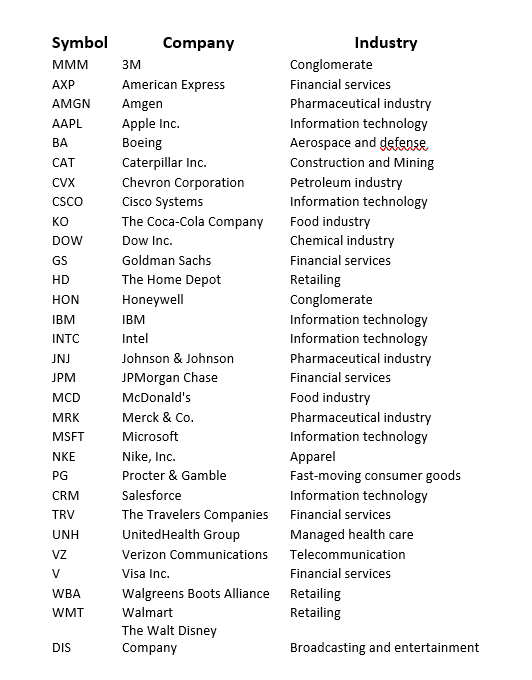
The current Dow 30 stocks represent a diverse cross-section of the U.S. economy. For example, the technology sector is often represented by giants like Apple and Microsoft, showcasing innovation and digital transformation. The healthcare industry might include pharmaceutical leaders such as Johnson & Johnson, reflecting advancements in medicine and biotechnology. Financial services are typically covered by major banks or investment firms like JPMorgan Chase. Consumer discretionary and staples are often represented by companies such as The Home Depot or Coca-Cola, indicating consumer spending patterns. Industrials, though not as dominant as in the past, still have a presence with companies like Boeing or Caterpillar.
The goal is not to have every industry represented, but rather to include leading companies whose performance broadly reflects the economic trends and health within key sectors. These are companies whose financial reports and strategic decisions can move markets and impact countless smaller businesses and supply chains. Their sheer scale and market influence make them bellwethers for their respective industries and the economy at large.
Notable Inclusions and Exclusions Over Time
The history of the Dow is peppered with significant changes that reflect major economic shifts. Iconic companies like General Electric, which was an original member and a continuous component for over a century, were eventually removed as their business models evolved or declined in relative importance. Conversely, companies like Apple and Salesforce have been added, marking the growing dominance of the technology and software sectors.
These changes underscore the Dow’s adaptability. When a company is added, it often signifies its coming of age as a blue-chip leader, garnering increased attention from institutional and retail investors alike. Conversely, an exclusion can signal a decline in a company’s market relevance or a significant shift in its business fortunes. For example, when Walgreens Boots Alliance was replaced by Amazon in early 2024, it highlighted the increasing weight of e-commerce and digital services in the modern economy over traditional retail and pharmacy chains. Such changes ensure that the Dow remains a dynamic and relevant indicator rather than a static historical artifact.
A Deeper Dive into the Current Dow Components
While the exact list of the Dow 30 stocks is subject to change and should always be verified with up-to-date financial news sources, understanding the types of companies typically found within it provides valuable insight into the U.S. economic landscape.
Sectoral Diversity and Blue-Chip Status
The Dow’s strength lies in its ability to offer a snapshot of market leadership across several critical sectors. While it’s not a perfectly proportional representation of the entire economy, the selection committee strives for a balance that reflects where economic activity and growth are concentrated. For instance, the presence of tech giants ensures coverage of the digital economy’s impact, while healthcare companies represent a vital and ever-growing sector. Financial institutions reflect the health of the capital markets, and consumer-focused companies offer insights into discretionary spending and essential goods.
The term “blue-chip” is central to the Dow’s identity. These are companies known for their financial stability, long-term track records of profitability, strong brand recognition, and often, consistent dividend payouts. They are generally considered less volatile than smaller, growth-oriented companies, making them attractive to investors seeking stability and reliable returns. Their inclusion in the Dow reinforces their status as leaders and often confers a perception of credibility and reliability.
Key Companies and Their Market Influence
To illustrate, consider some perennial examples of companies that have frequently, or consistently, been part of the Dow (understanding that the list is dynamic):
- Apple (AAPL): A technology behemoth, Apple’s inclusion highlights the critical role of consumer electronics, software, and digital services in the modern economy. Its stock movements significantly impact the Dow.
- Microsoft (MSFT): Another tech titan, Microsoft’s diversified portfolio spanning enterprise software, cloud computing (Azure), and gaming (Xbox) makes it a crucial bellwether for business and consumer tech trends.
- Johnson & Johnson (JNJ): Representing the healthcare sector, J&J’s presence underscores the importance of pharmaceuticals, medical devices, and consumer health products. Its stability often makes it a defensive play.
- JPMorgan Chase & Co. (JPM): As a leading global financial services firm, JPM’s performance reflects the health of the banking sector, capital markets, and broader economic confidence.
- Coca-Cola (KO): A classic example of a consumer staple, Coca-Cola’s global reach and consistent demand for its beverages provide insights into consumer spending habits and international market trends.
- The Home Depot (HD): This retail giant represents the consumer discretionary sector, offering a glimpse into consumer spending on home improvement, a key indicator of economic activity and housing market health.
These companies, individually and collectively, are not just large; they are trendsetters, innovators, and significant employers, whose performance is intertwined with the fabric of the American economy. Their sheer size means their quarterly earnings, product launches, or M&A activities can ripple through various industries and influence investor sentiment globally.
How to Track the Current Dow 30
Given the dynamic nature of the Dow’s components, it’s essential for investors and financial enthusiasts to know where to find the most up-to-date list. The official list of the Dow 30 stocks is maintained and updated by S&P Dow Jones Indices. Reliable sources for checking the current components include:
- The Wall Street Journal: As the co-creator of the index, The Wall Street Journal consistently publishes and updates the list of Dow components.
- S&P Dow Jones Indices Website: This is the official source, providing detailed information about the index and its constituents.
- Major Financial News Outlets: Reputable financial news websites (e.g., Bloomberg, Reuters, CNBC, Yahoo Finance) regularly update their pages with the current Dow components.
- Brokerage Platforms: Most online brokerage platforms will list the current components of the DJIA as part of their market data offerings.
Regularly checking these sources ensures that one has the most accurate information regarding which companies are currently included in this benchmark index.
Investing Implications and Strategies
For investors, the Dow 30 stocks offer a unique set of considerations. While investing solely in the Dow might not align with every investor’s goals, understanding its implications is crucial for a well-rounded investment strategy.
Pros and Cons of Focusing on Dow Stocks
Pros:
- Stability and Blue-Chip Quality: Dow companies are typically large, established, and financially sound, often referred to as “blue-chip” stocks. They tend to be less volatile than smaller companies and offer a degree of stability.
- Brand Recognition: Many Dow companies are household names, making them familiar and often comfortable investments for individual investors.
- Historical Performance: Over the long term, the Dow has demonstrated resilience and growth, reflecting the overall upward trend of the U.S. economy.
- Dividend Income: Many Dow companies have a history of paying consistent dividends, providing income for investors.
Cons:
- Limited Diversification: With only 30 stocks, the Dow provides limited diversification compared to broader indices like the S&P 500 (500 stocks) or a total market index (thousands of stocks). This concentrated exposure means that the underperformance of a few large components can significantly impact the index.
- Price-Weighted Bias: The price-weighted methodology means that companies with higher share prices, regardless of market capitalization, have a disproportionately larger influence on the index. This can sometimes lead to a less accurate representation of the broader market’s value.
- Missing Growth Opportunities: By focusing on large, established companies, the Dow may exclude many fast-growing, innovative companies that are not yet large enough or don’t fit the “blue-chip” criteria, potentially limiting exposure to high-growth opportunities.
- Subjective Selection: The selection process, being committee-driven rather than purely quantitative, can be perceived as less objective than other indices.
Diversification Beyond the Dow
While the Dow 30 offers exposure to a set of robust companies, smart investing principles emphasize the importance of broad diversification. Relying solely on the Dow 30 for an investment portfolio is generally not recommended due to its limited scope. Investors should consider diversifying across:
- Different Asset Classes: Beyond stocks, include bonds, real estate, and other alternative investments.
- Broader Equity Markets: Supplement Dow exposure with investments in the S&P 500, Nasdaq 100, Russell 2000 (small-cap stocks), and international markets.
- Diverse Sectors and Industries: Ensure your portfolio isn’t overly concentrated in a few sectors.
- Company Size: Include a mix of large-cap, mid-cap, and small-cap companies to capture different growth profiles.
A diversified portfolio reduces risk by ensuring that the poor performance of a single company or sector does not devastate overall returns.

Investing in the Dow: ETFs and Mutual Funds
For investors who wish to gain exposure to the Dow 30 stocks without buying all 30 individual shares, there are several convenient investment vehicles:
- Exchange-Traded Funds (ETFs): ETFs that track the Dow Jones Industrial Average are popular options. The most well-known is the SPDR Dow Jones Industrial Average ETF Trust (ticker: DIA), often referred to as “Diamonds.” Investing in DIA allows investors to own a diversified basket of the 30 Dow components in a single trade, typically with low expense ratios.
- Mutual Funds: Some mutual funds also aim to replicate the performance of the Dow or invest primarily in its components. These funds are managed by professionals and offer similar benefits of diversification and convenience, though they might have higher expense ratios or trading limitations compared to ETFs.
These financial tools provide an accessible way for individuals to participate in the performance of the Dow 30 companies, aligning with principles of personal finance and investing in a structured manner.
In conclusion, the Dow 30 stocks represent a crucial, albeit specific, segment of the U.S. equity market. Understanding its history, unique price-weighted methodology, and the selection criteria for its blue-chip components provides invaluable context for any investor. While it serves as a powerful market indicator and a reflection of corporate leadership, a prudent investment strategy always involves looking beyond a single index to ensure robust diversification and alignment with individual financial goals.
aViewFromTheCave is a participant in the Amazon Services LLC Associates Program, an affiliate advertising program designed to provide a means for sites to earn advertising fees by advertising and linking to Amazon.com. Amazon, the Amazon logo, AmazonSupply, and the AmazonSupply logo are trademarks of Amazon.com, Inc. or its affiliates. As an Amazon Associate we earn affiliate commissions from qualifying purchases.