
The ubiquitous calculator, a device so fundamental to our daily lives that we often take its presence for granted, represents a pinnacle of human ingenuity. From tallying groceries to solving complex engineering equations, its role is indispensable. Yet, the seemingly simple question, “who made a calculator,” unravels a rich, multi-century tapestry of innovation, collaboration, and incremental technological breakthroughs. It’s not the story of a single inventor but a fascinating narrative of minds across different eras, each building upon the insights and inventions of their predecessors. This journey, rooted deeply in the history of technology, explores humanity’s relentless quest to automate and simplify the arduous task of computation.

Early Attempts at Mechanical Calculation: The Quest for Automation Begins
The desire to perform calculations quickly and accurately is as old as civilization itself. Before the advent of mechanical or electronic devices, humans relied on their fingers, pebbles, and eventually, sophisticated manual aids to handle numerical tasks. These early innovations laid the foundational concepts for what would eventually evolve into the modern calculator.
The Abacus: Ancient Roots of Counting
Long before gears and circuits, the abacus stood as humanity’s first significant step towards externalizing and simplifying arithmetic. Originating in Mesopotamia around 2700–2300 BC, and later refined in ancient China and Rome, the abacus is a manual calculating device comprising a frame with rods on which beads slide. While not a “calculator” in the modern sense of automatic computation, it allowed skilled users to perform addition, subtraction, multiplication, and division with remarkable speed and accuracy. The abacus demonstrated the power of a structured physical system to represent and manipulate numbers, a principle that would resonate through later mechanical designs. It was a tangible proof-of-concept for the idea that tools could extend human cognitive abilities in mathematics.
Napier’s Bones and Logarithms: Simplifying Multiplication
The 17th century marked a significant turning point with Scottish mathematician John Napier’s contributions. In 1614, he published his work on logarithms, a revolutionary concept that could reduce multiplication and division to simpler addition and subtraction operations. This abstract mathematical tool was groundbreaking. To make logarithms practical, Napier also invented “Napier’s Bones” in 1617. These were a set of numbered rods, often made of bone or wood, used for mechanically multiplying, dividing, and finding square roots. While still requiring manual manipulation, Napier’s Bones significantly simplified complex arithmetic, paving the way for devices that could directly perform these operations. His work highlighted the power of mathematical theory combined with practical instrumentation.
Schickard’s Calculating Clock: The First True Mechanical Attempt
The credit for inventing what many consider the world’s first mechanical calculator often goes to Wilhelm Schickard, a German polymath and contemporary of Johannes Kepler. In 1623, Schickard designed and built a “Calculating Clock” for Kepler. This machine could add and subtract numbers up to six digits and included a mechanism for multiplying using Napier’s Bones in an integrated form. It featured a series of interconnected gears and dials, demonstrating an early understanding of how mechanical components could automate arithmetic operations. Tragically, Schickard’s prototype was destroyed in a fire, and his invention remained largely unknown outside a small circle until the 20th century. Despite its obscurity, Schickard’s design was remarkably sophisticated and represented a monumental leap in the pursuit of automated computation.
The Dawn of True Mechanical Calculators: Automating Arithmetic
The 17th century proved to be a fertile ground for innovation in mechanical calculation. Inspired by the need to simplify tedious manual tasks, brilliant minds across Europe began to develop machines that could perform arithmetic operations with unprecedented autonomy.
Pascal’s PASCALINE: A Pioneer’s Vision
Just two decades after Schickard, the French polymath Blaise Pascal, at merely 19 years old, developed his own mechanical calculator known as the “Pascaline.” Pascal’s motivation was deeply personal: to assist his father, a tax commissioner, with endless columns of figures. Between 1642 and 1644, Pascal built several versions of his device, which could perform addition and subtraction directly through a system of gears and wheels. A key innovation of the Pascaline was its “carry” mechanism, which automatically transferred a ten from one column to the next, much like we do in manual addition. While primarily limited to addition and subtraction and expensive to produce, the Pascaline was a functional, commercially available (albeit limited) mechanical calculator. It undeniably influenced subsequent designs and cemented Pascal’s legacy as a pivotal figure in the history of computing.
Leibniz’s Stepped Reckoner: Expanding Capabilities
Gottfried Wilhelm Leibniz, a German mathematician and philosopher, took the mechanical calculator concept a significant step further. In the 1670s, he designed and built the “Stepped Reckoner” (Staffelwalze). Leibniz’s machine was revolutionary because it could perform all four basic arithmetic operations—addition, subtraction, multiplication, and division—automatically. Its core innovation was the “stepped drum,” a cylinder with nine teeth of increasing length, which allowed for variable engagement with a counting wheel, thus facilitating multiplication through repeated addition and division through repeated subtraction. While the Stepped Reckoner proved mechanically complex and prone to errors, its conceptual leap was profound. Leibniz envisioned a machine that could not only calculate but also perform symbolic logic, prefiguring the philosophical underpinnings of modern computer science.
From Arithmometer to Pinwheel Calculators: Industrializing Computation
The 19th century witnessed the industrialization of mechanical calculators, making them more robust, reliable, and eventually, commercially viable. Charles Xavier Thomas de Colmar’s Arithmometer, patented in 1820, was the first mass-produced mechanical calculator. Based on Leibniz’s stepped drum, it was significantly more practical and durable, finding widespread use in offices, banks, and scientific institutions for nearly a century.
Later in the century, innovations like the pinwheel mechanism, pioneered by Frank S. Baldwin in the US (1875) and W. T. Odhner in Russia (1878), further simplified the design and improved efficiency. Pinwheel calculators became incredibly popular due to their compactness and ease of use, with companies like Odhner, Brunsviga, and Marchant producing millions of units. These machines, while still mechanical, were the workhorses of calculation for generations, demonstrating the growing demand for automated numerical processing in an increasingly complex world.
The Electromechanical Era and Beyond: Towards Electronic Calculation
As the 20th century dawned, the limitations of purely mechanical systems became apparent. The need for faster, more complex calculations, particularly in scientific and engineering fields, drove innovation towards integrating electrical components.
Electromechanical Innovations: From Relays to Tubes
The transition from purely mechanical to electromechanical devices marked a crucial phase. Early 20th-century inventors began exploring the use of electric motors to drive mechanical components, making calculators faster and reducing the physical effort required by operators. The ultimate leap came with the introduction of electrical relays and, subsequently, vacuum tubes. Relays allowed for the creation of logic circuits, enabling machines to perform calculations based on electrical signals rather than purely mechanical interactions. While bulky and power-intensive, devices using relays and vacuum tubes, such as the Atanasoff–Berry Computer (ABC) in the late 1930s and early 1940s, and later the formidable ENIAC, demonstrated the immense potential of electronics for computation. These machines were not “calculators” in the sense of personal devices, but they performed calculations at speeds unimaginable with mechanical systems, fundamentally reshaping the landscape of computation.
The Transistor Revolution and Miniaturization
The true breakthrough for personal electronic calculators arrived with the invention of the transistor in 1947 at Bell Labs. Transistors were minuscule, robust, and consumed far less power than vacuum tubes. This invention, and the subsequent development of integrated circuits (ICs) in the late 1950s, dramatically reduced the size, cost, and power consumption of electronic components. It was the transistor that transformed the room-sized computing machines into devices that could fit on a desktop, and eventually, in a pocket. The miniaturization allowed for complex electronic circuits to be packed into smaller form factors, making electronic calculators a practical reality for widespread adoption.
The Modern Electronic Calculator: A Personal Companion
With the transistor revolution, the dream of a fast, portable, and affordable personal calculating device finally materialized, democratizing computational power.
The First Electronic Calculators: Bridging the Gap
The world’s first all-electronic desktop calculator was the ANITA Mark VIII, launched in 1961 by the British company Sumlock Comptometer. It used vacuum tubes, making it large and expensive, but it performed calculations much faster and more quietly than its mechanical predecessors. Soon after, advancements in transistor technology led to more compact and reliable versions. By the mid-1960s, companies like Sharp (with its Compet CS-10A in 1964) introduced fully transistorized electronic desktop calculators, which quickly began to replace mechanical models in offices and businesses worldwide. These early electronic calculators were still bulky and costly but marked a clear shift towards the electronic era.
Texas Instruments and Hewlett-Packard: The Race for Portability
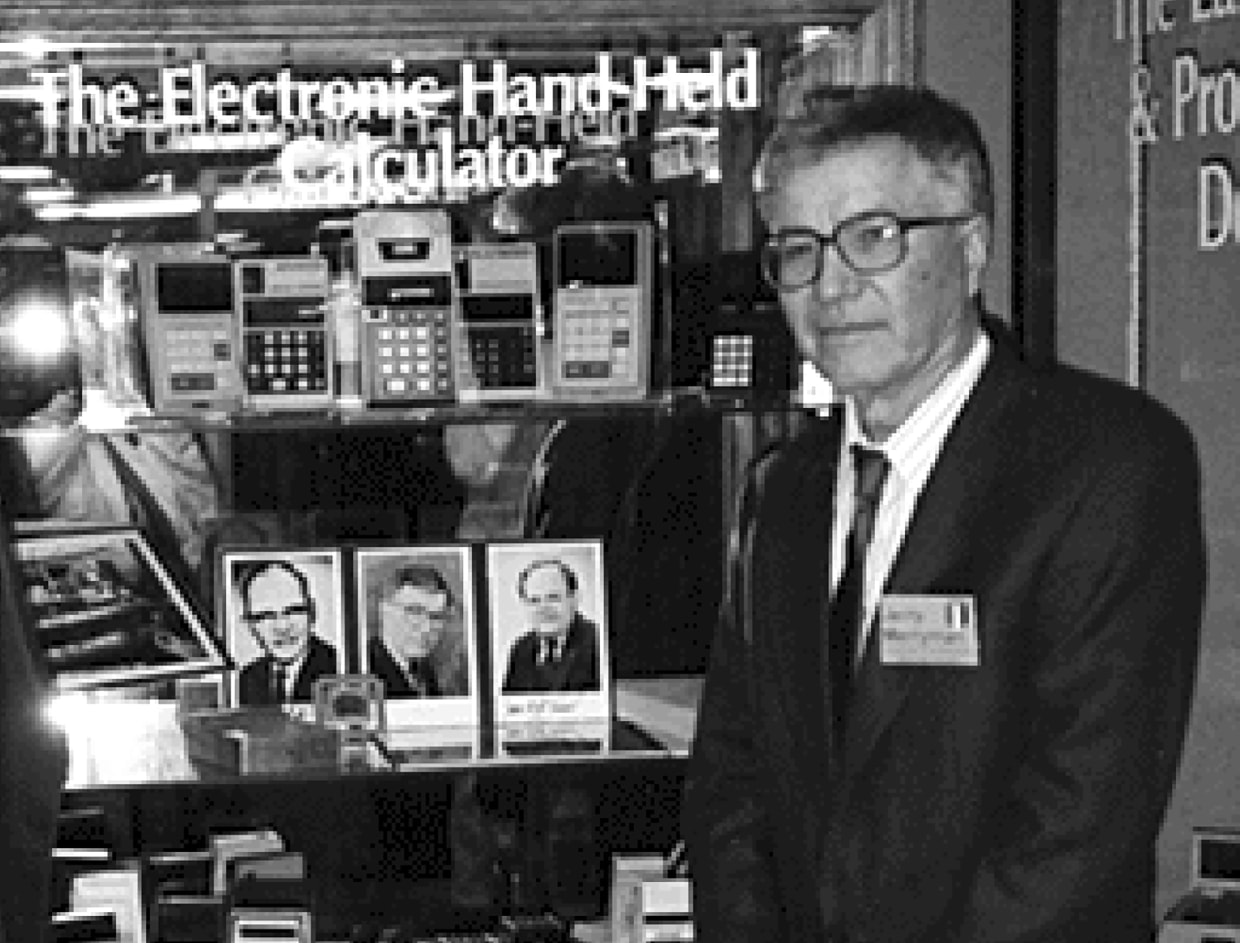
The race to create truly portable electronic calculators defined the late 1960s and early 1970s. In 1967, a team at Texas Instruments (TI) led by Jack Kilby developed the first handheld electronic calculator prototype, the “Cal-Tech.” It could add, subtract, multiply, and divide, and print results on a thermal printer. While TI licensed its chip technology to companies like Canon and Bowmar for initial commercial products (like the Bowmar Brain in 1971), they soon launched their own, leading to widespread affordability.
However, the major leap in functionality came from Hewlett-Packard (HP). In 1972, HP introduced the HP-35, the world’s first scientific handheld calculator. It was roughly pocket-sized and capable of performing complex trigonometric, logarithmic, and exponential functions previously only found on slide rules or large desktop machines. The HP-35 revolutionized science and engineering education and practice, making advanced computation accessible to individuals in a truly portable format. These devices, along with TI’s subsequent powerful models, democratized access to significant computational power.
From Basic Arithmetic to Scientific and Graphing Powerhouses
The evolution of the electronic calculator was rapid. From basic four-function models in the 1970s, they quickly expanded their capabilities. Scientific calculators became standard tools for students and professionals. The 1980s saw the introduction of programmable calculators, allowing users to write and store custom programs. The 1990s brought the graphing calculator, notably popularized by Texas Instruments with models like the TI-81 and TI-83. These devices could display graphs of functions, solve equations, and perform matrix operations, becoming indispensable in high school and university mathematics and science courses. Each iteration pushed the boundaries of what a handheld device could achieve, making increasingly complex tasks manageable with ease.
The Calculator in the Digital Age: Ubiquitous and Integrated
Today, the dedicated calculator, while still prevalent, exists alongside a vast ecosystem of digital computational tools, seamlessly integrated into our devices and software.
Integration into Software and Operating Systems
The rise of personal computers and smartphones has fundamentally transformed how we access calculating power. Most modern operating systems, from Windows to macOS, iOS, and Android, include built-in calculator applications that offer basic, scientific, and sometimes even programmer or statistical functions. These software calculators replicate and often exceed the capabilities of standalone hardware, offering convenience and accessibility at no extra cost. The physical calculator has, in many contexts, been subsumed into the broader digital device, making computation more ubiquitous than ever.
AI-Powered Computation and Advanced Tools
Looking ahead, the evolution of computational tools continues at a rapid pace. Artificial intelligence and machine learning are beginning to integrate with calculators, enabling more intuitive interfaces, natural language processing for input, and predictive capabilities. Online calculators now offer specialized functions for finance, engineering, statistics, and more, often far exceeding the scope of traditional handheld devices. Cloud-based computing allows for calculations of immense complexity, accessible from any device. From symbolic calculators like Wolfram Alpha to sophisticated data analysis tools, the concept of “calculating” has expanded beyond simple arithmetic to encompass highly advanced data processing, modeling, and intelligent problem-solving.

Conclusion
The question “who made a calculator” ultimately leads not to a singular individual but to a long, illustrious lineage of inventors, mathematicians, and engineers. From the ancient abacus to Schickard’s clock, Pascal’s arithmetic machine, Leibniz’s visionary stepped reckoner, and the industrialized marvels of the 19th century, each innovation built upon the last. The 20th century, with its electronic revolution driven by transistors and integrated circuits, finally brought the calculator into everyone’s hands, making it a portable, affordable, and incredibly powerful tool.
Today, the calculator’s legacy lives on in every smartphone, computer, and advanced computational system, continuing to evolve with AI and specialized software. It stands as a testament to humanity’s enduring drive to master numbers, simplify complexity, and push the boundaries of technological possibility. The calculator’s journey is not just a history of a device, but a compelling narrative of how persistent inquiry and cumulative innovation can transform the way we interact with the world around us.
aViewFromTheCave is a participant in the Amazon Services LLC Associates Program, an affiliate advertising program designed to provide a means for sites to earn advertising fees by advertising and linking to Amazon.com. Amazon, the Amazon logo, AmazonSupply, and the AmazonSupply logo are trademarks of Amazon.com, Inc. or its affiliates. As an Amazon Associate we earn affiliate commissions from qualifying purchases.