
In an era increasingly defined by algorithms, data, and artificial intelligence, the ability to understand and manipulate mathematical concepts has never been more critical. At the heart of much of this technological advancement lies algebra – a branch of mathematics dealing with symbols and the rules for manipulating these symbols. While often perceived as a purely academic subject, solving algebraic equations is a foundational skill that underpins everything from software development and data science to cybersecurity and machine learning.
This article aims to demystify the process of solving algebraic equations, placing it firmly within the context of technology. We’ll explore the core principles, essential techniques, and, crucially, how modern tech tools can aid in both learning and applying these solutions. For tech enthusiasts, aspiring developers, data scientists, and engineers, mastering algebra isn’t just about passing a test; it’s about acquiring a powerful toolset for innovation and problem-solving in the digital age.

The Core Principles of Algebraic Problem-Solving
At its essence, algebra is about finding unknown quantities. These unknowns are represented by variables, and the relationships between them are expressed through equations. To effectively navigate and solve these equations, a grasp of fundamental principles is indispensable.
Understanding Variables and Constants
In any algebraic equation, you’ll encounter two primary components: variables and constants. A variable is a symbol (typically a letter like $x$, $y$, or $z$) that represents an unknown quantity or a value that can change. For example, in a programming context, a variable might represent user input, an iteration count, or a data point. Constants, on the other hand, are fixed numerical values. They don’t change. Understanding this distinction is crucial, as the goal of solving most algebraic equations is to determine the value of the variable(s) that make the equation true. For instance, in $2x + 5 = 11$, $x$ is the variable, while $2$, $5$, and $11$ are constants.
The Golden Rule of Algebra: Balancing Equations
The most fundamental principle in algebra is that an equation must always remain balanced. Think of an equation as a perfectly balanced scale: whatever you do to one side, you must do to the other to maintain equilibrium. This means if you add a number to the left side, you must add the same number to the right side. The same applies to subtraction, multiplication, and division. This “golden rule” is the cornerstone of isolating variables, systematically peeling away constants and coefficients until the unknown variable stands alone on one side of the equation. This principle is mirrored in computational logic, where operations must be consistently applied to maintain data integrity and expected outcomes.
Order of Operations (PEMDAS/BODMAS) in Algebraic Contexts
Before you start manipulating an equation to isolate a variable, it’s often necessary to simplify expressions within the equation. This is where the order of operations, commonly remembered by acronyms like PEMDAS (Parentheses, Exponents, Multiplication and Division, Addition and Subtraction) or BODMAS (Brackets, Orders, Division and Multiplication, Addition and Subtraction), becomes vital. Applying operations in the correct sequence ensures accuracy. In algebraic problem-solving, this means simplifying any expressions within parentheses or brackets, evaluating exponents, then performing multiplication and division from left to right, and finally addition and subtraction from left to right. This systematic approach prevents errors and is a direct parallel to how compilers and interpreters process mathematical expressions in code.
Essential Techniques for Solving Various Equation Types
Algebraic equations come in various forms, each requiring slightly different strategies for solution. Understanding these common types and their associated techniques is key to building a robust problem-solving toolkit for tech applications.
Linear Equations: The Building Blocks
Linear equations are the simplest form of algebraic equations, typically involving a single variable raised to the power of one (e.g., $2x + 5 = 11$). They are called “linear” because when graphed, they form a straight line.
Solving a single-variable linear equation generally involves two main steps:
- Isolate the term with the variable: Use addition or subtraction to move all constant terms to one side of the equation and the variable term to the other. For example, in $2x + 5 = 11$, subtract 5 from both sides: $2x = 6$.
- Isolate the variable: Use multiplication or division to remove the coefficient (the number multiplying the variable). Continuing the example, divide both sides by 2: $x = 3$.
Linear equations are foundational for many algorithms, from simple calculations in financial software to resource allocation logic in operating systems.
Quadratic Equations: Bridging Theory to Application
Quadratic equations introduce a variable raised to the power of two. They take the general form $ax^2 + bx + c = 0$, where $a$, $b$, and $c$ are constants, and $a neq 0$. Quadratic equations often have two possible solutions for the variable.
Common methods for solving quadratic equations include:
- Factoring: If the quadratic expression can be factored into two binomials, setting each factor to zero provides the solutions. (e.g., $(x-2)(x-3)=0 implies x=2, x=3$).
- Completing the Square: A method to rewrite the quadratic equation into a perfect square trinomial, making it easier to solve.
- Quadratic Formula: The most universally applicable method, which always provides the solutions: $x = frac{-b pm sqrt{b^2 – 4ac}}{2a}$.
Quadratic equations are critical in fields like computer graphics for calculating trajectories and reflections, physics simulations in game development, and various optimization problems within machine learning models.
Systems of Equations: Handling Multiple Variables
Many real-world tech problems involve multiple unknown quantities related to each other. These scenarios are modeled using systems of equations, where you have two or more equations with two or more variables that must be solved simultaneously.
Two primary methods for solving systems of linear equations are:
- Substitution Method: Solve one equation for one variable in terms of the other variable(s), then substitute that expression into the other equation(s). This reduces the system to a single equation with fewer variables.
- Elimination Method: Multiply one or both equations by constants so that when the equations are added or subtracted, one of the variables is eliminated.
Systems of equations are fundamental in areas like resource management in cloud computing (e.g., balancing CPU, memory, and network resources), solving for optimal parameters in machine learning models (e.g., finding weights in linear regression), and analyzing complex network flows.
Leveraging Technology for Algebraic Solutions and Learning
While understanding the manual methods for solving algebraic equations is crucial, modern technology offers powerful tools that can streamline the process, verify solutions, and even tackle problems of immense complexity.
Symbolic Math Software and Libraries
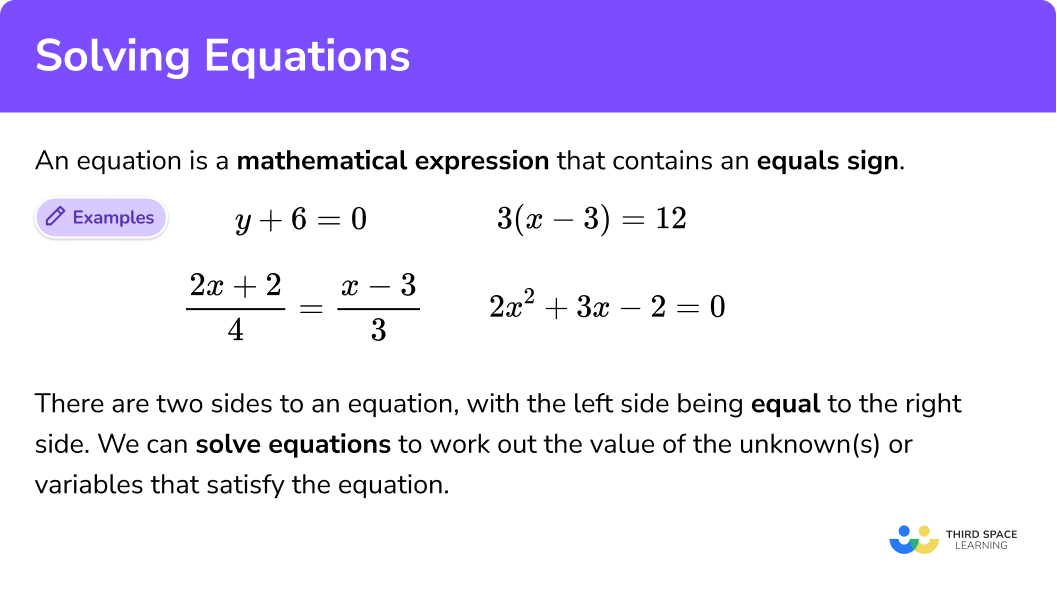
For those working in software development, data science, or engineering, symbolic math tools are invaluable. These programs and libraries can perform algebraic manipulations, solve equations, simplify expressions, and even differentiate and integrate symbolically.
- Python’s SymPy Library: A free and open-source Python library for symbolic mathematics. Developers can use SymPy to define symbolic variables and perform complex algebraic operations directly within their code. For instance, to solve $2x + 5 = 11$, one might write:
python

from sympy import symbols, solve

x = symbols('x')

equation = 2*x + 5 - 11

solution = solve(equation, x)

print(solution) # Output: [3]
- MATLAB/Octave: Widely used in engineering and scientific computing, MATLAB (and its open-source counterpart Octave) offers robust symbolic math toolboxes for solving equations, manipulating polynomials, and performing advanced linear algebra.
- Mathematica/Wolfram Alpha Pro: These commercial platforms are comprehensive computational knowledge engines that can solve virtually any algebraic equation or system, provide step-by-step solutions, and offer powerful visualization capabilities.
These tools are not just for verification; they enable rapid prototyping of mathematical models, automated derivation of complex formulas, and the integration of advanced mathematical functionality directly into applications.
Online Calculators and Educational Platforms
For learning, quick checks, and visual understanding, a plethora of online resources exist.
- Wolfram Alpha: Beyond its professional counterpart, the free version of Wolfram Alpha is an incredibly powerful computational knowledge engine that can solve equations and provide detailed steps.
- Desmos: An excellent graphing calculator that can visually represent equations, including systems, making it easier to understand solutions graphically.
- Khan Academy: Offers structured courses, video tutorials, and practice problems covering all levels of algebra, providing an accessible learning path for anyone.
- GeoGebra: Combines geometry, algebra, spreadsheets, graphing, statistics, and calculus into one easy-to-use package for visualizing mathematical concepts.
These platforms are invaluable for students and professionals alike, offering instant feedback, alternative solution methods, and a deeper conceptual understanding through interactive features.
The Role of AI and Machine Learning in Symbolic Computation
The field of artificial intelligence is increasingly encroaching on symbolic computation. While traditional AI has struggled with the nuanced reasoning required for advanced mathematics, recent breakthroughs in deep learning are enabling AI models to understand, generate, and even solve complex mathematical expressions. AI-powered tools can assist in finding proofs, simplifying expressions, and recognizing patterns in large datasets of equations. This emerging area hints at a future where AI could serve as an even more sophisticated mathematical assistant, capable of tackling problems that push the boundaries of human computation, automating parts of algorithm design and mathematical modeling processes.
Practical Applications of Algebra in Modern Tech
The utility of algebra extends far beyond abstract theory; it is woven into the very fabric of modern technology. Understanding algebraic principles is not just about solving for $x$; it’s about comprehending the underlying mechanisms of the digital world.
Data Science and Machine Learning
Algebra is the backbone of data science and machine learning.
- Linear Regression: One of the simplest yet most powerful predictive models, linear regression, is fundamentally an algebraic equation $y = mx + b$, where $m$ and $b$ are parameters determined by solving a system of equations to minimize errors.
- Gradient Descent: This ubiquitous optimization algorithm, used to train machine learning models, relies heavily on algebraic manipulation to find the minimum of a cost function by iteratively adjusting model parameters.
- Matrix Algebra: While technically a higher form of algebra, the principles of variables and operations extend into matrix manipulations. Matrices are fundamental for representing and processing large datasets, performing transformations in neural networks, and solving complex systems of linear equations efficiently.
Software Development and Algorithm Design
Every piece of software relies on algorithms, and many algorithms are direct implementations of algebraic logic.
- Game Physics: Simulating realistic movement, collisions, and trajectories in video games involves constant application of algebraic equations.
- Encryption Algorithms: Cryptography, the science of secure communication, uses complex algebraic structures (like modular arithmetic and polynomial equations) to encrypt and decrypt data, ensuring digital security.
- Resource Management: Operating systems and cloud platforms use algebraic logic to allocate CPU time, memory, and network bandwidth efficiently among competing processes.
Cybersecurity and Digital Forensics
Algebraic principles play a vital role in safeguarding digital assets and investigating breaches.
- Cryptography: As mentioned, robust encryption (e.g., RSA, AES) is deeply rooted in number theory and abstract algebra, making it difficult for unauthorized parties to decipher information without the correct algebraic keys.
- Intrusion Detection: Algebraic equations can be used to model normal network behavior. Deviations from these models, identified through solving and analyzing equations derived from network data, can flag potential security threats.
- Digital Forensics: Analyzing log files, network traffic, and file system metadata often involves solving for unknown parameters or patterns that point to malicious activity.
Cultivating Algebraic Fluency: Beyond the Classroom
Developing algebraic fluency is an ongoing journey that extends beyond traditional classroom settings. For tech professionals, it’s about integrating mathematical thinking into their daily problem-solving approach.
Practice and Problem-Solving Mindset
Consistent practice is paramount. Just like learning a new programming language, mastering algebraic equation solving requires repeated exposure to various problem types. Engage with challenges, work through examples, and don’t shy away from errors, as they are opportunities for deeper understanding. Develop a problem-solving mindset where you break down complex equations into manageable steps, identify knowns and unknowns, and systematically apply the appropriate rules. This analytical approach directly translates to debugging code, optimizing algorithms, and architecting robust systems.
Bridging Theory to Code
A critical step for tech professionals is to bridge the gap between abstract algebraic theory and practical coding. Try to translate the algebraic concepts you learn into functional code snippets. For example, if you learn to solve a quadratic equation manually, challenge yourself to write a Python function that implements the quadratic formula. This process solidifies understanding, demonstrates practical applicability, and enhances your coding skills simultaneously. Building small programs that solve various equation types, manipulate variables, or visualize functions can be an incredibly effective learning strategy.
Continuous Learning in a Dynamic Field
The tech landscape is constantly evolving, and with it, the mathematical demands placed on professionals. New algorithms emerge, new data structures are invented, and new optimization techniques are discovered. Therefore, cultivating algebraic fluency should be seen as a continuous learning process. Stay curious, explore advanced topics like linear algebra, calculus, and discrete mathematics as your tech career progresses, and always be open to learning new mathematical tools that can enhance your problem-solving capabilities in an ever-changing digital world.
Conclusion
The ability to solve algebraic equations is far more than a mere academic exercise; it is a foundational pillar for success in the technology sector. From the intricate logic of software algorithms to the predictive power of machine learning models and the impenetrable security of encryption, algebra provides the language and the tools to understand, build, and innovate. By mastering its core principles and leveraging the powerful computational tools at our disposal, tech professionals can unlock new possibilities, solve complex challenges, and contribute meaningfully to the digital future. Embrace algebra not as a hurdle, but as an essential key to unlocking the vast potential of the tech-driven world.
aViewFromTheCave is a participant in the Amazon Services LLC Associates Program, an affiliate advertising program designed to provide a means for sites to earn advertising fees by advertising and linking to Amazon.com. Amazon, the Amazon logo, AmazonSupply, and the AmazonSupply logo are trademarks of Amazon.com, Inc. or its affiliates. As an Amazon Associate we earn affiliate commissions from qualifying purchases.