
For millions of Americans, Social Security represents a vital financial cornerstone in retirement, disability, or as a safety net for survivors. Yet, the method by which the Social Security Administration (SSA) determines individual benefit amounts remains a mystery to many. Far from a simple flat rate, your Social Security benefit is the result of a complex, individualized calculation that considers a lifetime of earnings, inflation adjustments, and your chosen claiming age. Understanding this intricate process is not just an academic exercise; it’s a critical component of effective personal finance planning, allowing you to make informed decisions about your retirement strategy and future financial security.

This article will demystify the Social Security benefit calculation, breaking down the key steps from your earnings history to your final monthly payout. We’ll explore the underlying principles, the specific formulas involved, and the factors that can significantly influence the size of your checks. By shedding light on this crucial system, we aim to empower you with the knowledge to better anticipate your benefits and integrate them seamlessly into your broader financial picture.
Understanding the Foundation: Your Earnings Record
The journey to calculating your Social Security benefits begins, quite logically, with your earnings record. Every dollar you earn from “covered employment” – work for which you and your employer pay Social Security taxes (FICA taxes) – is meticulously recorded by the SSA. This record forms the bedrock of your future benefits, as the entire calculation hinges on how much you’ve contributed over your working life.
The Role of Your Annual Earnings
Each year, up to a certain maximum amount (known as the Social Security “taxable maximum” or “wage base limit”), your earnings are subject to Social Security taxes. This taxable maximum changes annually to reflect changes in the national average wage index. Only earnings up to this limit are considered in your benefit calculation. For instance, if the taxable maximum for a given year is $168,600 and you earned $200,000, only $168,600 of your earnings from that year will be credited towards your Social Security record. Earnings above this threshold are not taxed for Social Security and thus do not contribute to your benefit calculation.
Identifying “Covered” Earnings
It’s important to differentiate between all your income and “covered” earnings. Income from certain sources, such as some government pensions (if you didn’t pay Social Security taxes on that employment), or earnings that fall below the annual minimum for crediting, may not be counted. Most traditional W-2 employment and self-employment income (after certain deductions) are considered covered earnings. The SSA tracks these earnings using your Social Security number, which is why it’s crucial to ensure your personal information is accurate with your employer and with the SSA.
Why Accuracy Matters
Your earnings record is more than just a historical ledger; it’s the raw data that directly determines your future financial well-being from Social Security. Errors in this record, though rare, can significantly impact your benefits. For example, if an employer misreports your wages, or if there’s a typo in your Social Security number, years of earnings might be missing. The SSA advises reviewing your earnings record annually, which you can easily do by creating an account on the SSA’s official website (ssa.gov). If you find discrepancies, you have a limited time to correct them, making proactive review essential.
The Core Calculation: Average Indexed Monthly Earnings (AIME)
With your lifetime earnings record established, the SSA moves to the first major computational step: determining your Average Indexed Monthly Earnings (AIME). This isn’t just a simple average; it’s a sophisticated method designed to ensure that the value of your past earnings isn’t eroded by inflation, giving more weight to older earnings than a simple dollar-for-dollar sum would provide.
Indexing Your Past Wages
The concept of “indexing” is fundamental to AIME. Imagine earning $10,000 in 1975. While a substantial sum back then, its purchasing power is vastly different today. To account for inflation and the general rise in wages over time, the SSA “indexes” your past earnings to current wage levels. This means earnings from earlier years are adjusted upwards to reflect their value in today’s economy. This indexing typically applies up to the age of 60. For earnings in the year you turn 60 and subsequent years, your actual earnings are used without further indexing, as these wages are considered relatively recent.
Selecting the Highest 35 Years
Once all your earnings years (up to the taxable maximum, and indexed appropriately) are on an even playing field, the SSA identifies your 35 highest-earning years. For most individuals, this will encompass a significant portion of their career. If you have fewer than 35 years of covered earnings, the SSA will include years with zero earnings in the calculation, which will naturally lower your AIME and, consequently, your future benefits. This policy incentivizes longer careers and higher lifetime earnings. Conversely, working more than 35 years means that your lowest earning years can be dropped in favor of higher earning years, potentially boosting your AIME.
From Annual Earnings to AIME
After selecting your 35 highest indexed earning years, the SSA sums these indexed annual earnings. This total is then divided by 420 (which is the number of months in 35 years) to arrive at your Average Indexed Monthly Earnings. This AIME is the crucial figure that will be plugged into the next stage of the calculation, directly influencing your ultimate monthly benefit amount.
From AIME to Primary Insurance Amount (PIA)
The Average Indexed Monthly Earnings (AIME) is not your benefit amount. Instead, it is used to calculate your Primary Insurance Amount (PIA). Your PIA is the basic benefit you would receive if you start receiving benefits at your Full Retirement Age (FRA). It is the unadjusted monthly benefit before any modifications for early or delayed claiming, or other factors. The calculation from AIME to PIA is designed to be progressive, meaning it replaces a higher percentage of earnings for lower-income workers than for higher-income workers.
The Bend Points Formula
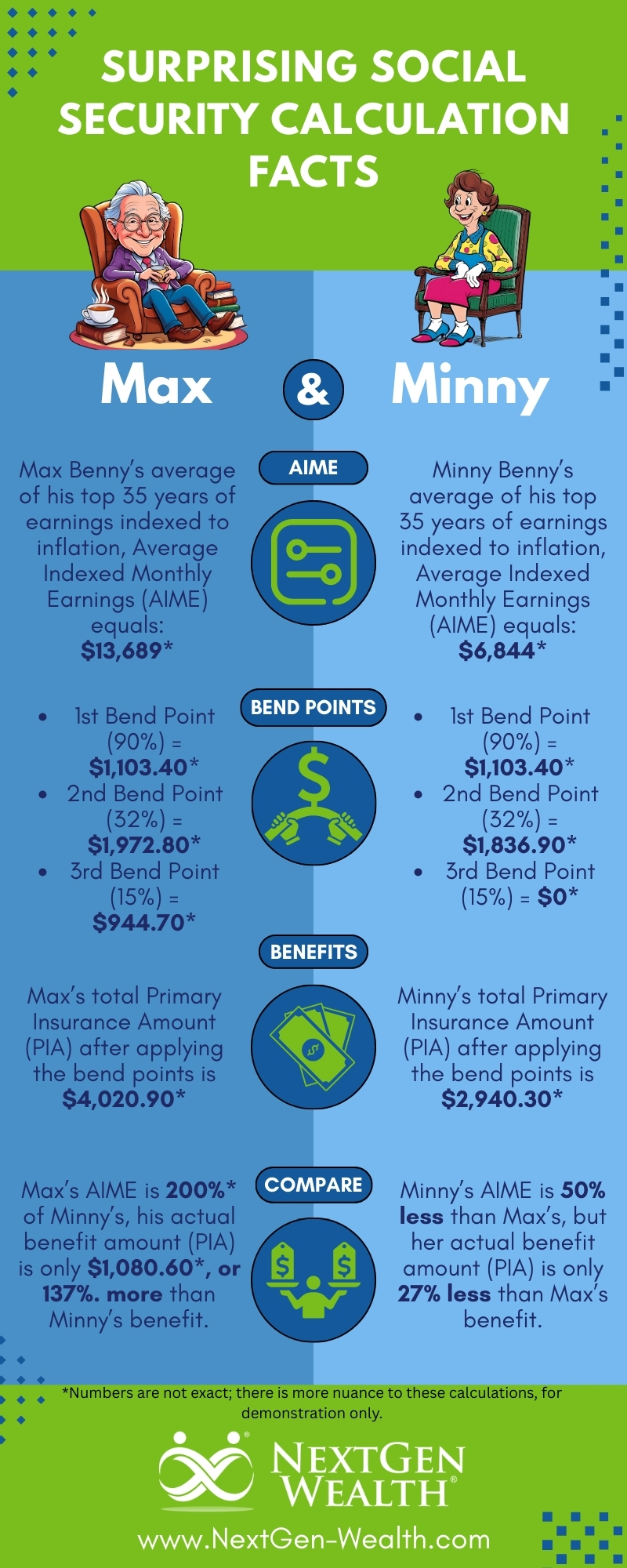
The SSA uses a “bend points” formula to convert your AIME into your PIA. This formula applies different percentages to specific segments of your AIME. For individuals who become eligible for retirement benefits in 2024, the formula uses three bend points:
- 90% of the first $1,174 of your AIME
- 32% of your AIME between $1,174 and $7,078
- 15% of your AIME over $7,078
Let’s illustrate with a simplified example:
If your AIME is $3,000, your PIA calculation would be:
- 90% of $1,174 = $1,056.60
- 32% of ($3,000 – $1,174) = 32% of $1,826 = $584.32
- 15% of the remainder (none in this example)
Your PIA would be $1,056.60 + $584.32 = $1,640.92 (approximately).
These bend points are adjusted annually based on the national average wage index, ensuring the formula remains relevant over time. This progressive structure aims to provide a social safety net, ensuring that even those with lower lifetime earnings receive a foundational level of support.
What PIA Represents
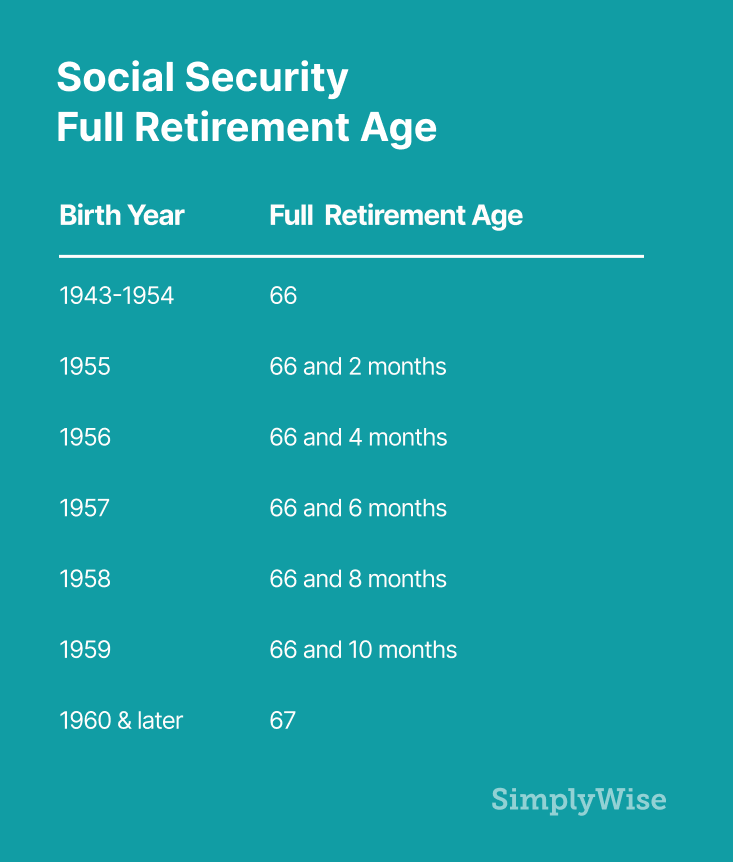
Your PIA is the benefit amount you are “entitled” to at your Full Retirement Age (FRA). Your FRA depends on your birth year, ranging from 66 for those born between 1943 and 1954, gradually increasing to 67 for those born in 1960 or later. The PIA is the figure from which all other benefit adjustments are made, whether for early claiming, delayed claiming, spousal benefits, or survivor benefits. It’s important to understand that your PIA is not necessarily what you will receive; it’s the starting point for further calculations.
How PIA Differs for Spouses and Survivors
While the primary earner’s PIA is calculated as described above, spousal and survivor benefits are typically a percentage of that PIA. For instance, a spouse claiming benefits at their own FRA can generally receive up to 50% of their partner’s PIA. A surviving spouse can often receive up to 100% of the deceased worker’s PIA. However, there are also “maximum family benefits” limits and “reduction factors” if benefits are claimed early, adding further layers of complexity to these derivative benefits.
Factors Adjusting Your Final Benefit
Once your Primary Insurance Amount (PIA) is established, it’s subject to several adjustments that can either increase or decrease the final monthly benefit you receive. These adjustments primarily revolve around your age when you choose to claim benefits, but other factors also play a role.
Claiming Age: Early vs. Full Retirement Age (FRA)
This is perhaps the most significant factor influencing your final benefit. While you can claim Social Security retirement benefits as early as age 62, doing so results in a permanent reduction of your monthly payment. For each month you claim before your Full Retirement Age (FRA), your benefit is reduced. For someone with an FRA of 67, claiming at 62 means a reduction of approximately 30% from their PIA. This reduction is designed to account for the longer period over which you will receive benefits. Conversely, waiting until your FRA means you receive 100% of your PIA.
Delayed Retirement Credits
If you choose to delay claiming benefits past your Full Retirement Age (FRA), you can earn “Delayed Retirement Credits” (DRCs). These credits permanently increase your monthly benefit by a certain percentage for each month you delay, up to age 70. For those born in 1943 or later, the annual increase is 8% (or 2/3 of 1% per month). This means that by waiting until age 70, you could increase your monthly benefit by 24-32% (depending on your FRA) compared to your PIA. This incentive is a powerful tool for boosting your retirement income, especially if you are in good health and have other income sources.
The Earnings Test (if claiming early)
If you claim Social Security benefits before your Full Retirement Age (FRA) and continue to work, your benefits may be temporarily reduced or withheld if your earnings exceed certain annual limits. This is known as the “earnings test.” For instance, in 2024, if you are under FRA, the SSA deducts $1 from your benefits for every $2 you earn above $22,320. In the year you reach FRA, the reduction is $1 for every $3 earned above a higher limit ($59,520 in 2024), only counting earnings before the month you reach FRA. Once you reach your FRA, the earnings test no longer applies, and you can earn as much as you like without impacting your Social Security benefits. Importantly, any benefits withheld due to the earnings test are not lost forever; they are used to recalculate your benefit at your FRA, giving you a slightly higher monthly payment.
Taxation of Social Security Benefits
Finally, it’s crucial to remember that a portion of your Social Security benefits may be subject to federal income tax, and in some states, state income tax. The amount that’s taxable depends on your “provisional income,” which includes your adjusted gross income, tax-exempt interest, and 50% of your Social Security benefits. If your provisional income exceeds certain thresholds, up to 50% or even 85% of your benefits could be taxable. This is an important consideration for retirement income planning, as it means your net benefit may be less than the gross amount calculated by the SSA.
Estimating and Planning for Your Future
Understanding the mechanics of Social Security benefit calculation is invaluable, but the true power lies in using this knowledge for proactive planning. Fortunately, the Social Security Administration provides robust tools and resources to help you estimate your future benefits and integrate them into your broader financial strategy.
Utilizing the Social Security Administration’s Tools
The most reliable resource for estimating your benefits is the SSA itself. By creating a “my Social Security” account on ssa.gov, you can access your personalized Social Security Statement. This statement provides an estimate of your retirement benefits at various ages (62, your FRA, and 70), as well as potential disability and survivor benefits. These estimates are based on your actual earnings record and projected future earnings, making them highly accurate for planning purposes. The website also offers various calculators that allow you to model different scenarios, such as the impact of claiming at different ages or changes in your future earnings.
The Importance of Regular Review
Your financial situation and earning patterns can change over time. Therefore, it’s not enough to check your Social Security Statement once and forget about it. Reviewing your statement annually, especially as you approach retirement, is crucial. This allows you to:
- Verify your earnings record: Catch any potential errors or missing income.
- Adjust projections: Account for career changes, periods of unemployment, or higher/lower earnings than previously anticipated.
- Re-evaluate claiming strategies: As your health, financial needs, and family situation evolve, your optimal claiming age might change.
Regular review ensures your retirement plan is based on the most current and accurate information available.
Integrating Social Security into Your Broader Retirement Plan
Social Security is a foundational element, but rarely the sole source, of retirement income. Effective financial planning requires integrating your estimated Social Security benefits with other income streams, such as 401(k)s, IRAs, pensions, and personal savings. Understanding your projected Social Security benefit allows you to:
- Determine your overall income needs: How much more do you need from other sources to meet your desired lifestyle?
- Optimize your claiming strategy: Should you claim early to bridge an income gap, or delay to maximize guaranteed income later?
- Manage longevity risk: Social Security, particularly when delayed, offers a valuable inflation-adjusted income stream for life, which can be a powerful hedge against outliving your other savings.
- Tax planning: Knowing the potential taxation of your Social Security benefits helps in structuring withdrawals from other retirement accounts to minimize your overall tax burden.
In conclusion, the Social Security benefit calculation process, while complex, is designed to fairly reward your lifetime contributions and provide essential financial security. By grasping how your earnings are indexed, how your AIME is calculated, and the impact of claiming age and other factors, you gain a powerful tool for navigating your financial future. Proactive engagement with your earnings record and utilization of the SSA’s resources are paramount steps towards making informed decisions that can significantly enhance your retirement security.
aViewFromTheCave is a participant in the Amazon Services LLC Associates Program, an affiliate advertising program designed to provide a means for sites to earn advertising fees by advertising and linking to Amazon.com. Amazon, the Amazon logo, AmazonSupply, and the AmazonSupply logo are trademarks of Amazon.com, Inc. or its affiliates. As an Amazon Associate we earn affiliate commissions from qualifying purchases.