
The conversion of fractions to decimals is a fundamental mathematical skill that underpins nearly every aspect of personal and business finance. While seemingly simple, understanding these conversions, especially for recurring decimals, is crucial for accurate budgeting, astute investing, and sound financial decision-making. So, what exactly is 1/9 as a decimal, and why does this particular conversion hold significant weight in the world of money?
At its core, 1/9 as a decimal is 0.111…, where the ‘1’ repeats infinitely. This understanding is not merely an academic exercise; it’s a practical tool that, when wielded effectively, can refine financial strategies and prevent costly misinterpretations.

The Foundation: Converting Fractions to Decimals for Financial Acumen
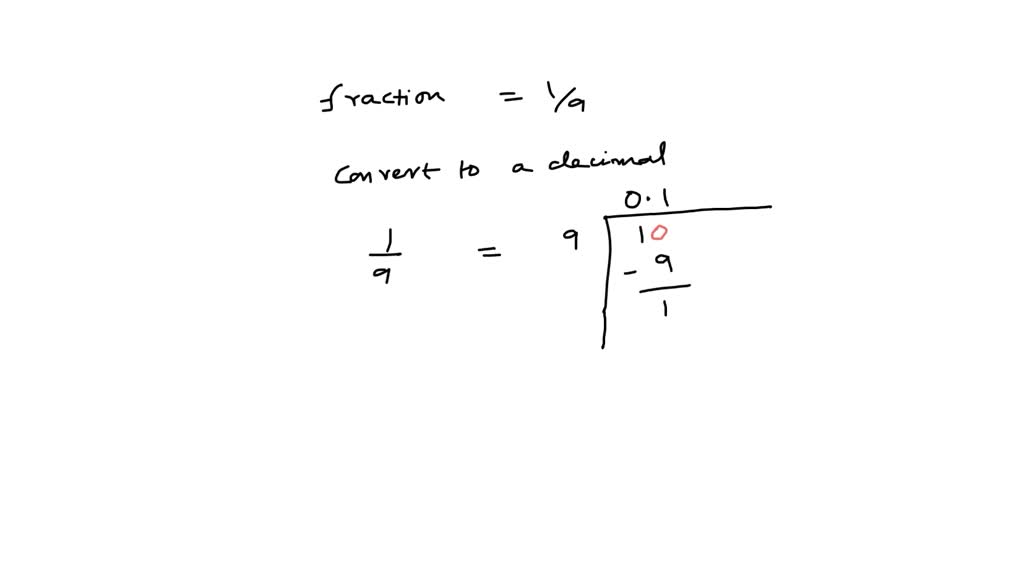
To convert any fraction into a decimal, one simply divides the numerator by the denominator. In the case of 1/9, you perform the operation 1 ÷ 9.
When you divide 1 by 9:
- 9 goes into 1 zero times, leaving 1.
- Add a decimal point and a zero to the 1, making it 10.
- 9 goes into 10 once (1 x 9 = 9), leaving a remainder of 1.
- Add another zero to the remainder, making it 10 again.
- 9 goes into 10 once, leaving a remainder of 1.
This pattern repeats indefinitely, resulting in a decimal representation of 0.111… This is known as a repeating or recurring decimal. While a calculator provides this answer instantly, understanding the mechanics of how 1/9 becomes 0.111… is vital because many financial scenarios require you to work with fractions that don’t neatly terminate.
The implication of a repeating decimal in finance is significant. When dealing with fractions like 1/3 (0.333…), 1/6 (0.166…), or 1/9 (0.111…), rounding too early or inaccurately can lead to substantial errors, especially when calculations involve large sums or compound over time. Precision, even with repeating decimals, is paramount for maintaining financial integrity and achieving desired outcomes.
Everyday Financial Applications of 1/9 and Similar Conversions
The ability to quickly convert fractions like 1/9 into their decimal equivalents is not just for mathematicians; it’s a vital skill for anyone managing money.
Budgeting and Expense Allocation
Effective budgeting often involves allocating proportions of your income to various categories. You might decide to save 1/10 of your income, allocate 1/5 to housing, or perhaps earmark 1/9 for a specific long-term goal. Knowing that 1/9 translates to approximately 11.11% allows for precise calculations. If your monthly income is $4,500 and you decide to put 1/9 of it towards a down payment, you immediately know that this amounts to $4,500 * 0.1111… = $500. Consistent application of these fractional allocations, converted accurately to decimals, ensures your budget is realistic and your financial goals remain on track. Over an entire year, a small rounding error can accumulate, leading to budget shortfalls or an inaccurate picture of your financial standing.
Understanding Discounts and Sales
While 1/9 isn’t a common discount percentage, the principle applies broadly. Promotions often feature “1/3 off,” “1/4 off,” or “1/2 price.” Instantly recognizing that 1/3 is 0.333… helps you calculate the exact savings on a purchase. If a retailer offers “up to 1/9 off” specific items, knowing that this is roughly 11.1% helps you quickly assess the value of the discount relative to other promotions. This mental agility empowers you to make smarter spending decisions, ensuring you truly understand the value proposition.
Share Ownership and Proportionality
In scenarios involving shared assets, partnerships, or even inheritance, understanding fractional ownership is key. If you own 1/9 of a rental property, it means you are entitled to 0.111… of the rental income and are responsible for 0.111… of the expenses. When the property is sold, your share of the capital gains will also be 0.111… of the total profit. Miscalculating this fraction, even slightly, can lead to disputes or an incorrect assessment of your financial position, especially in complex family trusts or business agreements.
Investing and Strategic Financial Planning
In the realm of investments, where percentages, ratios, and precise calculations dictate outcomes, the ability to work with fractions and their decimal equivalents is indispensable.
Fractional Shares and Dividends
The advent of fractional share investing has made it easier for individuals to own portions of high-priced stocks. If you invest enough to own 1/9 of a share in a company, understanding its decimal equivalent (0.111…) is crucial for tracking your investment’s value and dividend payouts. If a company declares a dividend of $10 per share, your 1/9 share would entitle you to $10 * 0.111… = $1.11 in dividends. While investment platforms typically handle these calculations, a solid grasp of the underlying math allows investors to verify figures, understand portfolio performance, and accurately project future earnings.
Interest Rates and Yields
Interest rates and yields are almost universally expressed in percentages or decimal form (e.g., 5.25% or 0.0525). However, understanding the fractional components can provide deeper insight. For instance, a “basis point” is 1/100 of a percentage point, or 0.0001. While 1/9 might not directly represent an interest rate, the conceptual leap from fractions to decimals is constantly in play. Understanding that 0.111… is exactly 1/9 can simplify mental estimations when evaluating complex financial products that might refer to proportions or percentages in less straightforward ways. For instance, if an investment promises “one-ninth of a percent” return over a certain period, you immediately know it’s a very small fraction, 0.00111…, guiding your expectations.
Portfolio Diversification and Asset Allocation
Strategic asset allocation is about dividing your investment capital among various asset classes (stocks, bonds, real estate, commodities, etc.) to optimize risk and return. An investor might decide to allocate 1/9 of their portfolio to emerging markets, 1/3 to fixed income, and the remainder to domestic equities. Translating 1/9 into 0.111… (or 11.1%) ensures that your portfolio rebalancing efforts are precise. If your target is to have exactly 11.1% in a certain sector, any deviation from this decimal value requires action. This level of precision helps maintain the desired risk profile and adheres to your long-term financial plan.
Business Finance and Operational Insights
For businesses, from sole proprietorships to large corporations, fractional-to-decimal conversions are fundamental to operational efficiency, profitability analysis, and stakeholder management.
Profit Sharing and Equity Distribution
In partnerships or ventures with multiple stakeholders, profits are often divided based on fractional ownership or agreed-upon proportions. If a partner holds 1/9 equity in a business, they are entitled to 0.111… of the company’s net profits. This directly impacts their annual payout and their share of capital if the business is sold. Accurate decimal conversion ensures fair distribution and transparency, preventing disputes that can arise from ambiguous or inaccurately rounded figures. Similarly, understanding how 1/9 of voting rights translates to decision-making power is crucial for corporate governance.
Cost Analysis and Resource Allocation
Businesses frequently analyze costs as a proportion of revenue or total expenditure. A department’s budget might be 1/9 of the overall operational budget. Knowing this translates to 0.111… allows for detailed tracking and comparison of actual spending against allocated funds. Resource allocation for projects, marketing campaigns, or product development also benefits from this clarity. If 1/9 of a project’s budget is earmarked for R&D, converting it to 0.111… of the total budget enables precise financial controls and accountability.
Financial Ratios and Performance Metrics
Many critical financial ratios, such as profit margins, debt-to-equity ratios, or current ratios, are derived by dividing one financial metric by another. While the results rarely come out to exactly 1/9, the underlying mechanism of converting fractions (the division result) into a decimal for interpretation is constant. Understanding that these ratios represent proportions helps businesses benchmark performance, identify areas for improvement, and communicate financial health to investors and stakeholders. For example, if a company’s research and development spending is 1/9 of its total revenue, knowing this translates to approximately 11.1% provides a clear, comparable metric.
The Broader Implications: Accuracy, Automation, and Avoiding Pitfalls
Beyond specific applications, the general understanding of converting fractions to decimals, particularly repeating decimals like 1/9, carries broader implications for financial literacy and decision-making.
The Importance of Precision in Financial Calculations
One of the most significant lessons learned from repeating decimals in finance is the critical importance of precision. Rounding 0.111… to 0.11 or 0.111 might seem insignificant, but when dealing with millions or billions of dollars, or when calculations compound over many periods, these small discrepancies can lead to substantial errors. Imagine calculating interest on a large sum over decades where the annual interest rate subtly involves a repeating decimal. Early rounding can inflate or deflate projected outcomes, impacting retirement planning, investment returns, or corporate valuations.
Leveraging Financial Tools and Software
Modern financial tools, from simple spreadsheet software to complex accounting systems and investment platforms, automate countless calculations. However, without a foundational understanding of the underlying mathematics, users are merely accepting outputs without critical assessment. Knowing how 1/9 becomes 0.111… allows you to sanity-check results, understand the implications of rounding performed by software, and identify potential errors or discrepancies. This empowers users to go beyond blindly trusting the machine, fostering a deeper, more robust financial understanding.

Critical Thinking in Financial Decision-Making
Ultimately, understanding basic numerical conversions like 1/9 to 0.111… enhances critical thinking in financial contexts. It allows individuals and businesses to better interpret financial news, evaluate product offerings (e.g., understanding a “one-ninth percentage point” fee structure), and make informed choices. This foundational mathematical literacy is a cornerstone of financial independence and robust wealth management, enabling clearer communication and more confident navigation of the complex financial landscape.
aViewFromTheCave is a participant in the Amazon Services LLC Associates Program, an affiliate advertising program designed to provide a means for sites to earn advertising fees by advertising and linking to Amazon.com. Amazon, the Amazon logo, AmazonSupply, and the AmazonSupply logo are trademarks of Amazon.com, Inc. or its affiliates. As an Amazon Associate we earn affiliate commissions from qualifying purchases.