
The stock market, a dynamic barometer of economic health and corporate performance, rarely moves in a straight line. While periods of growth are often celebrated, the inevitable downturns – whether a minor dip, a significant correction, or a full-blown bear market – can stir anxiety among investors. Understanding why a stock or the broader market is down is crucial for informed decision-making, helping to differentiate between fleeting turbulence and a fundamental shift. This article delves into the multifaceted reasons behind stock price depreciation, exploring macroeconomic forces, company-specific challenges, and the powerful role of investor psychology, all within the context of sound financial understanding.
Macroeconomic Headwinds: When the Economy Sputters
The health of the overall economy is perhaps the most significant determinant of stock market performance. When the economic landscape becomes challenging, it creates a ripple effect that can drag down even fundamentally strong companies. Understanding these broader economic pressures is the first step in comprehending market downturns.
Rising Interest Rates
One of the most potent tools in a central bank’s arsenal is the adjustment of interest rates. When central banks, like the Federal Reserve in the U.S., raise rates, they aim to cool down an overheating economy, often in response to inflation. However, higher interest rates have a profound impact on stock valuations. For companies, borrowing becomes more expensive, increasing their cost of capital for expansion, research, and daily operations. This directly impacts profitability. For consumers, higher rates mean more expensive mortgages, car loans, and credit card debt, leading to reduced disposable income and, consequently, lower consumer spending.
Furthermore, higher interest rates make fixed-income investments, such as government bonds, more attractive. As bond yields rise, they offer a more competitive, lower-risk alternative to stocks, drawing capital away from the equity market. This rebalancing act by investors can put significant downward pressure on stock prices, especially for growth stocks whose future earnings are discounted more heavily in a higher interest rate environment.
Inflationary Pressures
Inflation, the persistent rise in the general price level of goods and services, erodes the purchasing power of money. While moderate inflation is considered normal and even healthy for a growing economy, runaway inflation can be highly detrimental. For businesses, inflation translates to higher input costs – raw materials, labor, transportation, and energy become more expensive. If companies cannot pass these increased costs on to consumers through higher prices without sacrificing demand, their profit margins will shrink.
Moreover, persistent inflation often forces central banks to raise interest rates aggressively, creating a dual whammy for the stock market. High inflation also creates uncertainty, making it difficult for companies to plan future investments and for consumers to budget. This uncertainty can lead to a decrease in consumer confidence and business investment, further depressing economic activity and, by extension, stock valuations.
Economic Slowdown or Recession Fears
The specter of an economic slowdown or a full-blown recession is a primary driver of stock market downturns. A recession is typically defined as two consecutive quarters of negative GDP growth, characterized by widespread job losses, decreased consumer spending, and reduced corporate profits. During such periods, businesses face dwindling demand for their products and services, leading to lower revenues and earnings.
Investors, anticipating this decline in corporate profitability, will sell off stocks, driving prices down. The fear of a recession alone can be enough to trigger a market correction, as investors attempt to get ahead of the expected economic contraction. Sectors particularly sensitive to economic cycles, such as manufacturing, retail, and hospitality, often bear the brunt of these fears. A slowdown also impacts the ability of individuals to save and invest, further reducing capital flowing into the market.
Geopolitical Events and Global Instability
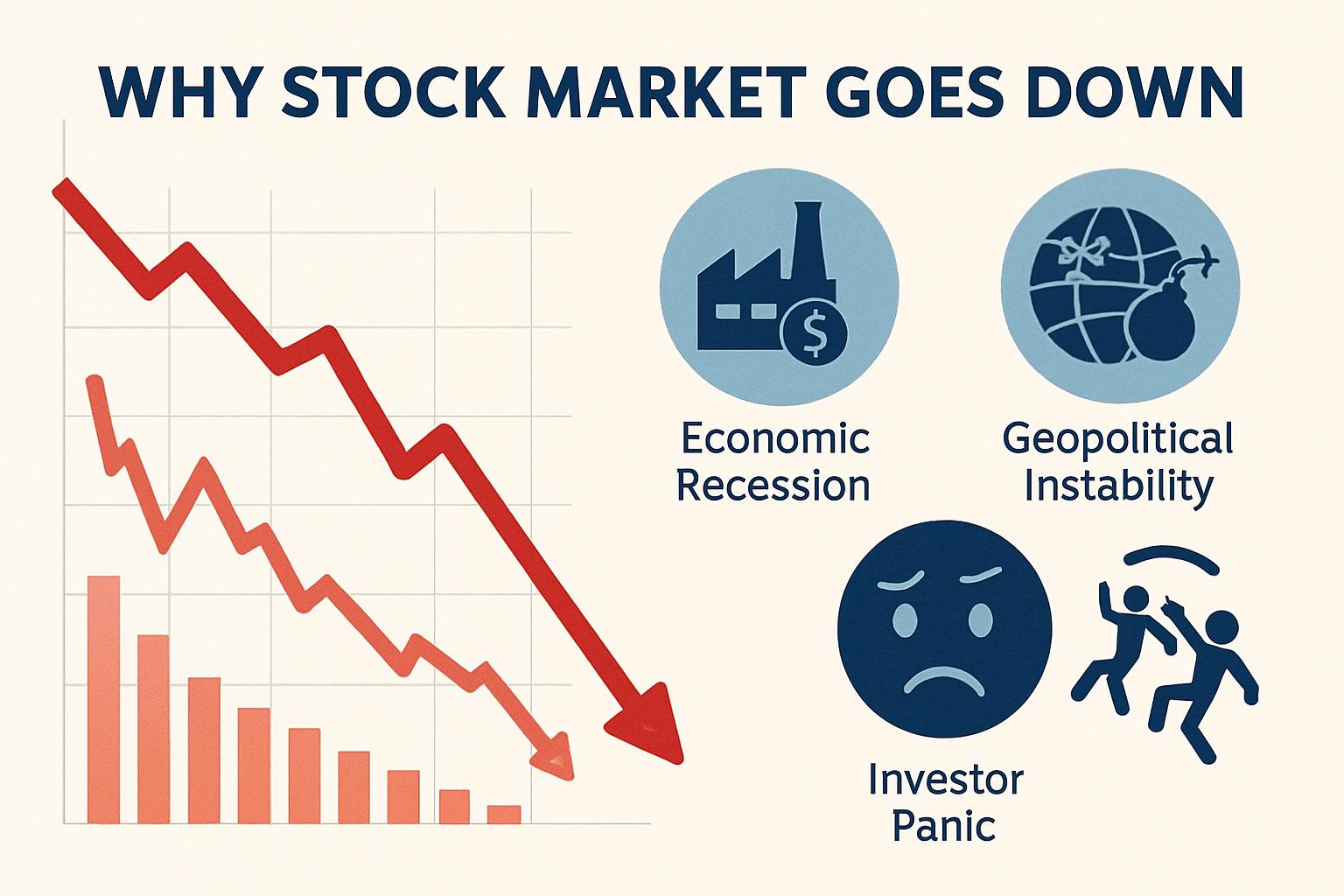
The interconnectedness of the global economy means that events far from home can have significant repercussions on local stock markets. Geopolitical events such as wars, trade disputes, political instability in key regions, or even major international policy shifts can introduce massive uncertainty. These events can disrupt global supply chains, increase the cost of critical resources (like oil), impact international trade agreements, and generally erode investor confidence.
For instance, a major conflict in a resource-rich region could send commodity prices soaring, impacting manufacturing costs worldwide. Trade wars can lead to tariffs, making exports more expensive and reducing international sales for companies. Such instability makes it difficult for businesses to predict future operating environments and for investors to gauge future earnings, often leading to a risk-off sentiment where capital flees equities for safer assets like gold or government bonds.
Company-Specific Challenges: When Individual Stocks Stumble
While macroeconomic forces can affect the entire market, individual stocks can decline for reasons entirely specific to the company itself, irrespective of broader economic trends. These company-specific issues highlight the importance of thorough fundamental analysis.
Weak Earnings Reports and Missed Guidance
A company’s quarterly or annual earnings report is a critical moment for investors. When a company announces earnings per share (EPS) or revenue figures that fall below analyst expectations, its stock price almost invariably suffers. Even if the company is profitable, missing the “consensus estimate” can signal underlying problems or a deceleration in growth.
Furthermore, management’s “guidance” for future earnings and revenue is equally crucial. If a company lowers its outlook for the upcoming quarter or year, it indicates that management anticipates challenges ahead. This revised guidance often leads to significant sell-offs, as investors adjust their valuation models downwards, reflecting the dimmer future prospects. A series of missed earnings or lowered guidance can severely damage investor confidence and lead to a prolonged stock decline.
Product Failures or Competitive Setbacks
Innovation and market leadership are vital for sustained corporate success. A significant product failure – perhaps a highly anticipated new product that doesn’t resonate with consumers, or one that is plagued with technical issues – can lead to substantial revenue losses and reputational damage. The market often punishes companies for such missteps, reflecting concerns about future innovation capabilities and market share.
Equally impactful is intense competition. A new entrant with a disruptive technology, a competitor launching a superior product, or aggressive pricing strategies from rivals can erode a company’s market share and profitability. If a company fails to adapt or innovate quickly enough to maintain its competitive edge, investors will often re-evaluate its long-term growth potential, leading to a decline in its stock price.
Management Missteps or Governance Issues
Effective leadership is paramount for any successful enterprise. Missteps by management, such as poor strategic decisions, failed mergers and acquisitions, or inefficient capital allocation, can directly impact a company’s financial health and investor trust. For example, excessive spending on non-core activities, engaging in risky ventures, or failing to address operational inefficiencies can all contribute to a stock’s decline.
Ethical lapses, accounting scandals, or significant corporate governance issues can be even more devastating. Allegations of fraud, executive misconduct, or lack of transparency can lead to a complete collapse of investor confidence, regulatory investigations, hefty fines, and, in severe cases, even bankruptcy. The market often reacts swiftly and harshly to such news, as these issues indicate a breakdown in the fundamental trust between a company and its shareholders.
Industry-Specific Disruptions
Beyond general economic trends, specific industries can face unique challenges that lead to a decline in stock prices for companies within that sector. Technological disruption, for instance, can render established business models obsolete almost overnight (e.g., Blockbuster vs. Netflix). Regulatory changes, such as new environmental standards for manufacturers or stricter financial regulations for banks, can significantly increase operating costs or restrict business operations.
Shifts in consumer preferences can also decimate an industry. The decline of print media, the shift from traditional retail to e-commerce, or changing dietary habits impacting food companies are all examples where evolving societal trends can lead to a sustained downturn for an entire sector. Investors constantly evaluate the long-term viability and adaptability of companies within these changing landscapes.
Market Dynamics and Investor Psychology: The Human Element of Downturns
While fundamentals and economics provide a rational framework for understanding stock movements, the market is ultimately driven by human decisions, often influenced by powerful emotions and complex technical factors. Investor psychology and market dynamics play a critical role in accelerating or decelerating stock declines.
Investor Sentiment and Panic Selling
Markets are not purely rational; they are deeply influenced by collective investor sentiment. When fear, uncertainty, and doubt (FUD) take hold, rational analysis can often be overridden by panic. Negative news, whether real or perceived, can trigger a domino effect where investors, fearing further losses, rush to sell their holdings. This “panic selling” can create a self-fulfilling prophecy, driving prices down even for companies with strong fundamentals.
This phenomenon is often described as “animal spirits” – a herd mentality where investors follow the actions of others rather than conducting independent analysis. Conversely, during periods of extreme optimism, prices can be driven up beyond reasonable valuations, making them more susceptible to sharp corrections when sentiment eventually shifts. Recognizing the role of emotion is key to avoiding impulsive decisions during a downturn.
Technical Factors and Chart Patterns
Technical analysis involves studying past market data, primarily price and volume, to identify patterns and predict future price movements. While not universally accepted, technical factors can influence short-term trading decisions and contribute to stock declines. For example, if a stock breaks below a significant “support level” – a price point where buying interest has historically been strong – it can trigger further selling as technical traders interpret this as a sign of weakness.
“Death crosses” (when a short-term moving average crosses below a long-term moving average) or “head and shoulders” patterns are other examples of chart formations that technical analysts interpret as bearish signals, often leading to increased selling pressure. While these are not fundamental reasons for a decline, the collective action of traders acting on these signals can amplify downward momentum.
Algorithmic Trading and Programmatic Selling
In today’s highly digitized markets, a significant portion of trading volume is executed by sophisticated algorithmic trading systems. These programs are designed to react to market signals, news, and technical indicators at speeds far beyond human capability. While they can enhance market efficiency, they can also exacerbate market downturns.
For example, if a specific news event or price movement triggers a sell signal for multiple algorithms simultaneously, it can lead to a cascade of programmatic selling that rapidly drives down prices. This automated selling can create a “flash crash” effect, where stocks drop dramatically in a very short period, often recovering quickly but leaving investors rattled. The sheer volume and speed of algorithmic trades mean that human traders often struggle to react in time, amplifying market volatility during declines.
Liquidation Events and Margin Calls
Large-scale selling by institutional investors, such as hedge funds or mutual funds, can put immense downward pressure on specific stocks or even the broader market. These “liquidation events” might occur if a fund is restructuring its portfolio, facing redemptions from its own investors, or needs to raise cash for other purposes. Such large block sales can overwhelm normal trading volume and depress prices.
Similarly, “margin calls” can force individual investors to sell. An investor trades on margin when they borrow money from their broker to buy stocks, using their existing investments as collateral. If the value of their portfolio falls below a certain threshold, the broker issues a margin call, demanding that the investor either deposit more cash or sell off assets to meet the minimum equity requirement. Forced selling due to margin calls can accelerate a stock’s decline, creating a vicious cycle of selling pressure.
Navigating the Downturn: Strategies for Investors
Understanding why a stock is down is the first step; the next is knowing how to react. While market downturns can be unsettling, they also present opportunities for disciplined investors.
Understand Your Risk Tolerance and Investment Horizon
Before reacting to any market decline, it’s crucial to revisit your personal financial plan. What is your risk tolerance? Are you comfortable with significant fluctuations, or do you prefer a more conservative approach? More importantly, what is your investment horizon? If you are a long-term investor with decades until retirement, short-term market dips are often less concerning and can even be opportunities. Panic selling during a temporary downturn can lock in losses and prevent participation in the eventual recovery. A well-defined financial plan acts as a critical anchor during turbulent times.
Diversification is Key
The age-old adage, “Don’t put all your eggs in one basket,” holds particularly true during market downturns. A diversified portfolio, spread across different asset classes (stocks, bonds, real estate), various industries, company sizes, and geographies, helps mitigate risk. If one sector or asset class experiences a significant decline, others might remain stable or even perform well, cushioning the overall impact on your portfolio. Diversification doesn’t guarantee against losses, but it significantly reduces the risk of a catastrophic single-point failure.
Focus on Fundamentals, Not Noise
During periods of market volatility, it’s easy to get swept up in the daily news cycle, speculation, and fear-mongering. Instead, disciplined investors focus on the underlying fundamentals of their investments. Is the company still generating revenue? Is it profitable? Does it have a strong balance sheet, manageable debt, and a competitive advantage? If the long-term thesis for an investment remains intact despite a short-term price dip, it might be an opportune time to hold or even accumulate more shares at a lower price. Distinguish between temporary market noise and fundamental deterioration.
Dollar-Cost Averaging
Dollar-cost averaging is a powerful strategy, especially during volatile periods. It involves investing a fixed amount of money at regular intervals (e.g., monthly) regardless of the stock price. When prices are high, your fixed amount buys fewer shares; when prices are low, it buys more shares. Over time, this strategy helps to average out your purchase price, potentially reducing the overall risk of investing a large lump sum at an unfavorable time. It also removes emotion from the investment decision, ensuring consistent participation in the market through its ups and downs.
Consider Rebalancing and Tax-Loss Harvesting
Downturns can be a strategic time for portfolio rebalancing. If some assets have declined significantly, they might now represent a smaller portion of your portfolio than initially desired. Rebalancing involves selling some assets that have performed well (if any) and buying more of those that have dipped, bringing your asset allocation back to your target. This can also be an opportunity for “tax-loss harvesting,” where you sell investments at a loss to offset capital gains and potentially reduce taxable income, then reinvest in similar (but not “substantially identical”) assets to maintain your market exposure. Consult a financial advisor for specific tax implications.
Conclusion
The question “why is stock down?” reveals a complex interplay of macroeconomic forces, company-specific performance, and the psychological whims of the market. From rising interest rates and inflation to product failures and panic selling, numerous factors can contribute to a stock’s decline. While these downturns can be challenging, a deep understanding of their causes, coupled with a disciplined, long-term investment strategy anchored by diversification and a focus on fundamentals, empowers investors to navigate volatility with greater confidence. Stock market declines are an inherent part of investing; recognizing them as inevitable rather than unexpected events allows for more rational decision-making and the potential to emerge stronger when the market eventually recovers.
aViewFromTheCave is a participant in the Amazon Services LLC Associates Program, an affiliate advertising program designed to provide a means for sites to earn advertising fees by advertising and linking to Amazon.com. Amazon, the Amazon logo, AmazonSupply, and the AmazonSupply logo are trademarks of Amazon.com, Inc. or its affiliates. As an Amazon Associate we earn affiliate commissions from qualifying purchases.