
Understanding the Dow Jones Industrial Average (DJIA)
The Dow Jones Industrial Average (DJIA), often simply referred to as “the Dow,” stands as one of the oldest, most recognized, and frequently cited stock market indexes in the world. Established in 1896 by Charles Dow and Edward Jones, its initial purpose was to provide a clear, easily understandable gauge of the health and direction of the U.S. industrial sector, and by extension, the broader economy. Though its name retains “Industrial,” the index has long since expanded its scope to include a diverse array of leading companies from various sectors, reflecting the evolution of the American economy from its industrial roots to a more service and technology-oriented landscape.
What is the DJIA?
At its core, the DJIA is a price-weighted index composed of 30 significant companies listed on U.S. stock exchanges. Unlike market-capitalization-weighted indexes (like the S&P 500), where companies with larger market values have a greater impact, the Dow gives more weight to stocks with higher share prices. This means that a one-dollar change in a high-priced stock will have a larger effect on the index’s value than a one-dollar change in a low-priced stock, regardless of the companies’ actual size. The sum of the prices of the 30 stocks is divided by a special number called the Dow Divisor, which is adjusted for stock splits, spin-offs, and changes in the index’s components to maintain historical continuity.
Why the Dow Matters to Investors
For individual and institutional investors alike, the Dow Jones Industrial Average serves as a critical barometer of the U.S. stock market’s overall performance and investor sentiment. Its longevity and the prominence of its constituent companies – often referred to as “blue-chip” stocks – lend it an aura of stability and reliability. These companies typically possess long histories of consistent earnings, strong balance sheets, and established market leadership. Consequently, the Dow is often seen as a bellwether for the economy, with its movements widely reported and analyzed by financial news outlets globally. While it only represents 30 companies out of thousands publicly traded, these 30 are often among the largest and most influential, making their collective performance a significant indicator for many investors building or monitoring their portfolios.
The Current Components of the Dow Jones
The composition of the Dow is not static; it evolves to remain relevant to the broader U.S. economy. While the exact list can shift, the Dow aims to include leading companies from various sectors that are representative of the nation’s economic structure. These are generally large, well-established corporations with excellent reputations, strong earnings, and substantial investor interest.
A Snapshot of the 30 Stocks
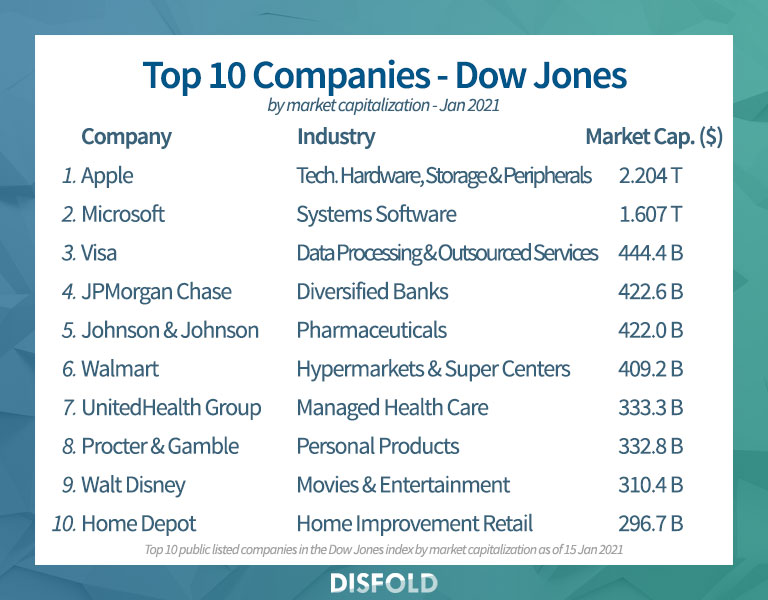
As of recent compositions, the Dow Jones Industrial Average typically includes a diverse mix of companies across key sectors. While the precise list can change, here’s a representative look at the types of industries and prominent companies that frequently make up the index:
- Technology: Companies like Apple (AAPL) and Microsoft (MSFT) represent the forefront of digital innovation, software, and consumer electronics.
- Financial Services: JPMorgan Chase (JPM), Goldman Sachs (GS), and Visa (V) are stalwarts of the banking, investment, and payment processing industries.
- Healthcare: Giants such as UnitedHealth Group (UNH), Johnson & Johnson (JNJ), and Merck (MRK) reflect the significant and growing importance of pharmaceuticals, medical devices, and health insurance.
- Consumer Discretionary/Staples: Companies like Home Depot (HD), McDonald’s (MCD), Procter & Gamble (PG), and Coca-Cola (KO) represent essential goods and services, as well as consumer spending habits.
- Industrials: Classic industrial names such as Boeing (BA), Caterpillar (CAT), and 3M (MMM) continue to signify the manufacturing and infrastructure backbone.
- Energy: Chevron (CVX) often represents the oil and gas sector, though its inclusion can vary with market dynamics.
- Communications: Verizon (VZ) and Walt Disney (DIS) illustrate the telecommunications and entertainment sectors, respectively.
- Other Diversified: Amgen (AMGN) (biotechnology), Salesforce (CRM) (cloud computing), and Honeywell (HON) (diversified technology and manufacturing) exemplify the broad reach.
This list is illustrative and subject to changes by the Averages Committee.
Why These Companies?
The selection of these 30 companies is not arbitrary. They are chosen because they are:
- Large and Established: They typically have market capitalizations in the hundreds of billions or even trillions of dollars.
- Industry Leaders: Many are dominant players within their respective sectors, often setting trends and driving innovation.
- Broadly Held and Traded: They have a wide base of shareholders and high trading volumes, ensuring liquidity.
- Excellent Reputations: They are generally considered “blue-chip” stocks, signifying stability, quality, and a history of strong performance.
- Representative of the U.S. Economy: Collectively, they aim to reflect the general health and direction of the American market across various critical industries.
In essence, the Dow seeks to capture the performance of America’s most influential and enduring corporate entities, whose fortunes often correlate with the broader economic environment.
The Evolution and Methodology of the Dow
The Dow Jones Industrial Average is a dynamic index, its constituents adapting over time to reflect the shifting economic landscape and the rise and fall of industrial dominance. This ongoing evolution is critical to maintaining its relevance as a market barometer.
How Companies Are Selected and Removed
The responsibility for selecting and removing companies from the DJIA rests with the S&P Dow Jones Averages Committee. This committee, comprising representatives from S&P Dow Jones Indices and The Wall Street Journal, does not adhere to rigid, quantitative rules for inclusion. Instead, it relies on a set of broad criteria and discretion to ensure the index remains a relevant and accurate reflection of the U.S. stock market. Key considerations for a company’s inclusion typically include:
- Reputation: The company should be well-established and have an excellent reputation.
- Sustained Growth: A history of consistent earnings and growth is highly valued.
- Interest to Investors: The company should attract significant investor interest.
- Sector Representation: The committee aims for a balanced representation of the major sectors of the U.S. economy, avoiding overconcentration in any single industry.
- Large Market Capitalization: While not a strict rule, companies are typically among the largest U.S. public companies.
Changes to the Dow are typically made only when a company’s relevance to the market has significantly diminished or when a major structural change occurs (e.g., mergers, bankruptcies), or to improve the overall representation of the U.S. economy. When a company is removed, another is added to maintain the count of 30. These changes are usually announced in advance to allow market participants to adjust.
Notable Changes Over Time
The Dow’s history is punctuated by significant changes that highlight economic shifts. For instance, in the early 20th century, the index was dominated by heavy industrial companies like U.S. Steel and General Electric. Over time, these gave way to consumer goods companies, then technology firms.
- General Electric (GE): A founding member of the Dow, GE was removed in 2018, having been part of the index continuously since 1907. Its removal symbolized the decline of conglomerate power and the rise of new industries.
- ExxonMobil (XOM) and Pfizer (PFE): In 2020, these giants were removed, reflecting a decreased emphasis on traditional energy and the restructuring of the healthcare sector, making way for Salesforce.com, Amgen, and Honeywell, which better represented modern economic drivers like cloud computing and biotechnology.
- Apple (AAPL): Added in 2015, its inclusion marked a significant acknowledgment of technology’s pervasive influence on the economy.
These examples illustrate the committee’s commitment to ensuring the Dow evolves to remain a mirror of the American economy, rather than a relic of its past.

The Dow Divisor
A crucial, yet often overlooked, aspect of the Dow’s methodology is the Dow Divisor. Because the DJIA is a price-weighted index, events like stock splits, company changes, or special dividends would distort the index’s value if not accounted for. The Dow Divisor is a variable number that ensures the index’s value remains comparable before and after such events. For example, if a company in the Dow undergoes a stock split, its share price drops, which would artificially lower the index. To counteract this, the Divisor is adjusted downwards, ensuring that the index’s value remains unchanged immediately after the split. This sophisticated mathematical adjustment maintains the integrity and continuity of the index’s historical data.
Investing in the Dow: Strategies and Considerations
For investors interested in the blue-chip performance represented by the Dow Jones Industrial Average, there are several avenues to consider. Each comes with its own set of advantages and disadvantages, catering to different investment goals and risk tolerances.
Direct Stock Ownership vs. Index Funds
The most straightforward way to “invest in the Dow” is to purchase shares of the individual 30 companies that comprise the index. This approach allows investors to have direct ownership and potentially benefit from the specific performance of each company. However, buying all 30 stocks individually can be costly and requires active management to rebalance the portfolio when the Dow’s composition changes.
A more common and often more practical approach is investing in exchange-traded funds (ETFs) or mutual funds that track the DJIA. These funds hold shares of the underlying 30 companies in proportions designed to replicate the index’s performance. Examples include the SPDR Dow Jones Industrial Average ETF Trust (DIA), commonly known as “Diamonds.” Investing in such a fund offers immediate diversification across the 30 blue-chip companies with a single transaction, generally lower fees than actively managed funds, and the convenience of not having to manage individual stocks.
Advantages and Disadvantages of Dow-Focused Investing
Investing in the Dow, whether directly or through index funds, presents distinct benefits:
- Stability and Quality: The index comprises large, well-established blue-chip companies, which are generally more stable and less volatile than smaller firms, potentially offering a degree of resilience during market downturns.
- Historical Performance: The Dow has a long track record, providing historical data for analysis and illustrating its consistent growth over the long term, despite periodic corrections.
- Ease of Access: Index funds make it incredibly easy for even novice investors to gain exposure to these leading companies without needing extensive research into each one.
However, there are also limitations:
- Limited Diversification: While diversified across 30 companies, it represents only a small fraction of the overall U.S. stock market. It lacks exposure to thousands of mid-cap and small-cap companies, and potentially high-growth sectors that might not yet qualify for the Dow.
- Price-Weighted Quirks: The price-weighted methodology means that higher-priced stocks influence the index more than lower-priced ones, irrespective of the companies’ actual market capitalization. This can sometimes distort its representation of overall market health.
- Sector Gaps: Despite efforts to diversify, the index may still have gaps in representing certain emerging or highly specialized sectors that are crucial to the modern economy.
The Dow’s Role in a Broader Portfolio
For many investors, the Dow is just one piece of a diversified investment strategy. While it offers exposure to leading U.S. corporations, a truly robust portfolio typically includes:
- Broader Market Exposure: Complementing Dow-focused investments with funds tracking the S&P 500 (representing 500 large-cap companies) or total U.S. stock market indexes (like the Russell 3000) can provide greater diversification and capture a wider range of market opportunities.
- International Diversification: Including international stocks helps reduce country-specific risk and taps into global economic growth.
- Fixed Income: Bonds and other fixed-income assets can provide stability and income, balancing the equity portion of a portfolio.
The Dow, therefore, often serves as a solid foundation or a core component for investors seeking exposure to established U.S. corporate strength, but it should ideally be integrated into a more comprehensive investment plan.
Beyond the 30: The Broader Market Context
While the Dow Jones Industrial Average holds a significant place in financial discourse, understanding its limitations and its position within the broader market landscape is essential for a complete financial perspective.
The Dow as a Barometer, Not the Whole Economy
It is crucial to remember that the DJIA, despite its prominence, tracks only 30 companies. While these companies are large and influential, they do not encompass the entire U.S. economy. The U.S. market is vast and complex, comprising thousands of publicly traded companies, from small-cap startups to mega-cap corporations, across an even wider array of sectors.
Other indexes provide a more comprehensive view:
- S&P 500: A market-capitalization-weighted index tracking 500 of the largest U.S. companies. It is often considered a better representation of the broader U.S. large-cap equity market than the Dow.
- Nasdaq Composite: Heavily weighted towards technology and growth companies, reflecting a different segment of the market, often with higher volatility but also higher growth potential.
- Russell 2000: Focuses on small-cap companies, providing insights into a segment of the economy driven by smaller, often more domestically oriented businesses.
Therefore, while the Dow offers a quick snapshot of the performance of established blue-chip companies, relying solely on it to gauge the entire market or economy can be misleading. It functions more effectively as a specific barometer for a particular segment of large, mature corporations.

Sector Representation and Gaps
The Averages Committee endeavors to maintain a diversified sector representation within the Dow. However, with only 30 components, perfect balance is challenging, and certain sectors may be over or underrepresented at any given time. For instance, while technology giants like Apple and Microsoft are included, the Dow might not fully capture the performance of emerging tech sub-sectors or smaller, innovative tech firms that are more prevalent in indexes like the Nasdaq. Similarly, while industrials are represented, the depth of exposure to the vast manufacturing sector is limited.
The Dow’s composition reflects an ongoing tension between its heritage (industrial focus) and the evolving nature of the modern economy (services, technology, biotech). Its value lies not in being an all-encompassing measure, but in its specific role as an indicator of the performance of America’s most recognizable and historically significant corporate entities. For investors and analysts, understanding “what companies make up the Dow Jones” is a starting point, illuminating the strength and direction of a crucial segment of the financial world, while also prompting a broader exploration of other market indexes for a truly holistic economic picture.
aViewFromTheCave is a participant in the Amazon Services LLC Associates Program, an affiliate advertising program designed to provide a means for sites to earn advertising fees by advertising and linking to Amazon.com. Amazon, the Amazon logo, AmazonSupply, and the AmazonSupply logo are trademarks of Amazon.com, Inc. or its affiliates. As an Amazon Associate we earn affiliate commissions from qualifying purchases.