
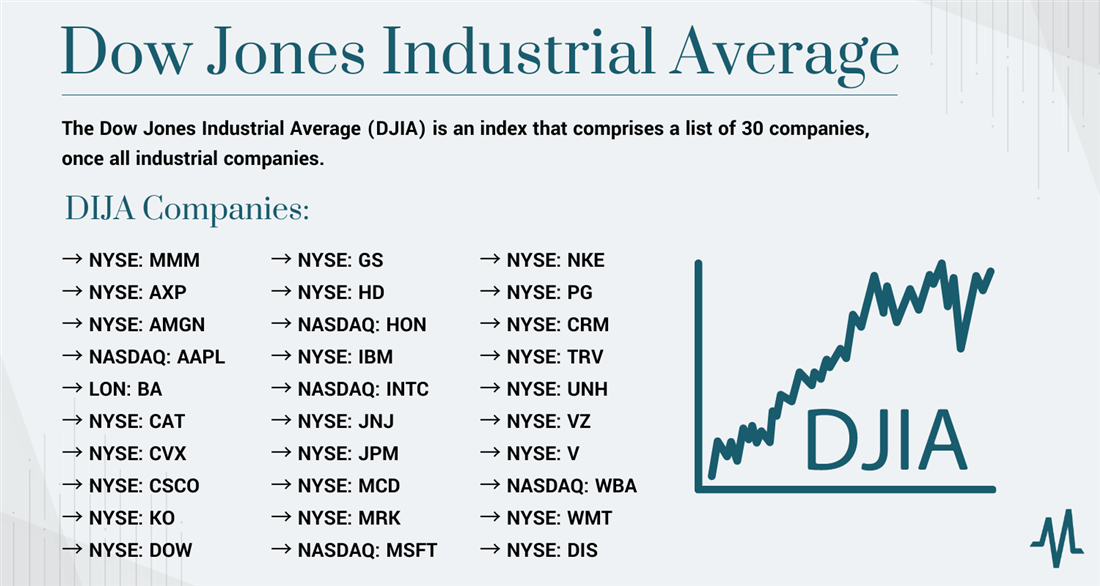
The Dow Jones Industrial Average (DJIA), often simply referred to as “the Dow,” is one of the most recognized and frequently cited stock market indices in the world. For decades, its daily fluctuations have been reported in news cycles as a primary indicator of the stock market’s health and, by extension, the broader economy. Yet, despite its pervasive presence in financial discourse, a fundamental question often arises for investors and the curious alike: “How many stocks are actually in the Dow?”
The answer, in its most direct form, is 30. This seemingly small number of companies, carefully selected and meticulously managed, represents a unique slice of American corporate power and economic influence. However, understanding the “how” and “why” behind this number, the selection process, and the Dow’s specific methodology reveals much more than a simple count. It unveils a rich history, a particular approach to market representation, and insights into its role as both a barometer and a benchmark for investors navigating the complexities of the financial world. This article delves into the intricacies of the Dow, exploring its composition, its distinctive calculation, and its enduring significance in the landscape of global finance.

The Dow Jones Industrial Average: A Cornerstone of the Market
Established in 1896 by Charles Dow, editor of The Wall Street Journal and co-founder of Dow Jones & Company, the Dow Jones Industrial Average was conceived as a simple tool to gauge the performance of the industrial sector of the U.S. economy. Over its long history, it has evolved significantly, but its fundamental purpose as a market barometer has remained. Today, it stands as a testament to the power of a select group of companies to reflect, to a certain extent, the broader economic narrative.
What is the DJIA?
At its core, the DJIA is a stock market index that measures the stock performance of 30 large, publicly owned companies based in the United States. Despite its name, which includes “Industrial,” the index today is far from solely industrial. It encompasses a diverse range of sectors, including technology, finance, healthcare, and consumer goods, reflecting the transformed nature of the modern American economy. The companies included are typically “blue-chip” stocks—established, financially sound, and highly respected corporations with long track records of profitability and stability. These are household names that have a significant impact on daily life and the global economy.
Why is it Significant?
The DJIA’s significance stems from several factors. Historically, it was one of the first and most widely tracked indices, giving it a deep-rooted psychological impact on market sentiment. Its longevity means it offers an unparalleled historical perspective, allowing analysts and historians to trace economic booms, busts, and transformations over more than a century. For many, its movement is synonymous with the health of the U.S. stock market. A “Dow up” day often signals optimism, while a “Dow down” day can trigger concerns. While more comprehensive indices exist today, the Dow retains its powerful symbolic status as a quick, easy-to-digest snapshot of market performance, often influencing headlines and investor confidence.
Beyond the “30”: The Index’s Unique Calculation
Unlike many modern market indices, which are weighted by market capitalization (meaning larger companies by total market value have a greater impact), the DJIA is a price-weighted index. This means that stocks with higher share prices inherently exert more influence on the index’s value than those with lower share prices, regardless of their company’s overall market capitalization. This distinctive methodology, a remnant of its original, simpler design, has significant implications for how the Dow is interpreted and how its movements are driven. It introduces a dynamic where a substantial move in a high-priced stock can sway the entire index more profoundly than a similar percentage move in a lower-priced stock, even if the latter company is much larger in terms of total value.
The Exclusive 30: Selection, Evolution, and Impact
The number 30 is not arbitrary, nor is it fixed in terms of its constituents. The selection of companies for the Dow is a deliberate process, aiming to ensure the index remains relevant and representative of the evolving U.S. economy. It’s a testament to these companies’ stature that they are chosen to bear the standard of “Dow component.”
Criteria for Inclusion: What Makes a “Dow Stock”?
The S&P Dow Jones Indices Committee is responsible for overseeing the composition of the DJIA. While specific, rigid rules are not publicly disclosed, the general criteria for inclusion revolve around a few key principles:
- Blue-Chip Status: Companies must be large, well-established, and have an excellent reputation. They are typically leaders in their respective industries.
- Broad Investor Interest: The companies should be widely held by institutional and individual investors and actively traded.
- Industry Leadership: Components are generally seen as bellwethers for their sectors, embodying significant influence and innovation.
- Economic Representation: The committee aims for a diverse mix of companies that reflect the overall structure of the U.S. economy. This is why the “Industrial” moniker is now largely historical.
- Sustainability and Growth: Companies should demonstrate a history of consistent earnings, robust financial health, and potential for sustained growth.
In essence, a Dow stock is expected to be a pillar of American industry, capable of weathering economic storms and adapting to changing market conditions.
The Role of the S&P Dow Jones Indices Committee
The S&P Dow Jones Indices Committee is crucial in maintaining the Dow’s relevance. This committee, comprised of representatives from S&P Dow Jones Indices and The Wall Street Journal, makes decisions about adding or removing companies. Their selections are not based on a formulaic, quantitative model but rather on a qualitative assessment guided by the principles outlined above. This introduces an element of discretion and expert judgment, aiming to ensure the index consistently reflects prominent and influential corporations. When a change is announced, it often garners significant attention, as inclusion in the Dow is seen as a prestigious acknowledgment of a company’s standing. Conversely, removal can be perceived as a slight, though it often reflects a shift in the company’s industry prominence or a broader economic rebalancing.
Evolution Over Time: A Living Index
The Dow is not a static list; it’s a living index that has evolved considerably since its inception. The original index in 1896 consisted of just 12 companies, predominantly heavy industrial firms like General Electric (the only original component to remain in the index until 2018) and American Cotton Oil Company. Over the decades, companies have been added and removed to reflect shifts in economic dominance, technological innovation, and corporate performance. For instance, the inclusion of technology giants like Apple and Microsoft, and the addition of healthcare behemoths like UnitedHealth Group, illustrate the committee’s commitment to ensuring the Dow accurately portrays the drivers of the modern economy, moving far beyond the smoke-stack industries of the 19th century. These changes ensure the Dow remains a relevant, albeit limited, indicator of economic health rather than a historical relic.
Understanding the Dow’s Weighted Influence
The Dow’s distinctive price-weighted methodology fundamentally shapes how its movements are understood and how different components contribute to its overall performance. This approach contrasts sharply with the market-capitalization weighting prevalent in most other major indices, leading to specific implications for investors.
Price-Weighted Index Explained
As mentioned, the DJIA is price-weighted. This means that a stock with a higher per-share price has a greater impact on the index’s value than a stock with a lower per-share price. For example, if a Dow component trading at $300 per share moves by 1%, it will have three times the impact on the index’s total point change compared to a component trading at $100 per share also moving by 1%. This holds true even if the company with the $100 stock has a significantly larger overall market capitalization (total value of outstanding shares).

This methodology has its roots in the index’s earliest days when calculations were simpler. In a world before sophisticated computing, adding up stock prices and dividing by a factor was straightforward. While technologically archaic by today’s standards, it persists due to the Dow’s historical significance and unique character. One key implication is that stock splits, which reduce a company’s share price, diminish that company’s individual influence on the index, even if its overall market capitalization remains unchanged.
The Dow Divisor: A Key to Consistency
To maintain the comparability of the index’s value despite changes in its components (like stock splits, mergers, or company removals/additions), the Dow utilizes a crucial element called the “Dow Divisor.” The divisor is a dynamic number that is adjusted whenever there’s a corporate action that alters the sum of the component prices but does not reflect a change in market conditions. For example, if a stock splits, its price goes down, which would artificially lower the index. To counteract this, the divisor is reduced so that the index value remains the same immediately after the split as it was before.
The index value is calculated by summing the prices of the 30 component stocks and then dividing by the Dow Divisor. Over time, the divisor has significantly decreased from its initial value of 30, reflecting the numerous adjustments made over more than a century. In late 2023, the divisor was a very small fraction (e.g., around 0.15), meaning that a $1 change in any single Dow stock’s price translates into a movement of approximately 6.5 points (1/0.15) in the DJIA.
Implications for Investors: Interpreting Dow Movements
For investors, understanding the price-weighted nature of the Dow is critical for accurate interpretation. Simply seeing a large point movement in the Dow does not necessarily mean an equally large percentage shift across the market. A significant portion of that point movement might be attributable to just one or two high-priced components. This can sometimes paint a misleading picture compared to a market-cap weighted index like the S&P 500, which offers a more balanced view of market breadth and size.
Investors should therefore view the Dow as a specific indicator, useful for tracking the performance of a select group of blue-chip companies and understanding historical trends, but not as the sole or most comprehensive measure of the entire U.S. stock market. It’s a powerful narrative tool but requires nuanced understanding to prevent misinterpretation of broader market forces.
The Dow vs. Broader Market Indices: A Comparative Perspective
While the Dow holds an iconic status, it’s just one of many market indices. A comprehensive understanding of the stock market requires looking beyond the 30 companies to broader, more inclusive benchmarks that offer different lenses through which to view economic performance and investment opportunities.
S&P 500: A Wider Lens
The S&P 500 is arguably the most widely followed and representative index of large-cap U.S. equities. It tracks 500 of the largest U.S. publicly traded companies, encompassing a significantly broader segment of the market than the Dow. Crucially, the S&P 500 is market-capitalization weighted, meaning companies with larger total market values have a greater influence on the index’s performance. This provides a more balanced and comprehensive picture of the large-cap segment of the U.S. economy, as it naturally gives more weight to the companies that collectively represent the largest share of market value. For many institutional investors and financial professionals, the S&P 500 is considered the true benchmark for U.S. stock market performance.
NASDAQ Composite: The Tech-Driven Indicator
The NASDAQ Composite Index is another major U.S. market index, primarily known for its heavy concentration of technology and growth companies. Unlike the Dow, which includes a diverse set of “industrials,” the NASDAQ Composite lists over 3,000 common stocks, American Depositary Receipts (ADRs), and other securities listed on the NASDAQ stock market. It is also market-capitalization weighted. Its composition makes it a particularly important indicator for sectors driven by innovation, biotechnology, and software. Investors looking for insight into the performance of the tech sector or high-growth companies often turn to the NASDAQ Composite, as its movements frequently reflect investor sentiment towards these often-volatile but high-potential industries.
Why Multiple Indices Matter
The existence of multiple indices, each with its own methodology and focus, is not redundant; it’s essential for a holistic understanding of the market. Each index offers a unique perspective:
- The Dow provides a quick, historically rich snapshot of 30 top-tier blue-chip companies, reflecting a specific slice of economic leadership.
- The S&P 500 offers a broad, market-cap weighted view of large-cap U.S. equities, representing a significant portion of the nation’s economic output.
- The NASDAQ Composite zeroes in on the performance of technology and growth-oriented sectors, highlighting areas of innovation and future potential.
By observing these different indices in conjunction, investors can gain a more nuanced and complete understanding of market dynamics, identify sector-specific trends, and make more informed decisions about their portfolios. No single index can fully capture the complexity and diversity of the entire stock market.
Investing Through the Dow: Strategies and Considerations
For investors, the Dow isn’t just a news headline; it represents a collection of high-quality companies and, indirectly, a reflection of market sentiment. There are several ways investors can engage with the Dow, ranging from direct ownership to diversified funds.
Direct Investment: Owning Individual Dow Stocks
Investors can, of course, purchase shares of any of the 30 companies that comprise the Dow Jones Industrial Average. This direct approach offers the benefit of full control over individual stock selection and the potential for higher returns if chosen companies outperform. However, it also comes with increased risk, as individual stocks are more volatile than diversified portfolios. It requires thorough research into each company’s fundamentals, management, competitive landscape, and future prospects. While Dow stocks are typically stable, even blue-chips can face challenges, and concentration in a few stocks increases portfolio risk compared to broad diversification.
Index Funds and ETFs: Diversified Exposure
A more common and often recommended approach for most investors is to gain exposure to the Dow through index funds or Exchange Traded Funds (ETFs). These financial products are designed to track the performance of the DJIA itself. By investing in a Dow-tracking ETF or index fund, investors effectively own a small piece of all 30 companies in their respective proportions, without having to buy each stock individually. This offers several benefits:
- Diversification: While limited to 30 companies, it’s still more diversified than owning just one or two stocks.
- Cost-Efficiency: Index funds and ETFs typically have lower expense ratios compared to actively managed funds.
- Accessibility: They are easy to buy and sell through standard brokerage accounts.
This strategy allows investors to benefit from the collective performance of these iconic companies with a more manageable risk profile and less individual stock-picking effort.
The Dow as an Economic Indicator: What it Tells Us
Beyond direct investment, the Dow serves as a valuable economic indicator. Its historical movements correlate with major economic events and cycles, offering insights into market sentiment and business confidence. A consistently rising Dow often suggests economic expansion and corporate prosperity, while sustained declines can signal recessions or periods of uncertainty. While its limited scope means it’s not a perfect predictor or comprehensive economic model, monitoring the Dow’s trends, in conjunction with other economic data and market indices, can provide a useful perspective on the broader financial landscape and help investors contextualize their investment decisions.
In conclusion, the question “how many stocks in the Dow?” might have a simple numerical answer—30. However, the true value lies in understanding the story behind that number: the careful selection of iconic companies, the unique price-weighted methodology, and its enduring role as a powerful, albeit specialized, barometer of market and economic health. For investors, the Dow is not just a daily headline; it’s a window into the performance of America’s corporate giants and a foundational element in the complex tapestry of global financial markets.
aViewFromTheCave is a participant in the Amazon Services LLC Associates Program, an affiliate advertising program designed to provide a means for sites to earn advertising fees by advertising and linking to Amazon.com. Amazon, the Amazon logo, AmazonSupply, and the AmazonSupply logo are trademarks of Amazon.com, Inc. or its affiliates. As an Amazon Associate we earn affiliate commissions from qualifying purchases.