
For many Americans, tax obligations are fulfilled automatically through payroll withholding. However, for a significant portion of the workforce, especially those in the gig economy, self-employment, or individuals with substantial investment income, a different system applies: estimated tax payments. Understanding when these IRS quarterly payments are due is not merely a matter of compliance; it’s a critical component of sound personal and business financial planning, crucial for avoiding unexpected penalties and managing cash flow effectively. Navigating these deadlines ensures you meet your tax responsibilities proactively and maintain financial equilibrium throughout the year.
Understanding Estimated Tax Payments
Estimated tax is the method used to pay tax on income that is not subject to withholding. This typically includes income from self-employment, interest, dividends, rent, alimony, or gains from the sale of assets. The U.S. tax system operates on a “pay-as-you-go” principle, meaning taxpayers are expected to pay taxes throughout the year as they earn income, rather than waiting until the annual tax filing deadline.
Who Needs to Pay Estimated Taxes?
The requirement to pay estimated taxes primarily affects individuals who do not have an employer withholding taxes on their behalf, or whose withholding is insufficient to cover their total tax liability. This broad category includes:
- Self-Employed Individuals: Freelancers, independent contractors, small business owners, and sole proprietors typically fall into this group. Their earnings are not subject to W-2 withholding, making estimated payments essential.
- Gig Economy Workers: Those earning income through platforms like Uber, Lyft, DoorDash, Etsy, or Airbnb are often considered independent contractors and must account for their tax obligations through quarterly payments.
- Individuals with Significant Investment Income: If you receive substantial income from stocks, bonds, mutual funds, or real estate investments (e.g., dividends, interest, capital gains), you may need to make estimated payments, especially if these amounts are not adequately covered by other withholding.
- Retirees with Unwithheld Income: Retirees who draw income from pensions, annuities, or IRAs that are not subject to withholding, or have substantial Social Security benefits that are taxable, may also need to pay estimated taxes.
- Alimony Recipients: Individuals receiving alimony payments (for divorce agreements predating 2019) must pay tax on this income, often necessitating estimated payments.
Generally, you need to pay estimated tax if you expect to owe at least $1,000 in tax for the year. Corporations, on the other hand, typically need to make estimated payments if they expect to owe $500 or more. Failing to pay enough tax throughout the year, either through withholding or estimated payments, can result in penalties, underscoring the importance of accurate financial forecasting and timely payment.
Why Estimated Taxes Are Necessary
The U.S. tax system’s “pay-as-you-go” structure is designed to ensure a steady flow of revenue to the government and prevent taxpayers from facing a massive tax bill at year-end. If you earn income throughout the year but don’t pay taxes on it until April 15 of the following year, you are essentially borrowing from the government interest-free. To discourage this and maintain fiscal stability, the IRS imposes penalties for underpayment of estimated taxes. These penalties act as an incentive for taxpayers to meet their obligations consistently throughout the tax year. From a personal finance perspective, making quarterly payments also helps in budgeting and cash flow management, preventing a sudden drain on savings when the annual tax deadline arrives. It encourages ongoing financial discipline rather than a last-minute scramble.
The Standard Quarterly Payment Schedule
For most individual taxpayers, the IRS divides the tax year into four payment periods, each with a specific due date. These deadlines are crucial for anyone obligated to make estimated tax payments. Missing these dates can lead to underpayment penalties, even if you ultimately pay all your taxes by the annual filing deadline.
Key Deadlines to Remember
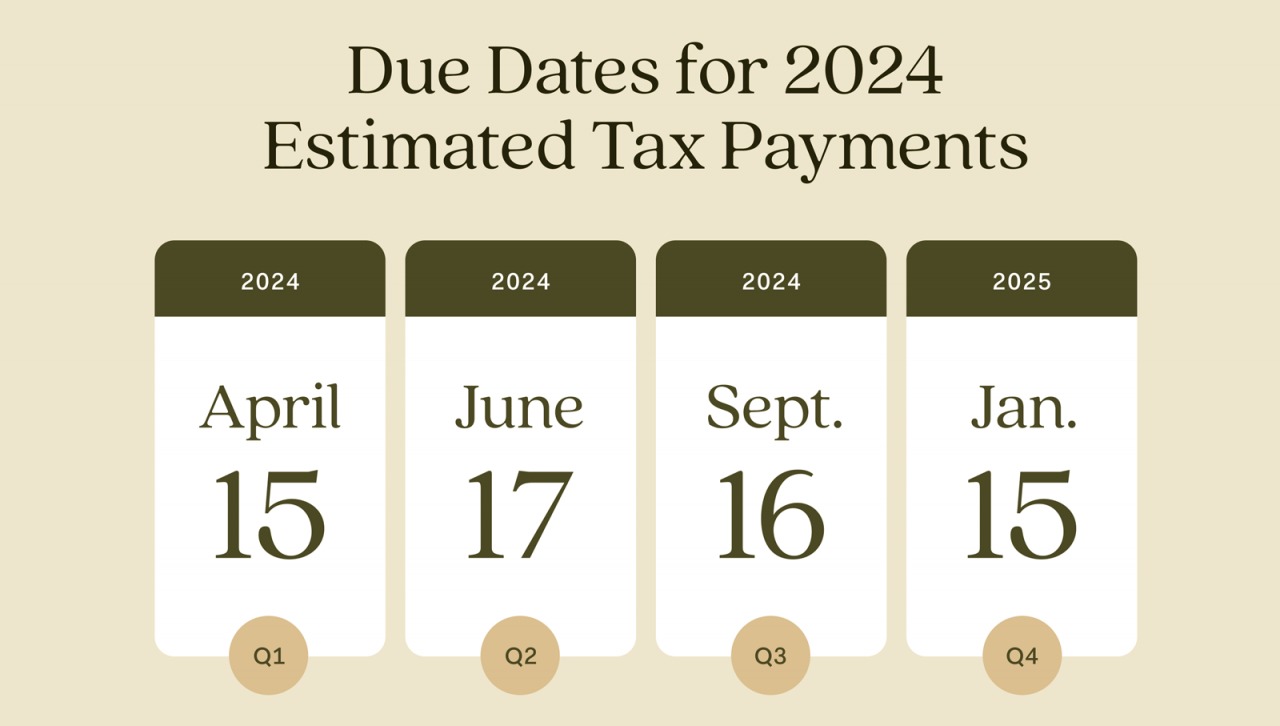
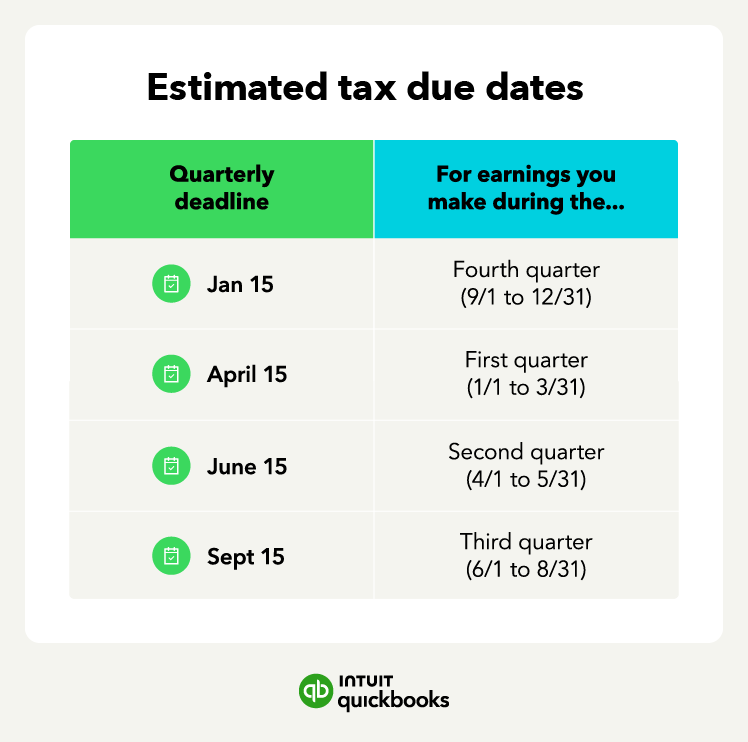
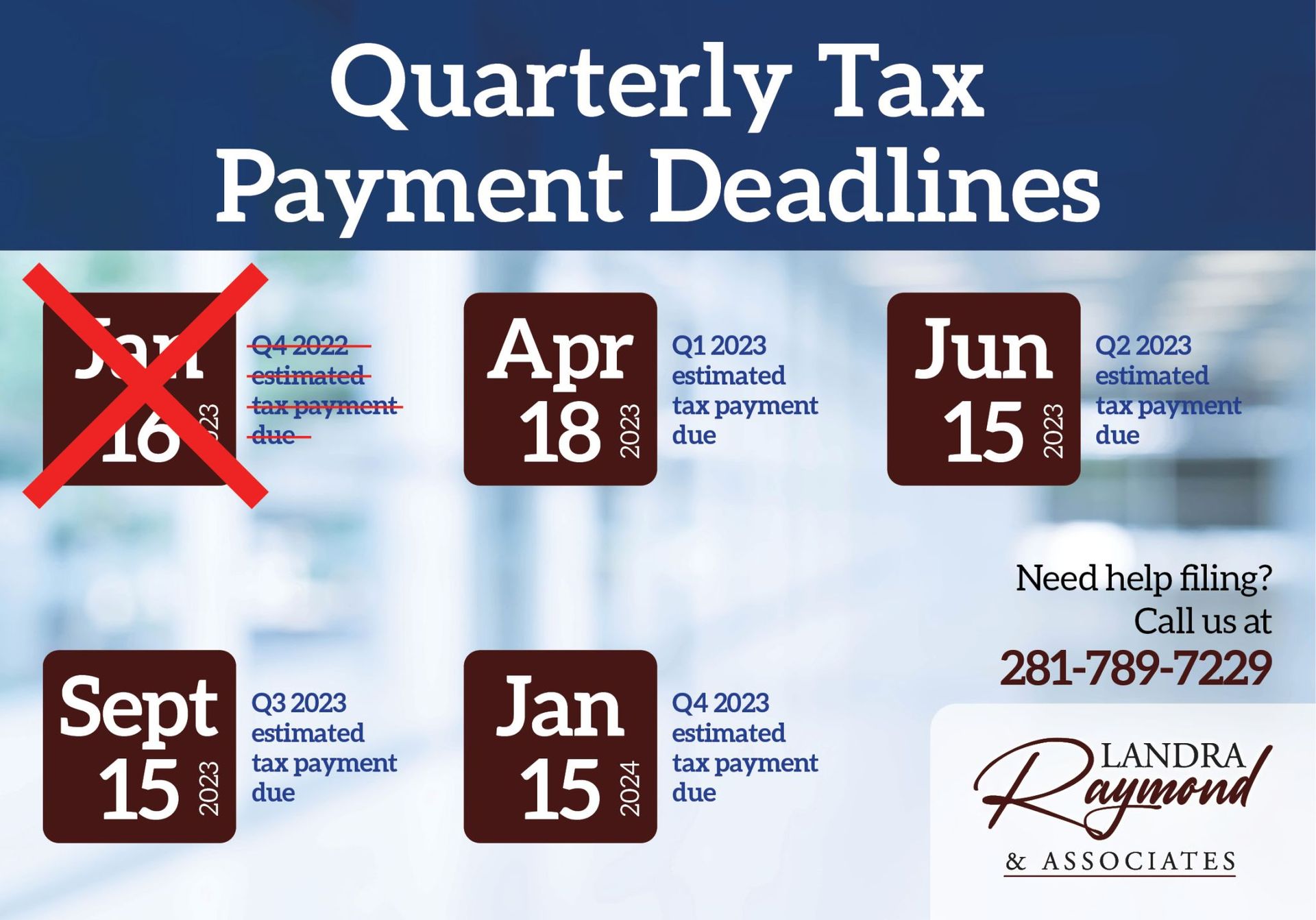
The standard quarterly payment dates for estimated taxes are:
- April 15: This payment covers income earned from January 1 to March 31. This is also the standard annual tax filing deadline for the previous year.
- June 15: This payment covers income earned from April 1 to May 31.
- September 15: This payment covers income earned from June 1 to August 31.
- January 15 of the next year: This final payment covers income earned from September 1 to December 31 of the previous year.
It’s important to note that if any of these dates fall on a weekend or a holiday, the deadline is typically pushed to the next business day. For instance, if April 15 falls on a Saturday, the deadline moves to the following Monday. Taxpayers should always verify the exact due dates for the current year, as these can occasionally shift.
What Each Quarter Covers
Understanding which period of income each payment covers is vital for accurate estimation. It’s not simply dividing your annual income into four equal parts if your income fluctuates.
- Quarter 1 (Jan 1 – Mar 31): Due April 15
- Quarter 2 (Apr 1 – May 31): Due June 15
- Quarter 3 (Jun 1 – Aug 31): Due September 15
- Quarter 4 (Sep 1 – Dec 31): Due January 15 (of the following year)
For taxpayers whose income is unevenly distributed throughout the year—such as seasonal workers or those who receive a large bonus late in the year—the “annualized income method” may be a more appropriate way to calculate payments. This method allows you to adjust your estimated payments based on when you actually earn income, potentially preventing overpayment in early quarters and underpayment later on.
Important Considerations for These Dates
While the standard dates apply to most, there are a few exceptions and nuances:
- Fiscal Year Filers: Businesses and individuals who operate on a fiscal year that is not the calendar year will have their quarterly payment dates adjusted to correspond with their unique fiscal periods. These dates are generally the 15th day of the 4th, 6th, and 9th months of their fiscal year, and the 15th day of the 1st month of the next fiscal year.
- Farmers and Fishermen: Special rules apply to individuals who receive at least two-thirds of their gross income from farming or fishing. They generally have only one estimated tax payment due date (January 15 of the next year for the full amount) or can file their tax return and pay the total tax due by March 1.
- Making Payments Early: You can always make a payment earlier than the due date. The IRS will credit the payment to your account on the date it is received. This can be a useful strategy for managing cash flow or if you anticipate significant income changes.
- December 31 Filers (for Q4): For the fourth-quarter payment (due January 15), you have the option to forgo this payment if you file your annual tax return (Form 1040) and pay any remaining tax due by January 31 of the next year. This is a common strategy for individuals who have their tax information ready early.
Calculating Your Estimated Tax
Accurately calculating your estimated tax payments is paramount to avoiding penalties and effectively managing your financial obligations. It requires a forward-looking approach, anticipating your income, deductions, and credits for the entire tax year.
Methods for Estimation
There are primarily two methods taxpayers use to estimate their tax liability:
- Prior Year’s Tax Method: This is often the simplest and most common method. You use your previous year’s tax return as a guide. If your income and deductions are expected to be similar, you can simply pay 100% of your prior year’s tax liability through estimated payments. For high-income taxpayers (Adjusted Gross Income of over $150,000 for single filers or $75,000 for married filing separately), this threshold increases to 110% of the prior year’s tax. This method provides a “safe harbor” against underpayment penalties, provided your current year’s income doesn’t drastically decrease.
- Current Year’s Income Projection: This method involves estimating your current year’s income, deductions, and credits as accurately as possible. It’s more complex but more precise, especially if your financial situation has changed significantly since the previous year. This approach requires you to project your gross income, subtract estimated deductions, and apply estimated tax credits to arrive at your estimated total tax liability. This total is then divided by four for quarterly payments.
Using Form 1040-ES
The IRS provides Form 1040-ES, Estimated Tax for Individuals, specifically to help taxpayers calculate their estimated tax. This form includes a worksheet that guides you through the process of estimating your:
- Adjusted Gross Income (AGI): Your total income less certain deductions.
- Deductions: Whether you’ll take the standard deduction or itemize.
- Taxable Income: AGI minus deductions.
- Tax: Calculated using tax rates for your filing status.
- Credits: Any applicable tax credits.
- Self-Employment Tax: If applicable, this needs to be included in your estimated tax.
- Total Estimated Tax: The amount you expect to owe for the year.
The form also provides payment vouchers for mailing checks, though electronic payment methods are generally preferred for speed and security. Even if you pay electronically, reviewing the 1040-ES worksheet is an excellent practice for accurate calculation.
Adjusting for Changes in Income or Deductions
Life happens, and financial situations are rarely static. It’s common for income, expenses, or deductions to change throughout the year. If your income fluctuates, or you experience a significant life event (marriage, birth of a child, new job, large capital gain/loss), you should re-evaluate your estimated tax payments.
- Mid-Year Adjustments: You don’t have to stick to your initial estimate if circumstances change. If you earn more than expected, increase your remaining payments to avoid penalties. If you earn less, you can decrease future payments to avoid overpaying.
- Annualized Income Method: For those with highly variable income, such as consultants with large, infrequent contracts or seasonal workers, the annualized income method (using Form 2210, Underpayment of Estimated Tax by Individuals, Estates, and Trusts) can be particularly useful. This method allows you to figure your income and deductions for each payment period and calculate your tax based on that actual income, rather than an even quarterly distribution. This can prevent large overpayments in early quarters and smooth out your tax burden.
Accounting for Self-Employment Tax
For self-employed individuals, it’s critical to remember that estimated tax payments must include not only income tax but also self-employment tax. Self-employment tax covers Social Security and Medicare taxes for individuals who work for themselves. As an employer, you normally pay half of these taxes, and your employee pays the other half through payroll deductions. When you’re self-employed, you’re responsible for both halves—the full 15.3% (12.4% for Social Security up to the annual limit, and 2.9% for Medicare with no wage limit). You can deduct one-half of your self-employment tax when calculating your adjusted gross income, which slightly reduces your overall tax burden. Neglecting to factor in self-employment tax is a common reason for underpayment among the self-employed, leading to unexpected penalties.
Avoiding Underpayment Penalties
Underpayment penalties are the IRS’s mechanism to encourage taxpayers to meet their “pay-as-you-go” obligations. Understanding how to avoid them is a crucial aspect of tax planning and financial management.
The 90% Rule and 100% Rule (or 110% Rule for High Earners)
The IRS offers “safe harbor” provisions to help taxpayers avoid underpayment penalties. You generally won’t owe a penalty if you pay at least 90% of your current year’s tax liability through estimated payments or withholding. Alternatively, you can avoid a penalty if you pay 100% of your prior year’s tax liability, whichever is smaller.
For taxpayers with an Adjusted Gross Income (AGI) exceeding $150,000 in the prior tax year ($75,000 for married individuals filing separately), the “prior year” safe harbor rule requires paying 110% of the previous year’s tax. This higher threshold ensures that high-income earners contribute more consistently throughout the year. Meeting one of these safe harbor rules is the most straightforward way to guarantee you won’t face an underpayment penalty.
Common Reasons for Penalties
Several factors can lead to underpayment penalties:
- Insufficient Payments: The most direct cause is simply not paying enough tax throughout the year, falling short of the 90% current year or 100%/110% prior year safe harbor thresholds.
- Missing Deadlines: Even if you pay the correct total amount, failing to make payments by the quarterly due dates can trigger penalties. The IRS calculates penalties based on the underpayment amount for each specific payment period.
- Unforeseen Income Spikes: A sudden increase in income (e.g., a large bonus, significant capital gain, or an unexpected inheritance) that isn’t accounted for in your estimated payments can lead to an underpayment.
- Underestimating Deductions/Credits: Overestimating your deductions or credits when calculating your estimated tax can also result in an underpayment if your actual deductions or credits turn out to be lower.
- Neglecting Self-Employment Tax: As discussed, self-employed individuals often underestimate their liability by forgetting to include Social Security and Medicare taxes in their estimates.
Strategies to Prevent Penalties
Proactive planning is key to penalty avoidance:
- Regular Review and Adjustment: Don’t set your estimated payments once and forget them. Review your income and expenses periodically (at least quarterly) and adjust your future payments as needed.
- Use the Safe Harbor Rules: Aim to meet either the 90% current year or 100%/110% prior year safe harbor. For most, paying 100% (or 110%) of the prior year’s tax is the easiest way to ensure compliance, especially if current year income is difficult to predict.
- Increase Withholding: If you have both W-2 income and other income requiring estimated payments, you can often avoid making separate quarterly payments by increasing the withholding from your W-2 employer. Use the IRS Tax Withholding Estimator (available on IRS.gov) or submit a new Form W-4 to your employer. This is an excellent strategy, as withholding is considered paid evenly throughout the year, regardless of when it’s actually withheld.
- Tax Planning with a Professional: Consult with a tax advisor who can help you accurately project income, deductions, and credits, and recommend the best payment strategy for your unique financial situation.
- Set Reminders: Mark all quarterly due dates on your calendar and set digital reminders to ensure you don’t miss any payments.
Exceptions to the Penalty
While penalties are common for underpayment, there are certain situations where the IRS may waive them:
- Casualty, Disaster, or Other Unusual Circumstances: If underpayment was due to a casualty, disaster, or other unusual circumstances where it would be inequitable to impose a penalty.
- Retirement or Disability: If you retired (after reaching age 62) or became disabled during the tax year, and your underpayment was due to a reasonable cause and not willful neglect.
- First-Time Penalty Abatement: In some cases, if it’s your first time receiving a penalty, you may qualify for a penalty abatement if you have a clean compliance record for the past three years.
You must generally request a waiver from the IRS, providing a clear explanation of your circumstances.
How to Make Your Quarterly Payments
Making estimated tax payments is straightforward, with several convenient options provided by the IRS. Choosing the right method can help streamline your financial processes and ensure timely credit for your payments.
IRS Direct Pay
IRS Direct Pay is the fastest and easiest way for individuals to make tax payments directly from their checking or savings account. It’s a free, secure, and government-run service. You can schedule payments up to 365 days in advance, receive email confirmations, and even modify or cancel payments up to two days before the scheduled date. This is an excellent option for one-off payments and offers peace of mind with instant confirmation.
Electronic Federal Tax Payment System (EFTPS)
For individuals and businesses who make regular estimated tax payments, the Electronic Federal Tax Payment System (EFTPS) is a robust and highly recommended option. It allows you to make all federal tax payments, including estimated taxes, electronically. While it requires a one-time enrollment process (which can take 5-7 business days to receive your PIN by mail), once set up, it offers a secure and flexible platform. You can schedule payments up to 365 days in advance and review your payment history. Many businesses and self-employed individuals find EFTPS indispensable for its comprehensive features and ability to manage multiple tax types.
Mail-in Payments
If you prefer traditional methods, you can still mail in your estimated tax payments with a check or money order. When doing so, you must use the appropriate payment voucher from Form 1040-ES, Estimated Tax for Individuals. Each voucher is designated for a specific payment period, so it’s crucial to use the correct one to ensure your payment is applied accurately. Make sure your check or money order is made payable to the “U.S. Treasury” and includes your name, address, Social Security number, daytime phone number, and the tax year and payment period on the memo line. Always mail your payment early enough to ensure it is postmarked by the due date.
Paying Through a Tax Professional or Tax Software
Many tax preparation software programs (like TurboTax or H&R Block) and tax professionals offer services to help you calculate and even submit your estimated tax payments electronically. This can be a convenient option, especially if your tax professional is already managing your overall tax strategy. They can ensure accuracy and timely submission, integrating your estimated payments into your broader financial plan.
Applying Overpayments from a Prior Year
If you had an overpayment on your prior year’s tax return, you have the option to apply that overpayment to your current year’s estimated tax. This can be a smart financial move, reducing the amount you need to pay out-of-pocket for your first (or even subsequent) quarterly payments. When filing your annual tax return, simply indicate on Form 1040 that you wish to apply the overpayment to your next year’s estimated tax, rather than receiving it as a refund. This strategy automatically credits your account, reducing your subsequent payment obligations for the new tax year.
aViewFromTheCave is a participant in the Amazon Services LLC Associates Program, an affiliate advertising program designed to provide a means for sites to earn advertising fees by advertising and linking to Amazon.com. Amazon, the Amazon logo, AmazonSupply, and the AmazonSupply logo are trademarks of Amazon.com, Inc. or its affiliates. As an Amazon Associate we earn affiliate commissions from qualifying purchases.