
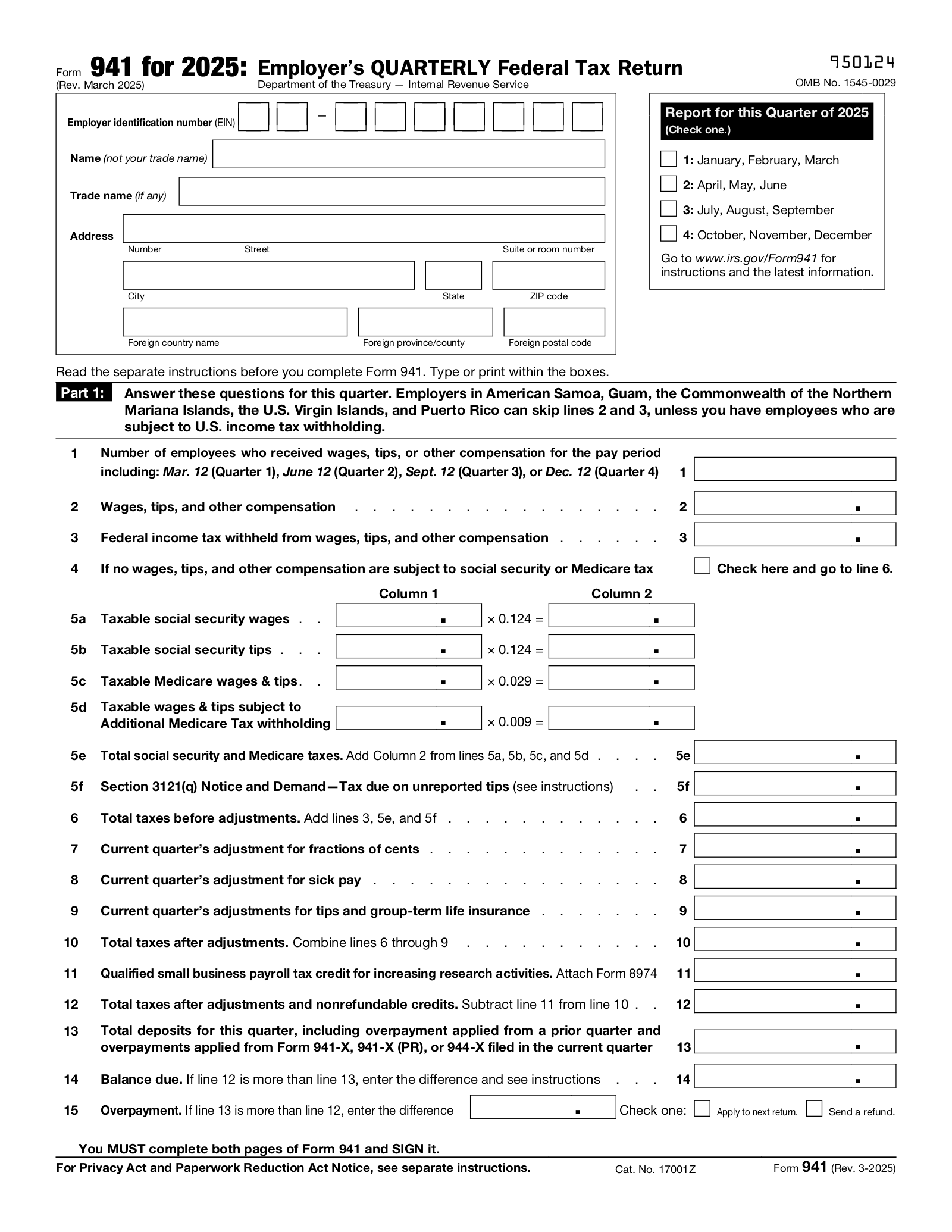
For businesses, navigating the labyrinthine world of federal taxes can often feel like a daunting task. Among the myriad forms and deadlines, IRS Form 941 stands out as one of the most critical for nearly every employer. Often dubbed the “Employer’s Quarterly Federal Tax Return,” Form 941 is the primary mechanism through which businesses report the income tax, Social Security tax, and Medicare tax they’ve withheld from their employees’ paychecks, along with their own share of Social Security and Medicare taxes.
This seemingly straightforward form is, in reality, a cornerstone of payroll compliance, directly impacting a company’s financial health and its standing with the Internal Revenue Service. Mismanagement of Form 941 can lead to significant penalties, interest, and even legal repercussions, underscoring its importance for businesses of all sizes. Understanding what Form 941 entails, who needs to file it, and how to do so accurately and on time is not just a matter of compliance; it’s a fundamental aspect of sound business finance. This comprehensive guide aims to demystify Form 941, providing employers with the insights needed to navigate their quarterly federal tax obligations confidently and strategically.
Understanding the Fundamentals of Form 941
At its core, IRS Form 941 is a reconciliation document. It allows the IRS to compare the taxes an employer has deposited throughout a quarter with the total tax liability calculated for that same period. This ensures that employees’ withheld taxes are accurately reported and forwarded to the government, funding crucial programs like Social Security and Medicare, while also accounting for the employer’s matching contributions.
Who Needs to File Form 941?
The general rule is straightforward: if you pay wages subject to income tax withholding and Social Security and Medicare taxes, you are required to file Form 941 quarterly. This applies to virtually all employers, regardless of their business structure (sole proprietorship, partnership, corporation, LLC) or the number of employees, even if you only have one.
However, there are a few notable exceptions:
- Agricultural Employers: If you pay wages for farmwork, you typically file Form 943, Employer’s Annual Federal Tax Return for Agricultural Employees, instead of Form 941.
- Household Employers: If you employ household workers (like nannies or housekeepers), you generally report and pay employment taxes on Schedule H (Form 1040), Household Employment Taxes, rather than Form 941.
- Certain Non-Profits: Some non-profit organizations might be exempt from certain payroll taxes, though many still have filing obligations.
- Seasonal Employers: If you hire employees for only part of the year and don’t pay wages during certain quarters, you should check the “final return” box on your last Form 941 and indicate the quarter you ceased paying wages. You won’t file for subsequent quarters until you resume paying wages.
It’s crucial for businesses to accurately determine their filing status, as choosing the incorrect form or failing to file can lead to significant penalties.
What Taxes Does Form 941 Report?
Form 941 is designed to report a specific set of federal taxes that employers are responsible for collecting and remitting. These include:
- Federal Income Tax Withheld: This is the portion of an employee’s gross pay that the employer holds back and sends to the IRS on the employee’s behalf. The amount is determined by the employee’s Form W-4 and tax brackets.
- Social Security Tax: Both the employer and the employee contribute to Social Security. For 2024, the employee’s share is 6.2% on wages up to the annual limit, and the employer matches this with another 6.2%. Form 941 reports both portions.
- Medicare Tax: Similarly, both the employer and the employee contribute to Medicare. For 2024, the employee’s share is 1.45% on all wages, and the employer matches this with another 1.45%. Form 941 reports both portions.
- Additional Medicare Tax Withholding: An additional Medicare tax of 0.9% applies to wages over a certain threshold ($200,000 for single filers, $250,000 for married filing jointly). Employers are responsible for withholding this from employees’ pay once their wages exceed the threshold, but only the employee is liable for this additional tax, not the employer.
- Qualified Sick and Family Leave Credits: In previous years, particularly during the COVID-19 pandemic, employers could claim refundable tax credits for providing paid sick and family leave. While these specific credits have largely expired, Form 941 (and its adjusted version, 941-X) was the mechanism used to report and claim them, highlighting the form’s adaptability to changing tax legislation.
Accurately calculating these taxes and reporting them on Form 941 is paramount, as discrepancies can trigger IRS scrutiny and potential audits.
The Mechanics of Filing: Deadlines and Payment Obligations
Beyond simply knowing what Form 941 is, employers must grasp the critical timelines and payment responsibilities associated with it. The IRS operates on a strict schedule, and adhering to it is non-negotiable for maintaining good standing and avoiding penalties.
Quarterly Filing Deadlines
Form 941 is, as its name suggests, a quarterly return. This means employers must file it four times a year, reporting on the taxes withheld and owed for the previous three-month period. The deadlines are as follows:
- Quarter 1 (January 1 – March 31): Due April 30
- Quarter 2 (April 1 – June 30): Due July 31
- Quarter 3 (July 1 – September 30): Due October 31
- Quarter 4 (October 1 – December 31): Due January 31 of the next year
It’s important to note that if any of these due dates fall on a Saturday, Sunday, or legal holiday, the deadline is shifted to the next business day. Furthermore, if you made all your tax deposits on time and in full for the quarter, you are granted an additional 10 calendar days to file Form 941. While this extension can be helpful, most businesses aim to file well before the absolute deadline to avoid last-minute issues.
Tax Deposit Rules: Accuracy and Timeliness
Filing Form 941 is only one half of the equation; the other, equally critical part, is depositing the taxes withheld and owed. Unlike the quarterly filing of Form 941, these deposits are typically made much more frequently – either monthly or semiweekly – depending on the employer’s total tax liability from a lookback period (usually the preceding calendar year).
- Monthly Depositors: If your total tax liability during the lookback period was $50,000 or less, you are generally a monthly depositor. This means you must deposit your taxes by the 15th day of the next month. For example, taxes for January would be due by February 15th.
- Semiweekly Depositors: If your total tax liability during the lookback period was over $50,000, you are a semiweekly depositor. This schedule is more complex:
- For wages paid on Wednesday, Thursday, or Friday, deposits are due by the following Wednesday.
- For wages paid on Saturday, Sunday, Monday, or Tuesday, deposits are due by the following Friday.
There’s also a crucial $100,000 Next-Day Deposit Rule. If your accumulated tax liability reaches $100,000 or more on any day during a monthly or semiweekly deposit period, you must deposit the tax by the next business day, regardless of your usual deposit schedule. Once this rule is triggered, you automatically become a semiweekly depositor for at least the remainder of the current and following calendar year.
All federal tax deposits must be made through the Electronic Federal Tax Payment System (EFTPS). The IRS mandates EFTPS for virtually all businesses, making electronic payments not just convenient but compulsory. Failure to make timely and accurate deposits can result in severe penalties, often calculated as a percentage of the underpayment for each day it’s late. This highlights the importance of precise payroll processing and diligent cash flow management.
Navigating Common Challenges and Special Circumstances
Even with a firm grasp of the fundamentals, employers often encounter scenarios that require special attention or adjustments. From correcting an accidental error to handling business transitions, knowing how to address these situations is vital for continued compliance.
Correcting Errors: Form 941-X
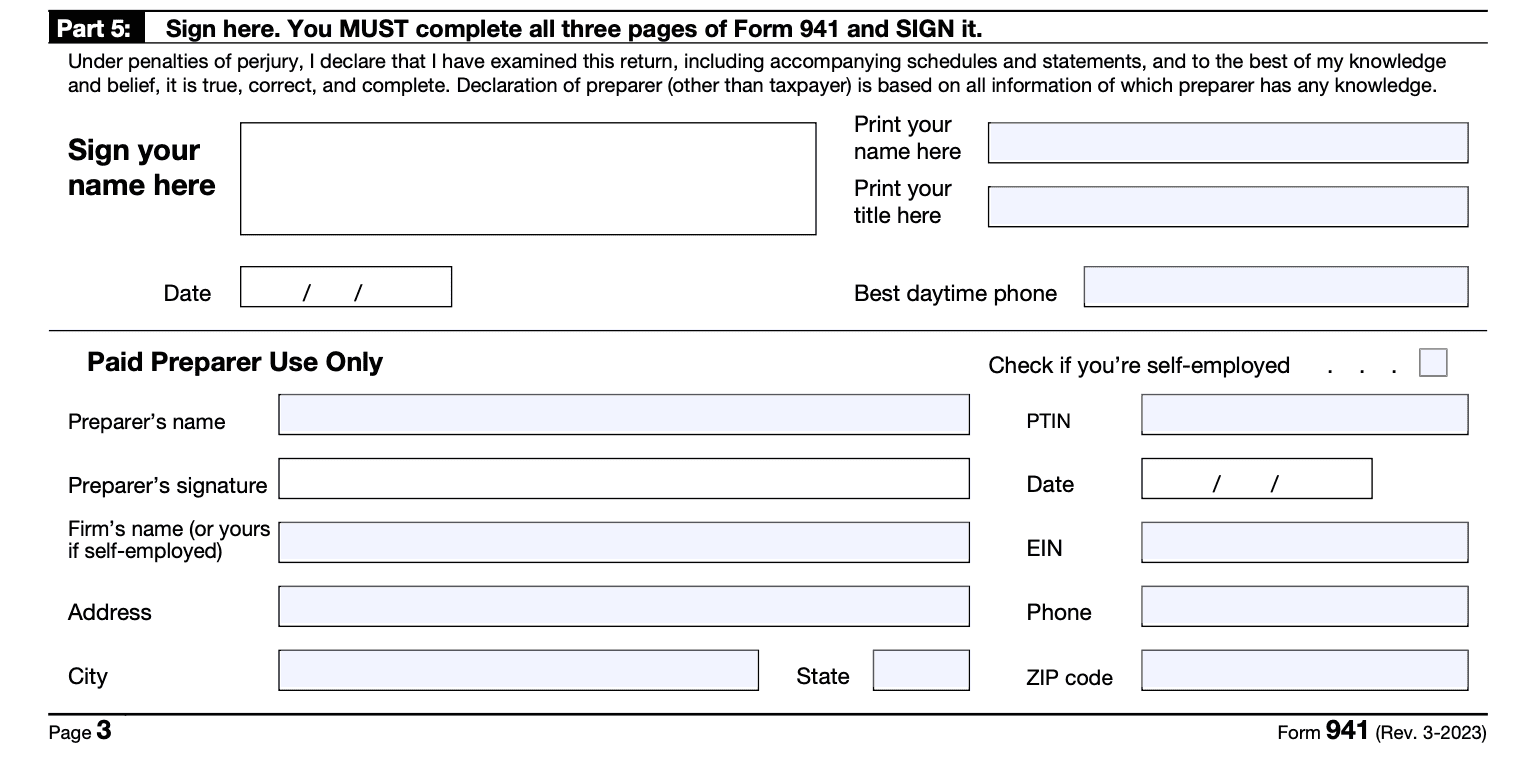
Mistakes happen, even with the most meticulous record-keeping. Whether it’s a clerical error, a miscalculation of wages, or an incorrect tax rate applied, the IRS provides a mechanism for correcting previously filed Forms 941: Form 941-X, Adjusted Employer’s Quarterly Federal Tax Return or Claim for Refund.
- When to Use 941-X: You use Form 941-X to correct errors on a Form 941 that you previously filed. This could involve underreported or overreported taxes.
- How to Use 941-X: The form requires detailed explanations of the error and how it was corrected. You must file a separate Form 941-X for each quarter you are correcting. It’s crucial to specify whether the adjustment increases or decreases your tax liability and if you are claiming a refund or owe additional tax.
- Importance of Prompt Correction: Correcting errors promptly is essential. The IRS generally allows you to correct errors for up to three years from the date you filed the original Form 941, or two years from the date you paid the tax, whichever is later. Delayed corrections can lead to increased penalties and interest.
Accurate record-keeping and a thorough review process before original submission can significantly reduce the need for Form 941-X, but knowing it exists provides a safety net for inevitable human error.
Dealing with Business Changes
Business dynamics are rarely static, and changes can directly impact Form 941 obligations.
- Starting a New Business: When you start a new business and hire employees, your first Form 941 will reflect your initial payroll activities. Ensure you obtain an Employer Identification Number (EIN) well in advance, as it is required for all federal tax filings.
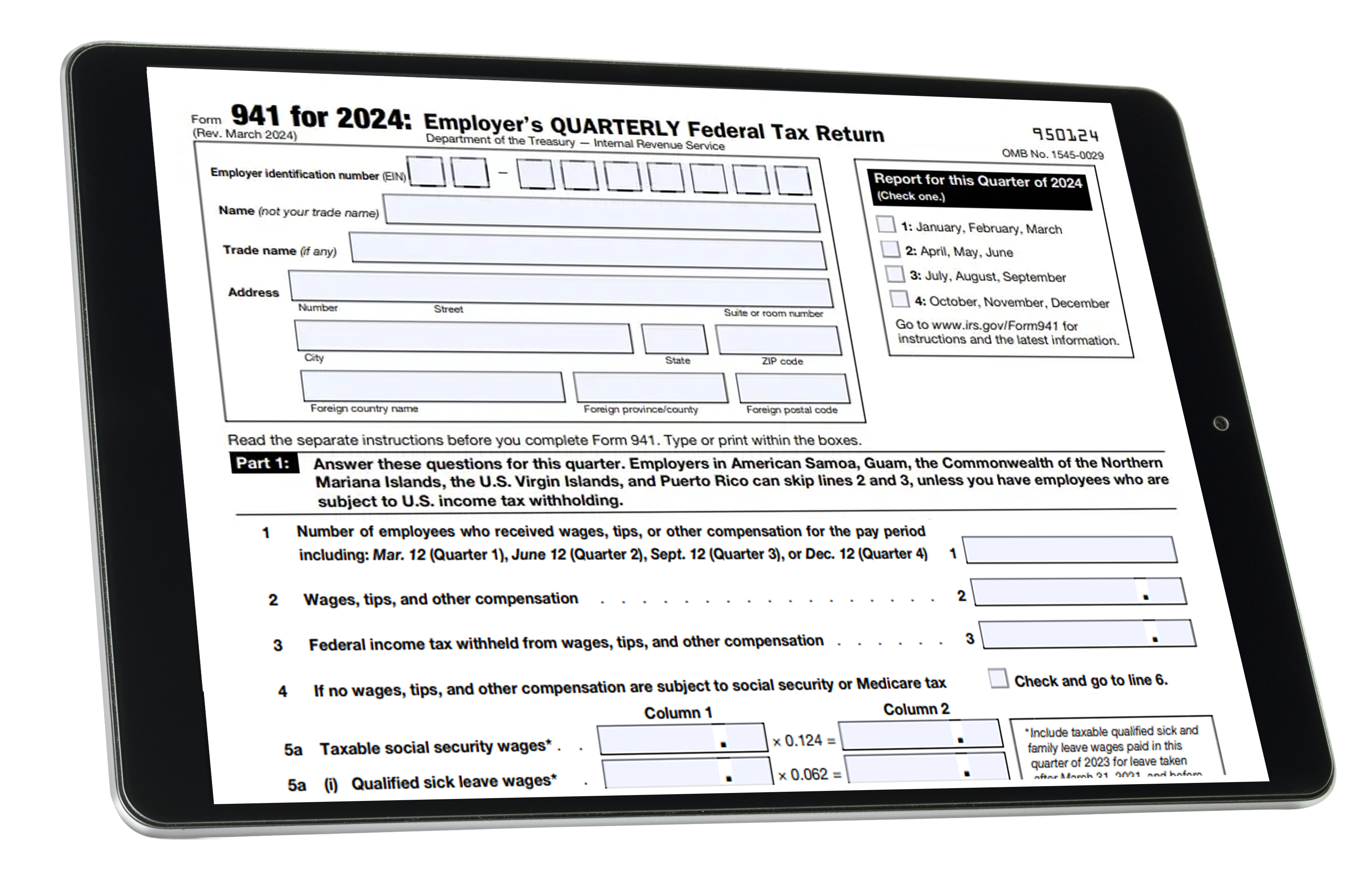
- Closing a Business: If you permanently stop paying wages, you must file a final Form 941 for the quarter in which you made your last wage payments. You must check the “final return” box on Form 941, along with the date you last paid wages. This signals to the IRS that you will no longer be filing quarterly returns. Failure to do so can result in the IRS continuing to expect filings and assessing penalties for non-submission.
- Changes in Employee Count: While not directly altering the filing requirement, significant changes in your employee roster will naturally affect your total wages paid and tax liability. Your payroll system must accurately track these changes to ensure correct reporting on Form 941.
The Impact of Payroll Software and Services
For many businesses, particularly small to medium-sized enterprises (SMEs), managing Form 941 and associated payroll taxes manually can be overwhelming. This is where payroll software and professional payroll services become invaluable financial tools.
- Streamlined Preparation: Modern payroll software automates wage and tax calculations, eliminating manual errors and significantly reducing the time spent preparing Form 941. Many solutions can even generate the form automatically.
- Automated Deposits: Most payroll services handle the tax deposit process, ensuring timely payments to the IRS via EFTPS and minimizing the risk of penalties.
- Integration: Advanced platforms integrate payroll with HR, time tracking, and accounting systems, providing a holistic view of labor costs and simplifying financial reporting.
- Compliance Updates: Reputable software and services continuously update their platforms to reflect the latest tax laws and regulations, helping businesses stay compliant without constant manual research.
Choosing the right payroll solution can transform Form 941 compliance from a burdensome chore into an efficient, automated process, allowing business owners to focus on core operations.
Strategic Implications and Best Practices for Employers
Beyond the mechanics of filing, understanding Form 941 has broader strategic implications for a business’s financial planning, risk management, and overall operational efficiency. Proactive management and adherence to best practices can turn a compliance obligation into a tool for better business finance.
Beyond Compliance: Financial Planning and Budgeting
Form 941 provides a snapshot of an employer’s quarterly payroll tax burden, which is a significant component of operating costs. By meticulously tracking these figures, businesses can:
- Forecast Cash Flow: Understanding the recurring tax deposit obligations helps in accurately forecasting cash flow. Payroll taxes are a predictable expense that must be accounted for in budgeting to avoid liquidity issues.
- Analyze Labor Costs: The data reported on Form 941, especially when combined with wage data, allows businesses to analyze their total labor costs, informing decisions about hiring, staffing levels, and compensation strategies.
- Strategic Tax Planning: While Form 941 itself is a reporting form, the underlying payroll tax amounts influence overall tax strategy. Businesses can better understand their federal tax liabilities and make informed decisions about other deductions, credits, or tax planning opportunities.
Integrating Form 941 data into broader financial models empowers businesses to make more informed decisions and manage their financial resources more effectively.
Record Keeping: Your Defense Against Audits
Thorough and organized record-keeping is not just a best practice; it’s a critical defense mechanism in the event of an IRS audit. For Form 941, this includes:
- Payroll Registers: Detailed records of all wages paid, tips reported, and taxes withheld for each employee.
- Forms W-4: Employee’s Withholding Certificate, which determines the amount of federal income tax to withhold.
- Time Cards/Attendance Records: Documentation supporting hours worked and wages earned.
- Tax Deposit Confirmations: Proof that all required tax deposits were made on time.
- Copies of Filed Forms 941 and 941-X: Keep copies of all original and adjusted returns.
The IRS generally requires employers to keep these records for at least four years from the date the tax becomes due or is paid, whichever is later. Maintaining these records in an accessible and organized manner, whether physically or digitally, can significantly streamline an audit process and prove compliance.
Staying Updated with Tax Law Changes
Federal tax laws are dynamic and subject to frequent changes. New legislation, adjustments to tax rates, or the introduction (or expiration) of tax credits can all directly impact Form 941 and an employer’s payroll obligations.
- Reliance on Reputable Sources: Employers should regularly consult official IRS publications (such as Publication 15, Circular E, Employer’s Tax Guide), subscribe to IRS updates, or work closely with knowledgeable tax professionals.
- Impact of Legislative Changes: Recent history, particularly during the COVID-19 pandemic, demonstrated how quickly payroll tax relief (like the qualified sick and family leave credits or the employee retention credit) could be introduced, requiring employers to understand and apply complex new rules through Form 941 and its related forms. Staying informed allows businesses to capitalize on beneficial provisions and avoid missteps with new requirements.
Proactive engagement with tax law changes ensures continued compliance and helps businesses adapt their financial strategies as needed.
Conclusion
IRS Form 941 is far more than just another government form; it is a vital quarterly report that underpins the federal tax system’s collection of employment taxes. For every employer, understanding and accurately managing their Form 941 obligations is absolutely critical for several reasons: it ensures compliance with federal tax laws, prevents costly penalties and interest, and provides essential data for financial planning and budgeting.
From determining who needs to file and what taxes are reported, to navigating stringent deadlines and deposit rules, the intricacies of Form 941 demand meticulous attention to detail. Leveraging modern payroll software and professional services can significantly ease this burden, transforming a complex task into an efficient process. Ultimately, by embracing best practices in record-keeping, proactively addressing errors, and staying vigilant regarding changes in tax legislation, businesses can confidently meet their Form 941 responsibilities, safeguarding their financial health and fostering a reputation of integrity and compliance. For any business striving for long-term success, mastering Form 941 is not an option—it’s a necessity.
aViewFromTheCave is a participant in the Amazon Services LLC Associates Program, an affiliate advertising program designed to provide a means for sites to earn advertising fees by advertising and linking to Amazon.com. Amazon, the Amazon logo, AmazonSupply, and the AmazonSupply logo are trademarks of Amazon.com, Inc. or its affiliates. As an Amazon Associate we earn affiliate commissions from qualifying purchases.