
Navigating the complexities of tax season can often feel like a daunting task, and one of the most fundamental questions for any taxpayer is, “Where do I send my IRS tax payment?” This seemingly simple query opens up a world of options, each with its own advantages and considerations. Ensuring your payment reaches the Internal Revenue Service (IRS) correctly and on time is paramount to avoiding penalties, interest, and unnecessary stress. In an increasingly digital world, the IRS has diversified its payment channels, offering convenience alongside traditional methods. This guide delves deep into the various pathways available for settling your tax obligations, empowering you with the knowledge to choose the method that best suits your financial situation and preferences.
The IRS collected over $4.9 trillion in taxes in a recent fiscal year, a testament to the scale of its operations and the vital role timely tax payments play in funding federal government initiatives. For individuals, businesses, and fiduciaries alike, understanding the appropriate channels for payment isn’t just about compliance; it’s about financial prudence and peace of mind. From instant online transactions to traditional mail, each method carries specific instructions, best practices, and implications for record-keeping. Let’s explore these options, ensuring your journey through tax season is as smooth and efficient as possible.
Understanding Your IRS Payment Obligations
Before you even consider how to send your payment, it’s crucial to understand what you’re paying, when it’s due, and the critical importance of fulfilling these obligations. A clear grasp of your tax liability and associated deadlines forms the bedrock of effective tax planning and compliance.
Who Needs to Pay?
The obligation to pay taxes extends across a broad spectrum of entities and individuals in the United States. This includes:
- Individuals: Most employed individuals have taxes withheld from their paychecks. However, if your withholdings are insufficient, or if you have income from other sources (e.g., investments, self-employment, rental properties), you might owe additional tax when you file your annual return.
- Self-Employed Individuals: Those who work for themselves are generally required to pay estimated taxes throughout the year, as no employer withholds taxes on their behalf. This usually involves making quarterly payments.
- Businesses: Corporations, partnerships, and other business entities have their own set of tax obligations, including income tax, employment taxes (e.g., Social Security, Medicare), and excise taxes. Like self-employed individuals, many businesses must make estimated tax payments.
- Fiduciaries: This category includes executors of estates and trustees of trusts, who are responsible for paying taxes on the income generated by the estate or trust.
Understanding your specific category helps determine not only your payment method but also the forms and schedules you might need to use.
When Are Payments Due?
Tax deadlines are non-negotiable and are among the most critical dates in the financial calendar. While the primary individual income tax deadline is typically April 15th (or the next business day if April 15th falls on a weekend or holiday), this is just one of many important dates:
- Annual Income Tax: For most individual filers, this is the final deadline for filing returns and paying any remaining tax due for the previous year.
- Estimated Taxes: For self-employed individuals and those with significant income not subject to withholding, estimated tax payments are typically due on April 15, June 15, September 15, and January 15 of the following year.
- Business Taxes: Deadlines vary significantly depending on the business structure and the type of tax. For instance, corporate income tax (Form 1120) might be due April 15 or March 15 depending on the fiscal year, while quarterly employment tax (Form 941) is due at the end of the month following each quarter.
- Extensions: While you can often get an extension to file your tax return, an extension to pay is rarely granted. If you anticipate owing tax, you must pay by the original deadline to avoid penalties, even if you file for an extension.
Missing these deadlines can result in significant financial repercussions, underscoring the importance of meticulous planning.
The Importance of Timely Payments
Failing to pay your taxes on time or paying less than what you owe can lead to a cascade of penalties and interest charges. The IRS applies:
- Failure-to-Pay Penalty: This penalty is generally 0.5% of the unpaid taxes for each month or part of a month that taxes remain unpaid, capped at 25% of your unpaid tax bill.
- Failure-to-File Penalty: If you don’t file on time, this penalty is generally 5% of the unpaid taxes for each month or part of a month that a tax return is late, capped at 25%. This penalty is often higher than the failure-to-pay penalty, so it’s always better to file on time, even if you can’t pay.
- Interest: In addition to penalties, the IRS charges interest on underpayments and unpaid taxes. The interest rate can change quarterly and is applied to both the underpaid tax and any penalties.
These charges can quickly compound, turning a manageable tax bill into a substantial financial burden. Proactive tax planning and timely payments are your best defense against these added costs.
Digital Pathways: The Easiest Ways to Pay Your Taxes
In today’s digital age, the IRS offers several convenient and secure electronic payment methods that are often faster, more accurate, and more environmentally friendly than traditional paper checks. These options provide instant confirmation and reduce the risk of lost mail.
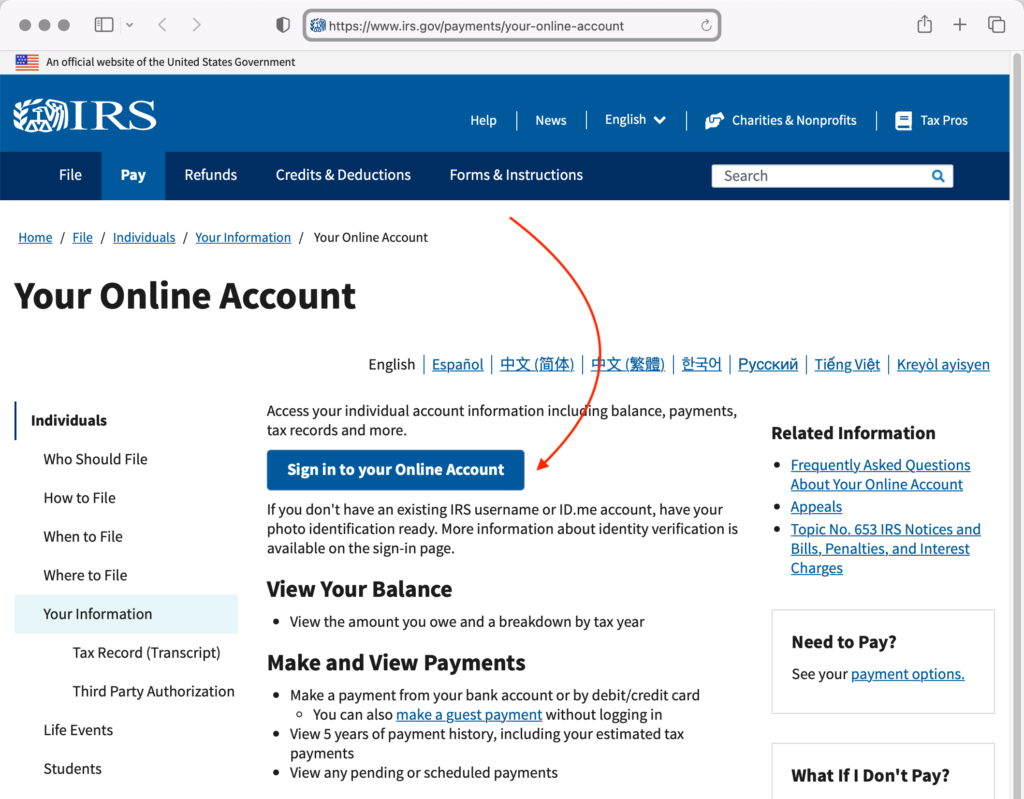
IRS Direct Pay
IRS Direct Pay is arguably the most straightforward and popular electronic payment option for individuals. It allows you to pay your tax bill or estimated taxes directly from your checking or savings account, free of charge.
- How it Works: You access IRS Direct Pay through the IRS website. You’ll need to verify your identity by providing your Social Security number (SSN) or Individual Taxpayer Identification Number (ITIN), date of birth, and filing status, along with your prior year’s adjusted gross income (AGI). After verification, you can designate the payment amount, tax year, and payment type (e.g., income tax, estimated tax).
- Benefits: It’s free, secure, and offers instant confirmation via email. Payments can be scheduled up to 365 days in advance. You can also view your payment history for the past 15 months.
- Limitations: It can only be used for payments from a checking or savings account, and it’s primarily designed for individual taxpayers.
Electronic Federal Tax Payment System (EFTPS)
EFTPS is a robust system primarily used by businesses but also available to individuals, offering more advanced features and greater flexibility for managing various federal tax payments.
- How it Works: EFTPS requires enrollment and a PIN. Once enrolled, you can schedule payments up to 365 days in advance, track payment history for up to 15 months, and make payments for various tax forms (e.g., Form 1040, 941, 1120). Payments are debited directly from your bank account.
- Benefits: Ideal for businesses that make frequent or varied tax payments. It provides a comprehensive record-keeping system and is free to use. It offers more tax types than IRS Direct Pay.
- Limitations: Requires prior enrollment, which can take several business days to complete. Less immediate setup than IRS Direct Pay.
Credit/Debit Card, Digital Wallet Options
For those who prefer the convenience of using a card or digital wallet, the IRS partners with several third-party payment processors. While these methods offer flexibility, they typically come with a processing fee.
- How it Works: You select a payment processor from the IRS website (e.g., PayUSAtax, ACI Payments, Link2Gov). You’ll then be redirected to their site to complete the transaction using your credit card, debit card, or a digital wallet option like PayPal.
- Benefits: Instant payment, often with immediate confirmation. Allows you to potentially earn rewards points on credit cards (though the processing fee might offset this). Useful if you need to pay quickly and don’t have enough funds in your bank account, but plan to pay off your credit card quickly.
- Limitations: The third-party processors charge a fee, which can range from 1.87% to 1.99% for credit cards and a flat fee (e.g., $2.50-$3.95) for debit cards. These fees are in addition to your tax liability.
Tax Software Providers

Many popular tax preparation software programs (e.g., TurboTax, H&R Block, TaxAct) offer integrated payment options directly through their platforms.
- How it Works: When you prepare your return using tax software, you’ll typically be prompted with an option to pay any taxes due electronically. The software will guide you through the process, often linking directly to IRS Direct Pay, EFTPS, or a third-party card processor.
- Benefits: Seamless integration with your tax filing process, reducing the chance of errors. Many offer direct debit from your bank account.
- Limitations: The specific payment options might depend on the software provider, and some might redirect you to the IRS or a third-party site.
Traditional Methods: When Digital Isn’t an Option (or Preferred)
While digital payments are increasingly popular, the IRS continues to offer traditional, non-electronic options for those who prefer them or lack access to online services. These methods require careful attention to detail to ensure proper delivery and processing.
Paying by Mail (Check or Money Order)
Sending your payment through the mail is a time-honored method, particularly for those who prefer physical records or don’t use online banking.
- How it Works: You should make your check or money order payable to the “U.S. Treasury.” Be sure to clearly write your full name, address, daytime phone number, Social Security number (or Employer Identification Number for businesses), the tax year, and the related tax form (e.g., “2023 Form 1040”) on the payment itself. Detach any payment voucher (like Form 1040-V for individuals) from your return and mail it with your payment.
- IRS Address Lookup: The mailing address for your payment depends on several factors: your location, the type of return you’re filing, and whether you’re sending a payment with your return or separately. Always consult the official IRS website (IRS.gov) or the instructions for your specific tax form to find the correct mailing address. Sending to the wrong address can significantly delay processing and lead to penalties.
- Importance of Accuracy: Double-check all information on your check/money order and the mailing envelope. Use certified mail with a return receipt for added proof of timely mailing, especially close to the deadline.
- Limitations: Slower processing time, risk of loss in mail, no instant confirmation. Payments must be postmarked by the due date.
Cash Payments
For individuals who prefer or need to pay in cash, the IRS offers options through retail partners.
- How it Works: You can make cash payments (up to $500 per payment) at participating retail stores (e.g., 7-Eleven, Family Dollar, CVS Pharmacy) using a barcode generated online through the IRS’s payment partners (like PayNearMe). You’ll need to initiate the process online to get the barcode, which you then present at the retailer.
- Benefits: Provides an alternative for the unbanked or those who primarily deal in cash.
- Limitations: Limited to specific retail locations, transaction limits, and requires prior online setup to obtain the barcode. A small processing fee may apply. This method is generally not recommended for large payments due to security and logistical concerns.
Paying in Person (Limited Circumstances)
While generally discouraged for routine tax payments, there are very limited circumstances where paying in person at a Taxpayer Assistance Center (TAC) might be possible.
- How it Works: Taxpayers needing to pay in person must make an appointment at a TAC. However, TACs are primarily for tax help and account issues, not for routine payment acceptance. They generally accept payments only in specific situations where a payment is hand-delivered with a tax return that is also being hand-delivered or where a taxpayer is resolving a specific payment issue with an IRS employee.
- Limitations: Not a primary payment method. Availability of this service varies and is often subject to strict criteria. Check the IRS website or call ahead before attempting to pay at a TAC.
Crucial Considerations Before Making Your Payment
Regardless of the method you choose, several critical steps and considerations can ensure your payment is successfully processed and accurately applied to your tax account.
Verifying Payment Information
Accuracy is key. Before finalizing any payment, meticulously double-check all details:
- SSN/EIN: Ensure your Social Security Number (SSN) or Employer Identification Number (EIN) is correct. A wrong ID number means your payment won’t be attributed to your account.
- Tax Year: Confirm the payment is designated for the correct tax year. Payments applied to the wrong year can cause significant headaches.
- Payment Amount: Verify the exact amount you intend to pay. Any discrepancy could lead to underpayment penalties or delays.
- Payment Type: Differentiate between payments for your annual return, estimated taxes, an extension, or a specific IRS notice.
A small error in any of these details can lead to your payment being misapplied, creating a new set of compliance issues.
Record Keeping
Maintaining robust records of your tax payments is essential for financial management and in case of any future inquiries from the IRS.
- Confirmation Numbers: For electronic payments, always save or print the confirmation number and email receipt. This is your proof of payment.
- Bank Statements: Review your bank or credit card statements to ensure the payment was successfully debited or charged.
- Cancelled Checks/Money Order Receipts: For mailed payments, keep copies of your checks and money order receipts. If you use certified mail, retain the mailing receipt and the green return receipt card once it comes back.
- Payment Vouchers: Keep copies of any payment vouchers (e.g., Form 1040-V) sent with your payment.
These records serve as your primary defense against any claims of non-payment or underpayment.
What If You Can’t Pay?
If, despite your best efforts, you find yourself unable to pay your full tax liability by the deadline, don’t ignore the problem. The IRS offers several options to help taxpayers who are facing financial hardship:
- Payment Plans:
- Short-Term Payment Plan: Allows up to 180 additional days to pay your tax liability in full, though interest and penalties still apply.
- Offer in Compromise (OIC): An agreement with the IRS that allows certain taxpayers to pay off their tax debt for a lower amount than what they originally owed. This is generally available only when there is significant doubt that the taxpayer can pay the full amount or if paying would cause economic hardship.
- Installment Agreement: Allows you to make monthly payments for up to 72 months. Interest and penalties continue to accrue, but the failure-to-pay penalty rate is reduced.
- Professional Help: Consider consulting a tax professional (like a CPA or Enrolled Agent). They can help you understand your options, negotiate with the IRS, and ensure you choose the best path forward for your specific situation.
The most important step is to file your return on time, even if you can’t pay. Filing on time minimizes penalties.
Avoiding Scams
Be vigilant against tax scams, especially during tax season. The IRS will never initiate contact with you by email, text message, social media, or phone to request personal or financial information, or demand immediate payment. Any communication demanding immediate payment via wire transfer, gift card, or cryptocurrency is a scam. All official IRS communications will come through regular mail.
Choosing where to send your IRS tax payment no longer has a single answer; rather, it involves selecting from a range of secure and convenient options. By understanding your obligations, exploring the digital and traditional payment pathways, and taking crucial precautions, you can navigate your tax responsibilities with confidence and ensure your hard-earned money reaches its intended destination without a hitch. Proactive planning, accurate execution, and diligent record-keeping are your most valuable assets in achieving seamless tax compliance.
aViewFromTheCave is a participant in the Amazon Services LLC Associates Program, an affiliate advertising program designed to provide a means for sites to earn advertising fees by advertising and linking to Amazon.com. Amazon, the Amazon logo, AmazonSupply, and the AmazonSupply logo are trademarks of Amazon.com, Inc. or its affiliates. As an Amazon Associate we earn affiliate commissions from qualifying purchases.