
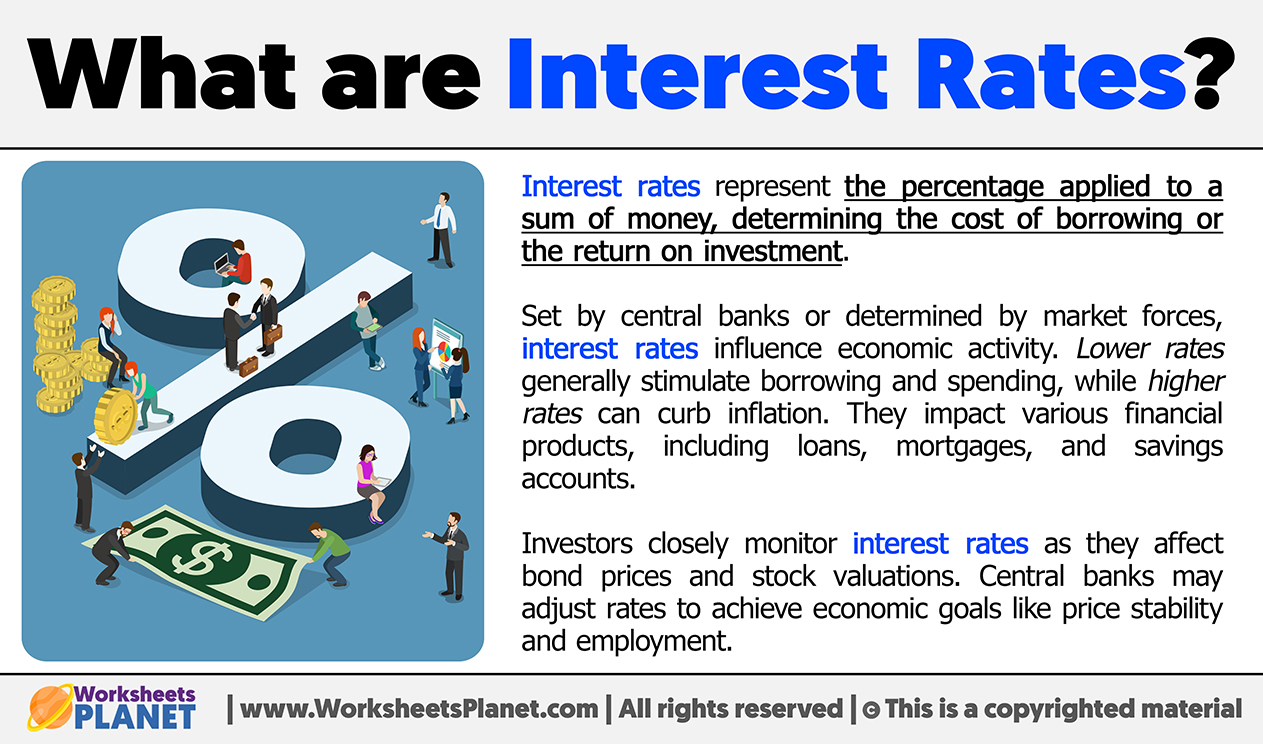
Interest rates are a foundational concept in the world of finance, often discussed in economic news, yet their precise meaning and far-reaching implications can remain opaque to many. At its core, an interest rate represents the cost of borrowing money or the return on lending or investing money, expressed as a percentage of the principal amount over a specific period, typically a year. Understanding interest rates is crucial for navigating personal finance, making informed investment decisions, and comprehending broader economic trends. They are the invisible hand shaping everything from your mortgage payments to the returns on your savings account, and critically, influencing the health and direction of national and global economies.
The Fundamental Concept of Interest Rates
The existence of interest rates stems from several key economic principles, primarily the “time value of money.” A dollar today is generally worth more than a dollar tomorrow because of its potential earning capacity. When you lend money, you forgo its immediate use and potential for investment. The interest rate compensates you for this foregone opportunity and for the risk that the borrower might not repay the loan.
Defining Interest Rates: The Price of Money
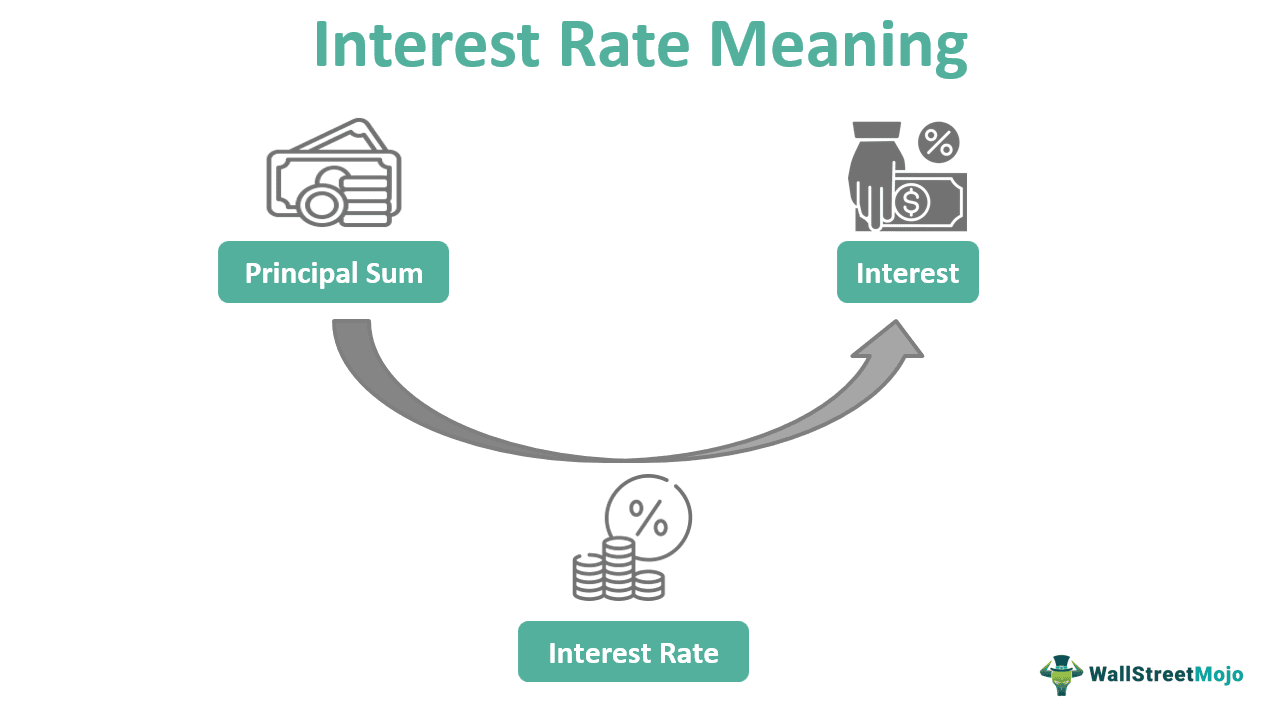
Simply put, an interest rate is the “price” of money. For borrowers, it’s the fee paid to use someone else’s money. For lenders or investors, it’s the compensation received for providing capital. This price is usually expressed as an annual percentage. If you borrow $1,000 at a 5% interest rate, you’ll owe $50 in interest for that year, in addition to the principal. Conversely, if you deposit $1,000 in a savings account offering 5% interest, you’ll earn $50 over a year.
Why Do They Exist?: Time, Risk, and Inflation
Beyond the time value of money, several factors necessitate interest rates:
- Opportunity Cost: As mentioned, lending money means you cannot use it for other purposes. The interest rate compensates for this lost opportunity.
- Risk: There’s always a risk that a borrower may default on a loan. A higher perceived risk typically translates to a higher interest rate to compensate the lender for taking on that additional risk. This is why a secure government bond typically offers a lower yield than a loan to a startup business.
- Inflation Expectations: Lenders anticipate that the purchasing power of money will erode over time due to inflation. A portion of the interest rate compensates them for this expected loss in value, ensuring that the money repaid in the future has similar purchasing power to the money lent today.
Types of Interest Rates and How They Work
Interest rates aren’t a monolithic concept; they come in various forms, each with distinct implications for borrowers and savers. Understanding these distinctions is key to making sound financial decisions.
Fixed vs. Variable Rates
One of the most common distinctions is between fixed and variable (or adjustable) rates:
- Fixed Rates: A fixed interest rate remains constant over the entire term of the loan or investment. This provides predictability, as payments or earnings will not change regardless of market fluctuations. Mortgages, some personal loans, and certain bonds often carry fixed rates.
- Variable Rates: Also known as adjustable rates, these rates can change over time based on an underlying benchmark interest rate (e.g., the prime rate, LIBOR, or a central bank’s policy rate). While they might offer lower initial payments, borrowers face the risk of higher payments if benchmark rates rise. Adjustable-rate mortgages (ARMs) and credit cards often have variable rates.
Nominal vs. Real Interest Rates
It’s crucial to distinguish between the stated rate and the rate adjusted for inflation:
- Nominal Interest Rate: This is the advertised or stated interest rate, not adjusted for inflation. It’s the rate you see on loan documents or savings accounts.
- Real Interest Rate: This rate accounts for inflation, reflecting the true earning power or cost of money. It is calculated by subtracting the inflation rate from the nominal interest rate. A 5% nominal rate during 3% inflation yields a 2% real rate, meaning your purchasing power only increased by 2%. Conversely, if inflation is higher than the nominal rate, the real interest rate is negative, eroding purchasing power.
Annual Percentage Rate (APR) vs. Annual Percentage Yield (APY)
These terms are often confused but serve different purposes:
- Annual Percentage Rate (APR): This represents the annual cost of borrowing money, including the interest rate and certain other fees (like origination fees). APR provides a more comprehensive picture of a loan’s total cost than the interest rate alone, making it easier to compare different loan offers.
- Annual Percentage Yield (APY): This represents the annual rate of return earned on an investment or savings account, taking into account the effect of compounding interest. APY provides a more accurate reflection of how much you’ll actually earn over a year, as it includes interest earned on previously accumulated interest.
Simple vs. Compound Interest
The method of calculating interest significantly impacts returns or costs:
- Simple Interest: Calculated only on the original principal amount. The interest earned or paid remains constant over the loan’s term. This is less common for longer-term loans or investments.
- Compound Interest: Calculated on the principal amount and on the accumulated interest from previous periods. This is often referred to as “interest on interest” and is a powerful force for wealth creation (or debt accumulation). The more frequently interest is compounded (e.g., daily, monthly, quarterly), the faster the principal grows.
Who Sets Interest Rates and Why They Matter
Interest rates are not arbitrary figures; they are influenced by a complex interplay of market forces, economic policies, and the actions of central banks. Their movements have profound implications across all facets of finance.
Central Banks and Monetary Policy
In most developed economies, central banks play a pivotal role in setting the overarching interest rate environment. In the United States, the Federal Reserve (often called “the Fed”) influences interest rates through its monetary policy. The Federal Open Market Committee (FOMC) sets the federal funds rate, which is the target rate for overnight borrowing between banks.
- Influencing Economic Activity: By raising or lowering the federal funds rate, the Fed aims to control inflation, stimulate economic growth, and maintain full employment.
- Raising Rates: Makes borrowing more expensive, which can slow down lending, reduce consumer spending, and cool down an overheating economy, thereby combating inflation.
- Lowering Rates: Makes borrowing cheaper, encouraging individuals and businesses to take out loans for spending and investment, which can stimulate economic activity during a slowdown.
Impact on Borrowers

For individuals and businesses, interest rates directly affect the cost of credit:
- Mortgages: Higher rates mean higher monthly payments and a greater total cost over the life of a home loan. Lower rates make homeownership more affordable.
- Credit Cards: Most credit cards have variable interest rates tied to the prime rate. When the Fed raises rates, credit card APRs typically follow suit, increasing the cost of carrying a balance.
- Personal and Business Loans: The cost of borrowing for cars, education, or business expansion rises with higher interest rates, potentially deferring large purchases or investments.
Impact on Savers and Investors
Interest rates also dictate the returns on savings and certain investments:
- Savings Accounts & CDs: When interest rates are high, banks offer more attractive rates on savings accounts and Certificates of Deposit (CDs), rewarding savers. Conversely, low rates offer meager returns.
- Bonds: Bond prices and yields have an inverse relationship. When market interest rates rise, newly issued bonds offer higher yields, making existing lower-yield bonds less attractive and causing their prices to fall. For investors holding bonds, rising rates can lead to capital losses if they sell before maturity.
- Stocks: The impact on stocks is more indirect. Lower interest rates can make borrowing cheaper for companies, potentially boosting profits, and also make bonds less attractive, pushing investors towards stocks for higher returns. Higher rates can have the opposite effect.
Impact on the Broader Economy
Interest rate changes ripple through the entire economy:
- Inflation: Higher rates are a key tool to combat inflation by reducing aggregate demand.
- Employment: While higher rates fight inflation, they can also slow economic growth and potentially lead to job losses as businesses face higher borrowing costs and reduced demand.
- Currency Values: Higher interest rates can attract foreign investment, increasing demand for a country’s currency and strengthening its exchange rate.
Factors Influencing Interest Rate Movements
Interest rates are dynamic, constantly shifting in response to a confluence of economic indicators and policy decisions. Understanding these drivers helps predict potential movements and their effects.
Inflation
Perhaps the most significant driver of interest rates, inflation dictates much of central bank policy. If inflation is rising or expected to rise, central banks typically increase interest rates to curb spending and cool the economy. Conversely, disinflationary pressures or outright deflation often lead to rate cuts.
Economic Growth and Outlook
The overall health and trajectory of the economy heavily influence rates. During periods of robust economic growth, businesses demand more capital for expansion, and consumers borrow more, pushing rates upward. In times of economic slowdown or recession, central banks often lower rates to stimulate borrowing and investment, aiming to jumpstart activity.
Supply and Demand for Credit
Like any market, the market for credit is governed by supply and demand. If there is high demand for loans (e.g., from homebuyers, businesses) and a limited supply of available funds, interest rates will generally rise. Conversely, an abundance of available capital coupled with low demand for loans will typically push rates down.
Government Debt and Fiscal Policy
A government’s fiscal policy, particularly its borrowing needs, can also impact interest rates. When governments issue large amounts of new debt (bonds) to finance deficits, it increases the supply of bonds, which can put upward pressure on interest rates to attract buyers, especially if the borrowing is perceived as high-risk or crowding out private investment.
Global Economic Conditions
In an interconnected world, global economic conditions and central bank actions in other major economies can influence domestic interest rates. Capital flows across borders, seeking the best risk-adjusted returns. If interest rates are significantly higher in one country compared to another, it can attract foreign capital, affecting the supply and demand for credit domestically and influencing currency exchange rates.
Navigating Interest Rates in Personal and Business Finance
Successfully managing your finances means actively considering how interest rates impact your borrowing, saving, and investing activities.
For Individuals
- Managing Debt: When interest rates are low, consider refinancing high-interest debt like mortgages or student loans to secure a lower rate and reduce monthly payments or total interest paid. Conversely, when rates are rising, focus on paying down variable-rate debt as quickly as possible to mitigate increased costs.
- Savings Strategies: In a rising rate environment, seek out high-yield savings accounts, money market accounts, or Certificates of Deposit (CDs) to maximize your returns. In a low-rate environment, these accounts may offer minimal returns, prompting consideration of alternative investments.
- Mortgage Decisions: Deciding between a fixed-rate and adjustable-rate mortgage often hinges on the current rate environment and your outlook. If rates are historically low and expected to rise, a fixed-rate mortgage offers stability. If rates are high and expected to fall, an ARM might offer initial savings, with the hope of refinancing later.
For Businesses
- Capital Expenditures: Businesses planning major investments in equipment, facilities, or R&D must factor in the cost of borrowing. Lower interest rates make capital projects more financially viable, encouraging expansion.
- Working Capital Management: Short-term borrowing for operational needs (e.g., lines of credit) is directly affected by current interest rates. Efficient cash flow management becomes even more critical during periods of high borrowing costs.
- Investment Decisions: For long-term projects, interest rates are used to discount future cash flows back to a present value. Higher discount rates (driven by higher interest rates) reduce the present value of future earnings, making long-term investments less attractive.
Understanding Financial Products
Interest rates are embedded in virtually every financial product:
- Bonds: The yield on a bond is essentially its interest rate, reflecting the return an investor receives.
- Money Market Funds: These short-term investment vehicles directly reflect prevailing short-term interest rates.
- Loans: Whether secured or unsecured, the interest rate is the primary determinant of the loan’s cost.
By demystifying “what are interest rates,” individuals and businesses alike can gain a powerful tool for financial planning, allowing for more strategic decision-making in an ever-changing economic landscape. Staying informed about current rate trends and understanding their underlying drivers is not just for economists; it’s a fundamental aspect of sound financial literacy.
aViewFromTheCave is a participant in the Amazon Services LLC Associates Program, an affiliate advertising program designed to provide a means for sites to earn advertising fees by advertising and linking to Amazon.com. Amazon, the Amazon logo, AmazonSupply, and the AmazonSupply logo are trademarks of Amazon.com, Inc. or its affiliates. As an Amazon Associate we earn affiliate commissions from qualifying purchases.