
Bitcoin has captivated the world as a revolutionary digital currency, sparking conversations about finance, technology, and the future of money. For many newcomers, however, the underlying mechanics can seem daunting, shrouded in technical jargon like “blockchain,” “cryptography,” and “mining.” While Bitcoin functions as a form of digital money, its very existence and operational integrity are rooted in a complex, yet elegant, technological framework. This article aims to demystify “how Bitcoin works” by delving exclusively into the core technologies that power it, providing a clear and accessible guide for beginners navigating the digital landscape. We will explore the foundational pillars of Bitcoin’s architecture, demonstrating how these technological innovations converge to create a secure, decentralized, and groundbreaking system.

The Foundational Pillar: Blockchain Technology
At the heart of Bitcoin lies its most iconic innovation: the blockchain. To understand Bitcoin, one must first grasp the concept of this distributed ledger technology, which serves as the immutable record of every transaction ever made on the network.
What is a Blockchain? A Digital Ledger
Imagine a traditional ledger, like a massive accounting book, where every financial transaction is recorded chronologically. Now, imagine that this ledger is entirely digital and accessible to everyone, everywhere. That’s the simplest way to visualize a blockchain. Specifically, a blockchain is a continuously growing list of records, called “blocks,” which are linked and secured using cryptography. Each block contains a batch of verified transactions, along with a timestamp and a cryptographic hash of the previous block. This cryptographic link forms a chain, ensuring that the order of blocks is preserved and tamper-proof.
For Bitcoin, this blockchain acts as the ultimate source of truth, publicly recording every single Bitcoin transaction from its inception. When you send Bitcoin to someone, that transaction is bundled with others into a block, which then becomes a permanent part of this ever-growing, public digital ledger.
Distributed Ledger Technology (DLT)
What makes the blockchain truly revolutionary is its distributed nature. Unlike traditional financial systems where a central authority (like a bank) maintains a single ledger, Bitcoin’s blockchain is replicated across thousands of computers globally, known as “nodes.” This decentralization is a cornerstone of Bitcoin’s design.
Every participant running a full Bitcoin node holds an identical copy of the entire blockchain. When a new block of transactions is added, it is broadcast to all these nodes, which then verify and add it to their own copies of the ledger. This distributed nature offers several critical advantages:
- No Single Point of Failure: If one node goes offline, the network continues to function seamlessly because thousands of other copies exist.
- Enhanced Security: It’s incredibly difficult for any single entity to alter the ledger, as they would need to gain control of and simultaneously modify more than half of all copies on the network – a practically impossible feat.
- Transparency: While user identities are pseudo-anonymous (represented by cryptographic addresses), all transactions on the blockchain are publicly visible and verifiable by anyone.
Immutability and Security Through Cryptography
The “chain” in blockchain isn’t just a metaphor; it’s a cryptographic reality. Each new block contains a cryptographic “fingerprint” (hash) of the block that came before it. This creates an unbreakable link. If someone were to attempt to alter a transaction within an old block, the hash of that block would change. Because the next block in the chain contains the original hash, this alteration would immediately invalidate all subsequent blocks in the chain.
This immutability is one of Bitcoin’s most powerful security features. Once a transaction is recorded and confirmed on the blockchain, it is practically irreversible and cannot be tampered with. This cryptographic linking, combined with the distributed nature of the ledger, forms a highly secure and resilient system that doesn’t rely on trust in any single third party. It’s a trustless system built on mathematical proof and cryptographic certainty.
The Engine of Trust: Cryptography in Bitcoin
Cryptography isn’t just for linking blocks; it’s fundamental to every aspect of Bitcoin, from securing individual ownership to authorizing transactions. It acts as the “engine of trust,” ensuring privacy, authenticity, and non-repudiation within the decentralized network.
Public-Key Cryptography: Your Digital Identity
At the core of securing individual Bitcoin ownership is public-key cryptography, also known as asymmetric cryptography. This system relies on a pair of mathematically linked keys: a private key and a public key.
- Private Key: This is a secret, alphanumeric code that functions like an ultra-secure password. It is unique to you and must be kept absolutely confidential. Whoever holds the private key controls the Bitcoin associated with it. Losing your private key means losing access to your Bitcoin forever.
- Public Key: This key is derived from your private key and can be shared freely. It acts as your digital identity on the Bitcoin network. From your public key, a Bitcoin address (a shorter, more user-friendly string of characters) is generated, which is what you share with others to receive Bitcoin.
The relationship between these keys is crucial: your private key can “sign” transactions, proving your ownership of the Bitcoin without ever revealing the private key itself. Your public key (and derived address) allows others to verify that signature. It’s like having a secure, tamper-proof digital signature that only you can create, but anyone can verify.
Hashing Functions and Digital Signatures
Beyond public-key pairs, cryptographic hashing functions play a vital role in Bitcoin’s operation. A hashing function is a mathematical algorithm that takes an input (data of any size) and produces a fixed-size string of characters, called a “hash” or “digest.” Key properties of hashing functions used in Bitcoin (like SHA-256) include:
- Determinism: The same input always produces the same output hash.
- One-way: It’s practically impossible to reverse-engineer the original input from its hash.
- Collision Resistance: It’s extremely difficult to find two different inputs that produce the same hash.
- Avalanche Effect: Even a tiny change in the input results in a drastically different output hash.
In Bitcoin, hashing is used extensively:
- Block Linking: As discussed, each block’s header contains the hash of the previous block, creating the chain.
- Transaction IDs: Every transaction is uniquely identified by its hash.
- Proof-of-Work: Miners solve a puzzle that involves finding a specific hash.
Digital signatures, enabled by public-key cryptography and hashing, are how you authorize spending your Bitcoin. When you want to send Bitcoin, your wallet software uses your private key to create a digital signature for that specific transaction. This signature is then attached to the transaction and broadcast to the network. Nodes can then use your public key (derived from your Bitcoin address) to verify two things:
- That the transaction was indeed authorized by the owner of the Bitcoin (because only the private key could have produced that specific signature).
- That the transaction has not been altered since it was signed.
This cryptographic foundation ensures that funds can only be spent by their legitimate owner and that all transactions are authentic and unforgeable.
Securing the Network: Mining and Consensus
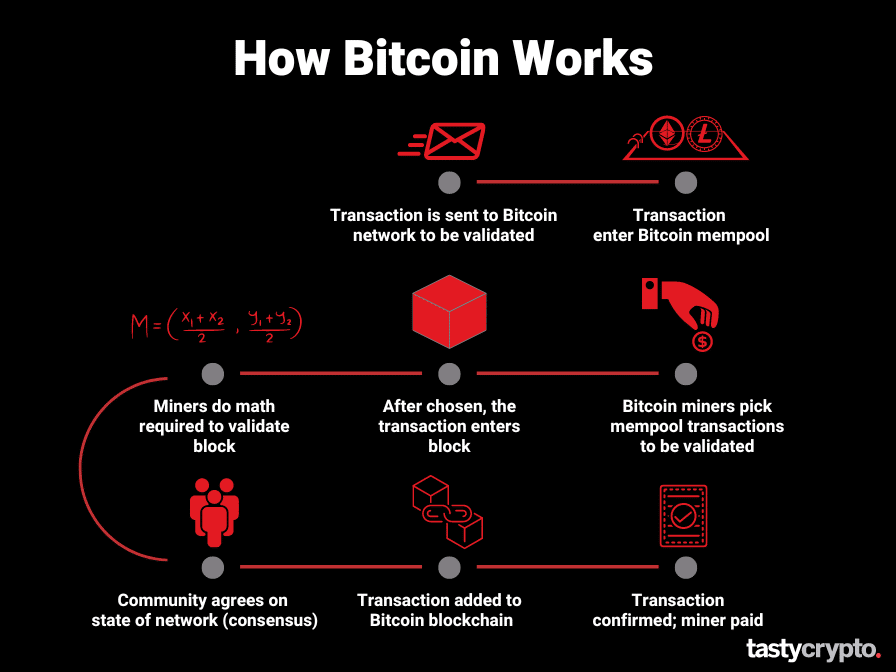
With a distributed ledger and cryptographic security in place, how does Bitcoin ensure that new transactions are added to the blockchain in an orderly and secure manner, and that everyone agrees on the single, correct version of the ledger? This is where Bitcoin mining and its consensus mechanism, Proof-of-Work, come into play.
What is Bitcoin Mining?
Bitcoin mining is the process by which new transactions are verified and added to the blockchain, and new Bitcoins are introduced into circulation. It’s not about digging for digital coins; rather, it’s a computational race. Miners are specialized computers (or networks of computers) that compete to solve a complex mathematical puzzle.
The goal of a miner is to be the first to find a specific number, called a “nonce,” that, when combined with the data of the new block (including all the new transactions), produces a hash that meets a certain difficult target. This target is dynamically adjusted by the network to ensure a new block is found, on average, every ten minutes.
The miner who successfully solves this puzzle “wins” the right to add the next block of verified transactions to the blockchain. As a reward for their significant computational effort and electrical consumption, they receive a block reward (a fixed amount of newly minted Bitcoin) and any transaction fees included by users in the transactions within that block. This incentive mechanism is crucial for securing the network and ensuring its continued operation.
Proof-of-Work (PoW) Explained
The mathematical puzzle that miners solve is known as Proof-of-Work (PoW). It’s designed to be computationally intensive to solve but very easy for anyone on the network to verify. This asymmetry is key:
- Difficult to Find: Finding the correct nonce requires vast amounts of computational power and trial-and-error, making it an expensive process. This cost is what gives “work” its value.
- Easy to Verify: Once a miner presents a solution (the correct nonce and the resulting hash), any other node on the network can instantly verify its correctness with minimal effort.
The purpose of PoW is multifaceted:
- Securing the Network: The sheer computational power required to solve the puzzle makes it prohibitively expensive and time-consuming for an attacker to alter past transactions or create fraudulent ones. To alter even a single block deep in the chain, an attacker would have to re-do the PoW for that block and all subsequent blocks faster than the rest of the honest network – a nearly impossible task unless they control the majority of the network’s processing power (a “51% attack”).
- Preventing Double-Spending: PoW ensures that a Bitcoin is not spent twice. Once a transaction is included in a confirmed block, the network has universally agreed that the Bitcoin has moved from one address to another, preventing the sender from trying to use the same Bitcoin again.
- Regulating Supply: The block reward, which decreases over time through a process called “halving,” ensures a predictable and finite supply of Bitcoin, mimicking the scarcity of precious metals.
Network Consensus and Validation
Bitcoin operates on a principle of decentralized consensus. There is no central authority to approve transactions or validate blocks. Instead, all full nodes in the network independently verify every transaction and every block according to the Bitcoin protocol’s rules.
When a miner finds a valid block, they broadcast it to the network. Other nodes receive this block, verify all its transactions, and check if the Proof-of-Work solution is correct. If everything checks out, they accept the block and add it to their local copy of the blockchain. They then begin working on finding the next block, building upon this newly accepted block.
In the rare event that two miners find a valid block at roughly the same time, creating a temporary fork in the chain, the network’s consensus mechanism resolves it. Nodes will continue to build on the block they received first. Eventually, one of the branches will grow longer as more miners build upon it. The Bitcoin protocol dictates that the longest valid chain is always the accepted chain. This ensures that the network quickly converges on a single, agreed-upon history of transactions, maintaining integrity and preventing discrepancies.
Interacting with Bitcoin: Transactions and Wallets
Now that we understand the underlying technology, let’s explore how these components come together when you actually send or receive Bitcoin.
How a Bitcoin Transaction Happens
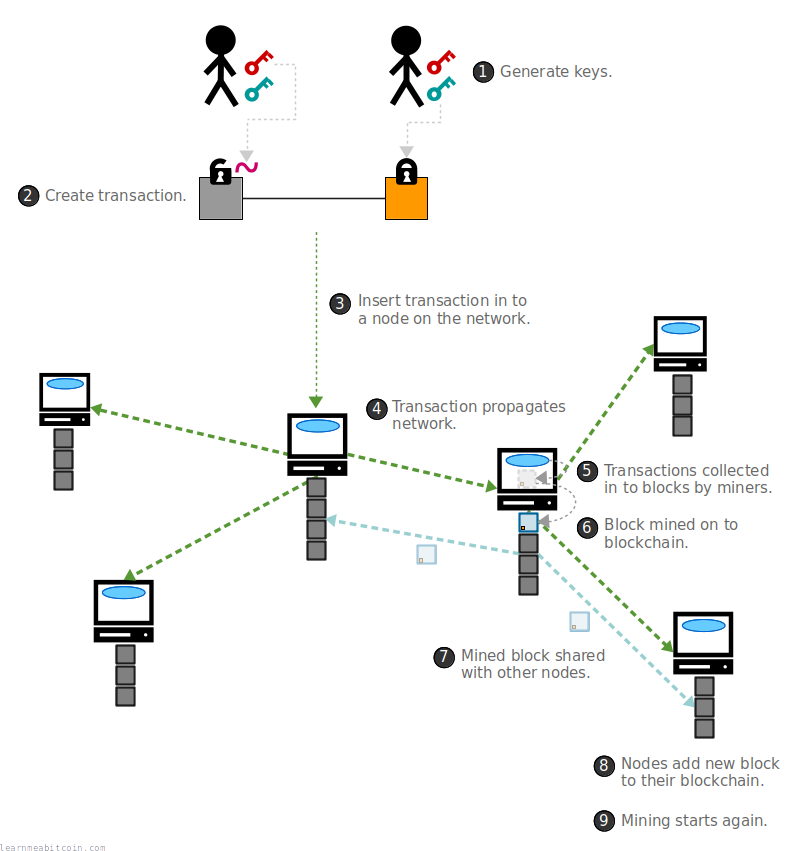
When you decide to send Bitcoin to someone, a series of technological events unfolds behind the scenes:
- Initiation: Using your Bitcoin wallet software, you input the recipient’s Bitcoin address and the amount you wish to send. Your wallet then uses your private key to create a digital signature for this specific transaction, proving your ownership of the funds.
- Broadcasting: The digitally signed transaction is then broadcast by your wallet to the entire Bitcoin network. It’s like shouting your transaction details into a public square for all the nodes to hear.
- Verification by Nodes: As the transaction travels across the network, various full nodes independently receive and verify it. They check for several things: Is the sender’s digital signature valid? Do they have sufficient funds (by checking the blockchain history)? Is the transaction correctly formatted?
- Inclusion in a Block: Once verified by enough nodes, the transaction sits in a “mempool” (memory pool) – a waiting area for unconfirmed transactions. Miners then pick transactions from this mempool, typically prioritizing those with higher transaction fees, to include in the block they are trying to mine.
- Confirmation: When a miner successfully solves the Proof-of-Work puzzle and adds a block containing your transaction to the blockchain, your transaction receives its first “confirmation.” As more blocks are added on top of that block, your transaction gains more confirmations, making it progressively more secure and irreversible. Typically, 3-6 confirmations are considered sufficient for most transactions.
Bitcoin Wallets: Your Digital Bank Account
Despite their name, Bitcoin wallets don’t actually “store” Bitcoin in the same way a physical wallet stores cash. Instead, a Bitcoin wallet is a piece of software or hardware that stores your private keys. These private keys are what give you control over the Bitcoin associated with your public addresses on the blockchain. Your Bitcoin always resides on the blockchain; your wallet simply provides the means to access and manage it.
There are several types of Bitcoin wallets, each offering different trade-offs in terms of security, convenience, and functionality:
- Hardware Wallets: Physical devices (like USB drives) designed specifically to securely store your private keys offline. They are considered the most secure option for storing large amounts of Bitcoin, as they are largely impervious to online hacking attempts.
- Software Wallets: Applications that run on your computer (desktop wallets), smartphone (mobile wallets), or within a web browser (web wallets). While convenient, they are generally less secure than hardware wallets because they are connected to the internet and thus more vulnerable to malware or phishing attacks.
- Paper Wallets: A physical printout of your Bitcoin public and private keys. While offline, they require extreme caution to avoid damage or loss and are generally considered less user-friendly and riskier for beginners due to the manual handling of keys.
Regardless of the type, the cardinal rule of Bitcoin wallets is to secure your private keys. If you lose them, your Bitcoin is inaccessible. If someone else gains access to them, they can steal your Bitcoin. Therefore, backing up your wallet (or more precisely, your seed phrase, which can regenerate your private keys) and employing strong security practices are paramount.
Conclusion
Bitcoin, at its core, is a remarkable technological achievement. For beginners, understanding “how it works” means appreciating the intricate dance between blockchain, cryptography, and the decentralized consensus mechanism driven by mining. The blockchain provides a transparent and immutable ledger, while public-key cryptography secures individual ownership and transactions through digital signatures. The Proof-of-Work mining process, combined with network-wide verification by nodes, ensures the integrity, security, and decentralized nature of the entire system.
By divorcing itself from traditional central authorities and instead relying on mathematical certainty and distributed consensus, Bitcoin pioneered a new paradigm for digital trust and security. While its financial implications are profound, its technological innovation is what truly underpins its revolutionary potential. For those looking to delve deeper, exploring these technical facets will unlock a richer understanding of what makes Bitcoin, and indeed the broader blockchain ecosystem, such a captivating and transformative technology.
aViewFromTheCave is a participant in the Amazon Services LLC Associates Program, an affiliate advertising program designed to provide a means for sites to earn advertising fees by advertising and linking to Amazon.com. Amazon, the Amazon logo, AmazonSupply, and the AmazonSupply logo are trademarks of Amazon.com, Inc. or its affiliates. As an Amazon Associate we earn affiliate commissions from qualifying purchases.