
Understanding how to calculate a monthly payment is a fundamental skill in personal finance, empowering individuals to make informed decisions about borrowing, saving, and budgeting. From mortgages and car loans to personal loans and credit card minimums, monthly payments are a pervasive element of modern financial life. Grasping the mechanics behind these calculations not only demystifies the process but also equips you with the tools to assess affordability, compare loan offers, and strategize for debt management. This article delves into the core components, the fundamental formulas, practical calculation methods, and the strategic implications of mastering monthly payment calculations, all strictly within the domain of personal and business finance.
Understanding the Core Components of a Payment Calculation
Before diving into formulas, it’s crucial to understand the foundational elements that constitute any loan payment calculation. These variables interact to determine the size and structure of your monthly obligation.
Principal Amount
The principal is the original sum of money borrowed from a lender. It is the core amount upon which interest accrues. For example, if you take out a $300,000 mortgage, $300,000 is your principal. As you make payments, a portion goes towards reducing this principal, and another portion covers the interest charged on the outstanding balance. The goal of any loan repayment is to fully amortize, or pay off, the principal amount over the agreed-upon term.
Interest Rate
The interest rate represents the cost of borrowing money, expressed as a percentage of the principal. It is essentially the lender’s fee for providing you with capital. Interest rates can be fixed or variable. A fixed interest rate remains constant throughout the loan term, providing predictable payments. A variable interest rate, also known as an adjustable-rate, can fluctuate over time based on market conditions or a specific benchmark index, leading to changes in your monthly payment. It’s also important to distinguish between the Annual Percentage Rate (APR) and the nominal interest rate. The APR typically includes the nominal interest rate plus certain fees and charges, offering a more comprehensive picture of the true annual cost of borrowing. For payment calculations, the monthly interest rate is derived from the annual rate.
Loan Term (or Amortization Period)
The loan term is the specified duration over which the borrower agrees to repay the loan, typically expressed in years or months. Common terms for mortgages are 15 or 30 years, while car loans often range from 3 to 7 years. The loan term significantly impacts the monthly payment and the total interest paid over the life of the loan. A shorter term generally results in higher monthly payments but less total interest paid, as you’re paying off the principal more quickly. Conversely, a longer term means lower monthly payments but more interest paid overall due to the extended period over which interest accrues on the outstanding balance.
Payment Frequency
While the article title specifically refers to “monthly payment,” it’s worth noting that payment frequencies can vary. Most consumer loans, especially mortgages and personal loans, are structured with monthly payments. However, some loans might offer bi-weekly or weekly payment options. For the purpose of monthly payment calculation, the frequency is assumed to be monthly, meaning there are 12 payments per year. This consistency simplifies the calculation process and aligns with most individuals’ monthly budgeting cycles.
The Fundamental Formula: An Overview
At the heart of monthly payment calculation for an amortized loan (where each payment contributes to both interest and principal) lies a specific mathematical formula. While numerous online calculators and spreadsheet functions exist to simplify this, understanding the underlying formula provides invaluable insight into how payments are structured.
The standard formula for calculating a fixed monthly payment (M) on a loan is:
M = P [ i(1 + i)^n ] / [ (1 + i)^n – 1 ]
Let’s break down each variable:
- M: The monthly loan payment you will make.
- P: The principal loan amount (the initial sum borrowed).
- i: The monthly interest rate. This is derived by dividing the annual interest rate (APR) by 12 (e.g., if the APR is 6%, then i = 0.06 / 12 = 0.005).
- n: The total number of payments over the loan’s lifetime. This is calculated by multiplying the loan term in years by 12 (e.g., for a 30-year loan, n = 30 * 12 = 360).
This formula effectively distributes the total principal and the total interest accrued over the life of the loan into equal monthly installments. Early in the loan term, a larger portion of each payment goes towards interest, as the principal balance is highest. As the principal is paid down, a progressively larger portion of each payment goes towards reducing the principal, leading to what is known as an amortization schedule.
Step-by-Step Calculation for a Standard Amortized Loan
While the formula might appear complex, breaking it down into manageable steps makes manual calculation feasible and clear. Let’s walk through an example.
Hypothetical Scenario:
You borrow $200,000 for a mortgage at an annual interest rate of 5%, over a 30-year term.
Step 1: Convert Annual Interest Rate to Monthly
The first crucial step is to convert the annual interest rate into a monthly rate. This is because payments are made monthly, and interest is typically compounded monthly.
- Annual Interest Rate (APR): 5% = 0.05
- Monthly Interest Rate (i): 0.05 / 12 = 0.0041666667 (it’s important to keep as many decimal places as possible for accuracy)
Step 2: Convert Loan Term to Total Number of Payments
Next, convert the loan term from years into the total number of monthly payments.
- Loan Term: 30 years
- Total Number of Payments (n): 30 years * 12 months/year = 360 payments
Step 3: Apply the Formula
Now, plug these values into our monthly payment formula:
M = P [ i(1 + i)^n ] / [ (1 + i)^n – 1 ]

- P = $200,000
- i = 0.0041666667
- n = 360
Let’s calculate the components:
- (1 + i) = 1 + 0.0041666667 = 1.0041666667
- (1 + i)^n = (1.0041666667)^360 ≈ 4.473507
- i(1 + i)^n = 0.0041666667 * 4.473507 ≈ 0.0186396
- (1 + i)^n – 1 = 4.473507 – 1 = 3.473507
- [ i(1 + i)^n ] / [ (1 + i)^n – 1 ] = 0.0186396 / 3.473507 ≈ 0.0053660
- M = P * [result from step 5] = $200,000 * 0.0053660 ≈ $1,073.20
So, your estimated monthly payment for this $200,000 mortgage would be approximately $1,073.20.
Understanding Amortization Schedules
The monthly payment calculated above remains constant throughout the loan’s life (for a fixed-rate loan). However, the allocation of that payment between principal and interest changes with each successive payment. An amortization schedule details this breakdown. In the early years, a larger portion of your payment goes towards interest, and a smaller portion reduces the principal. As the loan matures and the principal balance decreases, the interest portion shrinks, and more of your payment is applied to the principal. This ensures that the loan is fully paid off by the end of the term.
Beyond the Manual Formula: Practical Tools and Considerations
While understanding the formula is empowering, most individuals rely on practical tools for quick and accurate calculations. These tools streamline the process and often account for additional factors not included in the basic formula.
Online Loan Calculators
The easiest and most common way to calculate a monthly payment is by using online loan calculators. Virtually every bank, credit union, and financial planning website offers free, user-friendly calculators. You simply input the principal amount, interest rate, and loan term, and the calculator instantly provides the estimated monthly payment. Many advanced versions also allow you to add down payments, extra payments, or even taxes and insurance for a more comprehensive view, especially for mortgages. These calculators are excellent for comparing different loan scenarios quickly and efficiently.
Spreadsheet Software (Excel/Google Sheets)
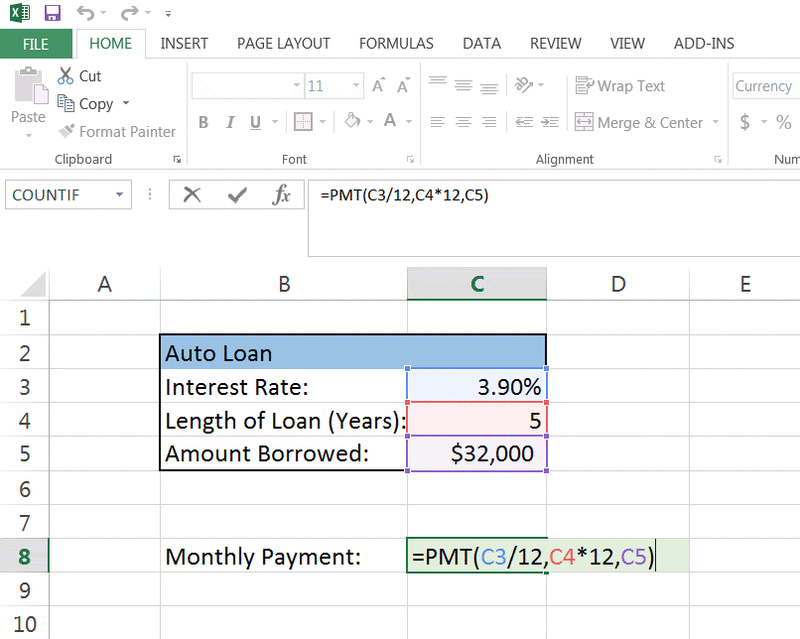
For those who prefer a more hands-on approach or need to integrate payment calculations into a broader financial model, spreadsheet software like Microsoft Excel or Google Sheets is incredibly powerful. The PMT function is specifically designed for this purpose.
The PMT function syntax is:
PMT(rate, nper, pv, [fv], [type])
- rate: The interest rate per period (i.e., the monthly interest rate,
APR / 12). - nper: The total number of payments for the loan (i.e.,
loan term in years * 12). - pv: The present value, or the total principal amount of the loan.
- [fv]: (Optional) The future value, or a cash balance you want to attain after the last payment is made. If omitted, it’s assumed to be 0 (meaning the loan is fully paid off).
- [type]: (Optional) Indicates when payments are due: 0 for end of the period (most common), or 1 for beginning of the period. If omitted, it’s assumed to be 0.
Using our previous example in Excel:
=PMT(0.05/12, 30*12, 200000)
This would yield ($1,073.64). The negative sign indicates an outgoing payment. The slight difference from our manual calculation is due to rounding in the manual steps; spreadsheets maintain higher precision.
Factors Affecting Your Actual Monthly Payment
It’s crucial to remember that the calculated loan payment is often just one component of your total monthly housing or vehicle expense. Several other factors can significantly impact your actual out-of-pocket payment:
- Taxes: For mortgages, property taxes are almost always included in your monthly payment, collected by the lender and held in an escrow account.
- Insurance: Homeowners insurance (for mortgages) and private mortgage insurance (PMI, if your down payment is less than 20% for a conventional loan) are also typically part of your monthly mortgage payment, collected via escrow. For car loans, auto insurance is a separate but mandatory monthly expense.
- Escrow Accounts: These are accounts managed by your lender to hold funds for property taxes and insurance, ensuring these obligations are paid on time.
- Additional Fees or Charges: Some loans might include administrative fees or service charges that are either rolled into the principal or collected separately.
- Variable Interest Rates: If you have a variable-rate loan, your monthly payment will fluctuate as the interest rate adjusts, impacting your budget significantly.
- Prepayments: Making extra payments towards the principal can reduce the total interest paid and shorten the loan term, though your scheduled monthly payment remains the same unless the loan is recast.
The Strategic Importance of Understanding Payment Calculations
Beyond the mechanics, truly grasping how monthly payments are calculated provides significant strategic advantages in managing your personal finances.
Budgeting and Financial Planning
Knowing precisely what your loan payments will be allows for accurate budgeting. You can allocate funds efficiently, ensure you have sufficient income to cover all your obligations, and plan for future financial goals. Understanding the fixed nature of a fixed-rate loan payment provides stability, while knowing how variable rates work helps you prepare for potential payment increases.
Debt Management and Reduction
When you understand the amortization schedule, you realize how much interest you pay, especially in the early stages of a loan. This insight can be a powerful motivator for accelerating principal payments. Making even a small extra payment each month can significantly reduce the total interest paid over the life of the loan and shorten its term. It also empowers you to evaluate refinancing opportunities more effectively, comparing new payment structures and total interest costs.
Making Informed Borrowing Decisions
Understanding the calculation empowers you to critically evaluate loan offers. You can compare different principal amounts, interest rates, and terms to determine the most affordable and financially sound option. For instance, you might see that a slightly lower interest rate or a slightly shorter term can lead to substantial savings over time, even if the monthly payment difference seems small initially. This knowledge prevents you from simply focusing on the lowest monthly payment without considering the total cost of the loan.
Negotiating Terms
Equipped with the knowledge of how each variable affects the monthly payment, you can engage in more informed negotiations with lenders. Whether it’s discussing the interest rate, the loan term, or even upfront fees, understanding the levers allows you to advocate for terms that are more favorable to your financial situation. This is particularly relevant for large purchases like homes or cars.

Conclusion
Calculating a monthly payment is more than just a mathematical exercise; it’s a cornerstone of sound financial literacy. By understanding the principal, interest rate, and loan term, and by familiarizing yourself with both the underlying formula and practical tools like online calculators and spreadsheet functions, you gain unparalleled clarity into your financial obligations. This knowledge is not merely about finding a number; it’s about making deliberate, informed decisions that contribute to effective budgeting, strategic debt management, and ultimately, greater financial well-being. Whether you’re planning a major purchase or simply managing existing debt, mastering monthly payment calculations is an indispensable skill for navigating the complexities of the financial world with confidence and control.
aViewFromTheCave is a participant in the Amazon Services LLC Associates Program, an affiliate advertising program designed to provide a means for sites to earn advertising fees by advertising and linking to Amazon.com. Amazon, the Amazon logo, AmazonSupply, and the AmazonSupply logo are trademarks of Amazon.com, Inc. or its affiliates. As an Amazon Associate we earn affiliate commissions from qualifying purchases.