
The cryptocurrency landscape is vast and complex, with numerous digital assets vying for prominence. Among these, XRP, often associated with Ripple Labs, stands out due to its unique origins and ambitious mission to revolutionize cross-border payments. To truly grasp its financial implications and investment potential, it is essential to understand “when did XRP come out” and the journey that followed.
The Genesis of XRP: A Look at its Foundational Years
The story of XRP begins not just with a technological innovation but with a vision to address fundamental inefficiencies in the global financial system. Its inception predates many other well-known cryptocurrencies, laying groundwork for digital assets designed for enterprise solutions rather than pure peer-to-peer cash.
Conception and Early Development of Ripple Labs
The concept that would evolve into XRP and Ripple Labs began to take shape as early as 2004 with Ryan Fugger’s RipplePay, a decentralized payment system. However, the modern iteration, directly leading to XRP, emerged from the collaboration of Jed McCaleb, Chris Larsen, and Arthur Britto. They founded OpenCoin in 2012, which was later rebranded as Ripple Labs Inc. in September 2013, and eventually simply Ripple. Their initial goal was to create a digital asset that could facilitate faster, cheaper, and more reliable international transactions, a stark contrast to the slow and expensive traditional correspondent banking system.
The core innovation was the XRP Ledger (XRPL), an open-source, decentralized technology. Unlike Bitcoin, which relies on mining to validate transactions and produce new coins, XRP’s entire supply was created at its inception. This pre-mined nature is a critical distinction with significant financial implications, as it means the supply is finite and not subject to inflationary mining rewards.
The Release of XRP and its Initial Purpose
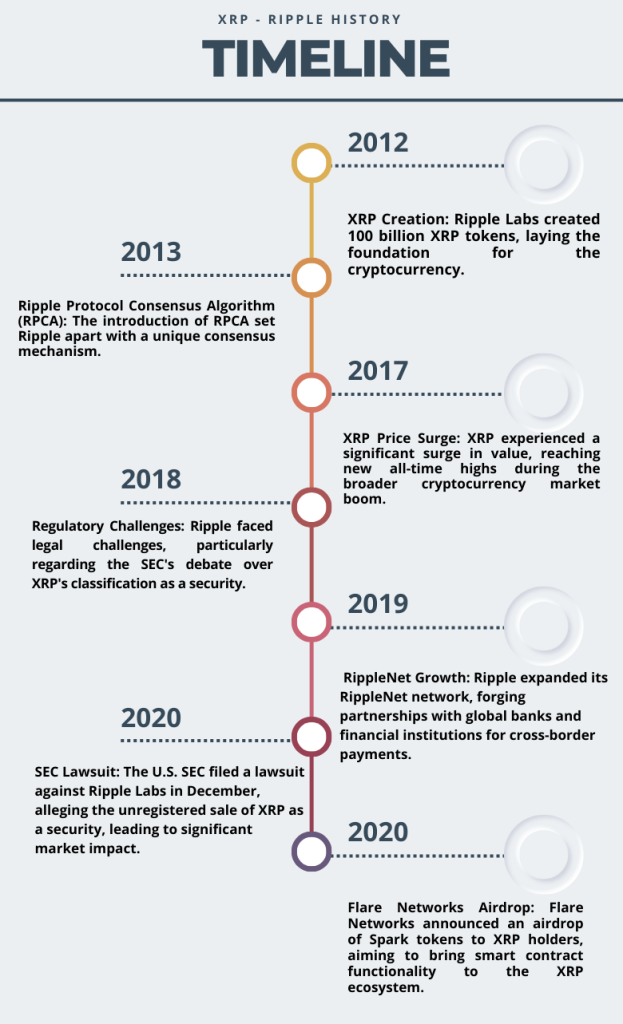
The XRP Ledger (XRPL) was officially launched in 2012, making XRP one of the earliest cryptocurrencies to emerge after Bitcoin. All 100 billion XRP tokens were created at this time. Ripple, the company, was initially given 80 billion of these tokens to fund its development and incentivize adoption, while the remaining 20 billion were distributed among the founders. This initial distribution strategy has been a frequent point of discussion and analysis in the investment community, as it concentrates a significant portion of the asset in the hands of a single entity, albeit with mechanisms to control its release into the market.
From its very beginning, XRP was designed with a specific utility: to act as a bridge currency in cross-border payments. Its purpose was not merely to be a speculative asset, but a tool to provide on-demand liquidity for financial institutions, reducing reliance on pre-funded nostro/vostro accounts. This functional design immediately positioned XRP within the realm of financial tools and business finance, differentiating it from many other digital assets that primarily focused on decentralized monetary systems or smart contract platforms. Its early existence marked a pivotal moment in the evolution of digital assets, demonstrating a tangible use case beyond simple currency.
Ripple’s Vision and XRP’s Role in Global Payments
Ripple’s overarching vision has consistently centered on improving the efficiency, speed, and cost-effectiveness of global payments. XRP is not merely a component of this vision; it is a central pillar, designed to solve specific liquidity challenges faced by financial institutions worldwide. Understanding this strategic intent is key to evaluating XRP’s long-term financial relevance and potential.
Addressing the Inefficiencies of Traditional Banking
Traditional international payments, often facilitated through the SWIFT system, are notoriously slow, expensive, and opaque. They typically involve multiple intermediary banks, each adding fees and processing time, and require financial institutions to pre-fund accounts in various local currencies (nostro/vostro accounts). This ties up significant capital, creating inefficiencies and risk, especially for smaller institutions or those operating in niche corridors.
Ripple identified these pain points as a major opportunity for disruption. Their solutions aim to create an “Internet of Value,” where money moves as seamlessly as information does today. XRP’s role in this system is to act as a universal bridge asset. Instead of maintaining numerous pre-funded accounts, institutions can convert their local currency into XRP, send it across the XRP Ledger, and then have the recipient convert XRP back into their local currency. This process is designed to take mere seconds, cost fractions of a cent per transaction, and eliminate the need for costly pre-funding, freeing up capital for other uses.
The xCurrent, xRapid (ODL), and xVia Solutions
Ripple developed a suite of products to enable its vision, with XRP playing a critical role in one of its most innovative offerings:
- xCurrent: This solution enables real-time messaging, settlement, and reconciliation between banks. While xCurrent does not directly use XRP, it forms the foundation for faster payment processing and offers a competitive edge in traditional banking operations.
- xRapid (now known as On-Demand Liquidity, or ODL): This is where XRP truly shines as a financial tool. ODL leverages XRP to facilitate instant and low-cost cross-border payments, particularly in corridors where liquidity is scarce or expensive. By using XRP as the intermediary currency, financial institutions can eliminate pre-funding requirements. This on-demand liquidity solution drastically reduces operational costs and capital allocation, making it a compelling proposition for financial service providers, especially remittance companies and small-to-medium enterprises involved in international trade.
- xVia: An API-based interface that allows financial institutions to easily access the RippleNet network and its various services, including ODL. It simplifies the integration process, enabling businesses to send payments globally with transparency and certainty.
The strategic deployment of XRP within these products underscores its intended utility as an institutional financial asset. Its design for high transaction throughput, low fees, and rapid finality positions it as a viable alternative for improving the efficiency of global monetary flows, directly impacting business finance and the mechanics of international trade.
Navigating the Market: XRP’s Price Performance and Investment Journey
Since its launch, XRP has been a significant player in the cryptocurrency market, attracting a diverse range of investors. Its journey has been characterized by periods of explosive growth, intense volatility, and significant regulatory challenges, all of which are crucial for understanding its investment profile.
Early Trading and Market Entry
After its initial creation in 2012, XRP tokens began to find their way onto nascent cryptocurrency exchanges. Early investors were often visionaries or risk-takers drawn to the promise of a digital asset with real-world utility in finance. Its price initially hovered at fractions of a cent, with limited trading volume. However, as the broader crypto market began to gain traction, and as Ripple continued to forge partnerships with financial institutions, XRP’s visibility and liquidity grew. This early period was vital for establishing its presence as a tradable asset alongside Bitcoin and other emerging cryptocurrencies, gradually building its market capitalization.
Volatility, Bull Runs, and Bear Markets
Like most cryptocurrencies, XRP has experienced extreme price volatility. It participated in the monumental bull run of late 2017 and early 2018, when its price soared to an all-time high of over $3, transforming early investments into substantial gains. This period cemented XRP’s status as a major altcoin, capturing widespread attention from retail and institutional investors alike. Factors contributing to this surge included growing awareness of its technology, increasing adoption of blockchain solutions, and speculative fever gripping the entire crypto market.

However, the subsequent bear market saw a significant correction, with XRP’s price falling sharply from its peak. This demonstrated the inherent risks associated with investing in digital assets, where market sentiment, regulatory news, and macroeconomic factors can lead to dramatic price swings. Throughout its history, XRP’s price movements have often been influenced by news regarding Ripple’s partnerships, ODL adoption, and broader crypto market trends. For investors, this volatility underscores the importance of a robust risk management strategy and a clear understanding of their investment objectives.
Investment Considerations for Digital Assets
Investing in XRP, or any digital asset, requires careful consideration of several factors beyond just price history. Its unique characteristics as a pre-mined asset with a significant portion held by Ripple means that company actions, such as controlled sales from escrow, can influence market dynamics. The ongoing development of the XRP Ledger, its expanding ecosystem, and the utility it provides for financial institutions are all fundamental drivers of its long-term value proposition.
Furthermore, investors must critically evaluate the competitive landscape. While XRP aims to solve a specific problem in global payments, it faces competition from other blockchain-based solutions, traditional payment networks, and even central bank digital currencies (CBDCs). Understanding XRP’s comparative advantages, such as its speed, cost, and proven track record with certain financial partners, is crucial for assessing its potential as a sustainable investment within the digital asset class. Diversification, thorough research, and a long-term perspective are paramount when navigating the often-turbulent waters of crypto investing.
Regulatory Hurdles and Their Impact on XRP’s Financial Standing
The journey of XRP and Ripple has been marked by significant regulatory scrutiny, most notably the lawsuit filed by the U.S. Securities and Exchange Commission (SEC). This legal battle has had profound financial implications for XRP, influencing its market presence, investor confidence, and its status within the broader financial ecosystem.
The SEC Lawsuit and its Ramifications
In December 2020, the SEC filed a lawsuit against Ripple, its CEO Brad Garlinghouse, and co-founder Christian Larsen, alleging that XRP was an unregistered security and that Ripple had conducted an unregistered securities offering. This lawsuit immediately cast a shadow over XRP, leading to widespread delistings or suspensions of trading by major cryptocurrency exchanges in the United States. The core of the SEC’s argument centered on the “Howey Test,” a legal framework used to determine if an asset qualifies as an investment contract, and thus a security.
The immediate financial impact was severe. XRP’s price plummeted following the news, reflecting investor uncertainty and fear. The delistings meant that many U.S. investors lost easy access to trade XRP, creating liquidity issues and fragmenting the market. For a digital asset designed to facilitate global financial transactions, being labeled an unregistered security had the potential to cripple its utility and adoption within regulated financial markets, especially in a jurisdiction as influential as the United States. This legal battle became a bellwether case for the entire crypto industry, with its outcome holding significant implications for how other digital assets might be classified and regulated.
Market Reactions and Investor Sentiment
The market’s reaction to the SEC lawsuit was a stark demonstration of how regulatory events can dramatically influence the financial value and perceived legitimacy of digital assets. For nearly three years, XRP’s price was largely dictated by legal developments, court rulings, and expert opinions related to the case. Periods of positive news, such as favorable court decisions or the revelation of documents helpful to Ripple’s defense, often triggered price rallies, indicating renewed investor optimism. Conversely, setbacks or unfavorable statements led to price declines.
Investor sentiment became highly polarized. Some long-term holders remained steadfast, believing in Ripple’s legal defense and XRP’s underlying utility. Others exited their positions, citing regulatory risk and the uncertainty of future market access. This period highlighted the importance of regulatory clarity for the mainstream adoption of cryptocurrencies. Without clear rules, institutions are hesitant to engage, and retail investors face heightened risks. The lawsuit served as a powerful reminder that while digital assets operate on decentralized networks, their financial viability is heavily intertwined with traditional legal and regulatory frameworks.
Implications for the Broader Crypto Regulatory Landscape
While primarily focused on XRP, the SEC vs. Ripple case held significant implications for the entire cryptocurrency industry. The outcome of the lawsuit, particularly the summary judgment in July 2023 which clarified that programmatic sales of XRP on exchanges were not securities offerings, provided some much-needed regulatory clarity. This ruling had a ripple effect, boosting confidence across the altcoin market and reigniting discussions about how different digital assets should be classified – as commodities, currencies, or securities.
From a financial perspective, the ruling was a partial victory for Ripple, leading to relistings on some U.S. exchanges and a significant price surge for XRP. It underscored that the context of an asset’s sale and its nature (e.g., utility vs. pure investment contract) are critical in its legal classification. This ongoing regulatory evolution will continue to shape the financial viability and investment attractiveness of XRP and other digital assets, influencing capital flows, institutional adoption, and the overall trajectory of the decentralized finance (DeFi) space. For any investor in the crypto market, understanding these regulatory nuances is as crucial as analyzing technological advancements or market trends.
The Future of XRP: Potential for Financial Innovation and Adoption
Looking ahead, XRP’s trajectory remains a subject of intense discussion within the financial and crypto communities. Its foundational design for enterprise payments, coupled with ongoing ecosystem developments, positions it uniquely for potential future financial innovation and broader adoption.
ODL Expansion and Enterprise Partnerships
Ripple’s core strategy revolves around the continued expansion of its On-Demand Liquidity (ODL) network. Despite the regulatory challenges, Ripple has continued to forge partnerships with financial institutions and payment providers globally, particularly in regions with less stringent crypto regulations than the U.S. These partnerships are crucial for demonstrating XRP’s real-world utility in addressing cross-border payment pain points. Each new corridor or financial partner that adopts ODL validates XRP’s function as an efficient bridge asset, driving demand and contributing to its utility value.
The focus on enterprise solutions differentiates XRP from many purely speculative cryptocurrencies. As global commerce increasingly demands faster and cheaper international money movement, the market for ODL’s capabilities could grow significantly. Ripple’s long-term success, and by extension XRP’s financial relevance, hinges on its ability to scale these enterprise integrations, moving from niche corridors to widespread adoption by major financial players. This expansion represents a tangible mechanism through which XRP can derive fundamental value, transcending mere market speculation.
Ecosystem Development and Use Cases Beyond Payments
While cross-border payments remain XRP’s primary use case, the XRP Ledger (XRPL) is an open-source, programmable blockchain with capabilities that extend beyond simple transfers. The XRPL supports features like a decentralized exchange (DEX), tokenization of assets, and smart contracts (via Hooks and other upcoming functionalities). This broader ecosystem development could unlock new use cases and drive further demand for XRP.
For instance, the tokenization of real-world assets (RWAs) on the XRPL could allow for more efficient trading and fractional ownership, opening new avenues for financial innovation. Decentralized finance (DeFi) applications built on the XRPL could leverage XRP as a core liquidity pair or collateral, further embedding it into the digital economy. These developments aim to expand XRP’s utility beyond its initial remit, potentially diversifying its value proposition and attracting a wider range of developers and users. This diversification is critical for strengthening its long-term financial stability and reducing its dependence on a single use case.

The Long-Term Investment Outlook
The long-term investment outlook for XRP is complex, balancing its proven utility and enterprise adoption potential against ongoing regulatory uncertainties and intense competition. Its recovery from regulatory hurdles and its continued global expansion of ODL are positive indicators. However, the future classification of XRP and other digital assets in key markets remains a critical factor. Clear regulatory frameworks would significantly de-risk institutional involvement, potentially unlocking massive capital flows into XRP and similar utility tokens.
Investors considering XRP must weigh its potential as a disruptor in global finance against market volatility, regulatory pressures, and the emergence of competing technologies. Its fixed supply, fast transaction times, and low fees remain attractive attributes. As the world moves towards a more digitized financial infrastructure, XRP’s foundational role in providing on-demand liquidity for cross-border payments positions it as a significant, albeit evolving, asset in the digital financial landscape. Its future success will largely depend on Ripple’s ability to navigate the global regulatory environment, scale its enterprise solutions, and foster a vibrant, innovative ecosystem around the XRP Ledger.
aViewFromTheCave is a participant in the Amazon Services LLC Associates Program, an affiliate advertising program designed to provide a means for sites to earn advertising fees by advertising and linking to Amazon.com. Amazon, the Amazon logo, AmazonSupply, and the AmazonSupply logo are trademarks of Amazon.com, Inc. or its affiliates. As an Amazon Associate we earn affiliate commissions from qualifying purchases.