
For individuals living with disabilities, the question of financial stability often looms large. Supplemental Security Income (SSI) is a critical federal program designed to provide financial aid to adults and children with disabilities who have limited income and resources. Understanding how much SSI disability you might receive is crucial for planning your financial future. This comprehensive guide aims to demystify the SSI payment structure, eligibility requirements, and the various factors that influence your monthly benefit amount, empowering you with the knowledge to navigate this essential support system.
Understanding Supplemental Security Income (SSI) Disability
Before delving into the specifics of payment amounts, it’s essential to grasp the fundamental nature of SSI and differentiate it from other related programs. SSI is administered by the Social Security Administration (SSA) but is funded by general tax revenues, not Social Security taxes. It serves as a safety net for those most in need.

SSI vs. SSDI: Key Distinctions
While both SSI and Social Security Disability Insurance (SSDI) provide benefits to people with disabilities, their eligibility criteria and funding sources are distinctly different.
- SSI (Supplemental Security Income): This is a needs-based program. Eligibility is determined by age (65+), blindness, or disability, combined with strict income and resource limits. It does not require a work history or payment of Social Security taxes. The benefit amount is generally standardized, with potential state supplements.
- SSDI (Social Security Disability Insurance): This is an insurance program. Eligibility is based on an individual’s work history and the Social Security taxes they and their employers have paid over time. The benefit amount is calculated based on lifetime average earnings. An individual can receive SSDI regardless of their current income or resources, as long as they meet the work credit requirements and the SSA’s definition of disability.
It is possible to receive both SSI and SSDI, often referred to as “concurrent benefits,” if your SSDI benefit is low enough to still meet SSI’s income limits. This guide focuses exclusively on SSI.
Who is Eligible for SSI?
To be eligible for SSI, you must meet several stringent criteria established by the SSA:
- Age, Blindness, or Disability:
- Age: Be age 65 or older.
- Blindness: Meet the SSA’s definition of blindness.
- Disability: Meet the SSA’s definition of disability for adults or children. For adults, this means you cannot engage in substantial gainful activity (SGA) due to a medically determinable physical or mental impairment that has lasted or is expected to last for a continuous period of at least 12 months, or result in death. For children, the disability must cause “marked and severe functional limitations.”
- Limited Income: Your “countable” income must be below the federal benefit rate (FBR), plus any state supplement. Not all income is counted; certain types are excluded or partially excluded.
- Limited Resources: Your “countable” resources (assets) must not exceed $2,000 for an individual or $3,000 for a couple. This includes cash, bank accounts, stocks, and other property that can be converted to cash. However, certain assets like your primary residence, one vehicle, and household goods are typically excluded.
- Citizenship/Residency: Be a U.S. citizen or national, or in certain categories of aliens.
- Application for Other Benefits: You must apply for any other cash benefits for which you may be eligible (e.g., pensions, unemployment benefits).
Meeting these criteria is the first step toward understanding what your potential SSI payment might be.
Deciphering the SSI Payment Calculation
The amount of SSI disability you receive is not a one-size-fits-all figure. It is determined by a combination of federal standards, state-specific provisions, and your personal financial situation. The goal is to provide a baseline level of income support.
The Federal Benefit Rate (FBR) and State Supplements
The foundation of your SSI payment is the Federal Benefit Rate (FBR). This is the maximum federal SSI payment an eligible individual can receive if they have no other countable income. The FBR is set annually and typically increases with cost-of-living adjustments (COLAs). For instance, in 2024, the FBR for an individual is $943 per month, and for an eligible couple, it is $1,415 per month.
Beyond the FBR, many states offer a state supplement to the federal SSI payment. These supplements vary significantly from state to state and can also depend on your living arrangement (e.g., living independently, in an assisted living facility, or with others). Some states administer their own supplements, while others have the SSA administer them on their behalf. It is crucial to check with your state’s social services or welfare department, or the SSA, to determine if a state supplement is available in your area and what factors might influence its amount.
What Counts as Income (and What Doesn’t)?
Your final SSI payment amount is the FBR (plus any state supplement) minus your “countable income.” The SSA has specific rules for what constitutes countable income and what deductions or exclusions apply. This is where the calculation becomes more nuanced.
Types of Income:
- Earned Income: Wages, net earnings from self-employment.
- Unearned Income: Social Security benefits, pensions, interest, dividends, cash from friends/relatives, veterans’ benefits, workers’ compensation.
- In-Kind Support and Maintenance (ISM): Food or shelter that someone else provides for you.
Income Exclusions and Deductions (What Doesn’t Count or is Partially Excluded):
The SSA allows several exclusions and deductions from your gross income before determining your countable income. Understanding these can significantly impact your final benefit amount.
- General Income Exclusion: The first $20 of most unearned income per month.
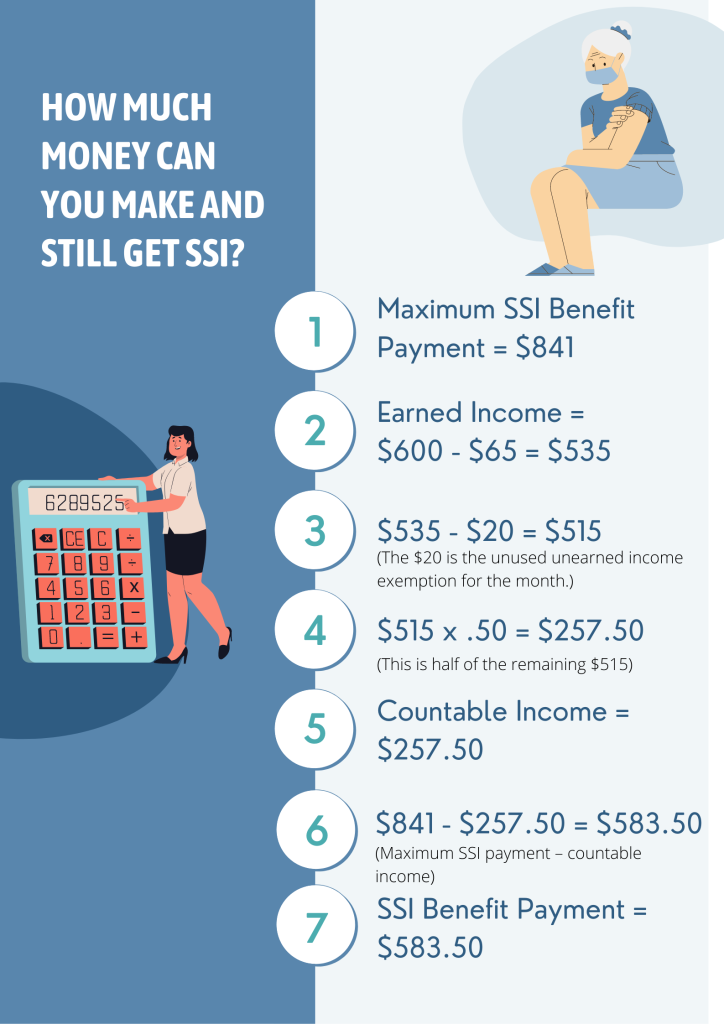
- Earned Income Exclusion: The first $65 of earned income, plus one-half of the remainder. This is a significant incentive for SSI recipients to work.
- Impairment-Related Work Expenses (IRWE): For disabled individuals, the cost of certain items and services needed to work (e.g., specialized transportation, attendant care) can be deducted from earnings.
- Blind Work Expenses (BWE): Similar to IRWE but for blind individuals, allowing deductions for expenses necessary to work.
- Plan to Achieve Self-Support (PASS): A special program that allows disabled or blind individuals to set aside income and resources for a specific work goal, without those funds counting against their SSI eligibility or payment amount.
- Other Exclusions: Certain benefits like food stamps, housing subsidies, and the value of medical care are generally not counted as income. Infrequent or irregular income below certain thresholds ($20 unearned, $10 earned) is also excluded.
How Countable Income Reduces Your Payment:
After applying all exclusions and deductions, your remaining “countable income” is subtracted dollar-for-dollar from the FBR (plus any state supplement). The result is your monthly SSI payment. For example, if the FBR is $943 and your countable income is $200, your SSI payment would be $743.
Resource Limits: Keeping Within the Threshold
In addition to income, your resources (assets) are also a critical factor in SSI eligibility. The resource limit is $2,000 for an individual and $3,000 for a couple. If your countable resources exceed these limits at the beginning of any month, you are not eligible for SSI benefits for that month.
What Counts as a Resource:
- Cash
- Money in bank accounts (checking, savings)
- Stocks, bonds, mutual funds
- Land (other than your primary residence)
- Second vehicles
- Life insurance policies with a cash surrender value over $1,500
What Does NOT Count as a Resource (Exclusions):
- Your home and the land it sits on (if it’s your primary residence)
- One vehicle, regardless of value, if used for transportation for you or a member of your household
- Household goods and personal effects
- Burial plots for you and your immediate family
- Up to $1,500 in funds designated for burial expenses for you and another $1,500 for your spouse
- Property essential for self-support (e.g., tools for a trade)
- Funds held in an ABLE account (Achieving a Better Life Experience Act) up to certain limits
Careful management of resources is essential to maintain SSI eligibility. If you anticipate exceeding the resource limit, it’s advisable to consult with a financial planner or benefits specialist to explore permissible ways to reduce countable resources.
Navigating the Application and Approval Journey
Applying for SSI disability benefits can be a lengthy and complex process. Understanding each step, from initial application to final approval or appeal, is vital for a smoother experience.
Step-by-Step Application Process
- Gather Information: Collect all necessary documents, including medical records, work history, financial statements, birth certificate, proof of citizenship/residency, and Social Security number.
- Submit Application: You can apply for SSI online (though an interview is usually required to complete it), by phone, or in person at your local Social Security office. The application involves filling out detailed forms about your medical condition, daily activities, and financial situation.
- Disability Determination Services (DDS): Once your non-medical eligibility (income, resources, citizenship) is confirmed by the local SSA office, your application is sent to the state’s DDS. This agency, staffed by medical and vocational experts, will review your medical evidence to determine if you meet the SSA’s definition of disability.
- Medical Review: DDS may contact your doctors, send you for consultative exams (at no cost to you), and gather additional medical records.
- Initial Decision: You will receive a letter informing you of the decision. Many initial applications are denied.
- Appeals Process: If denied, you have the right to appeal. The appeals process typically involves several stages:
- Reconsideration: A complete review of your case by someone who was not involved in the initial decision.
- Hearing by an Administrative Law Judge (ALJ): If reconsideration is denied, you can request a hearing before an ALJ. This is often the stage where applicants have the highest success rate.
- Appeals Council Review: If the ALJ denies your claim, you can ask the Appeals Council to review the ALJ’s decision.
- Federal Court Review: The final step, if all other appeals are exhausted.
The Critical Role of Medical Evidence
Medical evidence is the cornerstone of any disability claim. The SSA relies heavily on objective medical information to determine if your condition meets their definition of disability. This includes:
- Diagnosis and prognosis from treating physicians.
- Results from medical tests (X-rays, MRIs, lab tests).
- Hospitalization and surgical records.
- Statements from your doctors detailing your functional limitations (what you can and cannot do).
- Therapy notes (physical, occupational, mental health).
It is crucial to be actively engaged in your medical treatment and to ensure your doctors accurately document your symptoms, diagnoses, treatments, and most importantly, your functional limitations. Consistent medical care strengthens your claim.
What to Expect After Applying
The waiting period for an SSI disability decision can be substantial, often ranging from three to six months for an initial decision, and much longer if appeals are necessary. During this time:
- Maintain Contact: Respond promptly to all requests from the SSA or DDS for additional information.
- Continue Treatment: Keep attending doctor’s appointments and following prescribed treatments.
- Report Changes: Inform the SSA immediately of any changes to your income, resources, living arrangements, or medical condition.
- Potential Interviews: You may be contacted for interviews to clarify information on your application.
If approved, you will receive a notice detailing your monthly payment amount, the effective date of your benefits, and any past-due benefits you might receive. Payments are typically made on the first of the month for the prior month.
Factors Influencing Your Ongoing SSI Payments
Receiving SSI is not a static benefit; your payment amount can change based on various life circumstances. It’s imperative to understand these factors to maintain eligibility and ensure your benefits are calculated correctly.
Reporting Changes: Income, Living Arrangements, and Marital Status
The SSA requires SSI recipients to report changes in their circumstances promptly, as these can directly affect your eligibility and payment amount. Failing to report changes can lead to overpayments that you may have to repay, or underpayments where you miss out on benefits you’re owed.
- Changes in Income: Any increase or decrease in earned or unearned income must be reported. Even small amounts can impact your countable income and, consequently, your SSI payment.
- Changes in Resources: If your countable resources increase above the $2,000/$3,000 limit, you could lose eligibility. This includes receiving an inheritance, selling property, or winning money.
- Changes in Living Arrangements: Where you live and with whom can significantly alter your payment. For example, if you move into a medical treatment facility where Medicaid pays for over half your care, or if you begin living with someone who provides you with free room and board, your benefit may be reduced or terminated.
- Changes in Marital Status: Getting married or divorced can impact your countable income and resources, especially if your spouse also receives benefits or has income/resources that are deemed available to you.
- Other Changes: Changes in your mailing address, ability to work, or release from incarceration also need to be reported.
Most changes should be reported by the 10th day of the month following the month in which the change occurred.
Work Incentives and Maintaining Eligibility
The SSA offers several work incentives designed to help SSI recipients return to work and become more self-sufficient without immediately losing their benefits. These include:
- Earned Income Exclusion: As mentioned earlier, the first $65 of earned income plus half of the remainder is not counted.
- Impairment-Related Work Expenses (IRWE) / Blind Work Expenses (BWE): These allow you to deduct certain work-related expenses from your earned income.
- Plan to Achieve Self-Support (PASS): This allows you to set aside money for a specific work goal (e.g., education, vocational training, starting a business) without it affecting your SSI eligibility or payment.
- Student Earned Income Exclusion: For students under age 22, a portion of their earned income is excluded, encouraging educational pursuits.
- 1619(a) and 1619(b): These provisions allow eligible individuals to continue receiving SSI cash benefits (1619(a)) or Medicaid coverage (1619(b)) even if their earned income rises above the usual limits, as long as they meet other eligibility rules and their medical condition still limits their ability to work.
These incentives highlight the SSA’s commitment to supporting work efforts among disabled individuals and can be crucial tools for long-term financial planning.
The Continuing Disability Review (CDR) Process
The SSA periodically conducts Continuing Disability Reviews (CDRs) to determine if you are still disabled according to their rules. The frequency of these reviews depends on the nature of your disability:
- Medical Improvement Expected (MIE): Reviews typically conducted within six to 18 months after benefits start.
- Medical Improvement Possible (MIP): Reviews typically conducted about every three years.
- Medical Improvement Not Expected (MINE): Reviews typically conducted every five to seven years.
During a CDR, the SSA will review your current medical condition and your ability to work. You will be asked to provide updated medical information, and you may be sent for new consultative examinations. If the SSA determines your condition has medically improved to the point you are no longer disabled, your benefits may cease. It is critical to cooperate fully with the CDR process and continue your medical treatment.
Maximizing Your SSI Benefits and Financial Well-being
Navigating the complexities of SSI can be challenging, but with strategic planning and informed decision-making, you can optimize your benefits and foster greater financial stability.
Strategic Resource Management
For SSI recipients, managing resources within the strict limits is paramount. Here are some strategies:
- Spend Down Excess Resources: If you receive an unexpected sum (e.g., an inheritance or back payment of benefits), you typically have a limited time (often one month) to “spend down” these funds on exempt items (like a house repair, a new vehicle, or household goods) before they count against your resource limit.
- ABLE Accounts: These tax-advantaged savings accounts allow eligible individuals with disabilities to save money without losing their SSI or Medicaid benefits. Funds in an ABLE account (up to a certain limit, usually around $100,000 for SSI purposes) are not counted towards the resource limit. This is a game-changer for many, providing a path to save for future needs.
- Special Needs Trusts (SNTs): Funds held in a properly established SNT do not count as resources for SSI purposes. These trusts are often used to hold assets for a disabled individual, ensuring they can pay for supplemental needs (beyond basic food and shelter) without jeopardizing their benefits.
Consulting with an attorney specializing in disability law or special needs planning can provide invaluable guidance on these complex financial tools.
Seeking Expert Guidance
The rules surrounding SSI eligibility and payment calculations are intricate and can change. Seeking professional assistance can make a significant difference in your application process and ongoing benefit management:
- Social Security Administration (SSA): The SSA is your primary resource for information. Their website and local offices can provide forms, explanations, and direct assistance.
- Disability Advocates and Attorneys: These professionals specialize in disability claims and can represent you during the application and appeals process. They understand the legal and medical requirements and can help you gather evidence and present your case effectively. Many work on a contingency basis, meaning they only get paid if you win your case.
- Financial Planners (Specializing in Disability): Some financial planners have expertise in disability benefits and can help you create a financial plan that considers your SSI benefits, potential work incentives, and long-term financial goals, all while adhering to resource limits.
Leveraging these experts can help you avoid common pitfalls and ensure you receive all the benefits you are entitled to.
Long-Term Financial Planning with SSI
While SSI provides a vital safety net, it’s designed to be a subsistence-level income. Therefore, integrating it into a broader financial plan is crucial for long-term well-being.
- Budgeting: Develop a clear budget to manage your monthly SSI income effectively, prioritizing essential expenses.
- Work Incentives: Actively explore and utilize work incentives like PASS and the Earned Income Exclusion if you have any capacity to work, even part-time. This can provide additional income without completely losing your benefits.
- Medicaid Integration: SSI often automatically qualifies you for Medicaid, which provides crucial health coverage. Understand how your healthcare costs are covered and plan for any out-of-pocket expenses.
- Future Planning: Consider how potential changes in your health, living situation, or family status might impact your benefits. Proactive planning can help mitigate negative financial surprises.
Understanding “how much SSI disability will I receive” is not merely about a dollar figure; it’s about comprehending a complex system designed to support individuals with disabilities. By familiarizing yourself with eligibility criteria, payment calculations, application procedures, and ongoing reporting requirements, you can effectively manage your benefits and secure a more stable financial future. Always remember to report changes promptly and seek professional guidance when needed to navigate this crucial federal program successfully.
aViewFromTheCave is a participant in the Amazon Services LLC Associates Program, an affiliate advertising program designed to provide a means for sites to earn advertising fees by advertising and linking to Amazon.com. Amazon, the Amazon logo, AmazonSupply, and the AmazonSupply logo are trademarks of Amazon.com, Inc. or its affiliates. As an Amazon Associate we earn affiliate commissions from qualifying purchases.