
The Fundamental Role of Percentages in Finance
In the intricate world of finance, percentages serve as a universal language, distilling complex relationships into easily digestible figures. From personal budgets to corporate financial statements, understanding percentages is not merely a mathematical exercise; it’s a cornerstone of sound financial literacy and decision-making. While many are adept at calculating a percentage of a given number, a crucial yet often overlooked skill is the ability to reverse-engineer this process: finding the original, whole number when you only know a part of it and its corresponding percentage.

This skill is indispensable across countless financial scenarios. Whether you’re deciphering investment returns, evaluating discounts, managing debt, or analyzing business performance, the capacity to derive the total value from a partial percentage insight empowers individuals and organizations to make informed, strategic choices. A percentage fundamentally represents a part of a whole, expressed as a fraction of 100. For instance, 25% signifies 25 parts out of every 100. When we need to uncover the total value that this percentage represents, we’re essentially asking: “If this ‘part’ is ‘X’ percent of something, what is that ‘something’?”
Understanding the Core Formula
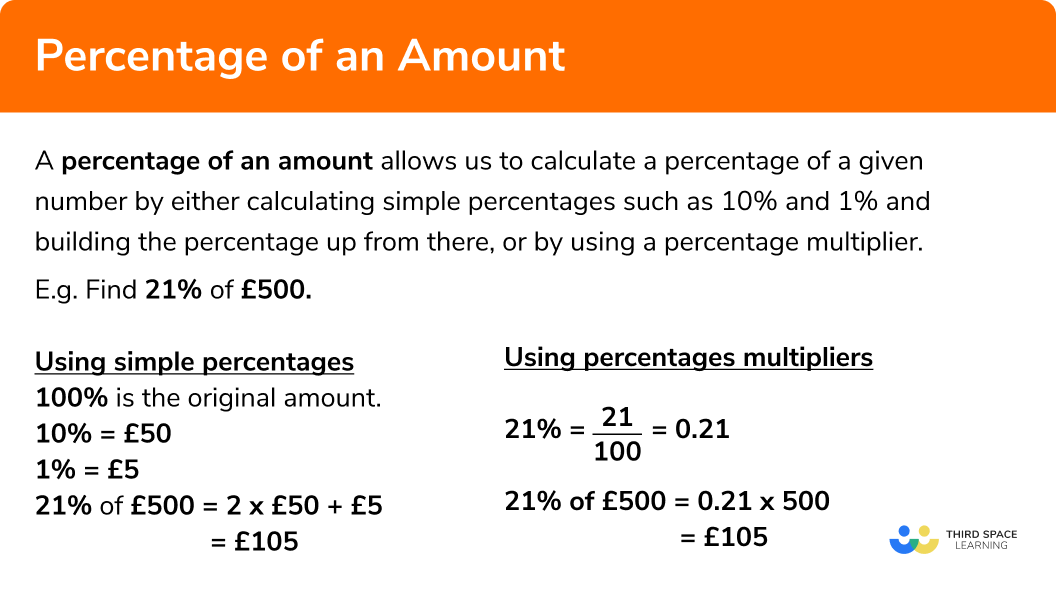
At its heart, finding the original number from a percentage relies on a simple algebraic rearrangement of the basic percentage formula. The fundamental relationship is:
Part = Percentage × Whole
Here, “Part” is the specific numerical value you know, “Percentage” is the given percentage expressed as a decimal, and “Whole” is the original, total number you aim to find.
To isolate and solve for the “Whole,” we rearrange the formula:
Whole = Part / Percentage (as a decimal)
The critical step here is to always convert the percentage into its decimal equivalent before performing the division. This is done by dividing the percentage by 100. For example:
- 25% becomes 0.25
- 7.5% becomes 0.075
- 150% becomes 1.50
This foundational understanding unlocks the door to a multitude of financial calculations, transforming vague percentage statements into concrete, actionable figures.
Practical Applications in Personal Finance
Mastering the art of finding a number from a percentage is immensely beneficial for personal financial management, enabling greater control and clarity over one’s economic situation.
Budgeting and Expense Tracking
Effective budgeting hinges on understanding where your money comes from and where it goes. Often, you might know the percentage an expense takes from your income, or the percentage of your savings goal you’ve achieved.
-
Scenario: You know that your monthly rent payment of $1,200 constitutes 30% of your net monthly income. To understand your total income, you would calculate:
- Total Income = $1,200 / 0.30 = $4,000
This insight allows you to evaluate if 30% aligns with typical budgeting rules of thumb (e.g., 50/30/20 rule) and plan other expenditures accordingly.
- Total Income = $1,200 / 0.30 = $4,000
-
Scenario: You’ve saved $750 towards a down payment for a car, and this amount represents 15% of your total savings goal. To find your total savings goal:
- Total Goal = $750 / 0.15 = $5,000
Knowing this total helps you assess your progress and adjust your savings strategy if necessary.
- Total Goal = $750 / 0.15 = $5,000
Loans, Interest, and Debt Management
Percentages are the bedrock of lending and borrowing, influencing everything from mortgage rates to credit card interest.
-
Scenario: Last month, you paid $60 in interest on your credit card. Knowing your card’s monthly interest rate is 1.5% (equivalent to 18% APR divided by 12 months), you can determine your average balance for that period:
- Average Balance = $60 / 0.015 = $4,000
This calculation provides a clear picture of the principal amount incurring interest, vital for strategizing debt reduction.
- Average Balance = $60 / 0.015 = $4,000
-
Scenario: You made a down payment of $70,000 on a new home, which represented 20% of the total purchase price. To determine the home’s full value:
- Home Price = $70,000 / 0.20 = $350,000
This helps in assessing the total loan amount required and overall affordability.
- Home Price = $70,000 / 0.20 = $350,000
Investing Returns and Portfolio Analysis
In the realm of investments, percentages communicate performance. Translating these percentages back into concrete dollar figures is essential for understanding actual wealth creation.
-
Scenario: Your investment portfolio yielded an 8% return last year, which translated to a gain of $5,600. To find the initial value of your portfolio at the start of the year:
- Initial Portfolio Value = $5,600 / 0.08 = $70,000
This metric is crucial for tracking the growth of your capital and evaluating the effectiveness of your investment strategies.
- Initial Portfolio Value = $5,600 / 0.08 = $70,000
-
Scenario: You aim to allocate 25% of your investment portfolio to a specific sector, and you currently have $12,500 invested in that sector. To find your total portfolio value:
- Total Portfolio Value = $12,500 / 0.25 = $50,000
This helps ensure your asset allocation remains aligned with your risk tolerance and financial goals.
- Total Portfolio Value = $12,500 / 0.25 = $50,000
Business Finance and Strategic Decisions
For businesses, calculating the whole from a percentage is not just an accounting task; it’s a strategic tool used for pricing, profitability analysis, and performance evaluation.
Profit Margins and Revenue Analysis
Understanding profit margins is fundamental to business viability. Percentages often represent these margins, making the reverse calculation vital for revenue planning.
-
Scenario: A company reported a gross profit of $150,000 for a product line, which represents a 30% gross profit margin. To find the total revenue generated by that product line:
- Total Revenue = $150,000 / 0.30 = $500,000
This revenue figure allows for accurate cost of goods sold (COGS) calculation and strategic sales forecasting.
- Total Revenue = $150,000 / 0.30 = $500,000
-
Scenario: A salesperson earned $8,000 in commission, representing a 5% commission rate on their total sales. To determine their total sales volume:
- Total Sales = $8,000 / 0.05 = $160,000
This provides critical data for sales performance reviews and incentive planning.
- Total Sales = $8,000 / 0.05 = $160,000
Discounts, Markups, and Pricing Strategies
Pricing products and services effectively requires a deep understanding of percentages, especially when applying discounts or markups.
-
Scenario: An item is currently selling for $160 after a 20% discount. To ascertain the original price of the item before the discount was applied:
- First, recognize that if there’s a 20% discount, the current price represents 100% – 20% = 80% of the original price.
- Original Price = $160 / 0.80 = $200
This calculation is essential for maintaining consistent pricing strategies and understanding true revenue potential.
-
Scenario: A business offers a 2% discount for early payment on invoices. If a customer took advantage of this discount and saved $120, what was the total original invoice amount?
- Original Invoice Amount = $120 / 0.02 = $6,000
This helps in tracking the cost of offering discounts and assessing their impact on cash flow.
- Original Invoice Amount = $120 / 0.02 = $6,000
Financial Ratios and Performance Metrics
Financial ratios often express relationships as percentages, and knowing how to extract the underlying numbers can illuminate a company’s health and efficiency.
-
Scenario: A company’s debt-to-asset ratio is 40%. If the company’s total debt is $2 million, what is the total value of its assets?
- Total Assets = $2,000,000 / 0.40 = $5,000,000
This ratio helps creditors and investors gauge financial leverage and risk.
- Total Assets = $2,000,000 / 0.40 = $5,000,000
-
Scenario: A company aims for a 15% return on equity (ROE). If they generated $750,000 in net income, what should their total equity be to meet this target?
- Total Equity = $750,000 / 0.15 = $5,000,000
This calculation provides insights for capital structure decisions and shareholder value creation.
- Total Equity = $750,000 / 0.15 = $5,000,000
Tools and Best Practices for Accuracy
While the calculations are straightforward, accuracy is paramount in financial matters. Leveraging appropriate tools and avoiding common pitfalls ensures reliable results.
Leveraging Spreadsheets and Financial Calculators
Modern financial management is significantly enhanced by digital tools.
- Spreadsheets (Excel, Google Sheets): These are invaluable for automating percentage calculations. You can set up cells to hold the ‘Part’ and ‘Percentage (as decimal)’ and a formula to automatically compute the ‘Whole’. For instance, if ‘Part’ is in cell A1 and ‘Percentage’ (e.g., 0.25) is in B1, the ‘Whole’ can be calculated using
=A1/B1. This allows for quick scenario analysis and minimizes manual errors. - Financial Calculators: Dedicated financial calculators, both physical and online, often have built-in functions for percentage-related calculations, including reverse percentages, which can be particularly useful for more complex financial planning scenarios involving multiple variables.

Common Pitfalls and How to Avoid Them
Even with simple formulas, errors can creep in. Awareness of common mistakes can significantly improve accuracy.
- Incorrect Conversion of Percentage to Decimal: The most frequent error is forgetting to divide the percentage by 100. Using 20 instead of 0.20 for 20% will yield wildly inaccurate results. Always double-check this conversion.
- Misidentifying the ‘Part’ and the ‘Whole’: Ensure you are correctly identifying which numerical value is the ‘Part’ (the known portion) and which is the ‘Whole’ (the unknown total). In discount scenarios, for example, the discounted price is not 20% of the original price if it’s a 20% discount; rather, it’s 80% of the original price. Carefully read the problem statement to define your variables.
- Confusing Percentage Points with Percentage Change: A shift from 5% to 7% is a 2 percentage point increase, but it is a (7-5)/5 = 40% percentage change. In financial reporting, these terms are often used distinctly, and misinterpreting them can lead to significant miscalculations.
- Ignoring Context: Financial percentages are rarely isolated. They are tied to specific timeframes, base amounts, and conditions. Always consider the context of the percentage you are working with to ensure your calculation is relevant and accurate.
By understanding the underlying mechanics, applying it to real-world financial scenarios, and exercising due diligence in calculations, anyone can confidently find the number from a percentage, unlocking deeper financial insights and empowering better decision-making. This seemingly simple mathematical skill is, in essence, a potent financial tool that enables individuals and businesses to see beyond the percentages and grasp the complete financial picture.
aViewFromTheCave is a participant in the Amazon Services LLC Associates Program, an affiliate advertising program designed to provide a means for sites to earn advertising fees by advertising and linking to Amazon.com. Amazon, the Amazon logo, AmazonSupply, and the AmazonSupply logo are trademarks of Amazon.com, Inc. or its affiliates. As an Amazon Associate we earn affiliate commissions from qualifying purchases.