
Interest is a fundamental concept in personal finance, banking, and economics, yet its calculation can often seem daunting. Whether you’re saving for a future goal, taking out a loan, or investing your hard-earned money, understanding how interest is calculated is not just beneficial—it’s essential. It empowers you to make informed decisions, optimize your financial strategies, and ultimately take control of your monetary future. This guide will demystify the process, breaking down the core principles, formulas, and practical applications of interest calculation.
The Fundamentals of Interest: Why It Matters
At its core, interest is the cost of borrowing money or the reward for lending it. It’s the price paid for the use of someone else’s money or the return earned on your own money over time. Grasping this basic concept is the first step toward financial literacy.

What is Interest?
In simple terms, interest can be defined as a fee that a borrower pays to a lender for the use of assets, typically money. Conversely, it’s also the amount a lender (or an investor) receives for permitting a borrower to use their money. This fee is usually expressed as a percentage of the principal amount (the initial sum of money) and is applied over a specific period. For instance, if you deposit money into a savings account, the bank pays you interest for using your money. If you take out a loan, you pay the bank interest for using theirs.
Why Understanding Interest is Crucial
Understanding interest is paramount for several reasons:
- Informed Decision-Making: When comparing loans (mortgages, car loans, credit cards), understanding interest rates and how they compound allows you to accurately assess the total cost of borrowing and choose the most favorable terms. Similarly, when choosing savings accounts or investment vehicles, knowing how interest accrues helps you maximize your returns.
- Financial Planning: Accurate interest calculations are critical for budgeting, retirement planning, and setting financial goals. Knowing how much interest you’ll pay on debts or earn on investments enables you to forecast your financial future more accurately.
- Debt Management: For those with existing debts, understanding interest helps in strategizing repayment. Knowing which debts accrue interest faster can guide you to prioritize high-interest debts, saving you significant money in the long run.
- Wealth Accumulation: The power of compound interest, often called the “eighth wonder of the world,” is a key driver of wealth accumulation. By understanding how it works, you can leverage it to grow your investments and savings substantially over time.
- Avoiding Pitfalls: Lack of understanding about interest can lead to poor financial choices, such as taking on high-interest loans that become unmanageable or missing out on opportunities to grow wealth effectively.
Mastering Simple Interest Calculations
Simple interest is the most straightforward form of interest calculation. It’s calculated only on the principal amount of a loan or deposit, meaning the interest earned (or paid) doesn’t earn (or incur) interest itself.
The Simple Interest Formula Explained
The formula for calculating simple interest is:
I = P * R * T
Where:
- I = Simple Interest (the total interest earned or paid)
- P = Principal Amount (the initial sum of money borrowed or invested)
- R = Annual Interest Rate (expressed as a decimal; e.g., 5% becomes 0.05)
- T = Time Period (the duration of the loan or investment in years)
To find the total amount (A) after the interest has been added, you use:
A = P + I or A = P * (1 + R * T)
Practical Examples of Simple Interest
Let’s illustrate with an example:
- Scenario: You invest $1,000 in a certificate of deposit (CD) that pays 3% simple annual interest for 5 years.
- P = $1,000
- R = 3% = 0.03
- T = 5 years
Calculation:
I = $1,000 * 0.03 * 5
I = $150
So, after 5 years, you would earn $150 in simple interest.
The total amount would be A = $1,000 + $150 = $1,150.
Another example:
- Scenario: You take out a short-term personal loan for $5,000 at a simple interest rate of 10% per year for 6 months.
- P = $5,000
- R = 10% = 0.10
- T = 6 months = 0.5 years (since T must be in years)
Calculation:
I = $5,000 * 0.10 * 0.5
I = $250
The total interest paid on this loan would be $250.
The total amount to repay would be A = $5,000 + $250 = $5,250.
When Simple Interest Applies
Simple interest is often used for:
- Short-term loans: Many short-term personal loans, car title loans, or payday loans might use simple interest.
- Bonds: Some bonds pay simple interest annually.
- Certain types of mortgages: Though less common now, some older mortgage structures used simple interest.
- Certificate of Deposits (CDs): Many CDs calculate interest on a simple basis.
While straightforward, simple interest doesn’t capture the dynamic growth potential that comes from interest earning interest, which leads us to compound interest.
Unlocking the Power of Compound Interest
Compound interest is where money truly starts to work for you. Unlike simple interest, compound interest is calculated on the initial principal and also on all the accumulated interest from previous periods. This means your interest earns interest, leading to exponential growth over time.
The Compound Interest Formula: Growth Over Time
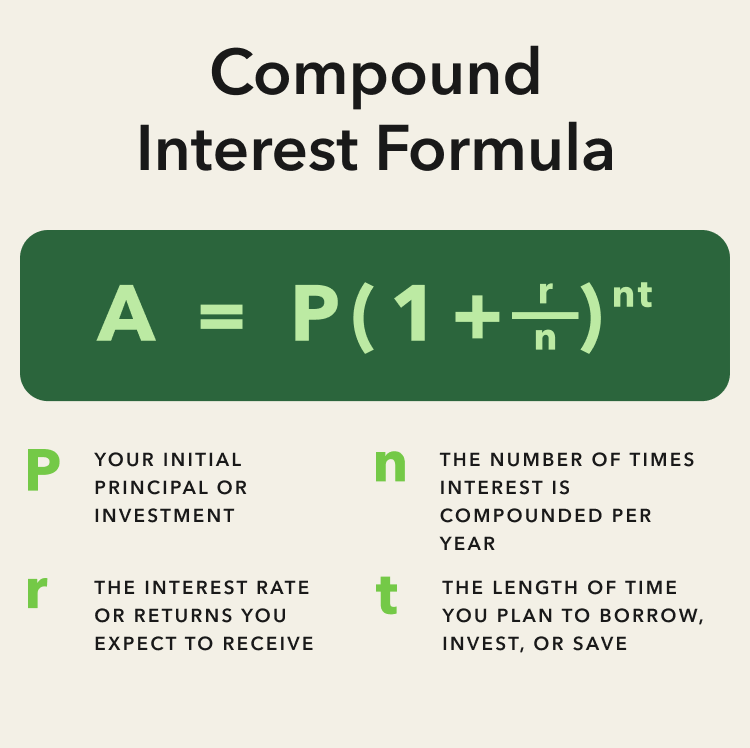
The formula for calculating compound interest is slightly more complex but far more powerful:
A = P * (1 + R/n)^(n*T)

Where:
- A = Future Value of the investment/loan, including interest
- P = Principal amount (the initial sum of money)
- R = Annual Interest Rate (as a decimal)
- n = Number of times that interest is compounded per year
- T = Time the money is invested or borrowed for, in years
To find only the compound interest earned, you would subtract the principal from the future value:
Compound Interest = A – P
Illustrative Examples of Compound Interest
Let’s revisit our investment example, but with compound interest:
- Scenario: You invest $1,000 at an annual interest rate of 3% for 5 years, compounded annually.
- P = $1,000
- R = 3% = 0.03
- n = 1 (compounded annually)
- T = 5 years
Calculation:
A = $1,000 * (1 + 0.03/1)^(1*5)
A = $1,000 * (1.03)^5
A = $1,000 * 1.159274
A = $1,159.27
The total amount after 5 years is $1,159.27.
The compound interest earned is $1,159.27 – $1,000 = $159.27.
Notice this is higher than the $150 earned with simple interest.
What if the interest is compounded more frequently?
- Scenario: You invest $1,000 at an annual interest rate of 3% for 5 years, compounded monthly.
- P = $1,000
- R = 3% = 0.03
- n = 12 (compounded monthly)
- T = 5 years
Calculation:
A = $1,000 * (1 + 0.03/12)^(12*5)
A = $1,000 * (1 + 0.0025)^60
A = $1,000 * (1.0025)^60
A = $1,000 * 1.161616
A = $1,161.62
Compounding monthly yields $161.62 in interest, slightly more than annual compounding ($159.27), illustrating the impact of compounding frequency.
The Magic of Compounding: Long-Term Implications
The “magic” of compounding truly shines over longer periods. A small principal can grow into a substantial sum given enough time and a consistent interest rate. This principle is why starting to save and invest early is so frequently advised. Even modest contributions can blossom into significant wealth due to the continuous cycle of interest earning interest. This makes compound interest a cornerstone of retirement planning, long-term savings, and effective wealth management strategies.
Key Factors Influencing Interest Calculations
Regardless of whether it’s simple or compound interest, several core variables dictate the final amount of interest paid or earned. Understanding these factors allows for better financial projections and strategic planning.
Principal Amount: The Starting Point
The principal is the initial sum of money on which interest is calculated. It’s the base of your loan or investment. Naturally, a larger principal amount will generate or incur more interest, assuming the rate and time remain constant.
- For borrowers: A higher principal means more total interest paid over the life of the loan.
- For investors/savers: A higher principal means more total interest earned over time.
Interest Rate: The Cost or Return
The interest rate is the percentage charged by a lender for money borrowed, or paid by a borrower for the use of assets. It is typically expressed as an annual percentage rate (APR). The rate is arguably the most impactful factor in interest calculations.
- A higher interest rate on a loan translates to a higher cost of borrowing.
- A higher interest rate on savings or investments translates to greater returns.
It’s crucial to understand whether a quoted interest rate is fixed (stays the same throughout the term) or variable (can change based on market conditions).
Time Period: Duration Matters
The time period, or the duration over which the money is borrowed or invested, is another critical component. Interest accumulates over time, so the longer the period, the more interest will be involved.
- For loans: A longer loan term, even with the same principal and interest rate, generally means more total interest paid because the interest has more time to accrue. This is a common trap for borrowers who opt for longer terms to lower monthly payments, not realizing the significant increase in overall cost.
- For investments: A longer investment horizon significantly amplifies the power of compound interest, leading to substantial growth. This underscores the importance of long-term investing.
Real-World Applications and Advanced Considerations
Understanding interest calculation extends far beyond simple formulas. It informs major financial decisions and plays a role in various financial products and services.
Interest in Loans: Mortgages, Car Loans, Personal Loans
Interest is the lifeblood of the lending industry.
- Mortgages: Often the largest loan individuals take out, mortgages typically involve compound interest over 15 to 30 years. Understanding the impact of the interest rate and term on total repayment is vital. Amortization schedules, which detail how each payment is split between principal and interest, are crucial tools here.
- Car Loans: Similar to mortgages, car loans use compound interest. The length of the loan term can dramatically change the total interest paid.
- Personal Loans and Credit Cards: While personal loans usually have fixed terms and rates, credit cards often have variable rates and compound interest daily or monthly on outstanding balances, making them one of the most expensive forms of borrowing if not managed carefully.
Interest in Savings and Investments: Growing Your Wealth
On the flip side, interest is how your money grows:
- Savings Accounts: Banks pay interest on deposits, though often at lower rates due to their liquidity.
- Certificates of Deposit (CDs): These offer higher fixed interest rates than regular savings accounts in exchange for locking up your money for a specified period.
- Bonds: Investors earn interest payments (coupons) from bonds issued by governments or corporations.
- Investment Accounts: While stock investments don’t directly pay interest, the concept of compound returns (reinvesting dividends or capital gains) mirrors the compounding effect.
The Impact of Compounding Frequency
As demonstrated in our examples, the more frequently interest is compounded (daily, monthly, quarterly, semi-annually, annually), the faster your money grows, assuming the same annual interest rate. This is because interest begins earning interest sooner. When comparing financial products, always look beyond just the annual rate; consider the compounding frequency, often reflected in the Annual Percentage Yield (APY) for savings, which accounts for compounding.
Tools and Resources for Interest Calculation
While manual calculation is excellent for understanding the principles, for complex scenarios or quick checks, various tools can be invaluable:
- Online Calculators: Numerous websites offer free simple and compound interest calculators.
- Spreadsheet Software: Programs like Microsoft Excel or Google Sheets have built-in financial functions (e.g.,
FVfor future value,PMTfor loan payments) that can calculate interest with precision. - Financial Calculators: Dedicated handheld financial calculators are also available for advanced computations.
Mastering the calculation of interest is a cornerstone of sound financial management. By understanding the distinction between simple and compound interest, recognizing the impact of principal, rate, and time, and applying this knowledge to real-world financial products, you can make smarter decisions, optimize your savings and investments, and navigate the world of loans with confidence. This fundamental skill empowers you to control your financial destiny rather than letting interest control you.
aViewFromTheCave is a participant in the Amazon Services LLC Associates Program, an affiliate advertising program designed to provide a means for sites to earn advertising fees by advertising and linking to Amazon.com. Amazon, the Amazon logo, AmazonSupply, and the AmazonSupply logo are trademarks of Amazon.com, Inc. or its affiliates. As an Amazon Associate we earn affiliate commissions from qualifying purchases.