
The Foundational Role of Percentages in Financial Literacy
Understanding how to calculate percentages is not merely an academic exercise; it is a critical skill for navigating the complex world of personal and business finance. From daily transactions to long-term investment strategies, percentages provide a universal language for comparing values, measuring growth, and assessing financial health. Mastering percentage calculations on a calculator empowers individuals and businesses to make informed decisions, optimize spending, and plan for future prosperity. Without this fundamental understanding, interpreting financial statements, evaluating discounts, or understanding interest rates becomes a daunting task, potentially leading to suboptimal financial outcomes.

Everyday Financial Scenarios: Discounts, Tips, and Taxes
Percentages are woven into the fabric of everyday financial life. When shopping, discounts are almost universally expressed as percentages. A “25% off” sale is meaningless if one cannot quickly determine the actual savings or the final price. Similarly, calculating tips for services, often ranging from 15% to 20%, requires a quick percentage calculation. Sales tax, a percentage of the purchase price, is another common occurrence. Accurately figuring these percentages on a calculator ensures that consumers pay the correct amount, budget effectively, and identify potential overcharges. For businesses, precise calculation of discounts, taxes collected, and employee tips is essential for accurate pricing, compliance, and cash flow management.
Investment and Savings Growth
For investors and savers, percentages are the primary metric for evaluating performance and potential. Interest rates on savings accounts, Certificates of Deposit (CDs), and bonds are always quoted as percentages, indicating the return on capital over a period. Stock market gains or losses are routinely discussed in percentage terms, reflecting the proportional change in value. Understanding compound interest—the interest earned on both the initial principal and the accumulated interest—is fundamentally a percentage calculation that illustrates the exponential growth potential of long-term investments. Calculating expected returns, evaluating investment risk, and projecting future savings balances all hinge on a solid grasp of percentage mechanics.
Loan Interest and Debt Management
On the flip side, percentages are equally crucial in understanding debt. Interest rates on mortgages, car loans, credit cards, and personal loans dictate the true cost of borrowing. A small difference in an annual percentage rate (APR) can translate into thousands of dollars over the life of a loan. Calculating the percentage of a payment that goes toward interest versus principal, or understanding the impact of an additional principal payment, empowers borrowers to manage their debt more effectively, strategize for early payoff, and avoid excessive interest charges. For financial institutions, accurate percentage calculations are the bedrock of lending models, risk assessment, and profit generation.
Mastering Your Financial Calculator: Basic Percentage Operations
While calculators vary, the fundamental operations for percentages remain consistent. Most financial calculations revolve around three core types: finding a percentage of a number, determining what percentage one number is of another, and calculating percentage increases or decreases.
Calculating a Percentage of a Number (Finding a Discount Amount)
This is perhaps the most common percentage calculation. It involves finding a part of a whole, such as determining a discount amount or the tax on an item.
Method 1: Using the Percentage Button (if available)
- Scenario: You want to find 20% of $150.
- Steps:
- Enter the base number:
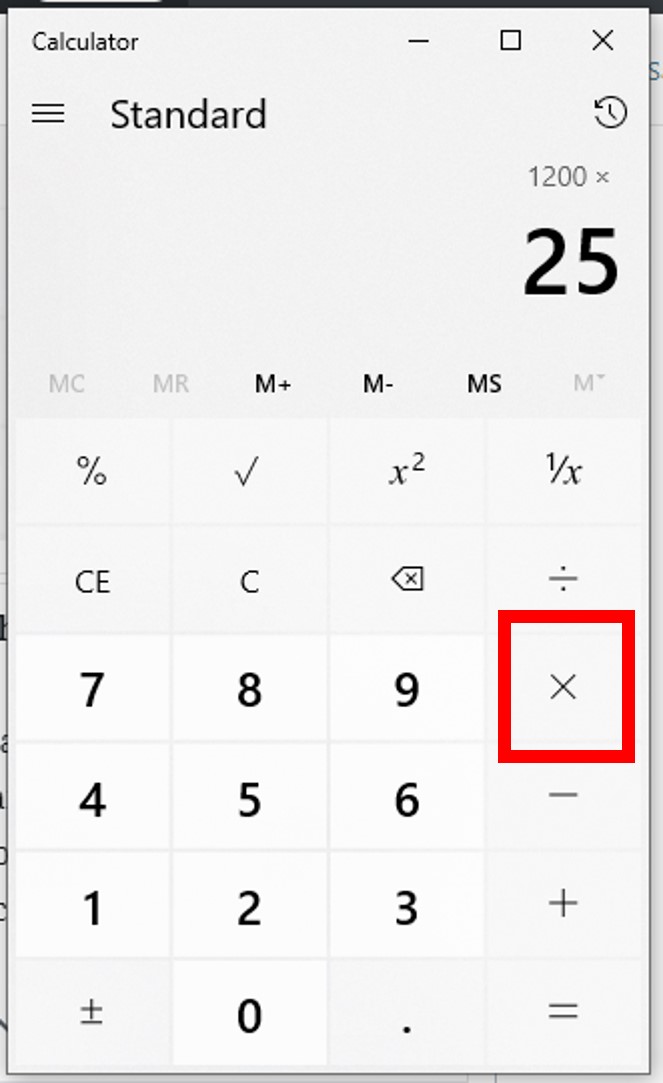
150 - Press the multiplication button:
* - Enter the percentage:
20 - Press the percentage button:
% - The result (
30) appears, representing 20% of 150.
- To find the final price after a 20% discount:
150 - 30 = 120.
- Enter the base number:
Method 2: Manual Calculation (Universal Method)
- Scenario: You want to find 20% of $150 (e.g., a 20% commission on a $150 sale).
- Steps:
- Convert the percentage to a decimal by dividing by 100:
20 / 100 = 0.20 - Multiply the base number by the decimal:
150 * 0.20 = 30
- This method is more universally applicable, especially on basic calculators without a dedicated percentage key.
- Convert the percentage to a decimal by dividing by 100:
Finding the Percentage One Number Is of Another (Profit Margin Calculation)
This calculation is used to express one value as a proportion of another, often to determine ratios or rates, like a profit margin or an expense ratio.
- Scenario: A business made a profit of $10,000 from sales of $50,000. What is the profit margin?
- Steps:
- Divide the part by the whole:
10000 / 50000 = 0.2 - Multiply the result by 100 to convert to a percentage:
0.2 * 100 = 20%
- So, the profit margin is 20%. This calculation is crucial for assessing business performance and comparing efficiency across periods or competitors.
- Divide the part by the whole:
Percentage Increase and Decrease (Investment Growth/Loss)
These calculations show the relative change between two values, essential for tracking financial growth, inflation, or depreciation.
To Calculate Percentage Increase:
- Scenario: Your investment portfolio grew from $10,000 to $12,000. What is the percentage increase?
- Steps:
- Find the absolute change:
12000 - 10000 = 2000 - Divide the change by the original number:
2000 / 10000 = 0.2 - Multiply by 100 to get the percentage:
0.2 * 100 = 20%
- Alternatively:
(New Value / Old Value) - 1 * 100->(12000 / 10000) - 1 * 100 = (1.2 - 1) * 100 = 0.2 * 100 = 20%.
- Find the absolute change:
To Calculate Percentage Decrease:
- Scenario: The value of an asset dropped from $5,000 to $4,500. What is the percentage decrease?
- Steps:
- Find the absolute change:
5000 - 4500 = 500 - Divide the change by the original number:
500 / 5000 = 0.1 - Multiply by 100 to get the percentage:
0.1 * 100 = 10%
- Alternatively:
1 - (New Value / Old Value) * 100->1 - (4500 / 5000) * 100 = (1 - 0.9) * 100 = 0.1 * 100 = 10%.
- Find the absolute change:
Advanced Percentage Applications for Financial Decision-Making
Beyond basic calculations, percentages are integral to more sophisticated financial analysis, enabling individuals and businesses to project, evaluate, and strategize effectively.
Compound Interest and Future Value Projections
Compound interest is the engine of long-term wealth accumulation. While complex calculations are often handled by dedicated financial calculators or software, understanding the underlying percentage mechanics is vital. The formula A = P(1 + r/n)^(nt) uses percentages for the interest rate (r). On a standard calculator, iterative calculations can demonstrate compounding. For example, to calculate interest compounded annually:
- Original Principal: $1,000
- Annual Interest Rate: 5%
- After 1 year:
1000 * (1 + 0.05) = 1050 - After 2 years:
1050 * (1 + 0.05) = 1102.50
This iterative approach, repeated for multiple periods, illustrates the power of compounding and allows for manual projections of investment growth or debt accumulation.
Understanding Financial Ratios (Return on Investment)
Financial ratios, expressed as percentages, are powerful tools for evaluating the performance and health of investments or businesses. Return on Investment (ROI) is a prime example:
- ROI Formula:
((Current Value of Investment - Cost of Investment) / Cost of Investment) * 100 - Scenario: You invested $5,000 in a stock, and it’s now worth $6,500.
- Calculation:
((6500 - 5000) / 5000) * 100 = (1500 / 5000) * 100 = 0.3 * 100 = 30%
An ROI of 30% provides a clear, comparable metric of profitability. Other ratios like profit margin, debt-to-income ratio, and expense ratios all rely on precise percentage calculations to offer insights into financial efficiency and risk.
Budgeting and Expense Analysis
Effective personal and business budgeting relies heavily on percentages. Allocating a certain percentage of income to housing, savings, or debt repayment provides a flexible framework for financial management.
- Scenario: Your monthly income is $4,000. You want to allocate 30% to housing, 15% to savings, and 10% to debt.
- Housing:
4000 * 0.30 = $1,200 - Savings:
4000 * 0.15 = $600 - Debt:
4000 * 0.10 = $400
Analyzing actual expenses as percentages of total income or total expenses helps identify spending patterns, areas for cost reduction, and adherence to financial goals. For businesses, analyzing departmental budgets as a percentage of total operational costs can highlight inefficiencies or areas of overspending.
Choosing the Right Financial Tool: Calculator Types and Their Advantages
While the methods for calculating percentages remain consistent, the type of calculator can significantly impact efficiency and the complexity of calculations handled.
Standard vs. Scientific vs. Financial Calculators
- Standard Calculators: Ideal for basic percentage operations encountered in daily shopping, tipping, or simple tax calculations. Their simplicity makes them quick and easy to use for the core tasks discussed in basic percentage operations.
- Scientific Calculators: While designed for more advanced mathematical functions (trigonometry, logarithms), they can perform all standard percentage calculations. They may be overkill for everyday financial tasks but offer robustness for those who already own one.
- Financial Calculators: Specifically designed for complex financial calculations, they often have dedicated keys for functions like present value (PV), future value (FV), interest rate (I/Y), and number of periods (N). These are invaluable for professional financial analysis, complex loan amortizations, and advanced investment planning, significantly streamlining compound interest and annuity calculations. For serious investors or finance professionals, a financial calculator is an indispensable tool.
Smartphone Apps and Online Calculators
The ubiquity of smartphones has made powerful calculators accessible to everyone. Many apps offer standard, scientific, and even dedicated financial calculator functionalities.
- Advantages: Portability, often free, and can integrate with other financial apps. Many online calculators are tailored to specific financial tasks, such as mortgage payment calculators or compound interest estimators, simplifying complex formulas into user-friendly interfaces.
- Considerations: While convenient, ensure the app or online tool is reputable and accurate. For critical financial decisions, double-checking results or using a trusted dedicated calculator may be prudent.

Practical Tips for Accuracy and Efficiency
Regardless of the calculator type, certain practices enhance accuracy and efficiency:
- Understand the “Order of Operations”: Familiarize yourself with how your calculator handles operations (e.g., multiplication before addition).
- Use Parentheses: For multi-step calculations, parentheses are crucial for ensuring operations are performed in the correct sequence.
- Double-Check Inputs: A single misplaced digit can dramatically alter the result. Always verify the numbers entered.
- Practice Regularly: Like any skill, proficiency in using a calculator for percentages comes with practice. Regularly applying these calculations to real-world financial scenarios builds confidence and speed.
Mastering percentage calculations on a calculator is an indispensable component of financial literacy. It empowers individuals and businesses to interpret financial data, assess opportunities and risks, and make sound financial decisions that contribute to long-term economic well-being.
aViewFromTheCave is a participant in the Amazon Services LLC Associates Program, an affiliate advertising program designed to provide a means for sites to earn advertising fees by advertising and linking to Amazon.com. Amazon, the Amazon logo, AmazonSupply, and the AmazonSupply logo are trademarks of Amazon.com, Inc. or its affiliates. As an Amazon Associate we earn affiliate commissions from qualifying purchases.