
In the intricate world of business finance, certain documents stand as pillars of compliance and operational integrity. Among these, IRS Form 941, often simply referred to as “941,” holds a paramount position for nearly every employer in the United States. Far from being just another bureaucratic form, Form 941 is a quarterly declaration of an employer’s federal income tax, Social Security, and Medicare tax withholdings from employee wages, alongside the employer’s share of Social Security and Medicare taxes. It represents a vital cog in the machinery of federal tax collection, ensuring that both employees and employers contribute their due share to the nation’s financial system.
Understanding “what is 941” is not merely about identifying a form; it’s about grasping a fundamental responsibility that impacts cash flow, legal compliance, and the smooth operation of a business. For entrepreneurs, small business owners, and seasoned CFOs alike, mastering the nuances of Form 941 is indispensable for avoiding penalties, maintaining good standing with the IRS, and fostering financial health. This comprehensive guide delves into the essence of Form 941, its critical components, filing requirements, and best practices for compliance, all framed within the indispensable context of sound business finance.
The Cornerstone of Payroll Tax Reporting
At its core, Form 941 serves as the primary mechanism through which employers report and pay their federal payroll taxes. These taxes are not discretionary; they are statutory obligations designed to fund critical government programs like Social Security, Medicare, and various federal initiatives.
What is Form 941? A Primer
IRS Form 941, officially titled “Employer’s QUARTERLY Federal Tax Return,” is used by employers to report:
- Wages they paid to their employees.
- Tips their employees reported to them.
- Federal income tax they withheld from employee wages.
- Social Security and Medicare taxes (FICA taxes) they withheld from employee wages.
- Their own share of Social Security and Medicare taxes.
- Any adjustments to previous quarters, or specific credits applicable, such as those related to family leave or employee retention credits from recent legislation.
The “quarterly” aspect is crucial: unlike annual income tax returns, Form 941 must be filed four times a year, providing the IRS with a continuous snapshot of employment tax liabilities and collections. This frequent reporting helps the government manage its cash flow and allows businesses to spread out their tax obligations.
Who Needs to File? Identifying Responsible Employers
Virtually every employer who pays wages subject to income tax withholding, Social Security, or Medicare taxes must file Form 941. This includes sole proprietors with employees, partnerships, corporations, and non-profit organizations. There are, however, a few exceptions:
- Seasonal employers: If you hire employees only for certain times of the year and do not pay wages during certain quarters, you do not need to file Form 941 for those quarters. You must indicate on your first Form 941 that you are a seasonal employer.
- Household employers: Those who pay only household employees (e.g., nannies, housekeepers) typically do not file Form 941. Instead, they report these taxes on Schedule H (Household Employment Taxes) with their Form 1040.
- Agricultural employers: Employers who pay only farmworkers generally use Form 943, Employer’s Annual Federal Tax Return for Agricultural Employees.
- Small employers: Some very small employers (those whose annual liability for social security, Medicare, and withheld federal income taxes is $1,000 or less) may be eligible to file Form 944, Employer’s ANNUAL Federal Tax Return, instead of Form 941. However, most businesses will fall under the Form 941 requirement.
It’s essential for businesses to accurately determine their filing obligations from the outset to avoid future complications and penalties.
Key Information Reported on Form 941
Form 941 is structured to capture a comprehensive picture of an employer’s quarterly payroll tax activity. Key data points include:
- Total number of employees: This helps the IRS track employment trends.
- Total wages, tips, and other compensation: The gross amount paid to employees before deductions.
- Federal income tax withheld: The amount of income tax deducted from employee paychecks.
- Taxable Social Security wages and tips: The portion of wages and tips subject to Social Security tax (up to the annual wage base limit).
- Taxable Medicare wages and tips: The portion of wages and tips subject to Medicare tax (no wage base limit).
- Current quarter’s adjustments: Corrections for fractions of cents or uncollected taxes.
- Total taxes before adjustments and deposits: The sum of all federal income, Social Security, and Medicare taxes due.
- Total deposits for the quarter: The payments already made to the IRS for the quarter.
- Balance due or overpayment: The difference between total taxes and deposits, indicating if more tax is owed or a refund is due.
Accurate compilation of this data relies heavily on meticulous payroll record-keeping and robust financial processes.
Navigating the Components of Form 941
Form 941 is divided into several parts, each serving a specific purpose in detailing the employer’s tax liabilities and payments. Understanding each section is key to accurate completion.
Part 1: Reporting Wages, Tips, and Taxable Distributions
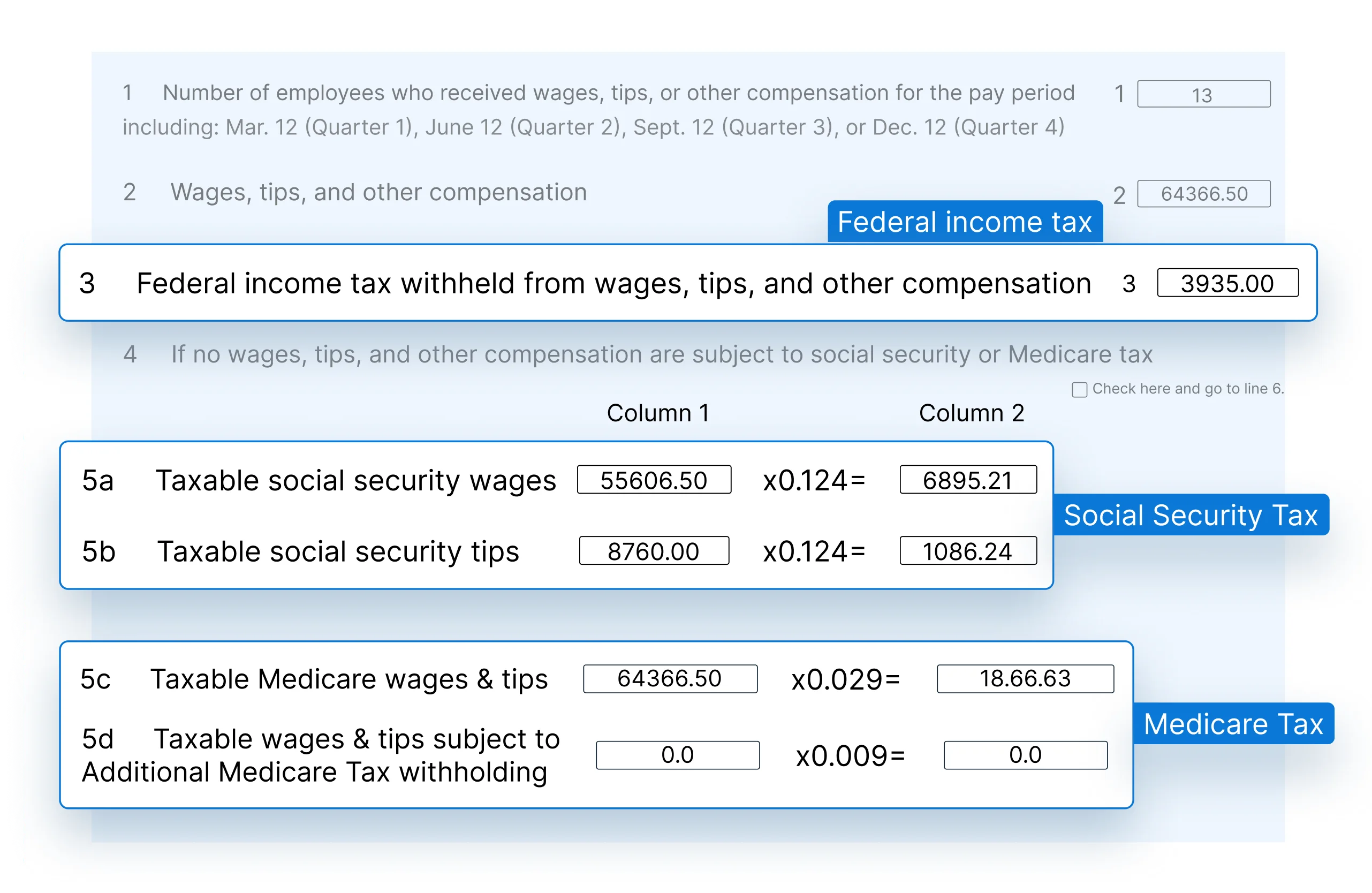
This is the core section where employers report all the foundational tax figures. It includes lines for:
- Total wages, tips, and other compensation.
- Federal income tax withheld.
- Taxable Social Security wages, tips, and the resulting tax (employer and employee share combined).
- Taxable Medicare wages, tips, and the resulting tax (employer and employee share combined).
- Taxable wages and tips subject to Additional Medicare Tax withholding (employee share only).
- Various adjustments and credits, such as qualified sick and family leave wages paid in prior quarters, and employee retention credits. These credits have been particularly relevant in recent years due to legislative responses to economic challenges.
Careful calculation in Part 1 is paramount as errors here ripple through the entire form and can lead to discrepancies with employee W-2s.
Part 2: Determining Your Tax Liability and Deposits
Part 2 focuses on how and when the employer deposited their payroll taxes throughout the quarter. It asks for the “Total tax liability for the quarter,” which should align with the total taxes calculated in Part 1. Crucially, employers must indicate their “Deposit Schedule” here:
- Semiweekly: For employers who reported more than $50,000 in employment taxes during a lookback period, or for those whose accumulated tax liability reaches $100,000 on any day. These employers generally deposit taxes on Wednesdays and Fridays.
- Monthly: For employers who reported $50,000 or less in employment taxes during the lookback period. These employers generally deposit taxes by the 15th of the following month.
Correctly identifying the deposit schedule is vital, as late deposits can incur significant penalties. This section requires employers to break down their tax liability by month or even by day if they are semiweekly depositors, reflecting the daily accumulation of tax.
Part 3: Addressing Special Circumstances
This section addresses specific questions that might apply to an employer’s situation. For instance:
- Are you a seasonal employer? (This tells the IRS if you expect to file future Forms 941 for all quarters.)
- Did you pay qualified sick and family leave wages for leave taken after March 31, 2020, and before April 1, 2021, or after March 31, 2021, and before October 1, 2021? (This relates to FFCRA and ARPA credits).
- Did you pay qualified wages for the employee retention credit?
These questions help the IRS understand specific tax credit claims and unusual filing patterns, often tied to temporary legislative measures.
Part 4 & 5: Contact Information and Signature
Part 4 allows employers to indicate if they want to designate an outside party (e.g., an accountant or payroll specialist) to discuss the return with the IRS. Part 5 requires the employer’s signature, title, and date, certifying that the information provided is accurate and complete under penalties of perjury. This is a critical legal acknowledgment of responsibility.
Critical Aspects of Filing and Compliance
Beyond simply filling out the form, successful Form 941 compliance involves adherence to strict deadlines, understanding deposit rules, and proactive error prevention.
Quarterly Deadlines: Staying on Schedule
Form 941 is due by the last day of the month following the end of each calendar quarter. The specific deadlines are:
- Quarter 1 (January 1 – March 31): Due April 30
- Quarter 2 (April 1 – June 30): Due July 31
- Quarter 3 (July 1 – September 30): Due October 31
- Quarter 4 (October 1 – December 31): Due January 31 of the following year
If a due date falls on a weekend or holiday, the deadline is extended to the next business day. Failure to file on time can result in penalties, underscoring the importance of calendar management for businesses.
Understanding Tax Deposit Schedules (Daily vs. Semi-Weekly)
The deposit schedule for federal payroll taxes (Social Security, Medicare, and withheld income tax) is distinct from the filing deadline for Form 941. Deposits are typically made much more frequently. The IRS determines an employer’s deposit schedule annually based on the total tax liability reported during a “lookback period” (generally the four quarters ending June 30 of the prior year).
- Monthly Depositor: If the total tax liability during the lookback period was $50,000 or less, taxes are due by the 15th of the following month.
- Semiweekly Depositor: If the total tax liability during the lookback period was more than $50,000, or if the accumulated tax liability reaches $100,000 on any day, taxes must be deposited more frequently. Generally, tax liabilities accumulated on Wednesday, Thursday, or Friday must be deposited by the following Wednesday. Liabilities accumulated on Saturday, Sunday, Monday, or Tuesday must be deposited by the following Friday.
The IRS uses the Electronic Federal Tax Payment System (EFTPS) for all federal tax deposits. Failure to deposit taxes on time and in the correct amounts can lead to significant penalties, sometimes even criminal charges in severe cases of willful non-compliance.
Common Errors and How to Avoid Them
Mistakes on Form 941 are not uncommon but can be costly. Common errors include:
- Mathematical errors: Simple addition or subtraction mistakes.
- Incorrectly applying tax rates: Especially for Social Security and Medicare.
- Misclassifying employees: Treating employees as independent contractors when they are not, leading to under-withholding.
- Errors in the lookback period calculation: Incorrectly determining the deposit schedule.
- Failure to report all wages or tips: Forgetting to include certain types of compensation.
- Not reconciling Form 941 with Form W-3/W-2: Discrepancies between quarterly filings and annual wage statements will raise red flags.
Avoiding these errors requires careful review, reconciliation of payroll records, and, often, the use of reliable payroll software or professional assistance.
Penalties for Non-Compliance
The IRS takes employment tax compliance very seriously. Penalties can be assessed for:
- Failure to file: A percentage of the unpaid tax for each month or part of a month the return is late, up to a maximum.
- Failure to pay: A percentage of the unpaid tax for each month or part of a month the tax remains unpaid.
- Failure to deposit: Penalties vary based on how late the deposit is, ranging from 2% to 15% of the underpayment.
- Making an invalid deposit: Depositing with the wrong method or on the wrong date.
These penalties can quickly accumulate, significantly impacting a business’s bottom line. In severe cases of intentional disregard or fraud, responsible individuals can face criminal charges.
Leveraging Technology and Professional Assistance
Given the complexity and critical nature of Form 941, many businesses turn to technology and expert advisors to ensure compliance.
The Role of Payroll Software in Streamlining 941
Modern payroll software solutions (e.g., QuickBooks Payroll, ADP, Gusto, Paychex) are invaluable tools for Form 941 compliance. They can:
- Automate calculations: Accurately calculate federal income tax, Social Security, and Medicare withholdings.
- Generate reports: Provide detailed payroll reports that simplify the data entry for Form 941.
- Facilitate e-filing: Many solutions offer direct electronic filing (e-file) of Form 941 and integration with EFTPS for tax deposits.
- Track liabilities: Keep track of accumulated tax liabilities to help determine deposit schedules.
- Alert to deadlines: Remind employers of upcoming filing and deposit deadlines.
By automating much of the process, payroll software significantly reduces the risk of manual errors and frees up valuable time for business owners.
When to Seek Expert Advice: Accountants and Payroll Services
While software can automate many tasks, complex scenarios or a lack of internal expertise often warrant professional assistance.
- Accountants and CPAs: Can provide expert guidance on tax law, reconcile payroll records, prepare and review Form 941, and advise on specific tax credits or adjustments. They are particularly useful for complex business structures or when making significant changes to payroll.
- Payroll Services: Full-service payroll providers handle all aspects of payroll, including calculating taxes, making deposits, filing Form 941, and generating W-2s. This is often the best option for businesses that want to completely outsource their payroll compliance and focus on core operations.
The cost of professional help is often a worthwhile investment when weighed against the potential penalties and time drain of managing complex payroll taxes internally.
Electronic Filing Advantages (e-File)
The IRS strongly encourages electronic filing for Form 941. E-filing offers several benefits:
- Increased accuracy: Software often performs error checks before submission.
- Faster processing: Returns are processed more quickly, and refunds (if applicable) are issued sooner.
- Proof of filing: E-filing provides immediate confirmation of submission.
- Convenience: Can be done from anywhere with an internet connection.
Most payroll software and tax professionals utilize authorized e-file providers to submit Form 941 on behalf of employers.
Beyond the Basics: Related Forms and Considerations
Understanding Form 941 also involves recognizing its place within a broader ecosystem of employment tax forms and regulations.
Form 941-X: Correcting Errors
If an employer discovers an error on a previously filed Form 941, they must correct it using Form 941-X, Adjusted Employer’s Quarterly Federal Tax Return or Claim for Refund. This form allows businesses to correct overpayments or underpayments of tax. It’s crucial to file Form 941-X as soon as an error is identified to minimize penalties and interest.
Form 944: For Small Employers
As mentioned earlier, some very small employers may be eligible to file Form 944, Employer’s Annual Federal Tax Return, instead of Form 941. This is for employers whose estimated annual employment tax liability (Social Security, Medicare, and withheld federal income tax) is $1,000 or less. The IRS will typically notify eligible employers if they should file Form 944 instead of Form 941. This streamlines reporting for businesses with minimal payroll tax obligations.
State Payroll Taxes: A Broader Perspective
It’s important to remember that Form 941 only covers federal payroll taxes. Businesses also have obligations for state payroll taxes, which can include:
- State Income Tax Withholding: In most states, employers must withhold state income tax from employee wages and remit it to the state.
- State Unemployment Tax Act (SUTA): Employers typically pay SUTA taxes to fund state unemployment benefits.
- State Disability Insurance (SDI): A few states require employers to withhold or contribute to state disability insurance.
Each state has its own forms, deadlines, and rules, adding another layer of complexity to payroll compliance. Businesses must understand both their federal and state obligations to maintain full compliance.
Impact of Legislative Changes (e.g., COVID-19 related credits)
Recent years have highlighted the dynamic nature of payroll tax regulations. Legislative responses to economic crises, such as the COVID-19 pandemic, introduced new tax credits like the Employee Retention Credit (ERC) and credits for qualified sick and family leave wages. These credits were often reported and claimed on Form 941, sometimes requiring amendments via Form 941-X. Staying informed about legislative changes is paramount, as they can significantly impact an employer’s tax liability and filing responsibilities.
In conclusion, “what is 941?” leads to a profound understanding of a fundamental financial responsibility for virtually every employer. Form 941 is more than just a form; it’s a quarterly testament to an employer’s commitment to federal tax compliance, directly impacting the well-being of employees and the national economy. By embracing diligent record-keeping, understanding filing requirements, leveraging appropriate financial tools, and seeking expert advice when needed, businesses can navigate the complexities of Form 941 with confidence and ensure their financial operations remain sound and compliant.
aViewFromTheCave is a participant in the Amazon Services LLC Associates Program, an affiliate advertising program designed to provide a means for sites to earn advertising fees by advertising and linking to Amazon.com. Amazon, the Amazon logo, AmazonSupply, and the AmazonSupply logo are trademarks of Amazon.com, Inc. or its affiliates. As an Amazon Associate we earn affiliate commissions from qualifying purchases.