
Facing a tax bill you can’t immediately pay can be an intimidating experience. The Internal Revenue Service (IRS) is a formidable entity, and the thought of owing money to them can cause significant stress and anxiety. However, it’s crucial to understand that the IRS offers various solutions for taxpayers who find themselves in this predicament. Ignoring tax debt is never an option and will only lead to more severe penalties and interest. Instead, proactively engaging with the IRS to establish a payment plan is a financially responsible and often necessary step towards resolving your tax obligations.

This guide delves into the mechanisms of setting up a payment plan with the IRS, outlining the available options, the application process, and essential considerations to ensure you navigate this challenge effectively. By understanding your choices and taking timely action, you can mitigate penalties, manage your financial burden, and ultimately achieve tax compliance.
Understanding Your Tax Debt and the IRS Landscape
Before exploring payment solutions, it’s vital to grasp the nature of your tax debt and the IRS’s role in collecting it. Tax debt arises when the amount of tax you owe (based on your income, deductions, and credits) exceeds what you’ve paid throughout the year via withholdings or estimated tax payments. This discrepancy can be due to various reasons, from unexpected income and insufficient withholdings to miscalculations or unforeseen financial difficulties that prevent lump-sum payment.
Why Tax Debt Occurs and Its Implications
Tax debt is not uncommon. Life events such as job changes, business fluctuations, medical emergencies, or simply underestimating tax liabilities can leave individuals and businesses with a substantial tax bill they cannot afford. The immediate implication of unpaid taxes is the accrual of penalties and interest. The IRS typically charges a failure-to-pay penalty (0.5% of the unpaid taxes for each month or part of a month that taxes remain unpaid, up to 25% of your unpaid tax) and interest on underpayments, which can compound over time, making your original debt grow significantly.
Furthermore, failing to address tax debt can lead to more aggressive collection actions from the IRS. These could include filing a Notice of Federal Tax Lien (a public notice that you owe the government money, which can affect your credit and ability to sell assets), issuing a levy (seizing property or wages), or even initiating criminal investigations in extreme cases of willful tax evasion. Understanding these potential consequences underscores the critical importance of prompt and proactive engagement with the IRS.
The Importance of Addressing Tax Debt Promptly
Procrastination is your worst enemy when it comes to IRS tax debt. The moment you realize you cannot pay your tax bill in full by the deadline, your focus should immediately shift to exploring payment options. The IRS prefers to work with taxpayers who are making a good-faith effort to resolve their obligations. Taking the initiative to set up a payment plan demonstrates this good faith and can prevent the escalation of penalties and more severe collection actions. Early action also provides you with more flexibility in choosing a suitable payment plan, as some options are time-sensitive or have specific eligibility criteria that might be harder to meet once a debt has aged considerably.
Exploring IRS Payment Plan Options
The IRS offers several avenues for taxpayers to resolve their outstanding tax liabilities, each designed for different financial situations. Understanding these options is the first step in determining the best path forward for your specific circumstances.
Installment Agreement (Short-Term vs. Long-Term)
An Installment Agreement is the most common and straightforward payment plan. It allows taxpayers to make monthly payments for a period, typically up to 72 months (6 years), until the tax debt is fully paid.
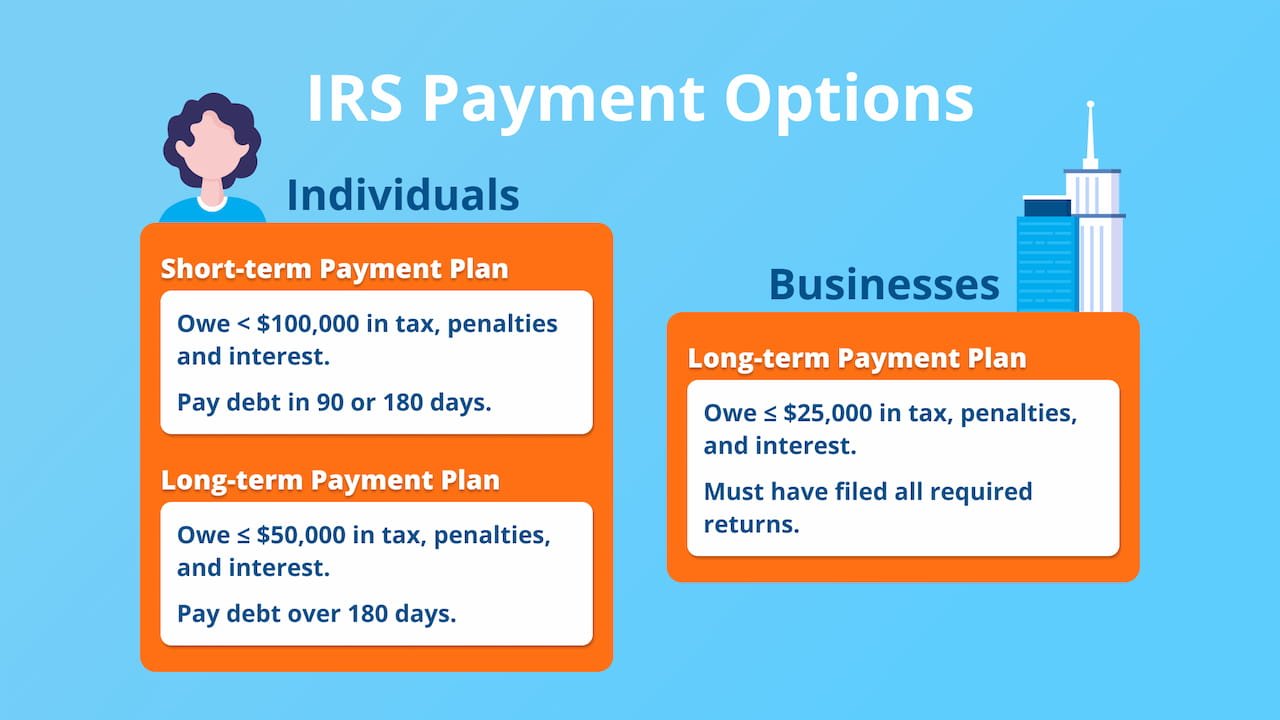
- Short-Term Payment Plan: If you can pay off your tax liability within 180 days (approximately six months), you may qualify for a short-term payment plan. While the IRS may grant you up to 180 additional days to pay your tax liability in full, interest and penalties continue to accrue until the balance is paid. There is no fee to set up a short-term payment plan.
- Long-Term Payment Plan (Installment Agreement): If you need more than 180 days, you can request a long-term payment plan, also known as a monthly installment agreement. This option allows you to make monthly payments for up to 72 months. While interest and penalties still apply, setting up this agreement prevents the IRS from taking further collection actions such as liens or levies, provided you adhere to the agreement’s terms. There is a fee to set up a long-term installment agreement, which can be reduced or waived for low-income taxpayers.
Offer in Compromise (OIC)
An Offer in Compromise (OIC) allows certain taxpayers to resolve their tax liability with the IRS for a lower amount than what they originally owe. An OIC is typically an option when taxpayers are experiencing significant financial difficulty and cannot pay their full tax liability. The IRS generally accepts an OIC when there’s doubt about the collectibility (whether the taxpayer can pay the amount owed), doubt as to liability (whether the assessed tax is correct), or effective tax administration (exceptional circumstances where collecting the full amount would cause economic hardship).
Applying for an OIC is a complex process requiring extensive financial documentation and detailed justification. The IRS assesses your ability to pay, your income, expenses, and asset equity to determine if accepting a reduced amount is in the government’s best interest.
Currently Not Collectible (CNC) Status
If you are experiencing severe financial hardship and cannot afford to pay your tax debt or make payments under an installment agreement, the IRS may determine that your account is Currently Not Collectible (CNC). This status means the IRS agrees you currently cannot pay, and it temporarily suspends collection activities.
While in CNC status, the IRS will not actively pursue collection, but interest and penalties continue to accrue. The IRS will periodically review your financial situation, typically annually, to see if your circumstances have improved. If they have, your CNC status may be revoked, and you’ll be expected to begin making payments or enter into another payment arrangement. This option is generally reserved for those facing significant financial distress where collection would genuinely jeopardize their ability to meet basic living expenses.
Other Resolution Options (e.g., Penalty Abatement)
Beyond formal payment plans, other resolution options exist. For instance, taxpayers may be eligible for penalty abatement if they can demonstrate that their failure to file or pay on time was due to reasonable cause and not willful neglect. First-time penalty abatement is also available to taxpayers who have a clean compliance history for the preceding three tax years. While not a payment plan, penalty abatement can significantly reduce the overall amount owed, making the remaining balance more manageable. It’s always advisable to explore if you qualify for penalty relief in conjunction with setting up a payment plan.
The Step-by-Step Process to Apply for a Payment Plan
Applying for an IRS payment plan requires careful preparation and adherence to specific procedures. The process varies slightly depending on the type of plan you seek.
Gather Necessary Information
Regardless of the plan, you’ll need to provide the IRS with accurate and complete financial information. This typically includes:
- Your Social Security number or Individual Taxpayer Identification Number (ITIN).
- Your current address and phone number.
- The tax year(s) and amount(s) of the tax you owe.
- For installment agreements: your proposed monthly payment amount and the date you can make your payment each month.
- For OIC or CNC status: extensive documentation of your income, expenses, assets, and liabilities, including bank statements, pay stubs, loan documents, and asset valuations.
Ensuring you have all required information readily available will streamline the application process and prevent delays.
Choosing the Right Application Method (Online, Mail, Phone)
The IRS offers multiple ways to apply for payment plans:
- Online Payment Agreement (OPA): For many taxpayers, the easiest and fastest way to set up an installment agreement is through the IRS Online Payment Agreement application. You can use this tool if you owe a combined total of under $50,000 in tax, penalties, and interest for individuals, or under $25,000 for businesses, and you’ve filed all required tax returns. The system will tell you immediately if your request is approved.
- By Mail: You can apply for an installment agreement by filling out Form 9465, Installment Agreement Request, and mailing it with your tax return or separately to the IRS. For an OIC, you’ll need to submit Form 656, Offer in Compromise, along with Form 433-A (OIC) or 433-B (OIC), Collection Information Statement for Wage Earners and Self-Employed Individuals or Businesses, respectively, and supporting documentation.
- By Phone: You can also call the IRS directly at the number listed on your tax notice or 1-800-829-1040 (for individuals) to discuss payment options and potentially set up an agreement over the phone. Be prepared for potentially long wait times and have all your information ready.
Completing Form 9465 (for Installment Agreements)
For a long-term installment agreement, if you cannot use the OPA, you will need to fill out Form 9465. This is a relatively simple two-page form where you provide your personal details, the amount you owe, your proposed monthly payment, and your preferred payment due date. If you’re a low-income taxpayer, you can also request a reduced user fee on this form. Attach the completed form to the front of your tax return (if filing) or mail it separately to the IRS address for your area.
Navigating the OIC Application Process (Form 656)
The OIC process is considerably more involved. It starts with Form 656, Offer in Compromise, and requires a detailed financial disclosure through Form 433-A (for individuals) or 433-B (for businesses). You’ll need to list all your assets, liabilities, income, and expenses with supporting documentation. The IRS will use this information to calculate your “reasonable collection potential” (RCP) – the amount they believe you can pay.
A non-refundable application fee (unless you meet low-income guidelines) and an initial payment (if choosing a lump sum or periodic payment option) are generally required when submitting an OIC. The IRS will review your application, which can take several months, and may request additional information or conduct interviews. It’s often advisable to seek professional help from a tax attorney or enrolled agent when pursuing an OIC due to its complexity.
Key Considerations and Potential Pitfalls
While setting up a payment plan is a responsible way to manage tax debt, it’s crucial to be aware of certain aspects and potential challenges.
Interest and Penalties
Even with an approved payment plan, interest and penalties generally continue to accrue on the unpaid balance until it’s fully satisfied. While an installment agreement prevents further failure-to-pay penalties, the initial penalties and all interest charges will still apply. The only exception might be if you qualify for penalty abatement due to reasonable cause. It’s important to factor this ongoing cost into your financial planning.
Impact on Your Credit Score
Generally, the IRS does not report tax debt directly to credit bureaus unless a Notice of Federal Tax Lien is filed. A federal tax lien can significantly damage your credit score, making it difficult to obtain loans, mortgages, or even rent property. Establishing an installment agreement often prevents the IRS from filing a lien. If a lien has already been filed, entering an agreement and making consistent payments may lead to its withdrawal or release once the debt is satisfied.
What Happens if You Default
Defaulting on an IRS payment plan can have serious repercussions. If you miss payments, fail to file future tax returns, or don’t pay future tax liabilities on time, the IRS can terminate your agreement. Once an agreement is terminated, the full amount of tax, penalties, and interest becomes immediately due. The IRS can then resume or initiate more aggressive collection actions, including liens and levies, and you may find it harder to negotiate new payment terms.
Seeking Professional Assistance
For complex tax situations, large tax debts, or when considering an Offer in Compromise or Currently Not Collectible status, seeking assistance from a qualified tax professional is highly recommended. Enrolled agents, CPAs, or tax attorneys specialize in IRS tax resolution and can:
- Help you understand your options and eligibility.
- Prepare and submit accurate documentation.
- Negotiate with the IRS on your behalf.
- Advise you on strategies to minimize penalties and interest.
Their expertise can be invaluable in navigating the complexities of IRS procedures and securing the most favorable outcome.
Maintaining Your Payment Plan and Future Compliance
Securing an IRS payment plan is a significant achievement, but it’s only half the battle. Maintaining the agreement and ensuring future tax compliance are equally crucial for long-term financial health.
Adhering to Payment Schedules
The most critical aspect of any IRS payment plan is consistent adherence to the agreed-upon payment schedule. Set up automatic payments if possible to avoid missing due dates. If you anticipate a problem making a payment, contact the IRS immediately to discuss your situation. They may be willing to temporarily adjust your payments or offer a brief deferral, but communication is key. Ignoring a missed payment will almost certainly lead to default.
Future Tax Filing Requirements
A fundamental condition of most IRS payment plans is that you remain compliant with all future tax obligations. This means:
- Filing all required tax returns on time.
- Paying any new tax liabilities in full by the due date.
If you incur new tax debt or fail to file subsequent returns while on a payment plan, the IRS can terminate your existing agreement. It is essential to adjust your withholdings or estimated tax payments to prevent future tax liabilities and ensure you can meet current and future tax obligations.
Reviewing Your Agreement
Periodically review your payment plan, especially if your financial situation changes. If you experience an increase in income, you might be able to pay off your debt faster, saving on interest. Conversely, if you face new financial hardship, you might be able to renegotiate the terms of your agreement for lower payments, although this will extend the time and increase the total interest paid. Staying proactive and communicative with the IRS can help ensure your payment plan remains sustainable.
Conclusion
Owing money to the IRS can be a daunting prospect, but it is not an insurmountable challenge. By understanding the various payment plan options – from straightforward installment agreements to complex Offers in Compromise – and diligently following the application process, taxpayers can effectively manage their tax debt. Prompt action, meticulous record-keeping, and consistent adherence to the agreement are paramount. Remember, the IRS is generally willing to work with taxpayers who are making an honest effort to meet their obligations. By taking a professional, proactive, and informed approach, you can successfully navigate your tax debt, avoid severe penalties, and pave the way for a more stable financial future.
aViewFromTheCave is a participant in the Amazon Services LLC Associates Program, an affiliate advertising program designed to provide a means for sites to earn advertising fees by advertising and linking to Amazon.com. Amazon, the Amazon logo, AmazonSupply, and the AmazonSupply logo are trademarks of Amazon.com, Inc. or its affiliates. As an Amazon Associate we earn affiliate commissions from qualifying purchases.