
For many individuals and businesses operating outside the traditional employer-employee relationship, the concept of quarterly estimated tax payments is a cornerstone of responsible financial management. Unlike those whose taxes are conveniently withheld from each paycheck, self-employed individuals, freelancers, gig workers, and even those with significant investment income, pensions, or rental income often find themselves directly responsible for remitting their income tax liability to the government throughout the year. Navigating this system effectively isn’t just about compliance; it’s about strategic financial planning, avoiding penalties, and maintaining peace of mind. This comprehensive guide will demystify the process, providing actionable insights into understanding, calculating, paying, and managing your estimated tax obligations.

Understanding Estimated Taxes: Who, Why, and What They Are
The U.S. tax system operates on a “pay-as-you-go” principle. This means that taxpayers are expected to pay taxes on their income as they earn it, rather than waiting until the annual tax filing deadline. For most wage earners, this is handled automatically through payroll withholding. However, for those with income not subject to withholding, estimated taxes bridge this gap, ensuring a steady stream of revenue for the government and preventing a massive, potentially unmanageable tax bill at the end of the year.
The Rationale Behind Estimated Payments
The primary purpose of estimated tax payments is to ensure that the Internal Revenue Service (IRS) receives a consistent flow of tax revenue throughout the year. This system benefits both the government and the taxpayer. For the government, it provides predictable funding. For taxpayers, it prevents the shock of a large tax bill due on April 15th, which can be particularly burdensome for those with fluctuating or high incomes. Instead, the tax burden is spread out, making it more manageable. Failing to pay enough tax through withholding or estimated payments can lead to underpayment penalties, making proactive management crucial.
Identifying Who Needs to Pay
While the specifics can vary, generally, you must pay estimated tax if you expect to owe at least $1,000 in tax for the year, and your withholding and credits are expected to be less than the smaller of:
- 90% of the tax to be shown on your current year’s return, or
- 100% of the tax shown on your prior year’s return (110% if your Adjusted Gross Income (AGI) in the prior year was over $150,000 for single filers or married filing jointly, or $75,000 for married filing separately). This is known as the “safe harbor” rule.
Common scenarios that trigger the need for estimated payments include:
- Self-Employment Income: Freelancers, independent contractors, small business owners, and gig economy workers are prime candidates.
- Investment Income: Significant dividends, interest, capital gains, and other investment earnings.
- Rental Income: Profits from rental properties.
- Pensions and Annuities: If taxes aren’t adequately withheld.
- Alimony: For agreements made before 2019.
- Gambling Winnings: Substantial winnings that aren’t subject to adequate withholding.
Even if you are employed, if you have significant income from other sources, you might need to make estimated payments. Alternatively, you could adjust your W-4 form with your employer to increase your withholding and cover the additional tax liability.
The Consequences of Underpayment
Ignoring or underpaying your estimated taxes can lead to penalties. The IRS assesses an underpayment penalty if you don’t pay enough tax throughout the year, either through withholding or estimated tax payments, or if you don’t pay on time. The penalty is calculated based on the amount of underpayment and the length of time it remained unpaid. While there are exceptions for certain situations (like casualty events or retirement for specific individuals), relying on these is not a sound financial strategy. The goal should always be to meet or exceed the safe harbor requirements to entirely avoid these avoidable financial setbacks.
Calculating Your Estimated Tax Liability
Accurately estimating your tax liability is the most critical step in managing quarterly payments. It requires foresight and a good understanding of your expected income, deductions, and credits for the year. This isn’t a one-time calculation; it’s an ongoing process that may need adjustments as your financial situation evolves.
Navigating Form 1040-ES
The primary tool for calculating estimated taxes is Form 1040-ES, Estimated Tax for Individuals. This form includes a worksheet that guides you through estimating your adjusted gross income, deductions, credits, and ultimately, your total tax liability for the year. The worksheet then helps you divide this total into four equal quarterly payments.
To complete Form 1040-ES, you’ll need to project your income for the current year. This includes all sources: self-employment, wages (if any), investments, rentals, etc. You’ll also need to estimate your deductions (standard or itemized) and any tax credits you expect to claim. Many taxpayers find it helpful to refer to their previous year’s tax return as a baseline, adjusting for any anticipated changes in income or expenses. For instance, if you expect higher self-employment income this year, you’ll factor that increase into your projection. Remember to account for self-employment taxes (Social Security and Medicare), which are a significant component for independent contractors.
Utilizing Safe Harbor Rules
The safe harbor rules are your best friend when it comes to avoiding underpayment penalties. As mentioned, if you pay at least 90% of your current year’s tax liability or 100% (or 110% for high-income earners) of your prior year’s tax liability through withholding and estimated payments, you generally won’t face a penalty.
For many, using the prior year’s tax as a guide is the simplest and most reliable safe harbor strategy, especially if your income is relatively stable. If you know your income will be significantly higher in the current year, aiming for 90% of your estimated current year’s tax is the more prudent approach to avoid a potentially large balance due come tax time, even if you avoid a penalty. Conversely, if your income is expected to be lower, calculating based on the current year’s lower projected income might mean you pay less in estimated taxes. Understanding and applying these rules correctly can save you from unexpected penalties and optimize your cash flow.
Accounting for Income Fluctuations
One of the biggest challenges for self-employed individuals is fluctuating income. What if your income streams are irregular, or you experience a sudden boom or bust? The IRS offers an annualized income method, which can be particularly useful. Instead of dividing your estimated annual income evenly across four quarters, this method allows you to base each quarterly payment on the income you actually earned during that specific period. For example, if you have a slow first quarter but expect a very busy third quarter, you would pay less in your first estimated payment and more in your third.
To use the annualized income method, you’ll need to use Form 2210, Underpayment of Estimated Tax by Individuals, Estates, and Trusts, Part III, Statement of Estimated Tax Underpayment. This method can prevent overpaying early in the year if income is low or underpaying later if income significantly increases. It requires diligent record-keeping and more frequent recalculations, but it offers a more precise way to match your tax payments to your actual earnings rhythm.
The Quarterly Payment Schedule and Methods
Once you’ve calculated your estimated tax liability, the next crucial step is to adhere to the payment schedule and utilize the various payment methods available. Timeliness is as important as accuracy in the world of estimated taxes.
Key Due Dates to Remember
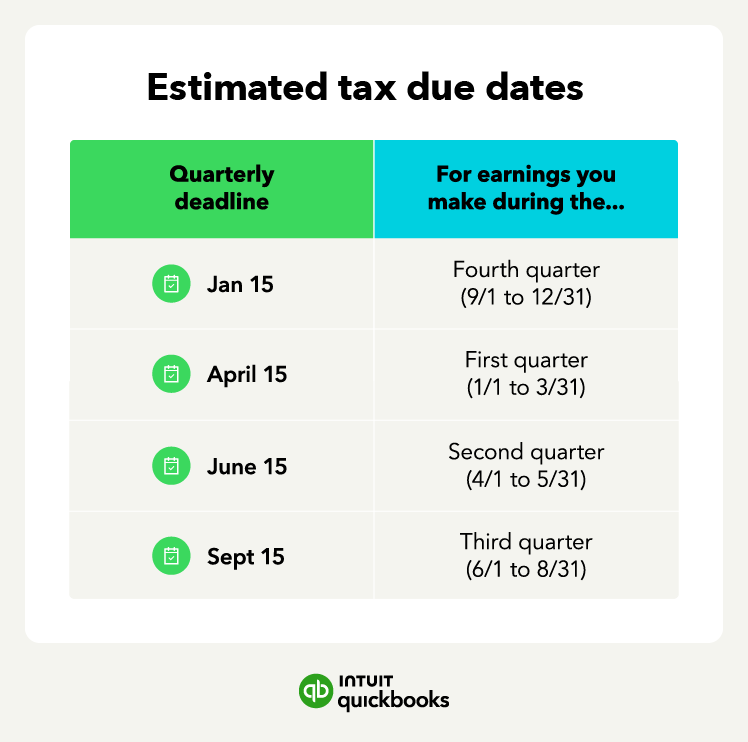
The tax year is divided into four payment periods, each with a specific deadline. It’s vital to mark these dates on your calendar, as missing a deadline can result in penalties, even if you eventually pay the full amount.
- First Quarter (Jan 1 to March 31): Due April 15
- Second Quarter (April 1 to May 31): Due June 15
- Third Quarter (June 1 to Aug 31): Due September 15
- Fourth Quarter (Sept 1 to Dec 31): Due January 15 of the next year
If any of these dates fall on a weekend or holiday, the deadline is typically pushed to the next business day. For those living in areas affected by natural disasters, the IRS often grants extensions to these deadlines, so it’s always wise to check for specific relief announcements.
Multiple Avenues for Payment
The IRS provides several convenient ways to make your estimated tax payments:
- IRS Direct Pay: This free service allows you to pay directly from your checking or savings account. It’s secure, fast, and you receive immediate confirmation. This is often the preferred method for many individuals.
- Electronic Federal Tax Payment System (EFTPS): This is a government service for making all types of federal tax payments. It requires enrollment and is particularly useful for business owners who make frequent federal tax deposits. It offers flexibility in scheduling payments in advance.
- Debit Card, Credit Card, or Digital Wallet: You can pay through authorized third-party payment processors. While convenient, these services typically charge a processing fee.
- Mail: You can print Form 1040-ES payment vouchers and mail a check or money order to the IRS. While still an option, electronic payment methods are generally faster and more secure.
- Through Tax Software: Many tax preparation software programs allow you to submit estimated payments directly through their platform, often integrating with IRS Direct Pay or EFTPS.
Choosing the right payment method often comes down to convenience, cost, and personal preference. Electronic methods are generally recommended for their speed, security, and proof of payment.
State Estimated Taxes: A Separate Consideration
It’s crucial to remember that estimated tax obligations aren’t limited to the federal government. Most states with an income tax also require estimated payments from individuals with income not subject to withholding. The rules, thresholds, and payment schedules can vary significantly from state to state. For instance, some states might have higher or lower underpayment thresholds, or slightly different quarterly due dates.
As part of your overall financial planning, you must research and understand your state’s specific requirements. Many states offer similar electronic payment options as the IRS. Neglecting state estimated taxes can lead to state-level penalties, so incorporating them into your annual tax strategy is non-negotiable for holistic financial compliance.
Strategies for Effective Management and Avoiding Pitfalls
Managing quarterly estimated tax payments successfully extends beyond just calculating and paying. It involves proactive planning, meticulous record-keeping, and knowing when to seek professional guidance.
The Importance of Meticulous Record-Keeping
Effective management of estimated taxes hinges on excellent record-keeping. You need to track all your income sources, business expenses, deductions, and credits throughout the year. This includes:
- Income Records: Invoices, payment receipts, bank statements, and any 1099 forms received.
- Expense Records: Receipts for business expenses, mileage logs, home office expenses, and other deductible costs.
- Payment Records: Confirmation numbers for electronic payments, canceled checks, and any other proof of your estimated tax payments (federal and state).
Good records not only make tax preparation easier at year-end but also enable you to accurately project your income and expenses for future estimated tax payments. They are also invaluable if you ever face an audit. Consider using accounting software or a dedicated spreadsheet to keep everything organized and easily accessible.
Leveraging Technology and Professional Guidance
In today’s digital age, numerous tools can simplify the estimated tax process. Accounting software like QuickBooks, FreshBooks, or Xero can track income and expenses in real-time, making it easier to project profits and calculate tax liability. Tax preparation software such as TurboTax, H&R Block, or TaxAct often includes features to help calculate and even submit estimated payments. These tools can automate calculations and provide reminders for upcoming due dates.
However, for complex financial situations, significant income fluctuations, or simply peace of mind, consulting with a qualified tax professional (such as a CPA or Enrolled Agent) is highly recommended. A professional can help you:
- Accurately project income and expenses.
- Optimize deductions and credits.
- Ensure compliance with both federal and state tax laws.
- Advise on safe harbor strategies.
- Represent you if there are any issues with your payments or filings.
Their expertise can not only save you from potential penalties but also identify opportunities for tax savings that you might miss.

Adjusting to Life’s Changes
Life is unpredictable, and so can be your income and financial situation. A new client, a significant investment gain, a large unexpected expense, or even a change in marital status can all impact your tax liability. It’s important to view estimated tax payments not as a rigid annual task but as a flexible process that can be adjusted.
If your income significantly increases or decreases during the year, or if you have a major life event that affects your deductions or credits, you should recalculate your estimated tax. You can adjust your remaining quarterly payments to reflect these changes. For example, if you had a windfall in the third quarter, you would make a larger payment for the third or fourth quarter (or both) to cover the additional tax due. Conversely, if your income drops, you can reduce subsequent payments to avoid overpaying. The IRS generally allows you to adjust your payments as needed, ensuring that you’re paying enough but not excessively. This adaptive approach is key to effective financial management and avoiding both underpayment penalties and unnecessary cash flow strains.
Mastering quarterly estimated tax payments is an essential skill for anyone earning income outside of traditional employment. By understanding the rules, diligently calculating your liability, adhering to payment schedules, and leveraging available tools and professional advice, you can manage your tax obligations with confidence and avoid unwelcome surprises, allowing you to focus on your financial goals.
aViewFromTheCave is a participant in the Amazon Services LLC Associates Program, an affiliate advertising program designed to provide a means for sites to earn advertising fees by advertising and linking to Amazon.com. Amazon, the Amazon logo, AmazonSupply, and the AmazonSupply logo are trademarks of Amazon.com, Inc. or its affiliates. As an Amazon Associate we earn affiliate commissions from qualifying purchases.