
The annual ritual of filing taxes can often feel like navigating a dense, labyrinthine forest, especially when confronted with a seemingly endless array of forms. For many, the most daunting question isn’t how to file, but rather what forms are actually necessary. The answer, unfortunately, isn’t a simple one-size-fits-all, as it hinges entirely on your unique financial situation, income sources, deductions, and credits. Understanding which forms apply to you is the crucial first step toward accurate and compliant tax filing, preventing headaches, penalties, and missed opportunities for savings.
This comprehensive guide aims to demystify the complex world of tax forms, equipping you with the knowledge to confidently identify the documents you need. We’ll explore the foundational forms that almost everyone encounters, delve into specific scenarios for investors, business owners, and those seeking deductions, and ultimately provide a roadmap for determining your personal tax form portfolio. By the end, you’ll have a clearer picture of your obligations and the tools to approach tax season with greater confidence and strategic insight.
Navigating the Tax Labyrinth: Understanding Your Core Forms
At the heart of the U.S. tax system lies a core set of forms that serve as the backbone for individual income tax returns. Familiarizing yourself with these fundamental documents is essential, as they are the starting point for most taxpayers.
The Cornerstone: Form 1040 and Its Essential Schedules
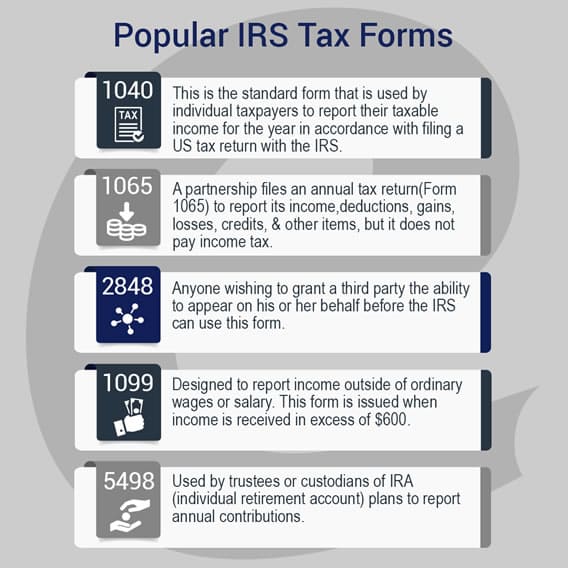
For the vast majority of individual taxpayers, Form 1040, U.S. Individual Income Tax Return, is the primary document filed with the Internal Revenue Service (IRS). This form is where you report your income, calculate your deductions and credits, and ultimately determine your tax liability or refund. Over the years, Form 1040 has undergone several redesigns, simplifying its appearance while still requiring detailed information.
However, Form 1040 rarely stands alone. It is often accompanied by various “schedules,” which are additional forms used to report specific types of income, deductions, or calculations that don’t fit directly onto the main 1040. Some of the most common schedules include:
- Schedule A (Form 1040), Itemized Deductions: If you choose to itemize your deductions instead of taking the standard deduction, Schedule A is where you list expenses such as medical and dental expenses, state and local taxes (SALT cap applies), home mortgage interest, and charitable contributions. This schedule is crucial for those whose itemized deductions exceed the standard deduction amount for their filing status.
- Schedule B (Form 1040), Interest and Ordinary Dividends: This schedule is used to report taxable interest income exceeding a certain threshold (typically $1,500) and ordinary dividends. If you have income from savings accounts, CDs, bonds, or stock dividends, Schedule B helps detail these earnings.
- Schedule C (Form 1040), Profit or Loss From Business (Sole Proprietorship): For individuals operating a business as a sole proprietor or independent contractor, Schedule C is vital. It’s where you report your business income and expenses, allowing you to calculate your net profit or loss from your self-employment activities. This schedule is often a significant component for freelancers, consultants, and small business owners.
- Schedule D (Form 1040), Capital Gains and Losses: If you sold stocks, bonds, real estate, or other capital assets, Schedule D is used to report and calculate your capital gains and losses. This schedule is critical for investors, determining whether your gains are short-term or long-term, which impacts their tax rate.
- Schedule E (Form 1040), Supplemental Income and Loss: This schedule is used for reporting income or loss from rental real estate, royalties, partnerships, S corporations, estates, and trusts. It’s particularly important for landlords and those with diversified investment portfolios beyond publicly traded stocks and bonds.
- Schedule SE (Form 1040), Self-Employment Tax: If you have net earnings from self-employment, Schedule SE is used to calculate the amount of self-employment tax you owe. This tax covers Social Security and Medicare contributions for self-employed individuals.
Understanding Your Income Documentation: W-2s and 1099s
Before you can even begin filling out Form 1040 and its associated schedules, you need to gather documentation of your income. The IRS relies on third-party reporting, meaning that those who pay you typically send a copy of your income details to both you and the IRS.
- Form W-2, Wage and Tax Statement: This is arguably the most common income document. Your employer sends you a W-2 by January 31st each year, detailing your wages, tips, and other compensation, along with the federal, state, and local taxes withheld from your pay. If you worked for multiple employers in a year, you will receive a W-2 from each of them.
- The 1099 Series: The 1099 forms report various types of non-wage income. There are numerous variations, each designed for a specific income source:
- Form 1099-NEC, Nonemployee Compensation: Replaced Form 1099-MISC for reporting non-employee compensation (e.g., payments to independent contractors for services). If you perform freelance work or are paid by a client as a contractor, you’ll likely receive this form.
- Form 1099-MISC, Miscellaneous Information: Still used for reporting miscellaneous income such as rents, royalties, prizes, awards, and other income not covered by other 1099 forms.
- Form 1099-INT, Interest Income: Received from banks and other financial institutions if you earned more than $10 in interest during the year.
- Form 1099-DIV, Dividends and Distributions: Received from corporations and mutual funds if you received more than $10 in dividends or other distributions.
- Form 1099-B, Proceeds From Broker and Barter Exchange Transactions: Sent by brokerage firms to report sales of stocks, bonds, and other securities. This form is crucial for completing Schedule D.
- Form 1099-R, Distributions From Pensions, Annuities, Retirement or Profit-Sharing Plans, IRAs, Insurance Contracts, etc.: Reports distributions from retirement accounts, pensions, and annuities.
- Form 1099-K, Payment Card and Third Party Network Transactions: Reports payments received through third-party payment networks (like PayPal, Venmo, Stripe) or credit card transactions, often relevant for small businesses and those with significant online sales.
- Form 1099-G, Certain Government Payments: Reports unemployment compensation, state and local tax refunds, and agricultural payments.
- Form 1099-SA, Distributions From an HSA, Archer MSA, or Medicare Advantage MSA: Reports distributions from health savings accounts (HSAs) and other medical savings accounts.
- Form 1099-C, Cancellation of Debt: Reports if a financial institution canceled $600 or more of your debt.
Keeping all these income documents organized and readily accessible is the first critical step in ensuring you have all the necessary information to accurately complete your tax return.
Beyond the Basics: Forms for Specific Financial Scenarios
While Form 1040 and its common schedules cover a wide range of taxpayers, various life events, investment strategies, and business structures necessitate additional specific forms. Understanding these can unlock potential savings or fulfill unique reporting obligations.
Entrepreneurial Endeavors: Forms for Self-Employment and Small Businesses
The landscape for business owners and self-employed individuals is rich with specific tax forms designed to capture the nuances of their operations. Beyond Schedule C and Schedule SE (as mentioned above), here are other key forms:
- Form 1120, U.S. Corporation Income Tax Return: Filed by C corporations to report their income, gains, losses, deductions, credits, and to figure their income tax liability.
- Form 1120-S, U.S. Income Tax Return for an S Corporation: Filed by S corporations to report income, gains, losses, deductions, credits, and to report their shareholders’ share of these items. S corporations are pass-through entities, meaning the profits and losses are passed through directly to the owners’ personal income without being subject to corporate tax rates.
- Form 1065, U.S. Return of Partnership Income: Filed by partnerships (including most multi-member LLCs) to report their income, gains, losses, deductions, and credits. Like S corporations, partnerships are pass-through entities, and the income and expenses are passed through to the partners’ individual returns via Schedule K-1.
- Schedule K-1 (Form 1065, 1120-S, or 1041): This form is not something you file yourself, but rather receive if you are a partner in a partnership, a shareholder in an S corporation, or a beneficiary of an estate or trust. It details your share of the entity’s income, losses, deductions, and credits, which you then report on your personal Form 1040.
- Form W-9, Request for Taxpayer Identification Number and Certification: This form is not filed with the IRS. Instead, you fill it out and give it to a business or person who will pay you. It’s used by the payer to get your correct Taxpayer Identification Number (TIN) (usually your Social Security Number or Employer Identification Number) so they can report payments to the IRS, typically on a 1099 form.
Investment Income and Gains: The Forms That Matter
Investors often face a specific set of forms to accurately report their diverse income streams and capital transactions. While Schedule D is the primary form for capital gains and losses, other forms play supporting roles:
- Form 8949, Sales and Other Dispositions of Capital Assets: This form is used to list the details of each individual capital asset sale (stocks, bonds, etc.). The totals from Form 8949 are then transferred to Schedule D. It helps categorize gains and losses as short-term or long-term and apply adjustments.
- Form 6781, Gains and Losses From Section 1256 Contracts and Straddles: For those involved in more complex derivatives trading, this form reports gains and losses from regulated futures contracts, foreign currency contracts, and other Section 1256 contracts.
- Form 4797, Sales of Business Property: Used to report sales and exchanges of property used in a trade or business, and involuntary conversions (such as from fire, theft, or condemnation) of business or investment property. This can include real estate and equipment.
Deductions and Credits: Maximizing Your Tax Benefits
Beyond income, many forms exist to help you claim deductions and credits that can significantly reduce your tax liability or even result in a refund. These forms require you to provide specific information to substantiate your claims.
- Form 8863, Education Credits (American Opportunity and Lifetime Learning Credits): Used to calculate and claim education credits for qualified tuition and related expenses paid for eligible students.
- Form 2441, Child and Dependent Care Expenses: If you paid for child care or care for a dependent so you could work or look for work, this form helps you calculate the Child and Dependent Care Credit.
- Form 8962, Premium Tax Credit (PTC): If you purchased health insurance through a Health Insurance Marketplace and received advance payments of the premium tax credit, or you want to claim the credit, you’ll use this form to reconcile the advance payments.
- Form 5695, Residential Energy Credits: Used to claim credits for making energy-efficient improvements to your home, such as installing solar panels, energy-efficient windows, or certain types of insulation.
- Form 8812, Credits for Qualifying Children and Other Dependents: Used to figure the refundable portion of the Child Tax Credit and the Credit for Other Dependents.
- Form 8995, Qualified Business Income (QBI) Deduction Simplified Computation: Used to figure the Qualified Business Income (QBI) deduction, which allows eligible self-employed individuals and small business owners to deduct up to 20% of their qualified business income.

This is by no means an exhaustive list, but it highlights some of the more common forms taxpayers might encounter. The key is to be aware of your financial activities throughout the year and how they might translate into specific tax forms.
Determining Your Unique Tax Form Portfolio
Given the sheer volume of forms, how do you pinpoint exactly which ones apply to you? The process involves a systematic review of your financial life and a strategic approach to information gathering.
Identifying Your Income Streams and Financial Activities
The most direct way to determine your necessary forms is to meticulously review all sources of income and major financial transactions from the past year.
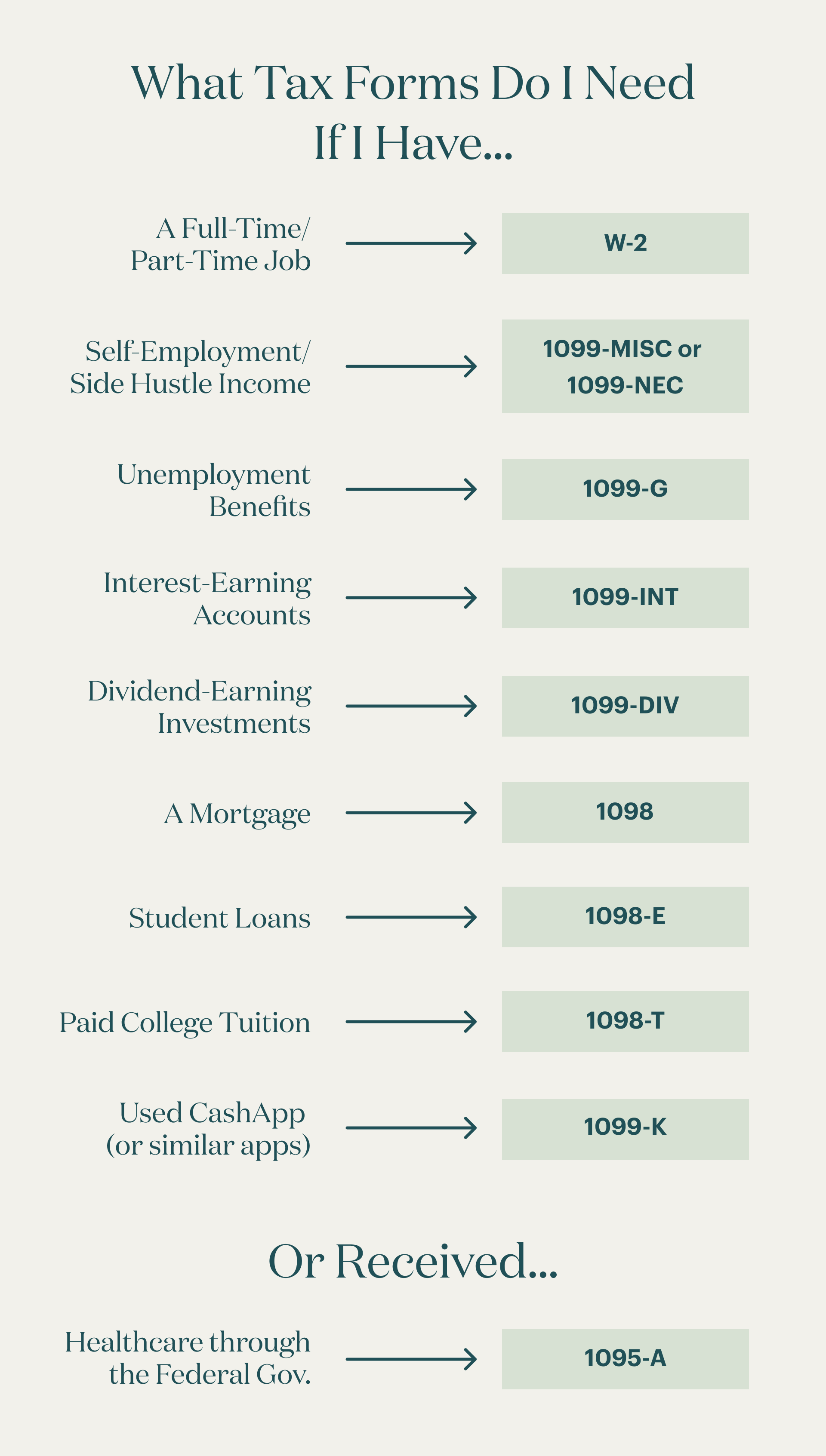
- Employment: Did you work for an employer? You’ll need your W-2(s).
- Self-Employment/Freelance: Did you earn money as an independent contractor or run a small business? Expect 1099-NECs, and you’ll likely need Schedule C and Schedule SE.
- Investments:
- Interest/Dividends: Did you earn interest from bank accounts or dividends from stocks/mutual funds? Look for 1099-INTs and 1099-DIVs, potentially requiring Schedule B.
- Stock Sales: Did you sell stocks, bonds, or other securities? You’ll get 1099-B, necessitating Form 8949 and Schedule D.
- Real Estate/Rental Income: Do you own rental properties or receive royalties? Schedule E will be necessary.
- Retirement/Pensions: Did you receive distributions from an IRA, 401(k), or pension? Expect 1099-R.
- Other Income: Did you receive unemployment benefits (1099-G), gambling winnings (W2-G), or other miscellaneous income (1099-MISC)?
- Major Life Events:
- Education: Did you pay for higher education? Look for Form 1098-T (Tuition Statement) to claim education credits (Form 8863).
- Homeownership: Did you pay mortgage interest? You’ll receive Form 1098 (Mortgage Interest Statement), relevant for Schedule A if itemizing.
- Healthcare: Did you have a Health Savings Account (HSA) (1099-SA, Form 8889)? Did you buy health insurance through the marketplace (Form 1095-A, Form 8962)?
- Dependents/Childcare: Did you pay for childcare? This can lead to the Child and Dependent Care Expenses (Form 2441).
- Charitable Contributions: If you made significant donations, these are typically claimed on Schedule A.
Create a checklist based on these questions. As you receive your income statements (W-2s, 1099s), check them against your list. Most of these forms are usually mailed by late January or early February.
Leveraging Technology and Professional Guidance
While manually sifting through potential forms might seem daunting, modern tools and professional advice can simplify the process significantly.
- Tax Software: Programs like TurboTax, H&R Block Tax Software, and TaxAct are designed to guide you step-by-step. By answering a series of questions about your income, deductions, and credits, the software automatically identifies and populates the correct forms for you. This is often the most accessible and cost-effective solution for many taxpayers.
- IRS Free File: For taxpayers with Adjusted Gross Income (AGI) below a certain threshold, the IRS offers free access to guided tax preparation software from various providers. This is an excellent resource for those who qualify.
- Tax Professionals: For complex financial situations, such as owning multiple businesses, significant investments, international income, or recent major life changes, hiring a Certified Public Accountant (CPA) or Enrolled Agent (EA) is highly recommended. These professionals are experts in tax law, can interpret your financial situation, identify all applicable forms, optimize your deductions and credits, and handle the entire filing process on your behalf. They can also represent you if you face an audit.
- IRS Publications: The IRS website (IRS.gov) is a treasure trove of information. Publications like Publication 17, “Your Federal Income Tax,” offer detailed explanations of tax laws and forms. While comprehensive, these can be dense for casual readers.
The decision to use software or a professional depends on the complexity of your taxes and your comfort level. For simple returns, software is often sufficient. For intricate scenarios, professional guidance offers peace of mind and expertise.
The Importance of Accuracy, Deadlines, and Record-Keeping
Understanding which forms you need is only part of the equation. The efficacy of your tax filing journey also hinges on accuracy, timely submission, and diligent record-keeping throughout the year.
Key Deadlines and Filing Considerations
Missing deadlines or filing incorrectly can lead to penalties and interest.
- Tax Day: The primary deadline for filing federal income tax returns (Form 1040) is typically April 15th each year, or the next business day if April 15th falls on a weekend or holiday. This is also the deadline for paying any taxes owed.
- State Taxes: Remember that most states also have income taxes, and their filing deadlines may differ slightly from the federal deadline. You’ll likely need to file separate state tax forms.
- Estimated Taxes (Form 1040-ES): If you are self-employed or have significant income not subject to withholding (e.g., investment income, rental income), you may be required to pay estimated taxes quarterly throughout the year. Failure to do so can result in penalties.
- Extensions (Form 4868): If you can’t file on time, you can request an extension using Form 4868, Application for Automatic Extension of Time to File U.S. Individual Income Tax Return. This generally grants you an additional six months to file, pushing the deadline to October 15th. Crucially, an extension to file is not an extension to pay. If you owe taxes, you must still pay them by the original April deadline to avoid penalties and interest.
- E-filing vs. Paper Filing: The IRS strongly encourages electronic filing (e-filing) due to its speed, accuracy, and convenience. E-filed returns are processed much faster, and refunds are typically issued within 21 days. Paper filing can take weeks or even months longer to process.
The Power of Meticulous Record-Keeping
The foundation of accurate tax filing is robust record-keeping. This is not just a year-end scramble; it should be an ongoing process throughout the year.
- Organize Your Income Documents: Keep all W-2s, 1099s, and other income statements in a designated folder, physical or digital, as soon as you receive them.
- Track Deductible Expenses: For self-employed individuals, meticulously track all business expenses. This includes receipts for office supplies, mileage logs, software subscriptions, travel, and meals.
- Document Credits: Keep records related to education expenses (tuition statements, book receipts), childcare costs, and home energy improvements.
- Investment Records: Maintain records of all investment purchases and sales, including dates, prices, and any associated fees. This is critical for calculating cost basis and capital gains/losses.
- Charitable Contributions: Keep receipts, bank statements, or acknowledgment letters for all charitable donations.
- Digital vs. Physical: Consider scanning all physical documents and storing them securely in the cloud or on an external hard drive. This creates backups and allows for easy access.
- Retention: The IRS generally recommends keeping tax records for at least three years from the date you filed your original return or two years from the date you paid the tax, whichever is later. For certain situations (e.g., if you underreported income by more than 25%), this period extends to six years. For property records, keep them until you sell the property.
Consistent and thorough record-keeping not only simplifies tax preparation but also provides crucial evidence in case of an IRS inquiry or audit, protecting you from potential issues.
Conclusion: Empowering Your Tax Filing Journey
The question, “What form do you need to file taxes?” is a pivotal one, signaling the beginning of your annual financial reconciliation. While the answer can appear multifaceted, it boils down to understanding your specific financial narrative for the year. By systematically identifying your income sources, financial activities, and potential deductions or credits, you can assemble your personalized portfolio of tax forms.
Embrace the tools available, whether it’s user-friendly tax software that guides you through the process or the expert counsel of a tax professional for more complex scenarios. Most importantly, cultivate a habit of diligent record-keeping throughout the year, transforming tax season from a chaotic scramble into an organized, manageable task.
Filing taxes isn’t just a legal obligation; it’s an annual opportunity to assess your financial health, ensure compliance, and potentially optimize your financial standing. Armed with knowledge and preparation, you can approach tax day with confidence, ensuring accuracy, minimizing stress, and securing your financial well-being.
aViewFromTheCave is a participant in the Amazon Services LLC Associates Program, an affiliate advertising program designed to provide a means for sites to earn advertising fees by advertising and linking to Amazon.com. Amazon, the Amazon logo, AmazonSupply, and the AmazonSupply logo are trademarks of Amazon.com, Inc. or its affiliates. As an Amazon Associate we earn affiliate commissions from qualifying purchases.