
For millions of consumers, managing personal finances requires more than just a traditional bank account. Whether you are part of the “underbanked” population or simply need immediate access to your funds without waiting for a bank’s multi-day clearing period, retail financial services have become a vital utility. Walmart, as one of the largest retail providers of these services, offers a streamlined check-cashing process. Understanding the fee structure, limits, and strategic benefits of using Walmart for your financial needs is essential for minimizing costs and maximizing liquidity.

The Breakdown of Walmart’s Check Cashing Fee Schedule
The most immediate question for any consumer is the cost. Walmart’s fee structure is designed to be transparent and competitive, particularly when compared to specialized check-cashing storefronts that may charge a percentage of the total check value. Walmart generally utilizes a tiered flat-fee system, which provides predictability for those budgeting their weekly or monthly income.
Standard Fees for Payroll and Government Checks
For the majority of checks handled at Walmart—which include payroll, government-issued checks, tax refunds, and insurance settlement checks—the fees are typically divided into two primary tiers. As of the current standards, checks up to and including $1,000 carry a fee of $4.00. For checks exceeding $1,000 up to the maximum limit of $5,000 (which may increase during tax season), the fee is usually $8.00.
This flat-fee model is often significantly more affordable than the 1% to 3% fees charged by specialized check-cashing outlets. For example, a $3,000 insurance settlement check cashed at a 2% rate would cost the consumer $60, whereas Walmart would charge only $8.00 for the same transaction.
Two-Party Personal Check Fees
Walmart also facilitates the cashing of two-party personal checks, though these are subject to stricter limitations and a different fee structure. A two-party personal check is one written by an individual to another individual. Currently, Walmart limits these checks to a maximum of $200. The fee for cashing these smaller personal checks is typically capped at $6.00. It is important to note that many retail competitors do not accept two-party checks at all due to the higher risk of fraud, making Walmart a unique resource for those receiving small personal payments.
Seasonal Adjustments for Tax Refunds
During the peak of tax season (generally January through April), Walmart often adjusts its maximum cashing limit to accommodate larger federal and state tax refund checks. While the standard limit is $5,000, it is common to see this limit raised to $7,500 during this window. The fee for these larger checks typically remains at the $8.00 tier, offering an exceptionally high-value service for taxpayers who need their full refund immediately to cover major expenses or debts.
Acceptable Check Types and Eligibility Requirements
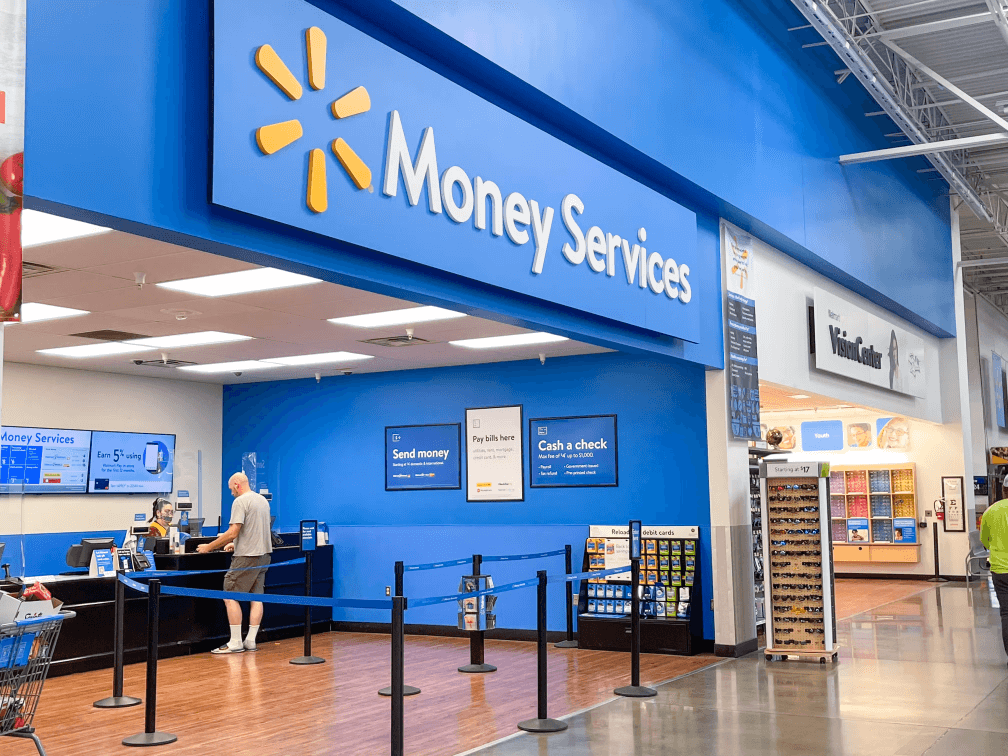
To maintain security and comply with federal financial regulations, Walmart restricts the types of checks it will cash. Understanding these categories is the first step in ensuring your trip to the MoneyCenter is successful.
Payroll, Government, and Tax Checks
These are the most common checks processed. Payroll checks issued by a business and government checks (including Social Security, Stimulus, and Veterans Affairs payments) are generally accepted with minimal friction. Tax refund checks, whether printed by the IRS or a state treasury, are also welcomed. Because these checks are issued by large entities or government bodies, they carry a lower risk of being returned for non-sufficient funds, allowing for lower fees and higher limits.
Specialized Financial Documents
In addition to standard payroll and government checks, Walmart also cashes:
- Cashier’s Checks: Often used for large purchases or legal settlements.
- Money Orders: Specifically those issued by MoneyGram that were purchased at a Walmart location.
- 401(k) and Retirement Distributions: These are treated similarly to payroll checks.
- Insurance Settlement Checks: These often arrive in higher amounts and benefit from the $8.00 flat fee.
Verification and Identification Requirements
Security is a cornerstone of Walmart’s financial services. To cash a check, you must provide a valid, government-issued photo ID. Acceptable forms of identification typically include a State-issued Driver’s License, a Military ID, a Tribal ID, a U.S. Passport, or a state-issued non-driver ID. Walmart uses electronic verification systems to scan the check and your ID to flag potential fraud. If a check is rejected, it is often due to a failure in these third-party verification databases rather than a decision made by the store associate.
Maximizing Liquidity: Why Retail Financial Services are Growing
The rise of retail check cashing isn’t just a matter of convenience; it’s a strategic choice for many individuals looking to optimize their cash flow. Traditional banking, while stable, often imposes “hold periods” on large deposits. A bank may place a three-to-five-day hold on a $4,000 check, which can be a significant barrier for someone who needs to pay rent, buy groceries, or cover an emergency immediately.
Instant Access to Capital
The primary advantage of Walmart’s service is the “instant” nature of the liquidity. Once the check is verified and the fee is paid, the consumer leaves the store with cash in hand or funds loaded onto a debit card. In a gig economy where workers may receive physical checks for various projects, this immediate access allows for more agile financial management.
Comparing Retailers to Traditional Banks
While banks offer “free” check cashing for their account holders, many banks are moving toward a model that requires a minimum balance to waive monthly maintenance fees. For individuals who cannot maintain a $500 or $1,000 minimum balance, the cost of a “free” bank account can actually exceed $150 per year in maintenance fees. In contrast, cashing a bi-weekly payroll check at Walmart for $4.00 results in an annual cost of approximately $104. For some, the retail model is actually the more cost-effective financial strategy.
The Role of the Walmart MoneyCard in Modern Finance
For those looking to move away from cash-only transactions, the Walmart MoneyCard serves as a bridge between traditional banking and retail financial services. It is a reloadable prepaid debit card that integrates deeply with Walmart’s check-cashing ecosystem.
Fee Waivers and Financial Incentives
One of the most compelling reasons to use the Walmart MoneyCard is the potential for reduced fees. Walmart frequently offers promotions where the check-cashing fee is waived or credited back if the consumer chooses to load the entire check amount onto a new or existing MoneyCard. This effectively makes the service free and provides the consumer with a secure way to spend their money online or at retailers that do not accept cash.
Building Digital Habits
The MoneyCard, issued by Green Dot Bank, offers features that mimic a high-end checking account, including:
- Cashback Rewards: Earning percentages back on purchases made at Walmart.com and Walmart fuel stations.
- Savings Interest: A competitive interest rate on funds held in a “Vault” within the account.
- Direct Deposit: The ability to bypass the physical check-cashing process entirely in the future by having payroll or government benefits deposited directly to the card, often up to two days early.
Strategic Financial Considerations for the Underbanked
While check cashing at Walmart is a valuable tool, it should be viewed as part of a broader financial strategy. For many, the goal is to minimize fees while maintaining maximum security over their earnings.
Navigating the “Hidden” Costs of Cash
While cashing a check at Walmart is straightforward, the subsequent use of that cash carries risks. Physical cash is susceptible to theft and loss, and paying bills in person with cash can incur additional costs in the form of gas and time. Consumers should consider using their cashed funds to purchase MoneyGram money orders (available at Walmart) for rent and utility payments, which provide a paper trail and proof of payment that cash cannot offer.
Transitioning to Digital Tools
For those using Walmart as their primary financial hub, the integration of the Walmart app can streamline the process. The “Check Out” feature in the app can sometimes allow users to pre-start their check-cashing transaction, reducing the time spent at the MoneyCenter desk. Furthermore, as consumers become more comfortable with these digital-retail hybrids, they build a financial history that can eventually make the transition to traditional credit or banking products smoother.

Final Thoughts on Retail Banking
Walmart check cashing remains a pillar of accessible personal finance. By offering a low-cost, transparent alternative to both traditional banks and high-fee check-cashing stores, it serves as a critical bridge for liquidity. Whether you are cashing a $50 two-party check or a $5,000 tax refund, understanding the $4/$8 fee structure and the requirement for valid identification ensures that you can navigate the system efficiently. In the modern financial landscape, having multiple avenues to access your money is not just a convenience—it is a necessity for financial resilience.
aViewFromTheCave is a participant in the Amazon Services LLC Associates Program, an affiliate advertising program designed to provide a means for sites to earn advertising fees by advertising and linking to Amazon.com. Amazon, the Amazon logo, AmazonSupply, and the AmazonSupply logo are trademarks of Amazon.com, Inc. or its affiliates. As an Amazon Associate we earn affiliate commissions from qualifying purchases.