
For millions, student loans represent a significant financial burden, a weighty legacy of pursuing higher education. The dream of a degree often comes tethered to years, if not decades, of repayment obligations that can strain budgets, delay major life milestones, and create considerable stress. The good news is that feeling overwhelmed by student loan debt doesn’t mean you’re without options. A multitude of strategies, both federal and private, exist to help borrowers reduce their monthly payments, manage their debt more effectively, and ultimately achieve financial freedom. Understanding these pathways is the first critical step toward alleviating the pressure and regaining control of your financial future.

This guide will delve into the various methods available to lower your student loan payments, offering professional insights and practical advice. We’ll explore the fundamental differences between federal and private loans, detail the array of relief programs offered by the government, examine the strategic considerations for private loan borrowers, and outline proactive steps you can take to mitigate your debt burden. Our aim is to equip you with the knowledge to make informed decisions and navigate the complex landscape of student loan repayment with confidence.
Understanding Your Student Loans: Federal vs. Private
Before diving into specific strategies, it’s imperative to understand the fundamental nature of your student loans. Not all loans are created equal, and the type of loan you hold dictates the specific avenues available for payment reduction and relief. Broadly, student loans fall into two main categories: federal and private. Their distinctions are not merely semantic; they represent vastly different sets of rules, borrower protections, interest rate structures, and repayment options.
The Distinction Matters: Why Knowing Your Loan Type is Crucial
The origin of your loan – whether from the U.S. Department of Education or a private financial institution – is the most critical factor in determining your options. Federal student loans are backed by the government and come with robust borrower protections, flexible repayment plans, and potential forgiveness programs. Private student loans, on the other hand, are offered by banks, credit unions, and other private lenders, typically featuring fewer borrower protections, less flexible repayment terms, and limited relief options. Mistaking one for the other can lead to missed opportunities for relief or attempting strategies that simply don’t apply to your specific loan type. Always check your loan statements or log into the National Student Loan Data System (NSLDS) for federal loans or your private lender’s portal to confirm your loan types.
Key Characteristics of Federal Student Loans
Federal student loans are generally considered more borrower-friendly. They come with a variety of benefits designed to help students manage their debt. These include fixed interest rates, which means your rate won’t change over the life of the loan; deferment and forbearance options that allow temporary pauses in payments under specific circumstances; and, critically for this discussion, income-driven repayment (IDR) plans that adjust your monthly payment based on your income and family size. Furthermore, federal loans are the exclusive gateways to significant forgiveness programs like Public Service Loan Forgiveness (PSLF). Common types of federal loans include Stafford Loans (subsidized and unsubsidized), PLUS Loans, and Perkins Loans.
Key Characteristics of Private Student Loans
Private student loans are often sought when federal aid isn’t sufficient to cover educational costs. Unlike their federal counterparts, private loans typically have variable interest rates that can fluctuate with market conditions, potentially leading to unpredictable monthly payments. They offer far fewer repayment flexibility options and almost no inherent forgiveness programs. Eligibility for private loans is often credit-based, requiring a strong credit history or a co-signer. While they can sometimes offer competitive interest rates to borrowers with excellent credit, the lack of consumer protections means borrowers must be extra vigilant and proactive in managing these debts.
Federal Relief Options: Income-Driven Repayment Plans and More
For those with federal student loans, the U.S. Department of Education provides a comprehensive suite of programs designed to make repayment more manageable. These options are often the most effective ways to lower your monthly payments, sometimes even to $0, depending on your income and family size.
Exploring Income-Driven Repayment (IDR) Plans
Income-Driven Repayment (IDR) plans are arguably the most impactful way to lower federal student loan payments. These plans calculate your monthly payment based on your discretionary income, not on your loan balance. This means if your income is low relative to your loan debt, your payments can be significantly reduced. After a certain number of years (typically 20 or 25, or 10 for PSLF), any remaining balance may be forgiven, though it might be subject to income tax.
- PAYE (Pay As You Earn): Generally caps payments at 10% of discretionary income.
- REPAYE (Revised Pay As You Earn): Caps payments at 10% of discretionary income, extending the benefit to more borrowers.
- IBR (Income-Based Repayment): Caps payments at 10% or 15% of discretionary income, depending on when you took out your loans.
- ICR (Income-Contingent Repayment): The oldest IDR plan, payments are capped at 20% of discretionary income or what you’d pay on a fixed 12-year plan, whichever is less.
It’s crucial to understand that while IDR plans lower your monthly burden, they can extend the repayment period, potentially increasing the total interest paid over the life of the loan. However, the benefit of forgiveness at the end of the term, combined with manageable monthly payments, often outweighs this concern for many borrowers.
Annual Recertification: Staying Compliant
To remain on an IDR plan, you must annually recertify your income and family size. Failing to do so can result in your payments reverting to the standard repayment amount, and any accrued interest may be capitalized (added to your principal balance), increasing your overall debt. Setting reminders and submitting your documentation promptly each year is vital to maintaining your reduced payments.
Deferment and Forbearance: Temporary Payment Pauses
For borrowers facing temporary financial hardship, federal student loans offer options to temporarily postpone or reduce payments.
- Deferment: Allows you to temporarily stop making payments on your loan. For subsidized federal loans, the government pays the interest that accrues during deferment. Common reasons for deferment include unemployment, economic hardship, military service, or returning to school.
- Forbearance: Also allows you to temporarily stop or reduce your loan payments. However, interest typically accrues on all loan types (subsidized and unsubsidized) during forbearance. It’s often granted for financial difficulty, medical expenses, or other extenuating circumstances.
While both options provide relief, they should be used judiciously. Accruing interest can increase your total loan cost, so explore other options like IDR plans first if your hardship is long-term.
Public Service Loan Forgiveness (PSLF): A Path to Debt Erasure
For those dedicated to careers in public service, PSLF offers a transformative path to debt forgiveness. Under PSLF, remaining federal student loan balances are forgiven after 120 qualifying monthly payments (10 years) while working full-time for a qualifying employer (government organizations at any level, or certain non-profit organizations). Payments must be made under a qualifying IDR plan. PSLF can be incredibly powerful for eligible borrowers, potentially wiping out substantial debt tax-free.
Federal Student Loan Consolidation
Federal loan consolidation allows you to combine multiple federal student loans into a single Direct Consolidation Loan. This can simplify repayment by giving you one monthly payment and potentially access to a wider range of IDR plans and PSLF eligibility. When you consolidate, your new interest rate is the weighted average of your previous rates, rounded up to the nearest one-eighth of a percent. Consolidation does not typically lower your interest rate but can extend your repayment term, which will lower your monthly payment. Be aware that consolidating can reset the clock on payments made towards IDR forgiveness or PSLF.
Private Loan Strategies: Refinancing and Negotiation
Unlike federal loans, private student loans offer fewer structured relief programs. However, strategic actions can still lead to lower payments or better terms. The primary mechanism for private loan borrowers to reduce their payments is refinancing.
Student Loan Refinancing: Is It Right for You?
Refinancing involves taking out a new loan from a private lender to pay off existing student loans (federal or private). The goal is typically to secure a lower interest rate, a different loan term (either shorter to pay off faster or longer to reduce monthly payments), or to combine multiple loans into one.
- When to Consider Refinancing: Refinancing is most beneficial if you have improved your credit score since you first took out your loans, have a stable income, or want to consolidate multiple private loans into a single, more manageable payment. A lower interest rate directly translates to lower monthly payments and less money paid over the life of the loan.
- The Process and What to Look For: Shop around with multiple lenders to compare interest rates and terms. Look at both fixed-rate and variable-rate options, understanding the risks associated with variable rates. Consider the loan term—a longer term will lower your monthly payment but increase total interest paid, while a shorter term saves interest but means higher payments.
- Potential Downsides: The most significant downside to refinancing federal loans into a private loan is losing access to all federal borrower protections, including IDR plans, deferment/forbearance options, and forgiveness programs like PSLF. For this reason, it’s generally recommended to only refinance federal loans if you are very secure in your financial situation and do not foresee needing federal protections. Refinancing private loans, however, usually carries fewer risks as you’re not sacrificing federal benefits.
Negotiating with Private Lenders: Limited but Possible
Private lenders are typically less flexible than the federal government. However, if you are experiencing significant financial hardship and are at risk of default, it might be possible to negotiate directly with your lender. They may offer limited hardship programs, temporary payment reductions, or even a settlement for a reduced amount if you can pay a lump sum. These situations are rare and often require demonstrating extreme financial distress, so this should be considered a last resort.
Proactive Steps to Reduce Your Debt Burden
Beyond specific loan programs, several proactive financial management strategies can help you lower your effective student loan payments and accelerate your path to debt freedom.
Making Extra Payments: Accelerating Your Payoff
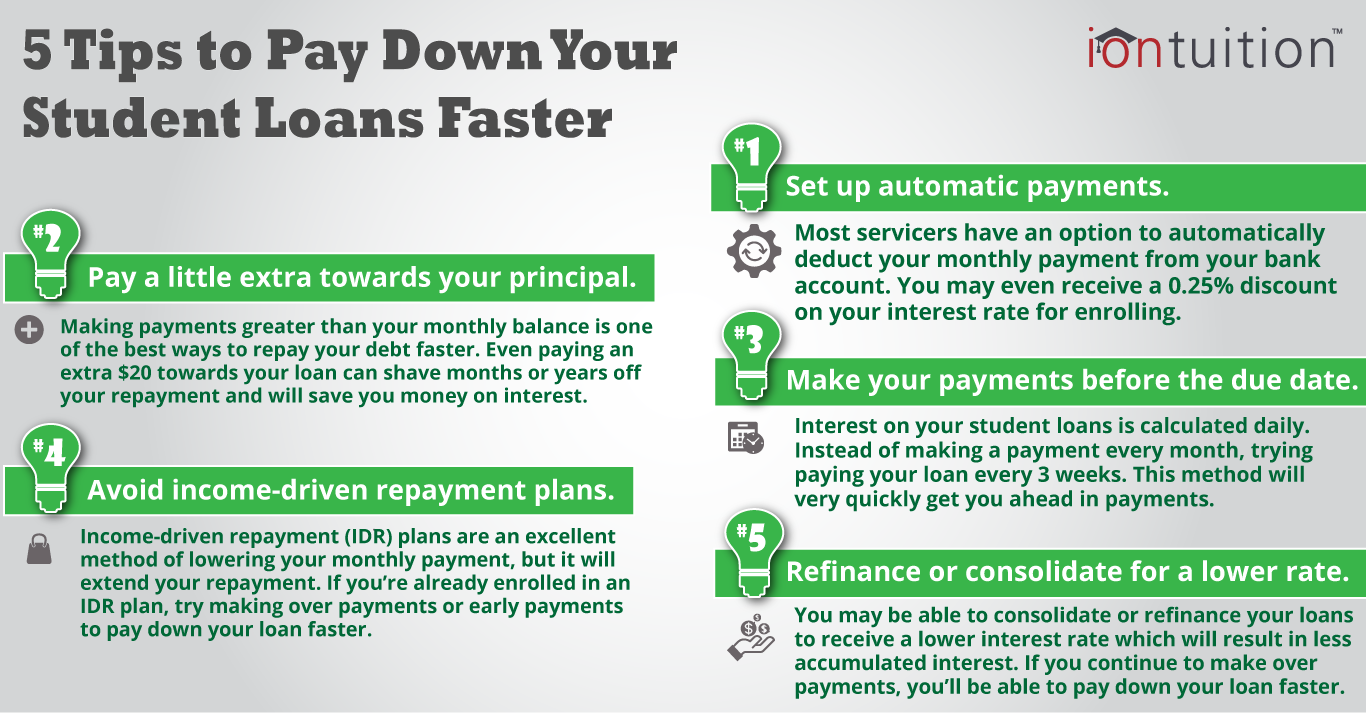
While counter-intuitive to “lowering payments,” making extra payments, even small ones, directly reduces your principal balance. Since interest is calculated on the principal, a lower principal means less interest accrues over time, effectively reducing the total cost of your loan and potentially allowing you to pay it off faster. Even rounding up your payment or applying unexpected windfalls (bonuses, tax refunds) can make a significant difference. Be sure to instruct your servicer to apply extra payments directly to the principal of the loan with the highest interest rate.
Budgeting and Financial Planning: Freeing Up Funds
A robust personal budget is the bedrock of effective financial management. By meticulously tracking your income and expenses, you can identify areas where you can cut back and free up more money to put towards your student loans. This might involve reducing discretionary spending, finding cheaper alternatives for necessities, or re-evaluating subscriptions. A clear budget empowers you to allocate funds strategically, ensuring your student loan payments are a priority rather than a constant struggle.
Employer-Assisted Student Loan Repayment Programs
Some forward-thinking employers are offering student loan repayment assistance as a benefit to attract and retain talent. These programs typically involve the employer contributing a certain amount directly towards an employee’s student loans. While not yet widespread, it’s a growing trend. Inquire with your HR department about such benefits, or keep an eye out for companies offering them when job searching. The amount contributed by an employer can sometimes be tax-free up to a certain limit, making it an even more attractive benefit.
Exploring State and Local Repayment Assistance Programs
Beyond federal and employer programs, some states and local governments offer their own student loan repayment assistance programs, often targeting professionals in specific high-need fields like healthcare, education, or law enforcement who commit to working in underserved areas. These programs vary widely by location and eligibility requirements, so researching opportunities in your state or region can uncover additional avenues for relief.
Navigating Challenges and Seeking Expert Advice
The journey to lower student loan payments can be complex, filled with jargon and seemingly endless paperwork. It’s crucial to approach it systematically and know when to seek help.
When to Seek Professional Guidance
If you’re feeling overwhelmed, struggling to understand your options, or unsure which path is best for your unique situation, consider consulting a certified financial planner or a reputable student loan counselor. They can provide personalized advice, help you navigate the application processes, and offer clarity on long-term financial planning. Be wary of anyone promising instant fixes or charging exorbitant fees for services you can do yourself.
Avoiding Scams and Unethical Services
Unfortunately, the student loan landscape is also ripe for scams. Be extremely cautious of companies that promise “guaranteed loan forgiveness” for an upfront fee, pressure you to sign documents without understanding them, or ask for your Federal Student Aid (FSA) ID. The Department of Education and its authorized servicers never charge fees for services like applying for IDR plans or PSLF. Always work directly with your loan servicer or trusted non-profit organizations.

The Long-Term View: Financial Wellness Beyond Loans
Lowering your student loan payments is a significant step, but it’s part of a broader journey toward overall financial wellness. As your student loan burden eases, seize the opportunity to build an emergency fund, contribute to retirement accounts, and pursue other financial goals. By systematically managing your debt and adopting sound financial habits, you can transform the burden of student loans into a stepping stone for a more secure and prosperous future. Empowering yourself with knowledge and proactive strategies is the most effective way to navigate your student loan debt and pave the way for lasting financial health.
aViewFromTheCave is a participant in the Amazon Services LLC Associates Program, an affiliate advertising program designed to provide a means for sites to earn advertising fees by advertising and linking to Amazon.com. Amazon, the Amazon logo, AmazonSupply, and the AmazonSupply logo are trademarks of Amazon.com, Inc. or its affiliates. As an Amazon Associate we earn affiliate commissions from qualifying purchases.