
Understanding how your Social Security benefits are taxed can be a complex but crucial aspect of retirement planning. For many retirees, Social Security represents a significant portion of their income, and failing to account for its tax implications can lead to unexpected financial shortfalls. This comprehensive guide will demystify the process, walking you through the steps to calculate the taxable portion of your Social Security benefits, identify key thresholds, and explore strategies to manage your tax liability effectively.
It’s a common misconception that Social Security benefits are entirely tax-free. While this holds true for some low-income retirees, a substantial number find that a portion of their benefits is subject to federal income tax. The rules for taxing Social Security benefits were established in 1983 and expanded in 1993, creating a tiered system based on your total income, often referred to as “provisional income.” Navigating these rules requires a clear understanding of what income counts and how the IRS determines your taxable percentage.
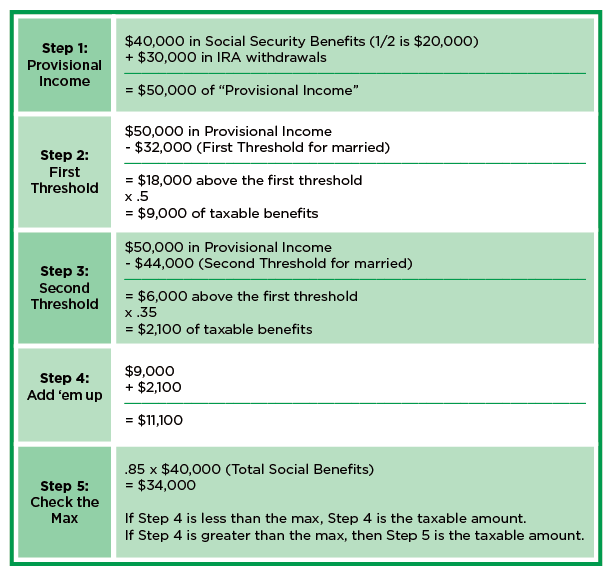
This article aims to provide a professional, insightful, and engaging exploration of this topic, empowering you to better plan your financial future. While we’ll break down the calculations and provide valuable insights, it’s always advisable to consult with a qualified tax professional for personalized advice tailored to your specific situation.
Understanding Social Security Taxation Basics
Before diving into the calculation, it’s essential to grasp the fundamental principles governing the taxation of Social Security benefits. The key takeaway is that the amount of your benefits subject to tax depends not just on your Social Security income, but on your combined income from all sources.
Who Pays Taxes on Social Security?
The simple answer is: it depends on your income level. The IRS uses a metric called “provisional income” to determine if and how much of your Social Security benefits are taxable. If your provisional income falls below certain thresholds, you may not owe any federal tax on your benefits. However, if it exceeds these thresholds, up to 50% or even 85% of your benefits could be subject to federal income tax. This progressive taxation aims to ensure that those with higher overall incomes contribute more.
What is Provisional Income?
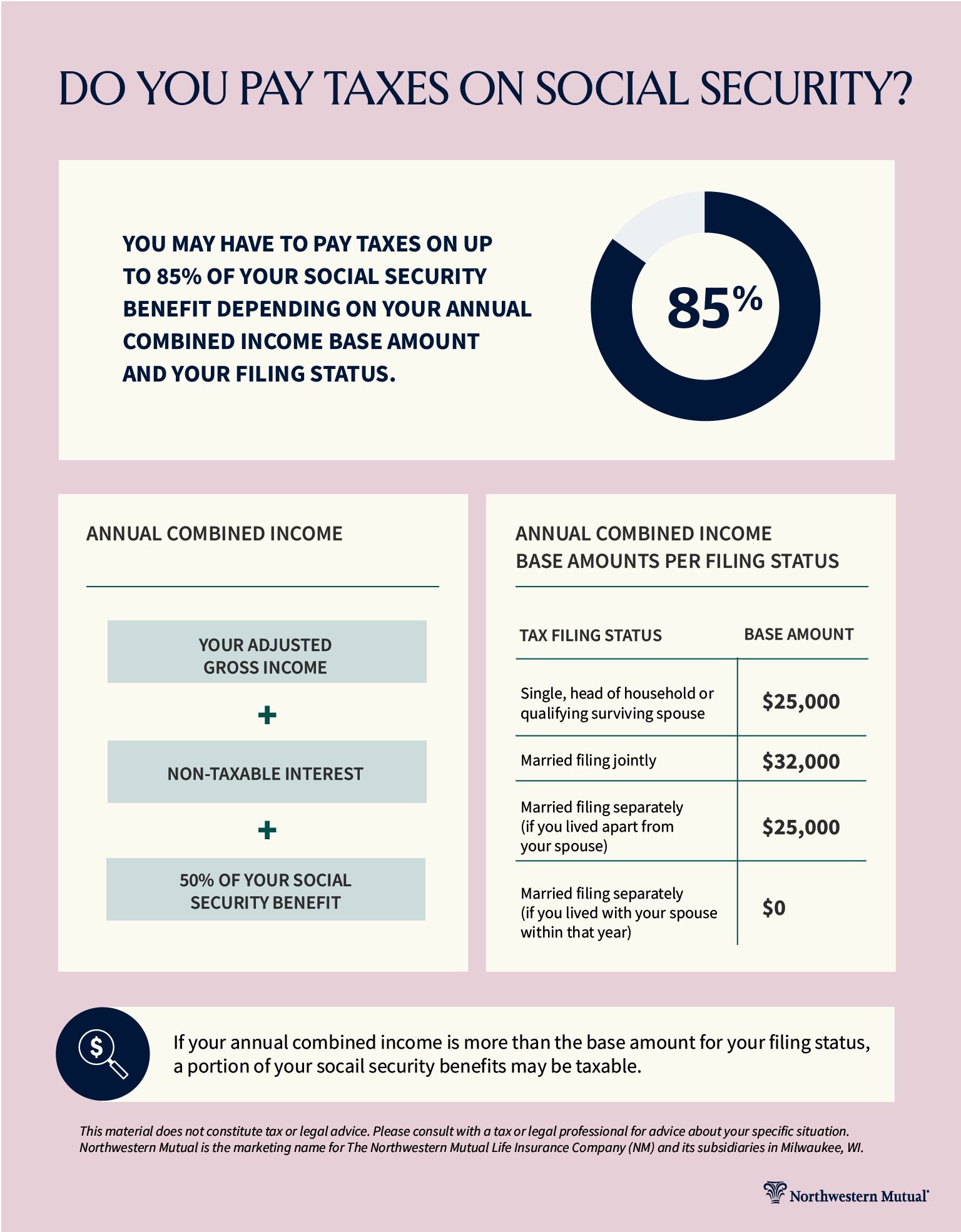
Provisional income is the cornerstone of Social Security taxation. It’s not a term you’ll typically find on your tax forms in a separate line item, but rather a calculation you perform to determine your tax liability. Here’s how it’s calculated:
- Adjusted Gross Income (AGI): This is your gross income minus certain deductions (like traditional IRA contributions, student loan interest, etc.). It’s a standard figure from your Form 1040.
- Tax-Exempt Interest: This includes interest from municipal bonds, which is typically free from federal income tax. However, for the purpose of calculating provisional income, this interest is added back.
- One-Half of Your Social Security Benefits: You add 50% of your total annual Social Security benefits (from Form SSA-1099, Box 5) to your AGI and tax-exempt interest.
Formula: Provisional Income = Your AGI + Tax-Exempt Interest + 50% of Your Social Security Benefits
Understanding this formula is the first critical step because your provisional income will dictate which tax bracket your Social Security benefits fall into.
Federal Tax Thresholds
The IRS has established specific provisional income thresholds that determine the percentage of your Social Security benefits that become taxable. These thresholds vary based on your tax filing status (single, married filing jointly, married filing separately).
- For single filers, head of household, or qualifying widow(er):
- If your provisional income is between $25,000 and $34,000, up to 50% of your benefits may be taxable.
- If your provisional income is more than $34,000, up to 85% of your benefits may be taxable.
- For married couples filing jointly:
- If your provisional income is between $32,000 and $44,000, up to 50% of your benefits may be taxable.
- If your provisional income is more than $44,000, up to 85% of your benefits may be taxable.
- For married individuals filing separately:
- If you lived with your spouse at any time during the tax year, up to 85% of your benefits are taxable, regardless of income. This rule essentially penalizes married couples who try to circumvent the thresholds by filing separately while still living together.
- If you lived apart from your spouse for the entire year, you use the single filer thresholds.
It’s crucial to note that these thresholds are not adjusted for inflation and have remained constant since their inception. This means that as other forms of income, including Social Security benefits themselves, increase over time due to cost-of-living adjustments (COLAs), more and more retirees find themselves pushed into the taxable tiers.
The Provisional Income Calculation: Your Key Metric
The heart of determining your Social Security tax liability lies in accurately calculating your provisional income. This metric serves as the gatekeeper, opening the door to either 0%, 50%, or 85% taxation of your benefits. Let’s break down its components in more detail and illustrate with an example.
Deconstructing the Components
To reiterate, your provisional income is the sum of:
- Your Adjusted Gross Income (AGI): This figure is crucial. It includes most forms of taxable income you receive, such as wages, self-employment income, pensions, annuities, taxable interest, ordinary dividends, capital gains, and distributions from traditional IRAs and 401(k)s. It also accounts for certain deductions “above the line,” like health savings account (HSA) deductions or half of self-employment taxes. You’ll find your AGI on line 11 of your Form 1040.
- Tax-Exempt Interest Income: This is a key add-back. While often beneficial for tax planning, interest from municipal bonds (muni bonds) and certain other state and local government obligations, which are typically exempt from federal income tax, must be included when calculating your provisional income for Social Security purposes. This ensures that higher-income individuals who hold substantial amounts of tax-exempt investments don’t unfairly escape Social Security benefit taxation. You’ll usually find this reported on Form 1099-INT.
- One-Half of Your Total Social Security Benefits: This is derived directly from your annual Social Security Benefit Statement (Form SSA-1099). Specifically, you’ll look at the amount in Box 5, which represents the net benefits paid to you during the year. Even if you don’t receive the benefits directly (e.g., they’re reduced for Medicare premiums or other deductions), Box 5 shows your gross benefit amount for the year.
A Practical Example of Provisional Income Calculation
Let’s consider a single filer, Maria, who is retired.
- She receives $20,000 in Social Security benefits for the year.
- She has a pension income of $15,000.
- She has $2,000 in taxable interest from a savings account.
- She also holds municipal bonds, generating $1,000 in tax-exempt interest.
- Her AGI before considering Social Security and tax-exempt interest is $17,000 ($15,000 pension + $2,000 taxable interest).
Now, let’s calculate Maria’s provisional income:
- AGI: $17,000
- Tax-Exempt Interest: $1,000
- One-Half of Social Security Benefits: 0.50 * $20,000 = $10,000
Maria’s Provisional Income = $17,000 (AGI) + $1,000 (Tax-Exempt Interest) + $10,000 (Half SS Benefits) = $28,000
With a provisional income of $28,000, Maria falls into the first federal tax bracket for single filers ($25,000 – $34,000), meaning up to 50% of her Social Security benefits will be taxable. This example clearly demonstrates how various income streams, even those otherwise tax-exempt, contribute to the provisional income calculation, ultimately impacting the taxability of Social Security benefits.
Step-by-Step Calculation: Determining Your Taxable Benefits
Once you have your provisional income calculated, the next step is to apply it to the federal tax thresholds to determine exactly how much of your Social Security benefits will be included in your taxable income. This isn’t always a straightforward percentage application, especially in the 50% taxation tier.
The Two-Tiered Calculation Method
The IRS employs a specific calculation method that can seem counterintuitive at first, particularly for the 50% taxation bracket. Let’s break it down:

Scenario 1: Provisional Income Below the First Threshold (e.g., < $25,000 for single)
- If your provisional income is below the lower threshold for your filing status, none of your Social Security benefits are taxable. Congratulations!
Scenario 2: Provisional Income Between the First and Second Threshold (e.g., $25,000 – $34,000 for single)
-
This is where it gets a bit tricky. The taxable amount is the lesser of:
- 50% of your Social Security benefits.
- 50% of the amount by which your provisional income exceeds the first threshold.
Let’s revisit Maria, with a provisional income of $28,000 and total Social Security benefits of $20,000. Her first threshold is $25,000.
- 50% of her Social Security benefits = 0.50 * $20,000 = $10,000
- 50% of (Provisional Income – First Threshold) = 0.50 * ($28,000 – $25,000) = 0.50 * $3,000 = $1,500
The lesser of $10,000 and $1,500 is $1,500. Therefore, $1,500 of Maria’s Social Security benefits are taxable. This $1,500 is then added to her other taxable income to determine her total adjusted gross income for federal income tax purposes.
Scenario 3: Provisional Income Above the Second Threshold (e.g., > $34,000 for single)
-
In this highest tier, up to 85% of your benefits can be taxable. The calculation becomes a bit more involved, combining elements from both tiers. The taxable amount is the lesser of:
- 85% of your Social Security benefits.
- The sum of:
- The amount that would have been taxable if your provisional income was exactly at the second threshold (i.e., $4,500 for single filers: 50% of the $9,000 difference between $25k and $34k).
- 85% of the amount by which your provisional income exceeds the second threshold.
Let’s use a new example: John, a single filer, has $30,000 in Social Security benefits and a provisional income of $40,000.
- 85% of his Social Security benefits = 0.85 * $30,000 = $25,500
- The sum of:
- The taxable amount if his provisional income was at the second threshold ($34,000): For a single filer, this is 50% of the difference between $34,000 and $25,000, which is 50% of $9,000 = $4,500.
- 85% of (Provisional Income – Second Threshold) = 0.85 * ($40,000 – $34,000) = 0.85 * $6,000 = $5,100
- Sum = $4,500 + $5,100 = $9,600
The lesser of $25,500 and $9,600 is $9,600. Therefore, $9,600 of John’s Social Security benefits are taxable.
This tiered approach highlights the progressive nature of Social Security taxation, ensuring those with significantly higher provisional incomes see a greater portion of their benefits subject to federal tax.
Using IRS Worksheets
While the manual calculations can be complex, especially for the 85% tier, the IRS provides helpful worksheets in Publication 915, “Social Security and Equivalent Railroad Retirement Benefits.” These worksheets guide you line-by-line through the calculation, making it easier to determine your exact taxable amount. Most tax software programs will also perform these calculations automatically once you input all your income information, including your Form SSA-1099.
Strategies to Manage Social Security Taxation
Understanding the calculation is only half the battle; the other half is exploring strategies to potentially reduce your taxable benefits. Since provisional income is the determining factor, managing your other income sources is key.
Optimize Retirement Account Withdrawals
One of the most impactful strategies involves careful planning of your retirement account withdrawals, especially from traditional IRAs and 401(k)s. These distributions are included in your AGI and thus directly contribute to your provisional income.
- Roth Conversions: Consider performing Roth conversions in years before you start taking Social Security or in early retirement years when your overall income might be lower. While Roth conversions are taxable events, the converted funds (and their earnings) can be withdrawn tax-free in retirement, and critically, do not contribute to provisional income calculations. This can help keep your AGI lower in later years when you are receiving Social Security.
- Taxable Account Withdrawals: If you have taxable brokerage accounts, strategically drawing from these might be preferable to taking larger distributions from traditional IRAs if the latter would push you into a higher Social Security tax bracket.
- Qualified Charitable Distributions (QCDs): If you are 70 ½ or older and have a traditional IRA, you can make a QCD directly to a qualified charity. This distribution counts towards your Required Minimum Distribution (RMD) but is excluded from your AGI. This can be a powerful tool for reducing your AGI and, consequently, your provisional income, without actually reducing your charitable giving.
Managing Tax-Exempt Income
While municipal bonds offer federal tax-exempt interest, remember that this interest does count towards your provisional income. For some retirees, especially those on the cusp of a Social Security tax threshold, reconsidering the allocation of their fixed-income portfolio might be beneficial. Weigh the benefits of tax-exempt interest against its impact on Social Security taxation. For example, if you’re in a lower tax bracket, taxable bonds might yield a higher after-tax return if their higher interest rate outweighs the tax savings and the impact on Social Security.
Delaying Social Security Benefits
While not solely a tax strategy, delaying when you start taking Social Security benefits can have indirect tax implications. By delaying, you increase your monthly benefit amount. If you delay taking benefits because you are still working or drawing heavily from other income sources, your provisional income might be higher, making more of your deferred, larger benefits taxable initially. Conversely, if you delay until you have fewer other income sources, the higher benefit might be less impacted by taxation. The primary driver for delaying is to increase lifetime benefits, but tax considerations should always be part of the holistic decision.
Important Considerations and Next Steps
The taxation of Social Security benefits is a multifaceted issue that extends beyond federal income tax. Several other factors merit consideration.
State-Level Taxation of Social Security
While federal taxation rules are universal across the U.S., it’s crucial to remember that some states also tax Social Security benefits. As of 2023, 11 states tax Social Security benefits to varying degrees: Colorado, Connecticut, Kansas, Minnesota, Missouri, Montana, Nebraska, New Mexico, Rhode Island, Utah, and Vermont. Each of these states has its own rules, often with different income thresholds or exemptions. For example, some states exempt benefits for lower-income residents, while others align more closely with federal rules or have flat taxes. If you reside in one of these states, you’ll need to research your state’s specific guidelines to get a complete picture of your tax liability.
Withholding and Estimated Taxes
If you determine that a portion of your Social Security benefits will be taxable, you have two primary ways to account for this tax liability throughout the year:
- Voluntary Withholding: You can elect to have federal income tax withheld from your Social Security benefits by filing Form W-4V, Voluntary Withholding Request. You can choose to have 7%, 10%, 12%, or 22% of your monthly benefit withheld. This is an excellent option for managing your tax obligations proactively and avoiding a large tax bill or underpayment penalties at year-end.
- Estimated Tax Payments: Alternatively, you can pay estimated taxes quarterly using Form 1040-ES, Estimated Tax for Individuals. This is generally required if you expect to owe at least $1,000 in tax for the year and the amount withheld from other income (like pensions or wages) is insufficient.
Record Keeping and IRS Form SSA-1099
The Social Security Administration (SSA) sends out Form SSA-1099, Social Security Benefit Statement, each January. This form reports the total amount of benefits you received during the previous year (Box 5). You’ll need this document when preparing your federal income tax return. It’s essential to keep accurate records of all your income sources, including Form SSA-1099, to ensure correct tax reporting.
Seeking Professional Guidance
The information provided here offers a comprehensive overview, but tax laws can be complex and are subject to change. Your individual financial situation, including unique income streams, deductions, and tax planning goals, will dictate the most appropriate strategies for you. For personalized advice, current information, and to ensure you are meeting all your tax obligations efficiently, consulting with a qualified financial advisor or tax professional is always highly recommended. They can help you develop a holistic retirement income strategy that minimizes your tax burden while maximizing your benefits.
Navigating the taxability of Social Security benefits is a critical component of sound financial planning in retirement. By understanding the provisional income calculation, applying the federal thresholds, and proactively implementing smart financial strategies, you can gain greater control over your tax liability and ensure a more secure and predictable financial future.
aViewFromTheCave is a participant in the Amazon Services LLC Associates Program, an affiliate advertising program designed to provide a means for sites to earn advertising fees by advertising and linking to Amazon.com. Amazon, the Amazon logo, AmazonSupply, and the AmazonSupply logo are trademarks of Amazon.com, Inc. or its affiliates. As an Amazon Associate we earn affiliate commissions from qualifying purchases.