
In the realm of technology, numbers are the fundamental language. From the elegant simplicity of binary code to the complex calculations powering AI algorithms, data in numerical form drives every facet of the digital world. While decimal representation often serves as the default for convenience and computational efficiency, the ability to convert numbers into fractions remains a crucial skill, particularly for applications demanding absolute precision, clarity in ratios, and a deeper understanding of mathematical relationships. This article delves into the methodologies of converting various numerical formats into fractions, framing these processes within the context of technology—highlighting their algorithmic underpinnings, practical applications in software, and the digital tools that facilitate these transformations.
Understanding the Core Principles: Decimals, Fractions, and Their Digital Lives
To appreciate the necessity and mechanics of converting numbers to fractions, it’s essential to first grasp the distinct nature of these two representations and how they interact within digital environments.
Decimals: The Ubiquitous Digital Format
Decimals are inherently tied to our base-10 number system, and their digital counterparts, floating-point numbers, are the workhorses of modern computing. They offer a straightforward way to represent real numbers, making them ideal for everyday measurements, financial transactions (up to a certain precision), and scientific data where approximate values are often sufficient.
However, floating-point numbers, by their very nature, carry inherent limitations. Due to the finite memory allocated, many rational numbers (which can be expressed as a fraction) cannot be represented exactly in binary floating-point format. For instance, the decimal 0.1 cannot be precisely represented as a binary floating-point number, leading to minute, but sometimes significant, precision errors. This imprecision can accumulate in complex calculations, leading to unexpected results in areas where exactitude is paramount.
Fractions: Precision and Relational Representation
Fractions, on the other hand, explicitly represent a part of a whole or a ratio between two integers. They consist of a numerator (the top number) and a denominator (the bottom number), offering an exact representation of rational numbers, free from the approximation issues often associated with floating-point decimals. In technology, this exactness is not merely an academic concern; it’s a critical requirement in various domains:
- Algorithmic Accuracy: In cryptographic algorithms, financial modeling, or scientific simulations, even minute rounding errors can compromise integrity or lead to catastrophic deviations. Fractions ensure calculations maintain their exact rational values.
- Data Representation: When defining aspect ratios for display resolutions (e.g., 16:9), scaling factors in design software, or representing probabilities, fractions provide a clear, unambiguous, and often human-readable representation of proportions.
- Symbolic Computation: Mathematical software relies heavily on exact arithmetic, where fractions are fundamental for manipulating algebraic expressions and solving equations without loss of precision.
The Need for Conversion in Software
The ability to convert between decimals and fractions allows developers and engineers to bridge the gap between user-friendly decimal inputs and the precise, ratio-based calculations often required internally. This conversion is vital for:
- User Interface (UI) Display: Presenting calculation results or measurements in a more intuitive fractional format (e.g., “1/2 inch” instead of “0.5 inches”).
- Input Validation and Parsing: Converting user-entered decimal values into internal fractional representations for backend processing.
- Interoperability: Ensuring compatibility between systems or libraries that might use different numerical representations.
- Educational Tools: Software designed to teach mathematics often requires robust fraction conversion capabilities.
Converting Terminating Decimals to Fractions: The Foundational Algorithm
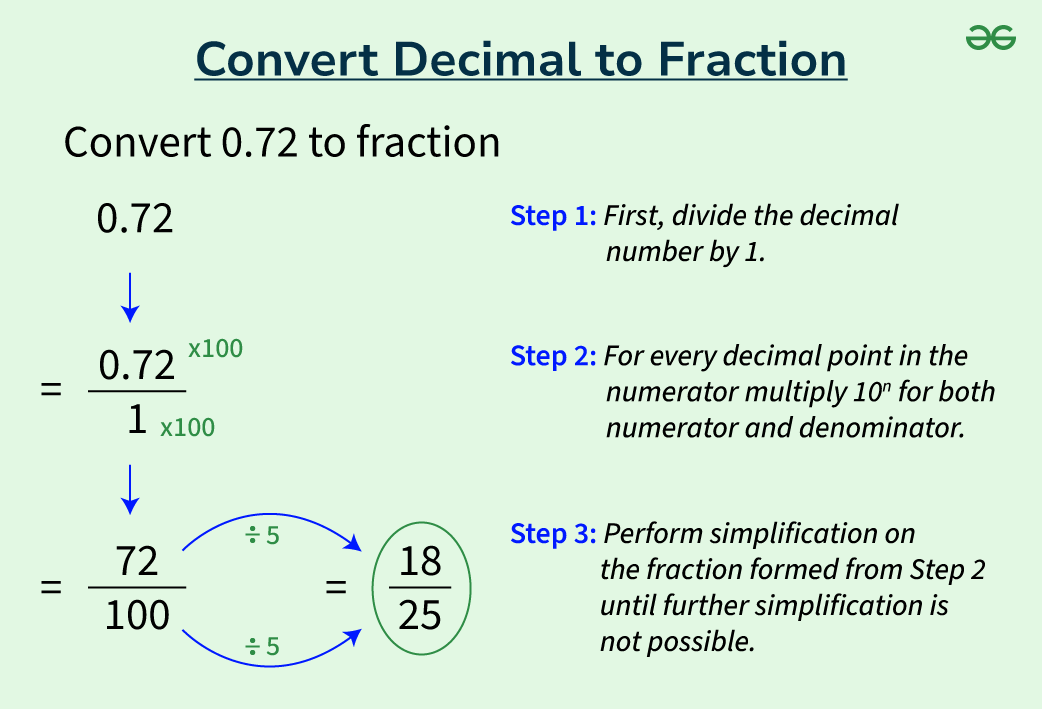
The process of converting a terminating decimal—one that has a finite number of digits after the decimal point—into a fraction is straightforward and forms the basis for more complex conversions. This method is highly amenable to algorithmic implementation in software.
Step-by-Step Method for Simple Decimals
- Identify the Decimal Places: Count the number of digits after the decimal point. Let this number be ‘n’.
- Form an Initial Fraction: Write the decimal number as a numerator without the decimal point. For the denominator, use 1 followed by ‘n’ zeros (which is equivalent to 10^n).
- Example: For 0.75, there are two decimal places (n=2). The initial fraction is 75/100.
- Example: For 0.2, there is one decimal place (n=1). The initial fraction is 2/10.
- Example: For 1.375, separate the whole number (1) and the decimal part (0.375). For 0.375, there are three decimal places (n=3). The initial fraction for the decimal part is 375/1000.
- Simplify the Fraction: Reduce the fraction to its simplest form by dividing both the numerator and the denominator by their Greatest Common Divisor (GCD). This step is crucial for canonical representation and computational efficiency.
Algorithmic Implementation and Pseudocode
This process translates directly into a robust algorithm that can be implemented in virtually any programming language:
function convertTerminatingDecimalToFraction(decimalNumber):
    // Handle negative numbers
    isNegative = (decimalNumber < 0)
    decimalNumber = abs(decimalNumber)

    // Separate whole and fractional parts
    wholePart = floor(decimalNumber)
    fractionalPart = decimalNumber - wholePart

    if fractionalPart == 0:
        return {numerator: wholePart, denominator: 1}

    // Convert fractional part
    stringRepresentation = toString(fractionalPart)
    // Find the number of digits after the decimal point
    // (excluding leading "0." and potential trailing zeros that might be represented in float)
    // A robust implementation would parse the string to find the exact number of decimal places
    // For example, "0.125" has 3 decimal places
    decimalPlaces = length(stringRepresentation) - 2 // Subtract "0."

    // Numerator is the fractional part scaled up
    // Denominator is 10^decimalPlaces
    numerator = round(fractionalPart * (10^decimalPlaces))
    denominator = 10^decimalPlaces

    // Simplify the fraction using GCD
    commonDivisor = findGCD(numerator, denominator)
    simplifiedNumerator = numerator / commonDivisor
    simplifiedDenominator = denominator / commonDivisor

    // Recombine with whole part if it exists
    if wholePart > 0:
        simplifiedNumerator = simplifiedNumerator + (wholePart * simplifiedDenominator)

    if isNegative:
        simplifiedNumerator = -simplifiedNumerator

    return {numerator: simplifiedNumerator, denominator: simplifiedDenominator}

// Helper function (Euclidean algorithm)
function findGCD(a, b):
    while b != 0:
        temp = b
        b = a % b
        a = temp
    return a
Handling Whole Numbers and Mixed Decimals
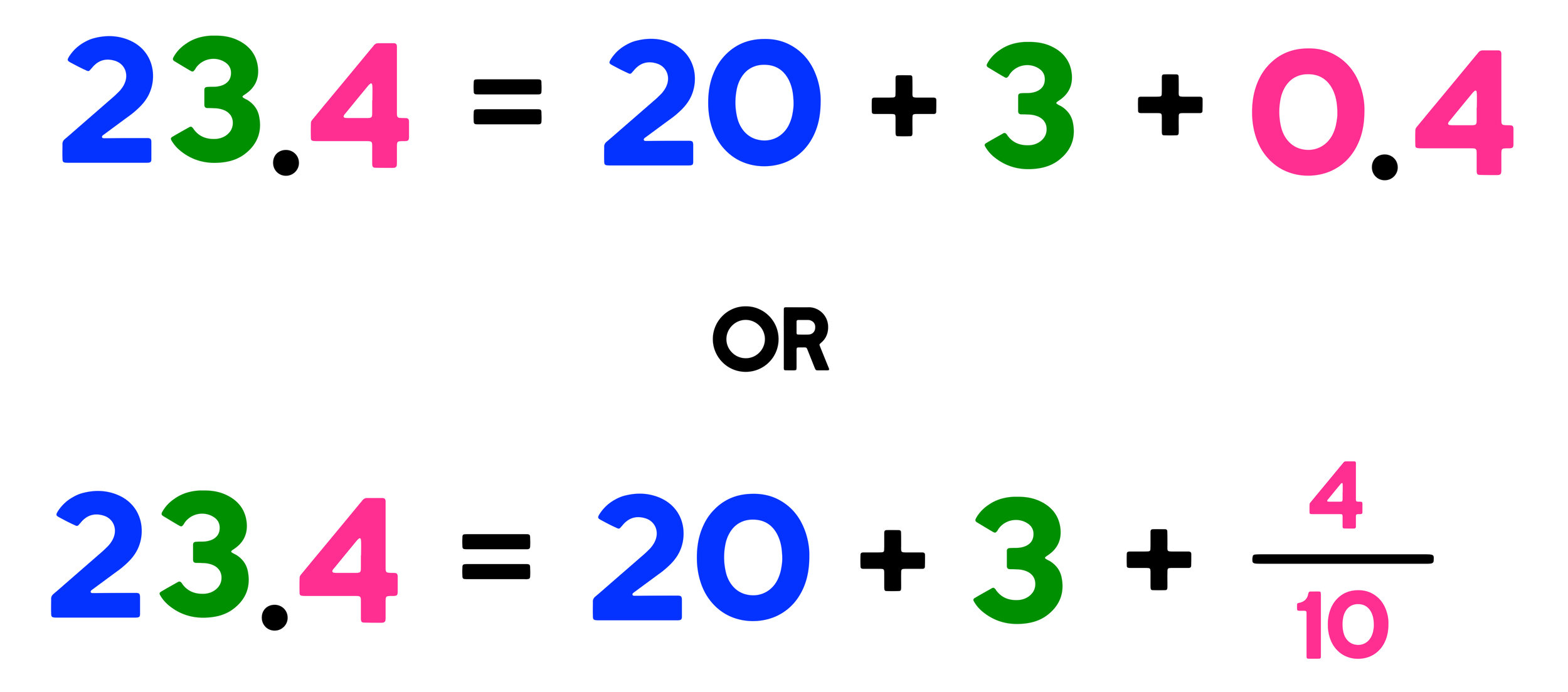
For numbers like 1.375, the approach involves first separating the whole number (1) from the decimal part (0.375). Convert the decimal part (0.375 becomes 375/1000, which simplifies to 3/8). Then, combine the whole number with the fraction: 1 + 3/8 = 8/8 + 3/8 = 11/8. This resulting improper fraction is often preferred in computational contexts as it avoids the complexity of mixed number objects.
Tackling Repeating Decimals: Advanced Digital Conversion
Converting repeating decimals into fractions is a more intricate process, as these numbers have an infinite sequence of digits after the decimal point. However, because the sequence repeats, they are still rational numbers and can always be expressed as a fraction. This conversion highlights the elegance of algebraic methods and the specialized tools required in digital systems.
Identifying Repeating Patterns
A repeating decimal, also known as a recurring decimal, features a digit or a block of digits that repeats infinitely. Examples include 0.333… (repeating ‘3’) or 0.142857142857… (repeating ‘142857’). In digital systems, detecting these patterns robustly can be challenging due to floating-point approximations. A typical float or double might represent 1/3 as 0.3333333333333333, which is an approximation, not a true repeat. Therefore, exact repetition detection often requires either string analysis of a high-precision decimal representation or knowledge of the number’s origin (e.g., if it’s the result of 1/3).
The Algebraic Method (Manual and Algorithmic Insight)
The standard method involves algebra:
- Set
xto the Repeating Decimal: Letx =the repeating decimal. - Multiply to Shift the Repeating Block: Multiply
xby10^n, wherenis the number of digits in the repeating block. This shifts the decimal point so that the repeating part aligns. - Subtract the Original Equation: Subtract the original equation (
x =decimal) from the new equation (10^n * x =shifted decimal). This subtraction effectively cancels out the infinite repeating part. - Solve for
x: The result will be a simple linear equation that can be solved forx, yielding a fraction.- Example (0.333…):
x = 0.333...(Eq. 1)10x = 3.333...(Eq. 2)- Subtract Eq. 1 from Eq. 2:
10x - x = 3.333... - 0.333... 9x = 3x = 3/9 = 1/3
- Example (0.121212…):
x = 0.121212...(Eq. 1)100x = 12.121212...(Eq. 2)- Subtract Eq. 1 from Eq. 2:
100x - x = 12.121212... - 0.121212... 99x = 12x = 12/99 = 4/33
- Example (0.333…):
Computational Approaches and Libraries
Implementing robust algorithms to convert any repeating decimal (especially from floating-point input) is complex. It requires sophisticated logic to:
- Detect the start and end of the repeating block: This might involve analyzing a high-precision decimal string representation for patterns or using number theory.
- Handle non-repeating parts before the repeating block: For instance, 0.1666… requires separating 0.1 from 0.0666…
Given these complexities, many programming languages offer specialized libraries or built-in types for rational numbers that handle such conversions. Python’sfractionsmodule, for example, can create exact fraction objects from decimals, often implicitly handling repeating patterns where possible or providing methods for specifying the numerator and denominator directly. Other languages might require custom implementations or external libraries (e.g., Boost.Rational in C++). These tools abstract away the intricate algebraic steps, allowing developers to focus on the application logic while maintaining numerical exactitude.
Simplifying Fractions: Ensuring Optimal Representation in Digital Systems
Once a number has been converted into a fraction (e.g., 75/100 or 12/99), the next critical step for digital systems is simplification. A fraction is in its simplest form (or lowest terms) when its numerator and denominator have no common factors other than 1.
The Importance of Simplification
- Readability and Usability: A fraction like 1/2 is far more intuitive and universally understood than 50/100, especially in user interfaces.
- Canonical Form: Simplification ensures that each rational number has a unique fractional representation. This is crucial for comparisons, database storage, and consistency in data processing. Without simplification, 1/2, 2/4, 3/6, etc., would all be treated as distinct entities, leading to errors in data matching or inefficient storage.
- Efficiency: While perhaps minor for single fractions, simplified fractions can marginally reduce the computational load in subsequent arithmetic operations, especially in large-scale symbolic computation or number theory applications.
The Greatest Common Divisor (GCD) Algorithm
The core of fraction simplification lies in finding the Greatest Common Divisor (GCD) of the numerator and denominator. The GCD is the largest positive integer that divides both numbers without leaving a remainder. Once found, both the numerator and denominator are divided by the GCD to yield the simplified fraction.
The most efficient and widely used algorithm for finding the GCD is the Euclidean Algorithm:
- Input: Two positive integers,
aandb. - Process: If
bis 0, thenais the GCD. Otherwise, replaceawithbandbwith the remainder ofadivided byb(a % b), and repeat the process.
function findGCD(a, b):
    while b != 0:
        temp = b
        b = a % b
        a = temp
    return a

function simplifyFraction(numerator, denominator):
    commonDivisor = findGCD(abs(numerator), abs(denominator)) // Use absolute values for GCD
    return {
        numerator: numerator / commonDivisor,
        denominator: denominator / commonDivisor
    }
Automated Simplification in Software
Modern programming environments and mathematical libraries almost universally include functions for GCD calculation and automated fraction simplification. When working with dedicated Fraction or Rational number types (like those in Python or Java with third-party libraries), simplification is often handled implicitly upon creation or modification of the fraction object. This built-in functionality saves developers from manually implementing the Euclidean algorithm, ensuring that fractions are always presented and processed in their optimal, simplified form. This automation is a cornerstone of robust numerical processing in technology.
Practical Applications, Tools, and Future Trends in Numeric Conversion
The ability to accurately convert numbers into fractions is not merely a theoretical exercise; it has tangible impacts across various technological domains.
Engineering and Scientific Computing
In fields like mechanical engineering, civil engineering, and physics, precise ratios are fundamental. CAD software, simulation tools, and data analysis platforms often deal with dimensions, tolerances, and physical constants that benefit from fractional representation. For instance, expressing a gear ratio as 3/2 rather than 1.5 ensures exactness in design specifications, preventing cumulative errors in complex machinery or structures. Scientific computing dealing with quantum mechanics or high-energy physics also often necessitates exact rational arithmetic to maintain the integrity of calculations involving fundamental constants.
Financial Systems and Data Analytics
While floating-point numbers are common for currency, there are scenarios in financial modeling, high-frequency trading, or systems dealing with precise share allocations where fractions can provide exact intermediate calculations, minimizing rounding errors that could lead to financial discrepancies. In data analytics and visualization, fractions are excellent for representing proportions (e.g., market share, survey responses) in a clear, unambiguous manner, sometimes preferred over percentages or decimals for specific interpretive contexts.
Programming Language Support and Libraries
As highlighted, many programming languages provide direct support or robust libraries for handling rational numbers:
- Python: The
fractionsmodule is a prime example, allowing forFractionobjects to be created from integers, floats, decimals, or strings, and supports arithmetic operations while maintaining exactness and auto-simplifying. - JavaScript: While lacking native
Fractiontypes, libraries likebig.jsor custom implementations usingBigIntcan facilitate rational number arithmetic, crucial for financial applications where JavaScript’s default floats are inadequate. - Java:
BigDecimaloffers arbitrary-precision decimal arithmetic, which can be combined with custom logic to represent and manipulate fractions, particularly when precision is paramount. - C++: Libraries like Boost.Rational provide robust
rationalnumber types.
The decision of when to use floating-point numbers versus rational numbers (fractions) is a key design choice in software development, balancing computational speed and memory usage against the absolute precision required by the application.
The Role of AI and Advanced Algorithms
As AI and machine learning become more prevalent, the handling of numerical data, especially with varying degrees of precision and exactness, will evolve. AI might not directly convert numbers to fractions in the same way a human or a traditional algorithm does, but symbolic AI and advanced numerical processing techniques could benefit from understanding and manipulating rational numbers. For instance, AI-driven mathematical assistants or scientific discovery platforms might use fractional representations internally for greater inference accuracy or for generating human-readable exact solutions. Future trends could see AI assisting in identifying optimal numerical representations for specific computational tasks, dynamically switching between decimal and fractional forms based on context and desired precision.

Conclusion
The conversion of numbers into fractions is more than a fundamental mathematical exercise; it’s a critical capability within the technological landscape. Understanding the algorithmic steps for converting terminating and repeating decimals, coupled with the essential process of simplification via the Euclidean algorithm, empowers developers and engineers to build more precise, robust, and user-friendly digital systems. From the foundational principles of data representation to advanced applications in engineering, finance, and scientific computing, the mastery of numeric transformations ensures that digital processes can achieve exactitude, clarity, and computational integrity. As technology continues its relentless march forward, the underlying mathematical principles, implemented through sophisticated software and libraries, remain the bedrock upon which our increasingly complex digital world is built.
aViewFromTheCave is a participant in the Amazon Services LLC Associates Program, an affiliate advertising program designed to provide a means for sites to earn advertising fees by advertising and linking to Amazon.com. Amazon, the Amazon logo, AmazonSupply, and the AmazonSupply logo are trademarks of Amazon.com, Inc. or its affiliates. As an Amazon Associate we earn affiliate commissions from qualifying purchases.