
In the realm of personal finance and investing, few concepts hold as much transformative power as compound interest. Often lauded as the “eighth wonder of the world” by Albert Einstein, its mechanism is deceptively simple yet profoundly impactful. At its core, compounding is the process of earning interest not only on your initial principal but also on the accumulated interest from previous periods. It’s a financial phenomenon that allows your money to grow exponentially over time, turning modest savings into substantial wealth. Understanding compound interest is not merely an academic exercise; it is a fundamental pillar of sound financial planning, critical for anyone looking to build wealth, save for retirement, or even navigate debt effectively. This deep dive will unravel the mechanics, benefits, and practical applications of compound interest, empowering you to harness its incredible potential.
The Core Concept of Compounding: Interest on Interest
To truly grasp the power of compound interest, it’s essential to distinguish it from its simpler counterpart and understand the underlying mechanism that drives its exponential growth. It’s the engine that fuels long-term wealth creation, making your money work tirelessly for you.
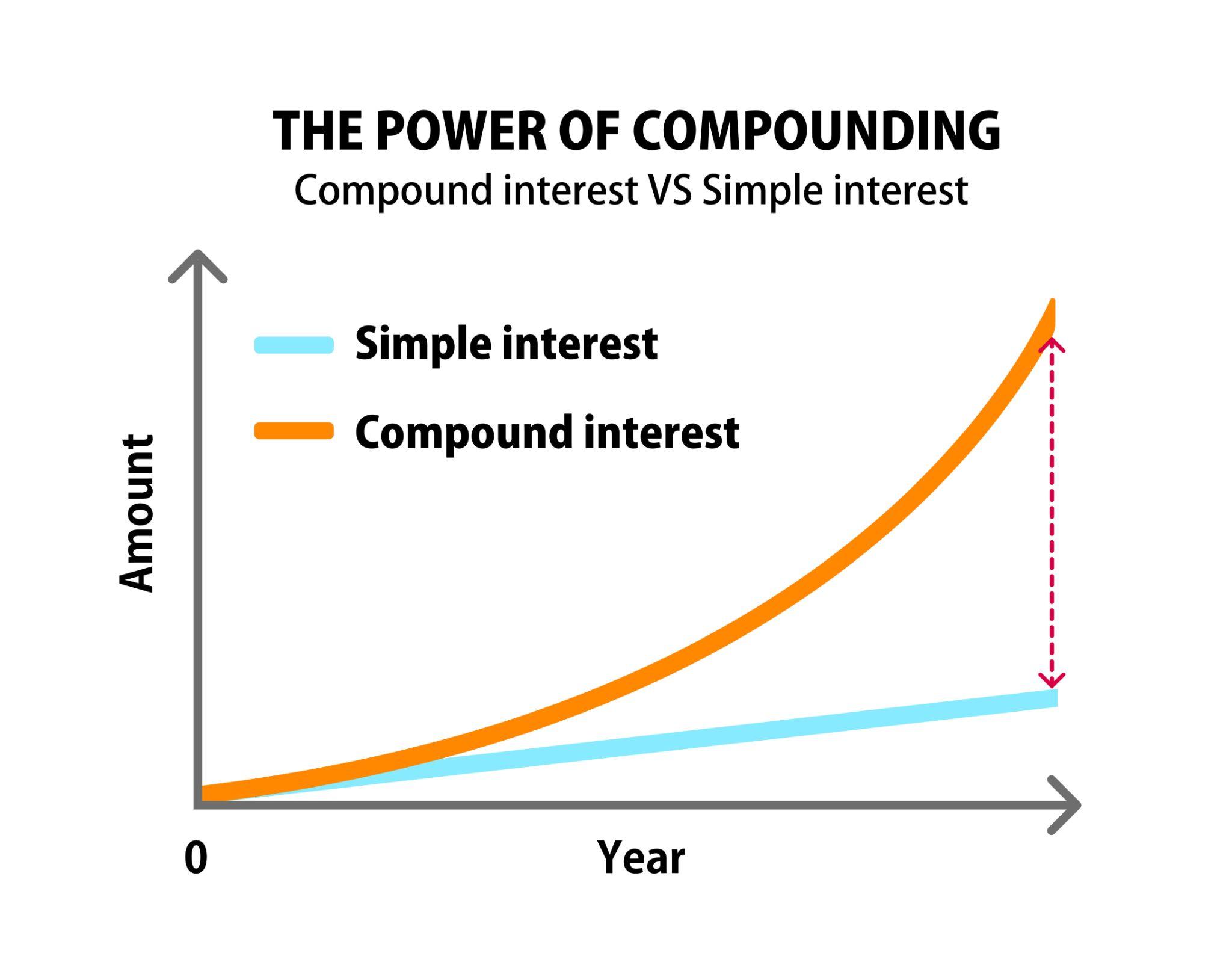
Defining Simple vs. Compound Interest
Before delving into the intricacies of compounding, let’s briefly clarify the difference between simple and compound interest.
- Simple Interest: This is interest calculated only on the principal amount of a loan or deposit. For example, if you invest $1,000 at a 5% simple interest rate per year, you would earn $50 each year. Your principal always remains $1,000 for the purpose of interest calculation. This method is often used for short-term loans or bonds, where the interest is paid out rather than reinvested.
- Compound Interest: In contrast, compound interest is calculated on the initial principal and also on all the accumulated interest from previous periods. Using the same example, if you invest $1,000 at a 5% compound interest rate per year, in the first year you earn $50 (5% of $1,000). In the second year, the interest is calculated on $1,050 (your original $1,000 plus the $50 earned). So, you’d earn $52.50. This seemingly small difference quickly snowballs, creating a powerful growth trajectory.
How Compounding Works: A Step-by-Step Explanation
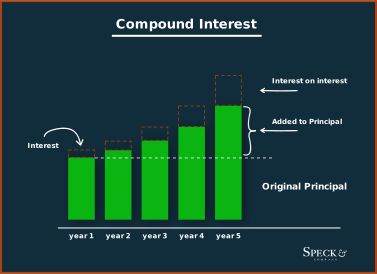
The magic of compounding lies in its iterative nature. Each time interest is calculated and added to the principal, that new, larger sum becomes the base for the next interest calculation. This process repeats over and over, creating a virtuous cycle of growth.
Consider an initial investment of $10,000 with an annual interest rate of 7%, compounded annually:
- Year 1:
- Initial Principal: $10,000
- Interest Earned: $10,000 * 0.07 = $700
- New Balance: $10,000 + $700 = $10,700
- Year 2:
- Initial Principal (for this period): $10,700
- Interest Earned: $10,700 * 0.07 = $749
- New Balance: $10,700 + $749 = $11,449
- Year 3:
- Initial Principal: $11,449
- Interest Earned: $11,449 * 0.07 = $801.43
- New Balance: $11,449 + $801.43 = $12,250.43
Notice how the interest earned increases each year, even though the interest rate remains constant. This is because the base upon which the interest is calculated is continuously growing. The more frequently interest is compounded (e.g., quarterly, monthly, daily), the faster the growth, as interest is added back to the principal more often.
The Power of Time and Rate
Two critical variables dictate the efficacy of compound interest: time and the interest rate.
- Time: This is arguably the most crucial factor. The longer your money has to compound, the greater the eventual accumulation. The initial growth might seem slow, but over decades, the curve of wealth accumulation becomes remarkably steep. Early investment is paramount because it gives your money the maximum possible time to benefit from compounding. Even small, consistent contributions made early can outperform larger, later contributions due to the sheer duration of compounding.
- Interest Rate: A higher interest rate naturally accelerates the compounding process. While higher rates often come with higher risk, finding a balance between acceptable risk and a favorable return is key. Even a seemingly small difference in percentage points can lead to a significant divergence in wealth over the long run.
Understanding these foundational elements sets the stage for appreciating why compound interest is considered a cornerstone of financial success.
Why Compound Interest is Dubbed the “Eighth Wonder of the World”
The profound impact of compound interest extends beyond mere calculation; it fundamentally alters the trajectory of financial growth, transforming ordinary savings into extraordinary wealth. Its designation as the “eighth wonder” by luminaries like Einstein is a testament to its unparalleled ability to generate prosperity.
Exponential Growth: A Wealth Accelerator
Unlike linear growth, where an asset increases by a fixed amount per period, compound interest drives exponential growth. This means that the rate of growth itself accelerates over time. In the early years of an investment, the interest earned is relatively small. However, as the principal (and accumulated interest) grows, the interest earned in subsequent periods becomes increasingly substantial. This effect is often visualized as a hockey stick curve: slow and steady at first, then dramatically upward.
For instance, a single $10,000 investment growing at 7% annually would take approximately 10 years to double with simple interest if the interest was continually withdrawn. With compound interest, it would double in roughly 10 years without any additional contributions, purely through the reinvestment of earnings. Over 30-40 years, the difference between simple and compound interest becomes staggering, illustrating how compounding truly acts as a wealth accelerator, far surpassing linear accumulation.
Overcoming Inflation and Preserving Purchasing Power
In a world where inflation steadily erodes the purchasing power of money, compound interest serves as a vital defense mechanism. If your savings earn only simple interest at a rate lower than inflation, your money is effectively losing value over time. For example, if inflation is 3% and your simple interest savings account earns 1%, your real return is -2%.
Compound interest, however, offers the potential to outpace inflation. By continuously reinvesting earnings, your money grows at a rate that can exceed the inflation rate, ensuring that your wealth not only maintains its purchasing power but also increases it over time. This is critical for long-term financial security, particularly for retirement planning where funds need to last for decades. A well-compounded investment protects your future self from the insidious erosion of inflationary pressures.
The Magic of Early Investment
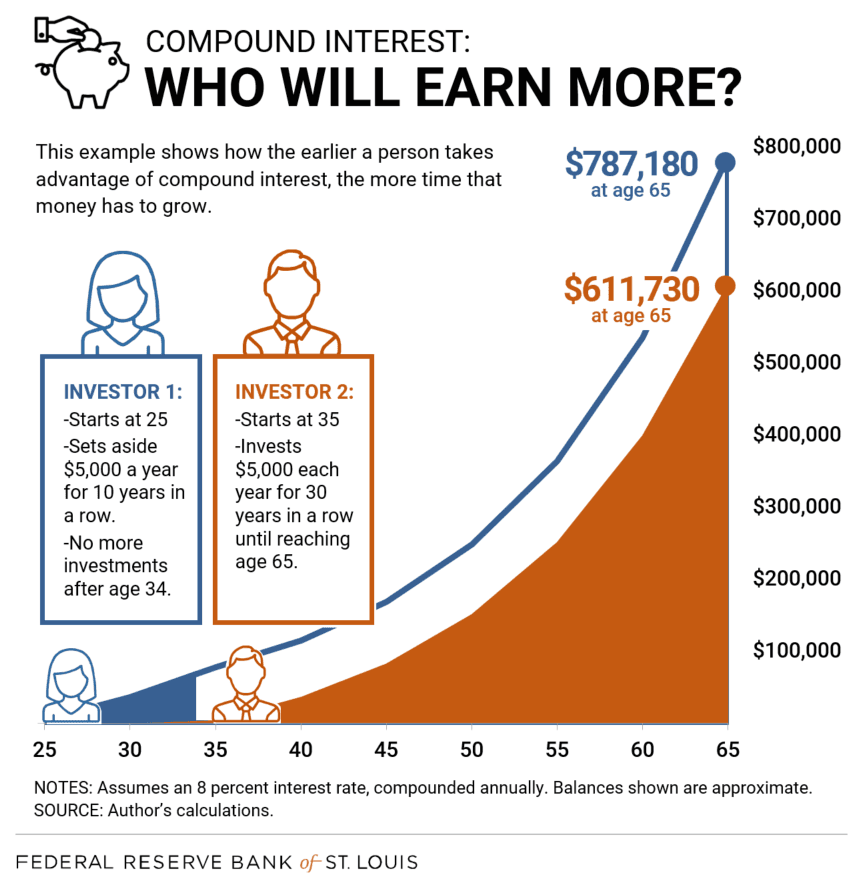
The most compelling aspect of compound interest is its disproportionate reward for early action. Because time is such a powerful multiplier in the compounding equation, starting to invest even small amounts early in life can lead to far greater wealth than investing larger amounts later.
Consider two individuals, Amy and Ben, both aiming for retirement:
- Amy invests $5,000 per year from age 25 to 35 (10 years, total $50,000 invested) and then stops, letting her money compound until age 65.
- Ben waits until age 35 to start investing, contributing $5,000 per year from age 35 to 65 (30 years, total $150,000 invested).
Assuming both earn a 7% annual return, Amy, despite investing less money and for a shorter period, would likely end up with a significantly larger nest egg than Ben. Her earlier contributions had an extra 20 years to compound, allowing the “interest on interest” to work its magic for a longer duration. This phenomenon underscores the golden rule of investing: “The best time to plant a tree was 20 years ago. The second best time is now.” For compound interest, the best time to invest was yesterday.
Practical Applications of Compound Interest in Your Financial Life
The theoretical elegance of compound interest truly shines when applied to real-world financial products and strategies. From everyday savings to sophisticated investment vehicles, understanding where compounding is at play can significantly impact your financial health.
Savings Accounts and Certificates of Deposit (CDs)
These are often the first introduction to compound interest for many individuals.
- Savings Accounts: While often offering lower interest rates, many savings accounts compound interest daily, monthly, or quarterly. Even at modest rates, consistent deposits and the power of compounding mean your balance will grow over time, albeit slowly. It’s a low-risk way to build an emergency fund or save for short-term goals.
- Certificates of Deposit (CDs): CDs typically offer higher fixed interest rates than standard savings accounts in exchange for locking up your money for a specified term (e.g., 6 months to 5 years). The interest earned on a CD is almost always compounded, often quarterly or semi-annually. This makes CDs a suitable option for medium-term savings goals where capital preservation and a guaranteed return are priorities.
Retirement Accounts: 401(k)s and IRAs
Retirement accounts are arguably the most powerful examples of compound interest in action, primarily because they are designed for long-term growth.
- 401(k)s: Employer-sponsored retirement plans like 401(k)s allow you to invest pre-tax dollars, which then grow tax-deferred. All dividends, capital gains, and interest earned within the 401(k) compound year after year without being taxed until withdrawal in retirement. This absence of annual taxation on earnings significantly accelerates the compounding process, as your full earnings are reinvested. Employer matching contributions further supercharge this growth.
- IRAs (Traditional and Roth): Individual Retirement Accounts offer similar tax advantages. Traditional IRAs allow for tax-deductible contributions and tax-deferred growth, while Roth IRAs feature after-tax contributions but allow for tax-free withdrawals in retirement. Both leverage compound interest to build substantial wealth over decades, providing a critical foundation for financial independence in later life.
Investment Portfolios: Stocks, Bonds, and Mutual Funds
Beyond fixed-income instruments, compound interest is a driving force in broader investment portfolios.
- Stocks: When you invest in dividend-paying stocks, reinvesting those dividends to purchase more shares is a classic example of compounding. You earn dividends on your initial shares, and then you earn dividends on the new shares purchased with those dividends, creating a compounding cycle. Capital appreciation (the increase in the stock price) also compounds over time.
- Bonds: While many bonds pay out simple interest, reinvesting the coupon payments from bonds into new bonds or other investments allows for compounding. Zero-coupon bonds are essentially designed around compounding, as they are purchased at a discount and mature at face value, with the implicit interest compounding over the bond’s life.
- Mutual Funds and Exchange-Traded Funds (ETFs): These professionally managed funds pool money from many investors to invest in a diversified portfolio of stocks, bonds, or other assets. When these funds pay out dividends or capital gains, investors often have the option to reinvest them back into the fund, purchasing more units. This systematically applies the principle of compounding to a diversified portfolio, enhancing long-term returns.
Understanding the Downside: Compound Interest on Debt
While compounding is a powerful ally for investors, it can be a formidable foe when applied to debt. Just as interest compounds on your savings, it also compounds on money you owe, particularly high-interest debts like credit card balances. If you don’t pay off your entire credit card balance each month, interest is calculated on the original balance plus the unpaid interest from previous months. This can quickly lead to an overwhelming debt spiral, making it incredibly difficult to pay off the principal. Understanding this negative side of compounding is crucial for managing personal finances responsibly and prioritizing debt repayment, especially high-interest debts, to mitigate its destructive power.
Strategies to Maximize the Power of Compounding
Harnessing the full potential of compound interest requires more than just understanding the concept; it demands strategic action and disciplined execution. By adopting specific habits and making informed choices, you can significantly amplify its benefits.
Start Early and Be Consistent
As highlighted earlier, time is the ultimate multiplier in the compounding equation. The single most impactful strategy is to start investing as early as possible. Even small contributions made in your 20s can outperform much larger contributions made later in life due to the extended period your money has to grow exponentially.
Beyond starting early, consistency is key. Regular, automated contributions to your investment accounts ensure that you are continuously feeding the compounding engine. This “dollar-cost averaging” approach also helps smooth out market fluctuations, as you buy more shares when prices are low and fewer when prices are high. Make saving and investing a regular, non-negotiable part of your financial routine, much like paying a bill.
Embrace Higher Interest Rates
While not always entirely within your control, seeking out investments with favorable interest rates or returns can dramatically accelerate your wealth accumulation. This doesn’t necessarily mean chasing high-risk ventures, but rather being mindful of where your money is held.
For instance, simply moving cash from a traditional savings account earning 0.01% to a high-yield savings account earning 4% can make a significant difference over time. For long-term growth, investing in diversified portfolios of stocks and bonds, which historically offer higher returns than cash, can provide the necessary growth rate for powerful compounding, commensurate with your risk tolerance. Regularly review your investment performance and rebalance your portfolio to ensure it aligns with your financial goals and risk profile.
Reinvest Your Earnings
This is a fundamental principle of maximizing compound interest. Whenever an investment generates income—be it dividends from stocks, interest from bonds, or distributions from mutual funds—always choose to reinvest those earnings back into the original investment or a similar one.
By reinvesting, you are essentially increasing your principal amount, which in turn leads to even more interest or dividends in the next cycle. This is the core mechanism of “interest on interest.” Most brokerage accounts and retirement plans offer automatic dividend reinvestment plans (DRIPs), making this strategy effortless. Avoid the temptation to withdraw earnings prematurely, as this disrupts the compounding process and slows down your wealth accumulation.
Avoid Unnecessary Withdrawals
Just as reinvesting earnings fuels growth, avoiding unnecessary withdrawals is equally important for preserving the compounding effect. Each withdrawal from a long-term investment reduces your principal, effectively shrinking the base upon which future interest is calculated.
While emergencies happen, and access to funds is sometimes necessary, viewing your long-term investment accounts as sacrosanct can significantly boost your eventual wealth. Before making a withdrawal, consider its long-term cost in terms of lost compounded gains. For example, taking a loan from your 401(k) might seem convenient, but it can interrupt decades of compounding growth, potentially costing you far more in the long run than the immediate benefit.
Tools and Calculations for Understanding Compound Interest
While the concept of compound interest is intuitive, understanding its precise mechanics and quantifying its impact can be immensely helpful for financial planning. Fortunately, various tools and formulas exist to assist in these calculations.
The Compound Interest Formula Explained
The fundamental formula for calculating compound interest is:
$A = P(1 + r/n)^{nt}$
Where:
- A = the future value of the investment/loan, including interest
- P = the principal investment amount (the initial deposit or loan amount)
- H = the annual interest rate (as a decimal)
- n = the number of times that interest is compounded per year
- t = the number of years the money is invested or borrowed for
Let’s break down each component:
- P (Principal): This is your starting sum. The bigger your initial investment, the more substantial the base for compounding.
- r (Annual Interest Rate): This is the percentage return your investment generates each year. Remember to convert it to a decimal (e.g., 5% becomes 0.05). A higher rate means faster growth.
- n (Number of Compounding Periods per Year): This is crucial. If interest is compounded annually, n=1. If quarterly, n=4. If monthly, n=12. If daily, n=365. The more frequently interest is compounded, the faster your money grows, because the interest is added to the principal more often.
- t (Time in Years): This represents the duration over which your investment will compound. As established, longer time horizons yield significantly greater results.
By manipulating this formula, you can calculate future values, determine necessary interest rates, or figure out how long it will take to reach a specific financial goal.
Online Calculators and Financial Software
For those who prefer not to manually crunch numbers, a plethora of online compound interest calculators are readily available. These user-friendly tools allow you to input your principal, interest rate, compounding frequency, and time horizon, instantly providing the future value of your investment. Many also allow for the inclusion of regular contributions, offering a more realistic projection for ongoing savings plans.
Furthermore, comprehensive financial planning software and spreadsheet applications (like Microsoft Excel or Google Sheets) often include built-in functions or templates for compound interest calculations. These tools can help you model different scenarios, compare investment strategies, and visualize the long-term impact of your financial decisions. Utilizing these resources can make complex projections accessible and empower you to make more informed choices.
The Rule of 72: A Quick Estimation Tool
While the formula provides precise figures, the Rule of 72 offers a remarkably simple and quick estimation for understanding compound growth. This rule states that to find the approximate number of years it will take for an investment to double at a given annual interest rate, you simply divide 72 by the annual rate of return.
For example:
- If you earn 6% interest annually, your money will roughly double in 72 / 6 = 12 years.
- If you earn 8% interest annually, your money will roughly double in 72 / 8 = 9 years.
- If you earn 10% interest annually, your money will roughly double in 72 / 10 = 7.2 years.
The Rule of 72 is particularly useful for gaining a quick intuition about the power of different interest rates and the time required for significant wealth accumulation without needing a calculator. It underscores how even small differences in rates can lead to substantial differences in doubling time, further emphasizing the importance of securing favorable returns.
In conclusion, compound interest is far more than a mathematical concept; it is a profound financial principle that underpins long-term wealth creation. By understanding its mechanics, leveraging its applications, and implementing smart strategies, individuals can transform their financial future, making their money work harder and smarter over time. Embracing the power of compounding is a definitive step towards achieving financial independence and security.
aViewFromTheCave is a participant in the Amazon Services LLC Associates Program, an affiliate advertising program designed to provide a means for sites to earn advertising fees by advertising and linking to Amazon.com. Amazon, the Amazon logo, AmazonSupply, and the AmazonSupply logo are trademarks of Amazon.com, Inc. or its affiliates. As an Amazon Associate we earn affiliate commissions from qualifying purchases.