
The stock market, often perceived as a complex, volatile, and exclusive realm, is in reality a foundational pillar of modern economies. Far from being a mere casino for the wealthy, it serves as a critical mechanism for companies to raise capital and for individuals and institutions to invest in the growth and future of those companies. Understanding its operations is not just for aspiring traders or financial professionals; it’s essential for anyone seeking to comprehend the broader economic landscape, build wealth, or make informed financial decisions. At its core, the stock market is a vast, interconnected network where ownership stakes in publicly traded companies, known as stocks or shares, are bought and sold. This intricate system facilitates capital allocation, drives innovation, and acts as a powerful barometer for economic health. Demystifying its mechanics reveals a sophisticated ecosystem governed by supply and demand, technological advancements, regulatory frameworks, and human psychology, all converging to determine the value of a company’s future prospects.

The Fundamental Purpose and Structure of the Stock Market
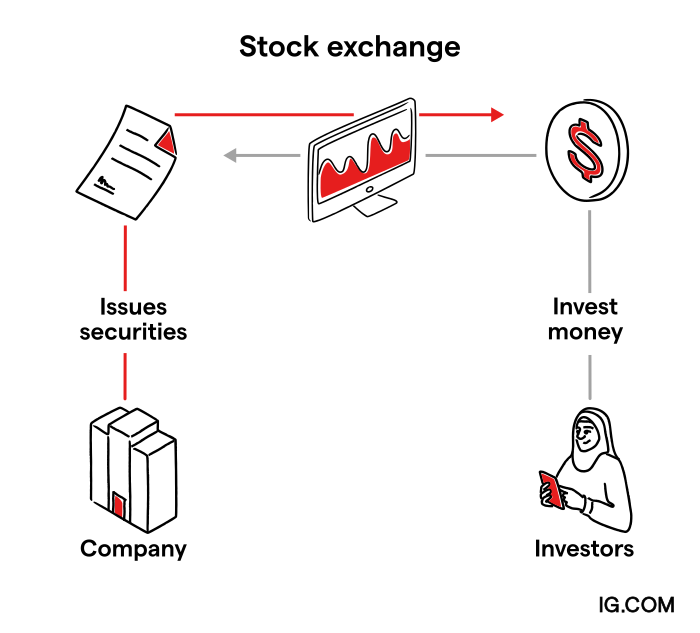
At its most basic, the stock market is a marketplace, albeit a highly specialized one. Its primary function is two-fold: to provide a platform for companies to raise capital for expansion, research, or debt repayment, and to offer investors an opportunity to participate in the growth of these companies by owning a piece of their business. This symbiotic relationship is crucial for economic development and wealth creation.
What is the Stock Market? More Than Just a Trading Floor
The term “stock market” is often used broadly, encompassing stock exchanges like the New York Stock Exchange (NYSE) or NASDAQ, as well as the entire ecosystem of brokers, investors, regulators, and financial instruments. It’s not a single physical location but a global network of interconnected exchanges and trading platforms. When a company decides to go public, it issues shares of ownership, which are then traded among investors. Each share represents a fractional ownership in the company, entitling the shareholder to certain rights, such as voting on corporate matters and potentially receiving dividends (a share of the company’s profits). The market’s existence transforms private ownership into a public and liquid form, allowing capital to flow efficiently between those who need it (companies) and those who have it (investors). This liquidity is key, enabling investors to buy and sell shares relatively easily, which, in turn, makes investing in public companies more attractive.
Key Participants and Their Roles
A diverse array of players contributes to the functioning of the stock market:
- Companies (Issuers): These are the entities that issue shares to raise capital. Their performance, growth prospects, and financial health are the underlying drivers of stock value.
- Investors: Ranging from individual retail investors saving for retirement to large institutional investors like pension funds, mutual funds, and hedge funds, investors provide the capital by buying shares. Their investment goals, risk tolerance, and research drive buying and selling decisions.
- Brokers: These intermediaries execute trades on behalf of investors. In the digital age, many brokers operate online, offering platforms for self-directed trading, while others provide full-service advice and management.
- Stock Exchanges: These are regulated marketplaces where stocks are bought and sold. They provide the infrastructure, rules, and technology for trading, ensuring fairness and transparency. Examples include the NYSE, NASDAQ, London Stock Exchange, and Tokyo Stock Exchange.
- Regulators: Government bodies like the Securities and Exchange Commission (SEC) in the U.S. oversee the market to protect investors, ensure fair dealing, and promote transparency. They enforce rules designed to prevent fraud and manipulation.
- Market Makers: These are firms that stand ready to buy or sell certain stocks, providing liquidity to the market by continuously quoting bid (buy) and ask (sell) prices. They profit from the spread between these prices.
Primary vs. Secondary Markets: Where Shares Come From and Are Traded
The journey of a stock typically begins in the primary market and continues in the secondary market:
- Primary Market: This is where new securities are issued for the first time. When a private company decides to go public, it undergoes an Initial Public Offering (IPO). In an IPO, the company, often with the help of investment banks (underwriters), sells its shares directly to institutional investors and sometimes to the public. The proceeds from these sales go directly to the issuing company, providing them with the capital they need.
- Secondary Market: After shares are initially sold in the primary market, they are then traded among investors in the secondary market. This is what most people typically refer to when they talk about the “stock market.” Companies do not receive any money from trades in the secondary market; rather, investors exchange shares with each other. The prices in the secondary market are determined by supply and demand dynamics, reflecting investors’ collective assessment of a company’s current and future value. This market provides liquidity, allowing investors to sell their shares when they choose, making their investments accessible.
The Mechanics of Buying and Selling Stocks
The process of buying and selling stocks, while seemingly complex, follows a structured set of procedures facilitated by technology and established market rules. This intricate dance of orders, prices, and executions forms the core of daily market activity.
Navigating Stock Exchanges: The Hub of Trading
Stock exchanges are central to the secondary market. They provide the centralized platform where buyers and sellers meet, directly or indirectly, to conduct transactions. Traditionally, this involved a physical trading floor, but today, most trading is electronic. For example, the NYSE still has a trading floor, but much of its volume is electronic, while NASDAQ is entirely electronic. Exchanges list companies that meet specific criteria regarding size, profitability, and governance, ensuring a certain level of credibility for investors. They also impose strict rules on trading behavior to maintain market integrity. When you place an order to buy or sell a stock, your broker routes that order to the appropriate exchange or to a market maker, where it interacts with other buy and sell orders.
Understanding Stock Orders: Market, Limit, and Stop
Investors communicate their intentions to their brokers through various types of orders:
- Market Order: This is an instruction to buy or sell a stock immediately at the best available current price. Market orders prioritize speed of execution over a specific price. While they typically execute quickly, the exact price received can fluctuate, especially in fast-moving or less liquid markets.
- Limit Order: A limit order specifies the maximum price an investor is willing to pay when buying or the minimum price they are willing to accept when selling. For a buy limit order, the order will only execute if the stock’s price falls to or below the specified limit price. For a sell limit order, it will execute only if the stock’s price rises to or above the specified limit price. Limit orders offer price control but risk non-execution if the market doesn’t reach the specified price.
- Stop Order (or Stop-Loss Order): This order becomes a market order once a specified “stop price” is reached. For a stop-loss order to sell, if the stock price drops to the stop price, it triggers a market order to sell, helping to limit potential losses. Conversely, a stop-buy order can be used to limit losses on a short position or to enter a long position once a stock breaks above a certain resistance level.
- Stop-Limit Order: This combines features of both stop and limit orders. Once the stop price is triggered, it becomes a limit order rather than a market order. This offers more price protection than a standard stop order but, like a limit order, risks non-execution if the market moves too quickly past the specified limit price.
The Role of Brokers and Digital Trading Platforms
Brokers are the gatekeepers to the stock market for most individual investors. They provide the accounts and platforms necessary to place orders. The rise of online discount brokers has democratized investing, allowing individuals to trade stocks with low commissions (often zero for basic trades) and sophisticated tools, research, and educational resources. These digital platforms automate much of the order routing and execution process, allowing investors to manage their portfolios from their computers or mobile devices. Full-service brokers, on the other hand, offer personalized advice, portfolio management, and a broader range of financial products, typically for higher fees. Regardless of the type, brokers play a crucial role in ensuring that investor orders are transmitted accurately and efficiently to the exchanges.
Bid-Ask Spreads and Market Liquidity
Every stock has a bid price and an ask price. The bid price is the highest price a buyer is currently willing to pay for a stock, while the ask price (or offer price) is the lowest price a seller is willing to accept. The difference between these two prices is known as the bid-ask spread. This spread represents the profit margin for market makers, who facilitate trading by continuously quoting these prices. A narrow bid-ask spread typically indicates high liquidity, meaning there are many buyers and sellers, making it easy to execute trades quickly without significantly affecting the price. Conversely, a wide spread suggests lower liquidity, where fewer participants might lead to larger price movements when trades occur. Understanding these dynamics is crucial for investors, as wide spreads can increase transaction costs, especially for frequent traders.
Factors Influencing Stock Prices and Market Dynamics
Stock prices are not static; they are in constant flux, driven by a complex interplay of fundamental data, economic forces, and human behavior. Discerning these influences is key to understanding market movements and making informed investment decisions.
Company Performance and Financial Health
At the most fundamental level, a company’s stock price reflects its underlying value, which is heavily tied to its financial performance and future prospects. Investors analyze various metrics:
- Earnings: Strong, consistent, and growing earnings per share (EPS) are a primary driver of stock prices. Companies that exceed earnings expectations often see their stock prices rise.
- Revenue Growth: Increasing sales indicate a growing business, which is attractive to investors.
- Profit Margins: Healthy profit margins suggest efficient operations and pricing power.
- Balance Sheet Strength: Low debt, ample cash reserves, and valuable assets signal financial stability and resilience.
- Management Quality: Effective leadership, a clear strategic vision, and a history of successful execution inspire investor confidence.
- Competitive Landscape: A company’s ability to maintain a competitive advantage (e.g., through patents, brand loyalty, or efficient operations) is critical for long-term growth.
- Future Prospects: Innovation, new product pipelines, market expansion, and potential for sustainable growth are often valued highly by the market, sometimes even more than current earnings.
Macroeconomic Indicators and Geopolitical Events
Beyond individual company performance, broader economic and political factors exert significant influence on the stock market:
- Interest Rates: Central bank policies, particularly changes in interest rates, profoundly impact the market. Lower rates can make borrowing cheaper for companies, encouraging expansion, and make bonds less attractive, pushing investors towards stocks. Higher rates have the opposite effect.
- Inflation: High inflation erodes purchasing power and can increase operating costs for companies, potentially hurting profits and stock valuations.
- GDP Growth: A strong economy, characterized by robust Gross Domestic Product (GDP) growth, typically translates to higher corporate earnings and a more optimistic outlook for stocks.
- Employment Data: Low unemployment rates signal a healthy economy with strong consumer spending, which benefits many businesses.
- Consumer Confidence: When consumers feel secure about their financial future, they are more likely to spend, boosting corporate revenues.
- Geopolitical Events: Wars, political instability, trade disputes, and international crises can create uncertainty, leading to market volatility as investors react to perceived risks.
- Technological Advancements: Breakthroughs in technology can create new industries, disrupt existing ones, and significantly impact the valuations of companies within those sectors.

Investor Sentiment, News, and Market Psychology
The stock market is not purely rational; human psychology plays a substantial role. Investor sentiment, which refers to the overall attitude of investors toward a particular market or asset, can drive significant price swings:
- Fear and Greed: These powerful emotions often dictate investor behavior. Greed can lead to speculative bubbles, while fear can trigger panic selling, causing sharp market declines.
- News and Media: Major news announcements, whether about a company’s earnings, a new product, an economic report, or a political development, can cause immediate and dramatic reactions in stock prices. The speed and accessibility of information in the digital age amplify these effects.
- Herd Mentality: Investors sometimes follow the crowd, buying or selling based on what others are doing, rather than on independent analysis. This can amplify trends, both positive and negative.
- Technical Analysis: Some investors use historical price and volume data to identify patterns and predict future price movements, influencing their buying and selling decisions. While debated, its widespread use means it can be a self-fulfilling prophecy for some.
- Market Bubbles and Crashes: These extreme events are often driven by excessive speculation (bubbles) or widespread panic (crashes), demonstrating the powerful influence of collective psychology.
Supply, Demand, and Market Efficiency
Ultimately, stock prices are determined by the fundamental economic principles of supply and demand. If more investors want to buy a stock than sell it, demand exceeds supply, and the price rises. Conversely, if more investors want to sell than buy, supply exceeds demand, and the price falls. The constant interplay of these forces, driven by all the factors mentioned above, determines the market price at any given moment. The concept of market efficiency posits that stock prices reflect all available information. In an efficient market, it’s difficult to consistently “beat the market” because prices instantly adjust to new information. While various degrees of market efficiency are debated, it underscores the idea that current stock prices encapsulate a vast amount of collective knowledge and expectations.
The Importance of Regulation and Risk Management
Given the vast sums of money involved and the potential for abuse, the stock market operates under a strict regulatory framework. This oversight, combined with prudent risk management by investors, is crucial for maintaining market integrity and investor confidence.
Ensuring Fairness and Transparency: Regulatory Bodies
Regulatory bodies are tasked with safeguarding investors and ensuring the integrity of the capital markets. In the United States, the Securities and Exchange Commission (SEC) is the primary federal agency responsible for enforcing securities laws, proposing new rules, and regulating the securities industry. Key aspects of regulation include:
- Disclosure Requirements: Companies issuing public shares must provide comprehensive and accurate financial information to the public regularly. This includes quarterly and annual reports, ensuring transparency for investors.
- Insider Trading Laws: These laws prohibit individuals with non-public material information about a company from trading its stock. This prevents unfair advantages and ensures a level playing field.
- Market Manipulation Prevention: Regulators work to prevent activities such as “pump-and-dump” schemes, where promoters artificially inflate stock prices before selling their shares, leaving other investors with losses.
- Broker-Dealer Oversight: Brokers and investment advisors are regulated to ensure they act in the best interest of their clients and adhere to ethical standards.
- Exchange Regulation: Stock exchanges themselves are regulated to ensure fair and orderly markets.
These regulations foster trust, encourage participation, and help maintain the market’s role as a reliable mechanism for capital formation. Without robust oversight, the market would be prone to widespread fraud and instability, deterring legitimate investment.
Understanding and Mitigating Investment Risks
Investing in the stock market inherently involves risk, but it’s a risk that can be managed and understood. Key risks include:
- Market Risk: The risk that the overall market will decline, affecting even fundamentally sound stocks. This is often tied to macroeconomic downturns or systemic events.
- Specific Stock Risk (Company-Specific Risk): The risk that an individual company’s stock will perform poorly due to factors unique to that company (e.g., poor management, failed product, scandal).
- Liquidity Risk: The risk that an investor may not be able to sell a stock quickly enough at a fair price, particularly for less frequently traded securities.
- Inflation Risk: The risk that inflation will erode the purchasing power of investment returns over time.
- Interest Rate Risk: The risk that changes in interest rates will negatively impact stock valuations, especially for interest-sensitive sectors or growth stocks.
Mitigating these risks is central to successful investing:
- Diversification: Spreading investments across various companies, industries, and asset classes (e.g., stocks, bonds, real estate) is the most fundamental way to reduce specific stock risk. If one investment performs poorly, others may perform well, balancing the overall portfolio.
- Asset Allocation: Determining the appropriate mix of different asset types based on an investor’s age, financial goals, and risk tolerance helps manage overall portfolio risk.
- Long-Term Horizon: Historically, the stock market has shown an upward trend over long periods, despite short-term volatility. Investing for the long term allows time for market fluctuations to smooth out and for investments to compound.
- Research and Due Diligence: Thoroughly researching companies and understanding their fundamentals before investing can reduce specific stock risk.
- Dollar-Cost Averaging: Investing a fixed amount of money regularly, regardless of stock prices, can reduce the impact of market volatility. When prices are low, more shares are bought, and when prices are high, fewer shares are bought, averaging out the purchase price over time.
The Long-Term Perspective: Growth and Volatility
While the stock market is known for its short-term volatility, experiencing daily, weekly, or monthly ups and downs, its long-term trajectory has historically been upward. This long-term growth is driven by economic expansion, corporate innovation, and the reinvestment of earnings. Investors who adopt a long-term perspective and ride out short-term market corrections are often rewarded with substantial capital appreciation. Volatility, while unnerving, is a normal feature of the market, reflecting the continuous repricing of assets based on new information and changing expectations. It presents both risks and opportunities for investors. A disciplined approach, guided by a clear financial plan and an understanding of one’s risk tolerance, is crucial for navigating these inherent market characteristics.
The Stock Market’s Broader Economic Impact
Beyond individual investors and companies, the stock market plays a profound role in the broader economy, acting as a catalyst for growth, a creator of wealth, and a crucial indicator of economic health.
Fueling Economic Growth and Innovation
The stock market is a powerful engine for economic expansion. By providing companies with access to vast amounts of capital, it enables them to:
- Invest in Research and Development: Companies can fund the creation of new technologies, products, and services that drive innovation and competitive advantage.
- Expand Operations: Capital raised from stock sales can be used to build new factories, hire more employees, enter new markets, or acquire other businesses, leading to job creation and economic activity.
- Pay Down Debt: Reducing debt obligations frees up cash flow for reinvestment in the business or for distribution to shareholders.
- Foster Entrepreneurship: The prospect of eventually taking a company public provides a significant incentive for entrepreneurs to build and grow businesses, knowing there’s a mechanism for them to realize value and for investors to exit.
This capital allocation mechanism is far more efficient than traditional lending for many growth-oriented businesses, making the stock market indispensable for a dynamic, growing economy.
Wealth Creation and Financial Planning
For individuals, the stock market is arguably the most accessible and effective long-term wealth-building tool. By investing in stocks, individuals can:
- Participate in Economic Growth: As the global economy expands and companies become more profitable, shareholders benefit from increasing stock prices and potential dividends.
- Combat Inflation: Over the long term, equity investments have historically outperformed inflation, helping to preserve and grow purchasing power.
- Fund Long-Term Goals: Stock market investments are a cornerstone of financial planning for retirement, purchasing a home, funding education, or other major life goals. Through vehicles like 401(k)s, IRAs, and mutual funds, millions of people participate in the stock market, building their financial futures.
- Generate Passive Income: Dividend-paying stocks can provide a regular stream of income, which can be reinvested or used for living expenses.
The compounding effect of investment returns over decades can transform modest initial investments into substantial wealth, making the stock market a critical component of personal financial independence.
A Barometer for Economic Health
Often referred to as a “leading indicator,” the stock market is seen as a forward-looking barometer of economic health. Stock prices reflect investors’ collective expectations about future corporate earnings and economic conditions.
- Investor Confidence: A rising market often signals optimism about future economic growth, employment, and corporate profitability.
- Early Warning System: Conversely, a sustained downturn in the stock market can sometimes precede an economic recession, as investors anticipate challenges before they fully manifest in economic data.
- Reaction to News: The market’s immediate reaction to economic reports (e.g., GDP figures, inflation rates, unemployment data) provides real-time insights into how these factors are being interpreted by a vast network of sophisticated participants.
While not always perfectly predictive, the stock market’s movements are closely watched by economists, policymakers, and business leaders for signals about the direction of the economy, influencing decisions on everything from monetary policy to corporate investment strategies. In conclusion, the stock market is a sophisticated and indispensable mechanism that connects capital with opportunity, drives economic progress, and offers individuals a powerful path to wealth creation, all while reflecting the dynamic interplay of fundamental value, economic forces, and human behavior.
aViewFromTheCave is a participant in the Amazon Services LLC Associates Program, an affiliate advertising program designed to provide a means for sites to earn advertising fees by advertising and linking to Amazon.com. Amazon, the Amazon logo, AmazonSupply, and the AmazonSupply logo are trademarks of Amazon.com, Inc. or its affiliates. As an Amazon Associate we earn affiliate commissions from qualifying purchases.