
In an era of commission-free stock trading and an increasingly competitive financial services landscape, it’s a natural and crucial question: how does a financial giant like Charles Schwab Corporation, a custodian for trillions in client assets, manage to generate substantial profits? The answer lies in a sophisticated, multi-faceted business model that leverages its vast client base, technological prowess, and strategic financial operations. Far from relying on a single revenue stream, Schwab has meticulously constructed a diverse array of income generators, primarily rooted in the careful management of client assets and the provision of various financial services. Understanding Schwab’s revenue architecture offers invaluable insights into the intricacies of the modern financial industry and how large-scale investment platforms thrive.
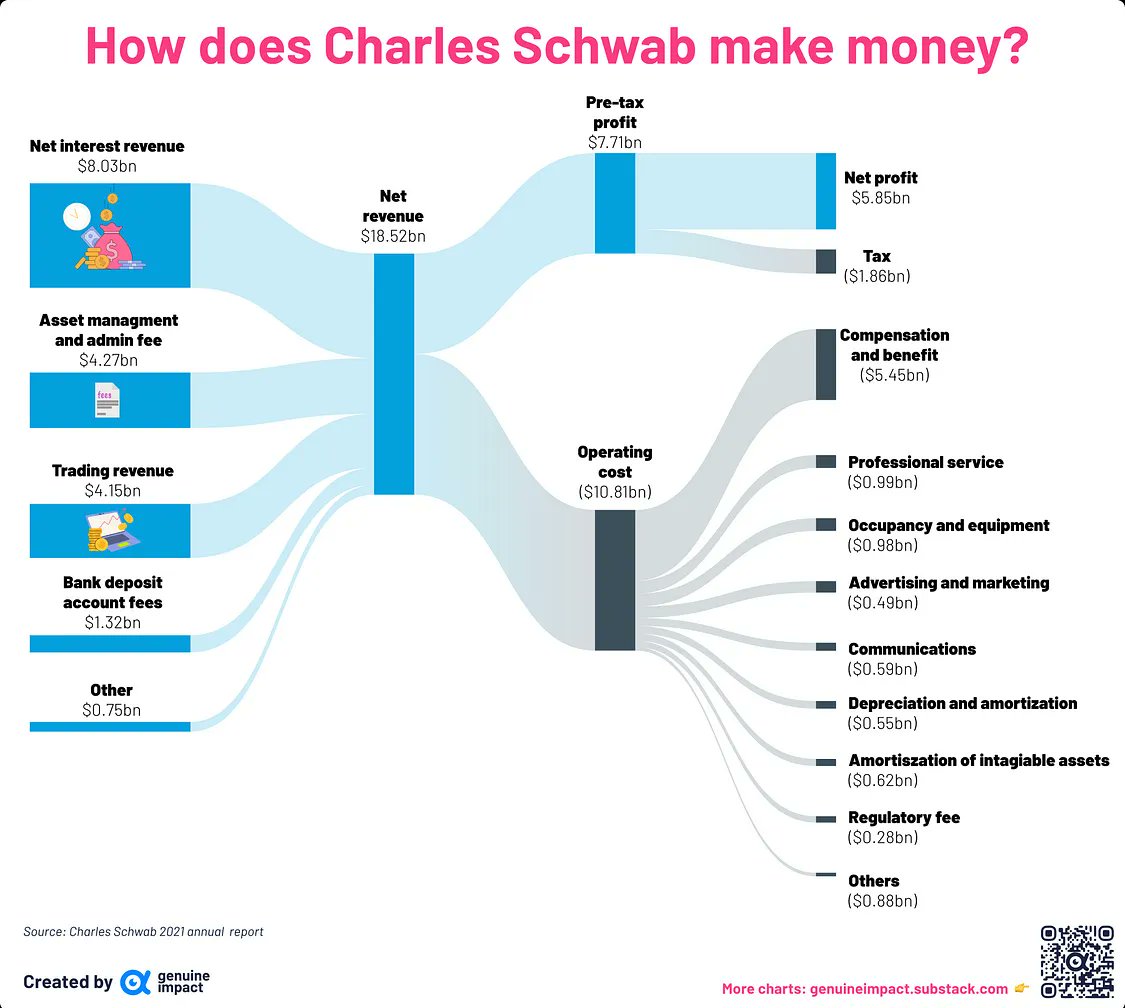
Schwab’s business model is a masterclass in monetizing relationships and assets rather than solely transactional fees. While direct trading commissions have largely been eliminated for standard equity and ETF trades, the underlying capital and client activity generate significant indirect income. This article delves into the core mechanisms through which Schwab earns its considerable revenue, providing a comprehensive look at the strategies that underpin its financial success.
The Bedrock of Profit: Net Interest Revenue
The most significant component of Schwab’s income, often constituting the largest share, is derived from its net interest revenue. This stream fundamentally relies on the difference between the interest Schwab earns on client cash balances and the interest it pays out to clients on those same balances. It’s a classic banking model, albeit applied within a brokerage context.
Maximizing Client Cash Balances
Schwab’s vast ecosystem attracts millions of investors who deposit cash into their brokerage accounts, often as uninvested funds awaiting deployment, emergency reserves, or proceeds from asset sales. This cash, whether held in money market funds, bank sweep programs, or other cash management vehicles, is not idly sitting in a vault. Instead, Schwab intelligently redeploys these funds. A substantial portion of client cash is swept into Schwab Bank, its federally chartered bank subsidiary, or other third-party banks. This allows Schwab to use these deposits to fund its lending activities and invest in various interest-earning assets.
The sheer scale of client assets under custody, which often reaches into the trillions, means that even a small percentage of these assets held in cash translates into tens or hundreds of billions of dollars. This massive pool of low-cost funding is the foundation of Schwab’s interest-earning capabilities. The company actively encourages clients to consolidate their financial lives with Schwab, including banking and investment services, further increasing these valuable cash balances.
The Mechanics of Net Interest Margin
Net interest margin (NIM) is the core metric here. Schwab takes the cash from client accounts and primarily invests it in higher-yielding assets, such as U.S. Treasury securities, agency mortgage-backed securities, and other investment-grade fixed-income instruments. It also uses these deposits to fund its own lending operations, including mortgage loans, home equity lines of credit (HELOCs), and other consumer and commercial loans through Schwab Bank. The difference between the interest income earned on these assets and loans, and the typically lower interest expense paid to clients on their cash balances, is Schwab’s net interest revenue.
For instance, if Schwab pays clients a nominal 0.50% interest on their swept cash but earns 3.50% by investing that cash in a diversified portfolio of safe, short-to-medium-term fixed-income securities or through its lending activities, the 3.00% difference is its net interest margin. Given the enormous sums involved, this percentage, though seemingly small, translates into billions of dollars in profit annually.
Sensitivity to Interest Rates
Net interest revenue is highly sensitive to prevailing interest rates set by central banks. In a rising interest rate environment, Schwab generally sees its net interest income increase. This is because the rates Schwab earns on its deployed assets and loans tend to adjust upwards faster and to a greater extent than the rates it pays to clients on their deposits. Conversely, in a low or falling interest rate environment, net interest income can decline as the yield on its asset portfolio decreases. This sensitivity makes interest rate forecasts a critical factor in Schwab’s financial outlook and strategy, prompting the company to actively manage its asset-liability duration to optimize its NIM across various economic cycles.
Empowering Investment Decisions: Asset Management & Advisory Fees
While net interest revenue forms the largest chunk, a significant and steadily growing portion of Schwab’s income comes from various fees related to asset management and advisory services. As clients increasingly seek professional guidance and diversified, hands-off investment solutions, Schwab has expanded its offerings to cater to these needs.
Robo-Advisors and Digital Platforms
Schwab was an early pioneer in the robo-advisor space with its “Schwab Intelligent Portfolios” offering. These platforms provide automated, algorithm-driven portfolio management services at a low cost, often with no advisory fee for the core service. However, Schwab still generates revenue from these products. For Schwab Intelligent Portfolios, the company earns money by holding a portion of the client’s cash balance in Schwab Bank, thereby generating net interest revenue, and by including its own proprietary Schwab ETFs and mutual funds within the recommended portfolios, for which it earns management fees. For “Intelligent Portfolios Premium,” which includes unlimited access to human financial planners, Schwab charges a flat advisory fee after an initial planning fee. This hybrid model captures clients seeking both cost-effectiveness and the option for human interaction.
Human-Guided Wealth Management
For clients with more complex financial needs or larger asset bases, Schwab offers a range of human-advised solutions. These include “Schwab Private Client” and “Schwab Advisor Services.” With Schwab Private Client, individuals work directly with a dedicated Schwab financial consultant who provides personalized advice, portfolio management, and financial planning. Fees for these services are typically asset-based, meaning Schwab charges a percentage of the assets under management (AUM). This model aligns Schwab’s interests with client growth, as its revenue increases proportionally with the size of client portfolios.
Schwab Advisor Services, on the other hand, is a leading provider of custodial, operational, and trading support to independent registered investment advisors (RIAs). While Schwab doesn’t directly charge the end clients of these RIAs for advisory services, it earns revenue through various channels related to these relationships. This includes providing banking services to RIAs, offering specific platform tools, and indirectly benefiting from the cash sweep and asset management fees on proprietary products that RIAs might utilize within their clients’ portfolios custodied at Schwab. This segment highlights Schwab’s dual role as both a direct-to-consumer wealth manager and a vital infrastructure provider for the broader financial advisory industry.

Proprietary Funds and ETFs
Schwab’s extensive suite of proprietary mutual funds and exchange-traded funds (ETFs) is another significant revenue driver. When clients invest in Schwab-branded funds, whether through a self-directed brokerage account, a robo-advisor, or a human advisor, Schwab charges an expense ratio or management fee for overseeing those funds. These fees, though often lower than those of many competitors, add up substantially given the trillions of dollars managed across various Schwab funds. The company offers a broad spectrum of funds, from broad market index funds to sector-specific ETFs and actively managed mutual funds, catering to diverse investor preferences and generating steady income. The vertical integration of creating, distributing, and managing these funds is a powerful synergistic revenue engine.
Transactional Velocity: Payment for Order Flow and Lending Services
Beyond the steady streams of interest and advisory fees, Schwab also generates revenue through transaction-related activities and specialized lending, even in a “zero-commission” environment.
Understanding Payment for Order Flow (PFOF)
While direct commissions on standard equity and ETF trades have been eliminated, Schwab, like many other brokerages, receives compensation known as Payment for Order Flow (PFOF). When a client places a trade, Schwab routes that order to market makers (e.g., Citadel Securities, Virtu Financial, Two Sigma Securities) for execution. These market makers pay Schwab a small per-share or per-contract fee for the opportunity to execute these orders. Market makers profit by capturing the bid-ask spread and providing liquidity. For Schwab, PFOF represents a consistent revenue stream, especially with its high trading volume. Critics argue PFOF creates potential conflicts of interest, but regulators generally permit it as long as brokerages fulfill their best execution obligations to clients. Schwab maintains that it prioritizes best execution, ensuring clients receive optimal prices, regardless of PFOF.
Margin Lending and Securities-Based Loans
Schwab offers clients the ability to borrow money against the value of their investment portfolios, a practice known as margin lending or securities-based lending. Clients use margin loans to amplify their investment power, provide short-term liquidity, or bridge financial gaps without selling assets. Schwab charges interest on these loans, with rates varying based on the loan amount and prevailing market rates. The interest earned on margin loans can be a substantial revenue stream, particularly during periods of market optimism when investors are more inclined to use leverage, or when interest rates are higher. Securities-based loans (SBLs) offer a more flexible, non-purpose loan option, allowing clients to borrow against their portfolio for various personal needs without impacting their investment strategy, also generating interest income for Schwab.
Other Transactional Fees
While core equity and ETF trades are commission-free, Schwab still charges fees for certain specialized transactions. These can include:
- Options and Futures Trading: While often lower than historical rates, options and futures contracts typically incur a per-contract fee.
- Mutual Funds Outside of Schwab’s Network: Many third-party mutual funds available on Schwab’s platform may carry transaction fees, redemption fees, or 12b-1 fees (marketing and distribution fees paid out of fund assets) which Schwab may share.
- International Securities Trading: Trading foreign stocks or investing in certain international markets often involves higher commissions or foreign exchange conversion fees.
- Fixed Income Trades: While many bonds can be traded without explicit commissions, Schwab may mark up or mark down the price to generate revenue.
- Broker-Assisted Trades: Clients who require a broker to place a trade over the phone might incur a higher service charge compared to self-service online trading.
These specific fees, while not as broad as core equity commissions once were, contribute a consistent portion of revenue, especially from active traders or those requiring specialized services.
Beyond Core Brokerage: Diversified Revenue Streams
Schwab’s financial ecosystem extends beyond individual brokerage accounts, touching various aspects of personal and corporate finance, each contributing to its overall profitability.
Corporate and Retirement Services
Schwab provides services to corporations and their employees, primarily through its retirement plan services. The company acts as a recordkeeper and custodian for 401(k) plans, pension plans, and other employer-sponsored retirement programs. Schwab earns fees for administrative services, managing the investment options within these plans, and potentially from the underlying investment products offered. This segment captures a vast pool of assets, benefiting from both asset-based fees and service charges related to plan administration, participant education, and compliance.
Banking and Lending Products
As mentioned, Schwab Bank plays a crucial role in generating net interest revenue from client cash. However, Schwab Bank also offers a range of traditional banking products and services that generate additional income. These include:
- Mortgage Lending: Offering home loans and refinancing options to clients.
- Home Equity Lines of Credit (HELOCs): Providing flexible credit secured by a client’s home equity.
- Deposit Account Services: While primarily serving as a sweep for brokerage cash, the bank also offers standard checking and savings accounts.
- Credit Cards: Co-branded credit cards generate interchange fees (a small percentage of each transaction paid by merchants) and interest on outstanding balances.
These banking services deepen client relationships, capture more of their financial wallet, and diversify Schwab’s income streams beyond pure investment services.

Financial Planning and Advisory Subscriptions
Increasingly, Schwab is also moving towards subscription-based models for certain premium financial planning and advisory services. While specific offerings vary, this trend involves charging a recurring fee for access to comprehensive financial planning tools, dedicated financial professionals, and ongoing advice, rather than solely relying on AUM-based fees for certain tiers of service. This model provides more predictable revenue and caters to clients who may not meet high AUM minimums for traditional advisory services but still desire professional guidance.
In conclusion, Charles Schwab’s ability to thrive in a competitive, commission-free environment is a testament to its expertly diversified revenue model. By strategically leveraging vast client cash balances for net interest income, charging for sophisticated asset management and advisory services, monetizing transaction flow through PFOF and specialized trading fees, and expanding into a robust suite of banking and corporate services, Schwab has built a resilient and highly profitable financial powerhouse. Its success underscores a broader shift in the financial industry: value creation no longer solely resides in transaction costs, but in the comprehensive management of wealth, the intelligent deployment of capital, and the cultivation of deep, long-term client relationships.
aViewFromTheCave is a participant in the Amazon Services LLC Associates Program, an affiliate advertising program designed to provide a means for sites to earn advertising fees by advertising and linking to Amazon.com. Amazon, the Amazon logo, AmazonSupply, and the AmazonSupply logo are trademarks of Amazon.com, Inc. or its affiliates. As an Amazon Associate we earn affiliate commissions from qualifying purchases.